
Best Roof Financing Terms Compared: 2026 Guide
Roof Financing Terms differ by loan type; this guide compares common options to help homeowners weigh costs, rates, and repayment terms.
If you have significant equity and a good FICO score, a HELOC or home equity loan gives you the best all-in roof financing terms in 2026. Homeowners without equity but with good credit get the fastest path through an unsecured personal loan from lenders like LightStream or SoFi. And if you can pay off a balance within about a year, a contractor’s true 0% promo plan can cost you nothing in interest — if you read the fine print carefully.
Here’s the quick picture before we go deeper:
- Best overall (equity + good credit): HELOC with variable APR or home equity loan with fixed APR
- ⚡ Best for fast funding, no equity: Unsecured personal loan with variable APR depending on credit
- Best for short-term payoff: Contractor 0% promo — only if it’s true interest-free, not deferred
- Best for low credit / no equity: FHA Title I loan with loan limits up to several tens of thousands, up to 20 years term, or PACE where available
- Before you borrow anything: Check whether storm, hail, or wind damage makes you eligible for an insurance claim first
tl;dr: Check insurance → check your equity → run total-cost math. Those three steps will tell you which of the options below is your best move.
Table of Contents
- How do the best roof financing terms compare in 2026?
- How do you choose the right roof financing for your situation?
- What are the best home equity loan and HELOC terms in 2026?
- How does a cash-out refinance work for a roof project?
- How do personal loans work for roof financing without equity?
- What should you watch for with contractor financing?
- Is PACE financing or a grant program right for your situation?
- Should you file an insurance claim instead of financing?
- How does total cost change across different financing options?
- Which financing path fits your homeowner profile?
- Hytzroofing makes roof financing easier in Tampa Bay
- Key Takeaways
- The part most homeowners get wrong about roof financing
- Useful sources and further reading
- FAQ
How do the best roof financing terms compare in 2026?
The table below covers every major financing category side by side. Rate ranges come from mid-2026 lender data and national averages. Use it to narrow your shortlist, then read the section for each option you’re considering.
| Financing Type | Est. APR (2026) | Typical Term | Loan Limits | Collateral | Credit Score | Fees & Closing Costs | Speed to Funding | Best-For Use Case | Tax Deductible? |
|---|---|---|---|---|---|---|---|---|---|
| Home equity loan | 7.75%–10.5% fixed | 5–30 yrs | Up to 85% LTV | Home equity | 680+ | Origination + appraisal ($500–$2,000+) | 2–6 weeks | High balance, predictable payments | Potentially (consult tax advisor) |
| HELOC | 7.5%–10% variable | 10–20 yr draw/repay | Up to 85% LTV | Home equity | 680+ | Origination + appraisal ($500–$2,000+) | 2–6 weeks | Phased work, flexibility | Potentially (consult tax advisor) |
| Cash-out refinance | Varies with mortgage rate | 15–30 yrs | Up to 80% LTV | Home (first lien) | 620–680+ | 2%–5% of loan amount | 4–8 weeks | Rate change + roof rolled in | Mortgage interest rules apply |
| FHA Title I | ~6%–11% fixed | Up to 20 yrs | Up to $25,000 | None (up to limit) | No minimum set | Low to moderate | 3–6 weeks | No-equity homeowners | No |
| Personal loan | 9%–23% | 2–7 yrs | $1,000–$100,000 | None | 620–750+ for best rates | Origination 0%–8% | 1–5 days | Fast funding, no equity | No |
| Contractor financing (true 0% promo) | 0% promo / 26%–28% post-promo | 6–24 months promo | Varies by contractor | None | 600+ | Embedded dealer fee 8%–12% | Same day | Short-term payoff, immediate start | No |
| Contractor financing (fixed installment) | 9.99%–17.99% | 2–12 yrs | Varies | None | 600+ | Dealer fee may apply | Same day | No equity, immediate start | No |
| PACE financing | ~6%–9% effective | 5–25 yrs | Varies by program | Property tax lien | No credit check | Program fees vary | 2–4 weeks | Low credit, long terms | No |
| Credit card (0% intro APR) | 0% intro / 20%–29% after | 12–21 months promo | $1,000–$30,000 | None | 700+ | Balance transfer fee possible | Immediate | Small projects, fast payoff | No |
How to read this table: APR tells you the annual cost of borrowing, but it doesn’t include dealer fees embedded in contractor pricing. Always ask for the total cost — principal + all interest + all fees over the full term. PACE financing is only available in select states; confirm your state participates before counting on it.
How do you choose the right roof financing for your situation?
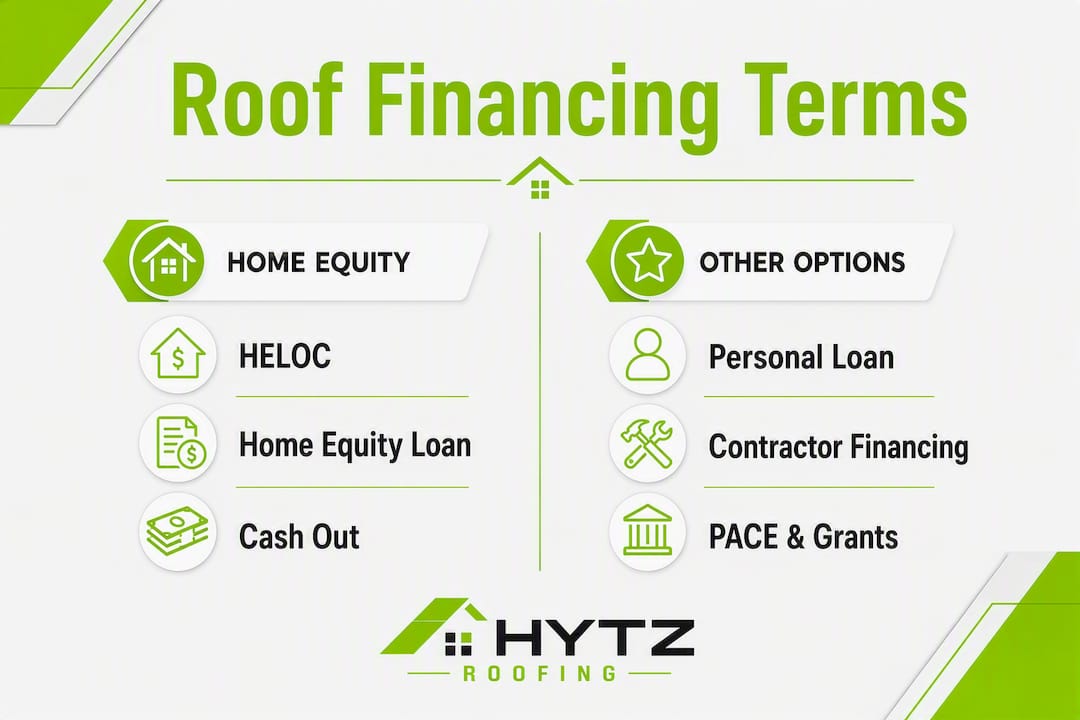
Start with two quick questions. Do you have documented storm, hail, or wind damage? If yes, get a certified inspection before you apply for anything. An approved insurance claim can eliminate the need to borrow entirely. If no damage is covered, move to the second question: do you have at least 15% equity in your home?
Your answers to those two questions point you toward a short list of options. Here’s the decision path:
- Storm/hail/wind damage present? → Get a certified inspection and file a claim first. Financing is the fallback, not the first move.
- 15%+ equity + 680+ FICO? → HELOC or home equity loan. Lowest all-in cost.
- Good credit but limited equity? → Unsecured personal loan. Fast, no appraisal.
- Low credit or no equity? → FHA Title I or PACE (where available).
- Need funding today and can pay off within 12 months? → Ask your contractor for a true 0% plan in writing.
Documents to gather before you apply
- Two most recent pay stubs and W-2s
- Most recent mortgage statement (shows current balance and equity)
- Homeowner’s insurance declarations page
- Insurance claim paperwork (if applicable)
- Written contractor estimate with itemized line items
- Two years of tax returns (required for home equity and refinance products)
Steps to compare offers the right way
- Pre-qualify with at least two lenders using soft-pull tools so your credit score isn’t affected. Many online lenders let you preview estimated APRs in minutes.
- Get your contractor estimate in writing before applying — lenders need a project cost figure.
- Calculate total cost, not just monthly payment. Multiply monthly payment by the number of months, then add all fees. That number is what you’re actually paying.
- Check for dealer fees. Ask your contractor: “What is the cash price vs. the financed price?” A difference of 8%–12% signals an embedded dealer fee.
- Align closing with your project schedule. Home equity and refinance products take 2–6 weeks to close. Don’t sign a contract with a contractor before your funds are confirmed.
Pro Tip: If you’re considering a promotional 0% plan, calculate your required monthly payment to pay off the full balance two months before the promo ends. That two-month buffer protects you from a retroactive interest charge if a payment posts late.
Questions to ask lenders and contractors
- Is this a true 0% plan or a deferred-interest plan?
- What is the standard APR after the promotional period?
- Are there origination fees, prepayment penalties, or dealer fees?
- What happens if I miss one payment during the promo period?
- Can I see the full loan agreement before signing the contractor contract?
What are the best home equity loan and HELOC terms in 2026?
For homeowners with 15%+ equity and a 680+ FICO score, these two products consistently offer the lowest all-in cost for a roof replacement. The key difference is structure: a home equity loan gives you a fixed lump sum at a fixed rate, while a HELOC works like a revolving credit line at a variable rate.
Home equity loan (second mortgage)
Home equity loan APRs in mid-2026 run roughly 7.75%–10.5% for well-qualified borrowers. You receive the full loan amount upfront, make fixed monthly payments, and know exactly what you’ll pay over the life of the loan. That predictability is valuable for a defined project like a roof replacement.

Typical terms run 5–30 years, and most lenders cap borrowing at 85% of your home’s appraised value minus your current mortgage balance. Expect an origination fee and an appraisal, which together can add $500–$2,000+ to your costs. Approval and funding usually take 2–6 weeks.
Pros for roofing projects:
- Fixed rate means no payment surprises
- Potentially the lowest APR available for qualified borrowers
- Larger loan amounts available for higher-cost projects
Cons:
- Requires equity and an appraisal
- 2–6 week timeline doesn’t work for emergency repairs
- Your home is collateral
HELOC (home equity line of credit)
HELOCs were averaging roughly 7.5%–10% in mid-2026 for well-qualified borrowers, priced at prime plus a lender margin of 0.50%–2.00%. They remain variable rate products that may be slightly cheaper than home equity loans at the start, but the variable rate is a real risk over a 10–20 year repayment period. If rates rise, your payment rises with them.
A HELOC works well if you’re doing phased work — replacing the roof now and planning other improvements later. You draw what you need, pay interest only on what you use during the draw period, and repay over the repayment period.
Pro Tip: Use a HELOC for roofing only if you plan to pay it down aggressively. A variable rate that looks attractive at 7.5% today can climb meaningfully over a 15-year repayment window. If you want certainty, the fixed home equity loan is the safer structure.
** Mid-2026 rate snapshot:** HELOC APRs: 7.5%–10% variable. Home equity loan APRs: 7.75%–10.5% fixed. Both require 680+ FICO and 15%+ equity for best pricing.
A note on tax deductibility: Interest on home equity debt used to substantially improve your home may be deductible under IRS rules, but eligibility depends on your total mortgage debt, filing status, and how the funds are used. Consult a tax advisor before counting on a deduction. The IRS guidance on home mortgage interest is the right starting point.
For a deeper look at how term length affects your total interest on these products, the roof financing term length guide at Hytzroofing walks through the math clearly.
How does a cash-out refinance work for a roof project?
A cash-out refinance replaces your existing mortgage with a new, larger loan. The difference between your old balance and the new loan amount comes to you as cash, which you use to pay for the roof. You’re not adding a second loan — you’re rewriting your first mortgage entirely.
This makes sense in a narrow set of circumstances. If your current mortgage rate is higher than today’s rates, a cash-out refinance can lower your monthly payment while funding the roof. If your current rate is already low, rolling a $14,000 roof into a 30-year mortgage at a higher rate means paying interest on that roof for decades.
When a cash-out refinance works for roofing:
- Your current mortgage rate is meaningfully above today’s market rates
- You want to consolidate the roof cost into one long-term payment
- You have substantial equity and a strong credit profile (620–680+ FICO minimum)
- You’re not in a hurry — the process takes 4–8 weeks
When it doesn’t make sense:
- Your existing rate is already competitive
- The roof cost is small relative to your mortgage balance
- You need funding in days, not weeks
- Closing costs (typically 2%–5% of the new loan amount) would exceed the savings
Timeline and coordination
- Order a home appraisal (lender-required, typically 1–2 weeks to schedule)
- Submit full mortgage application with income, asset, and insurance documentation
- Underwriting review (1–3 weeks)
- Closing and funding (1 week after approval)
- Coordinate contractor start date for at least one week after confirmed funding
One practical note: if you’re also filing an insurance claim for storm damage, wait for the claim settlement before closing a cash-out refinance. The insurance payout may reduce how much you need to borrow, and lenders will want to see the claim resolved before finalizing your loan.
For context on how construction-style financing compares for larger projects, construction loan rate mechanics in 2026 offer a useful reference point.
How do personal loans work for roof financing without equity?
Unsecured personal loans are the fastest path to roof funding when you don’t have equity or can’t wait 4–6 weeks for a home equity product to close. No appraisal, no collateral, no lien on your home. The tradeoff is cost: rates run higher than secured options.

Personal loan APRs in 2026 range roughly 9%–23% depending on your credit profile and lender. Excellent-credit borrowers (750+ FICO) can find offers below 10% from lenders like LightStream and SoFi. Fair-credit borrowers (620–680 FICO) typically land in the mid-teens or higher.
Example lenders worth investigating
- LightStream (division of Truist): known for competitive rates for excellent-credit borrowers, no origination fees, and same-day funding in some cases
- SoFi: offers personal loans with no origination fees and unemployment protection features
- Upgrade: works with a wider credit range; charges origination fees of 1.85%–9.99%
- Best Egg: targets fair-to-good credit borrowers; origination fees apply
- Rocket Loans, Universal Credit, Happen Bank, Splash, Citi: additional options worth comparing depending on your credit profile and state
None of these are endorsements. Rates vary by applicant, and the only way to know your actual offer is to pre-qualify with a soft pull.
Quick cost example: $14,000 roof, personal loan
A $14,000 personal loan at 12% APR over 5 years produces a monthly payment of roughly $311 and total interest of approximately $2,660. At 9% APR over the same term, the monthly payment drops to about $290 and total interest falls to roughly $1,400. The rate difference alone saves nearly $1,260 over the life of the loan — which is why shopping at least two lenders before accepting a point-of-sale offer matters.
Steps to apply for a personal loan:
- Check your credit score (free through most banks or Credit Karma)
- Pre-qualify with 2–3 lenders using soft-pull tools — no credit impact
- Compare APR, origination fee, and total repayment amount (not just monthly payment)
- Submit full application with pay stubs, tax returns, and contractor estimate
- Accept funds and pay contractor directly or via check
For a full walkthrough of personal loan mechanics and prequalification strategies, the personal loan for roofing guide at Hytzroofing covers the process step by step.
What should you watch for with contractor financing?
Contractor financing is the most convenient option on this list and the one most likely to cost you more than you expect. The approval happens at the point of sale, funding is immediate, and you can start your project the same day. Those are real advantages. But the structure of these plans deserves a close read before you sign.
How the plans work
True 0% promotional plans charge no interest if you pay the full balance before the promo period ends (typically 12–24 months). These are genuinely interest-free — but only if you pay on time and in full.
Deferred-interest plans look identical to true 0% plans in the marketing materials. The difference: if you carry any balance past the promo end date, the lender retroactively charges all accrued interest from day one at rates of 26%–28% APR. One missed payment or a balance of $1 at month 13 can trigger hundreds or thousands of dollars in back-interest.
Fixed-installment plans carry stated APRs of roughly 9.99%–17.99% with no promo period. These are more transparent but often more expensive than a personal loan from an independent lender.
Where dealer fees hide
Contractor financing programs typically include an embedded dealer fee of 8%–12% that the lender charges the contractor for offering the program. Contractors often pass this cost to you by inflating the financed project price. A roof quoted at $14,000 cash may be quoted at $15,400–$15,680 when financed. You won’t see a line item labeled “dealer fee” — it’s built into the project price.
How to expose it: Ask your contractor for both the cash price and the financed price. If they differ by more than a few hundred dollars, you’re looking at an embedded fee. That fee changes the real cost of the “0%” plan significantly.
Red flags to watch for:
- Contractor can’t tell you whether the plan is true 0% or deferred-interest
- No written loan agreement before you sign the project contract
- Cash price and financed price are different with no explanation
- Standard APR after promo is not disclosed upfront
- Prepayment penalty buried in the fine print
Pro Tip: Before signing any contractor financing agreement, ask: “Is this a deferred-interest plan or a true no-interest plan?” Get the answer in writing. Then check the deferred payment roof financing guide to understand exactly what the fine print means.
Questions to ask your contractor
- What is the cash price for this project?
- Is the financing through a third-party lender? Who is the lender?
- Is this a true 0% plan or a deferred-interest plan?
- What is the APR after the promotional period?
- Are there any origination fees, dealer fees, or prepayment penalties?
- What happens if I miss one payment during the promo period?
For a direct comparison of bank loans versus contractor point-of-sale programs, the bank vs. contractor roof loans guide at Hytzroofing breaks down the key structural differences.
Is PACE financing or a grant program right for your situation?
PACE (Property Assessed Clean Energy) financing is one of the few options that requires no credit check and no down payment. It’s also one of the most misunderstood. Here’s what it actually is and where it works.
How PACE works
PACE programs attach the loan to your property as a tax assessment, repaid through your property tax bill over 5–25 years. Effective rates run roughly 6%–9% in example markets, and because repayment is tied to the property rather than the borrower, there’s no traditional credit underwriting. That makes it accessible for homeowners with low credit scores or past financial difficulties.
The catch is significant. PACE creates a senior lien on your property, meaning it takes priority over your mortgage in certain situations. That lien can block you from refinancing your mortgage and can complicate a home sale if the buyer’s lender won’t accept the existing PACE assessment. Many conventional mortgage lenders won’t approve a refinance on a property with an active PACE lien.
⚠️ PACE warning: If you plan to sell or refinance your home within the next 5–10 years, a PACE lien can create serious complications. The lien typically stays with the property, not the borrower, and the buyer’s lender may require it to be paid off at closing. Confirm your state’s PACE program rules and consult a real estate attorney before signing.
PACE is available in select states only. California, Florida, and Missouri have active residential PACE programs, but availability varies by county and municipality even within those states. Confirm your specific address is in an eligible program area before counting on this option.
Grants and low-income assistance programs
The USDA Section 504 Home Repair program offers loans and grants to very-low-income rural homeowners for essential repairs including roofing. HUD also maintains a list of FHA Title I approved lenders for homeowners who need a fixed-rate, no-equity option up to $25,000.
PACE and grant programs at a glance:
- No credit check (PACE) or low credit threshold (FHA Title I)
- Long repayment terms (5–25 years for PACE, up to 20 years for FHA Title I)
- PACE creates a senior property lien — major risk for future refinancing or sale
- Grant programs have strict income and location eligibility requirements
- Approval timelines: 2–4 weeks for PACE, 3–6 weeks for FHA Title I
Should you file an insurance claim instead of financing?
Before you apply for any loan, spend 30 minutes answering this checklist. An approved insurance claim pays for your roof without adding debt. That’s always the better outcome when it’s available.
Insurance-first checklist ✅
- Documented damage from a covered peril? Storm, hail, wind, and falling objects are typically covered. Age-related wear is not.
- Damage exceeds your deductible? If your deductible is $2,500 and the repair estimate is $3,000, the net insurance benefit is small. If the estimate is $14,000, filing makes clear sense.
- Has an adjuster inspected the property? Your insurer will send one, but a contractor-certified inspection can document damage more thoroughly and support your claim.
- Is the damage recent? Most policies require claims to be filed within a specific window after the damage event. Don’t wait.
- Has your contractor reviewed the insurance scope of work? A contractor experienced with insurance claims can identify line items the adjuster missed and advocate for a complete settlement.
Pro Tip: Working with a contractor who performs certified insurance inspections gives you a documented damage report that supports your claim from day one. Hytzroofing provides certified inspections for insurance and financing purposes — this is one of the most practical ways to speed up claim approval and avoid leaving money on the table. Learn more about Hytz’s storm damage process.
How insurance timing intersects with financing
If your claim is approved but the settlement takes 2–4 weeks, you may need a short-term bridge. A personal loan or contractor financing can cover the gap, with the insurance payment used to pay it off immediately. In that scenario, the total interest cost is minimal because the loan term is measured in weeks, not years.
How does total cost change across different financing options?
Same roof, same project cost, very different outcomes depending on which financing you choose. These examples use a $14,000 roof replacement — within the national average range of $9,800–$16,000 — to show how term length and fees change what you actually pay.
| Financing Scenario | Monthly Payment | Total Interest | Total Paid | Notes |
|---|---|---|---|---|
| HELOC at 7.5%, 10-year repayment | ~$167 | ~$2,040 | ~$16,040 | Variable rate — could rise |
| Home equity loan at 8.5%, 10 years | ~$173 | ~$2,760 | ~$16,760 | Fixed, predictable |
| Personal loan at 12%, 5 years | ~$311 | ~$2,660 | ~$16,660 | No equity needed, faster |
| Contractor promo 0% (true), 12 months | ~$1,167 | $0 | $14,000 | Must pay in full before month 12 |
| Contractor promo with 10% dealer fee + deferred interest triggered | ~$1,167 | ~$3,640 retroactive | ~$17,640 | If promo missed — worst case. |
What the numbers show
- The HELOC and home equity loan are the cheapest options for homeowners who qualify — total interest under $2,800 on a $14,000 project.
- The personal loan at 12% costs roughly the same total as a home equity loan at 8.5% over 5 years, because the shorter term limits interest accumulation even at a higher rate.
- The true 0% promo is the cheapest of all — but only if you can make payments of roughly $1,167/month for 12 months. Most homeowners can’t sustain that payment, which is why the deferred-interest trap catches so many people.
- A triggered deferred-interest plan can cost more than any other option on this list. That retroactive 26%–28% APR applied to the full original balance from day one is the single most expensive outcome.
For more on how term length affects your total interest across these scenarios, the roof financing term length guide at Hytzroofing walks through the math in detail.
Which financing path fits your homeowner profile?
Here’s the shortlist by situation. Each recommendation includes one immediate action and one risk to watch.
-
High equity + good credit (680+ FICO, 15%+ equity): HELOC or home equity loan. Action: Contact your current mortgage lender or a credit union to pre-qualify. Risk: Approval takes 2–6 weeks — don’t sign a contractor contract before funds are confirmed.
-
⚡ Good credit, limited equity (680+ FICO, under 15% equity): Unsecured personal loan from LightStream, SoFi, or Upgrade. Action: Pre-qualify with two lenders using soft-pull tools before accepting any contractor financing offer. Risk: Rates above 15% APR make a 7-year term expensive — keep the term to 3–5 years if possible.
-
No equity, lower credit (under 620 FICO): FHA Title I loan (up to $25,000, up to 20 years) or PACE where available. Action: Contact a HUD-approved FHA Title I lender for a program overview. Risk: PACE creates a senior lien — avoid it if you plan to refinance or sell within 5 years.
-
Fast funding needed (emergency repair): Unsecured personal loan (1–5 day funding) or contractor point-of-sale financing. Action: Pre-qualify online today; have your contractor estimate ready. Risk: Point-of-sale financing may include embedded dealer fees — ask for the cash price before agreeing to the financed price.
-
✅ Short-term bridge — can pay off within 12 months: Contractor true 0% promo plan or 0% intro APR credit card. Action: Ask the contractor in writing whether the plan is true 0% or deferred-interest before signing. Risk: Missing the payoff deadline on a deferred-interest plan triggers retroactive interest at 26%–28% APR on the full original balance.
Hytzroofing makes roof financing easier in Tampa Bay
Financing a roof is complicated enough without also managing contractor estimates, insurance claims, and lender timelines at the same time. Hytzroofing handles all three together for Tampa Bay homeowners.
Hytzroofing holds the GAF Master Elite® Contractor designation (earned by fewer than 2% of roofing contractors in North America), the GAF President’s Club Award, the 2024 Brava Roof Tile Excellence Award, and the Angi Super Service Award 2025. Every project is backed by BBB Accreditation with an A+ rating and Florida Contractor License #CCC1332551.
Here’s what that means for your financing: Hytzroofing performs certified roof inspections that support insurance claims and lender requirements, coordinates directly with third-party lending partners to align financing approval with your project start date, and manages the full replacement from estimate to completion. Financing is provided through third-party lending partners — Hytzroofing helps you navigate the options and the paperwork, not just the shingles.
Ready to get started? Request your estimate and financing pre-qualification today. If storm damage is involved, the storm damage repair page walks you through the insurance claim process step by step.
This article provides general information about roof financing options and is not financial or legal advice. Confirm current program terms, eligibility, and tax treatment with your lender, a licensed financial advisor, or a tax professional before applying.
Key Takeaways
For most homeowners in 2026, the best roof financing terms come from matching your equity and credit profile to the right product type — and always comparing total cost, not just monthly payment.
| Point | Details |
|---|---|
| Check insurance first | Storm, hail, or wind damage may be covered — an approved claim eliminates the need to borrow. |
| Equity owners get the best rates | HELOC (7.5%–10%) and home equity loans (7.75%–10.5%) offer the lowest all-in cost for 680+ FICO borrowers. |
| Beware deferred-interest promos | Missing the payoff deadline triggers retroactive interest at 26%–28% APR on the full original balance from day one. |
| Total cost beats monthly payment | Longer terms lower monthly payments but raise total interest — always calculate principal + interest + fees. |
| Hytzroofing coordinates the process | Hytzroofing provides certified inspections, insurance claim support, and partner lender coordination for Tampa Bay homeowners. |
The part most homeowners get wrong about roof financing
The single most common mistake isn’t choosing the wrong loan product. It’s accepting the first financing offer presented at the point of sale without shopping it against anything else.
Contractor financing is convenient by design. The approval happens in the same conversation as the project estimate, the paperwork is minimal, and the “0% for 12 months” framing sounds like a great deal. But convenience is exactly what makes it expensive. By the time you’re sitting at a kitchen table with a contractor and a tablet, you haven’t pre-qualified anywhere else, you don’t know your actual APR options, and you’re making a multi-thousand-dollar financing decision in real time.
The math in this article shows that a personal loan at 12% APR over 5 years produces roughly the same total cost as a home equity loan at 8.5% over 10 years on a $14,000 project. That’s a meaningful insight: the “cheaper” secured product isn’t always cheaper when you factor in the longer term. And a contractor promo with an embedded 10% dealer fee can cost more than either of them if the deferred-interest clause triggers.
What actually protects you is doing 20 minutes of pre-qualification work before you meet with any contractor. Know your credit score. Know your equity. Have two soft-pull APR estimates in hand. That context turns a high-pressure point-of-sale moment into a straightforward comparison — and it’s the single step most homeowners skip.
Useful sources and further reading
These resources support the facts and figures in this article and are worth bookmarking for your own research.
- HUD FHA Title I Property Improvement Loan Program — Official HUD page for the FHA Title I program, including lender lists and eligibility details for homeowners without equity.
- NerdWallet: Best Roof Financing Options 2026 — Lender comparisons and pre-qualification tool recommendations for personal loans and home equity products.
- The Roofing Brief: Roof Financing 2026 — 7 Options Ranked by APR & Traps — Detailed APR ranges, dealer fee data, and deferred-interest mechanics used throughout this article.
- CostPrism: Roof Replacement Financing Guide 2026 — National average project cost data and insurance-first guidance.
- Hytzroofing: Roofing Loan Types Compared — Local context and deeper product descriptions for Tampa Bay homeowners.
- Hytzroofing: How to Read Roofing Estimate Line Items — Helps you spot hidden charges in contractor bids before you finance anything.
- Hytzroofing: Roof Replacement Steps Homeowners Expect — Project timeline guidance for coordinating financing approval with your contractor’s schedule.
For questions about mortgage-interest deductibility on home equity products, consult a licensed tax advisor or CPA. Tax treatment depends on your specific situation and how funds are used.
FAQ
What are the best financing options for roof replacement in 2026?
For homeowners with 15%+ equity and a 680+ FICO score, a HELOC (7.5%–10% APR) or home equity loan (7.75%–10.5% APR) offers the lowest all-in cost. Homeowners without equity but with good credit get the fastest path through an unsecured personal loan from lenders like LightStream or SoFi.
Will roofing prices go down in 2026?
Material and labor costs have remained elevated, and there’s no broad industry signal pointing to significant price decreases in 2026. Locking in a contractor estimate now and securing financing pre-approval before prices shift is generally the more reliable approach than waiting.
What is the 25% rule for roofing?
Some local building codes require a full roof replacement rather than a partial repair when more than 25% of the roof surface is damaged or replaced within a set period. The specific threshold varies by jurisdiction, so confirm the rule with your local building department and contractor before planning a partial repair.
What is the cheapest month for roofing?
Late fall and winter (November through February) tend to be slower seasons for roofing contractors in most U.S. markets, which can create more scheduling flexibility and occasionally better pricing. In Florida, the slower season aligns with the cooler, drier months after hurricane season ends.
How do I avoid the deferred-interest trap in contractor financing?
Ask your contractor in writing whether the plan is a true 0% plan or a deferred-interest plan before signing anything. If it’s deferred-interest, calculate the monthly payment needed to pay off the full balance two months before the promo period ends — and set up automatic payments to hit that amount every month.
Recommended
- Roofing Loan Types Compared: Your 2026 Guide | Hytz Roofing
- Roof Financing Term Length: What Homeowners Need to Know | Hytz Roofing
- Bank vs. Contractor Roof Loans: Key Differences in 2026 | Hytz Roofing
- Deferred Payment Roof Financing Options: 2026 Guide | Hytz Roofing
Related Hytz Roofing Services