
Roof Financing Term Length: What Homeowners Need to Know
Roof financing term length refers to the number of months or years used to repay a roofing loan and influences monthly payments and total interest.
Last updated: August 8, 2026
A roof financing term length is the agreed-upon repayment period for a loan or financing plan used to pay for a roofing project. Terms range from as short as 12 months on promotional contractor plans to as long as 30 years on home equity loans. Understanding what is a roof financing term length matters because it directly controls your monthly payment, your total interest cost, and how long your roof debt follows you. The right term depends on your budget, your financing type, and how long you plan to stay in your home.
What is a roof financing term length, and what ranges are typical?
Roof financing term lengths fall into three broad categories: short, medium, and long. Each category matches a different financing product, and choosing the wrong one can cost you thousands.
Short-term financing (up to 3 years) covers promotional contractor plans and some personal loans. These plans often advertise 0% interest for 12 or 18 months. They work well if you can pay off the full balance before the promotional period ends.

Medium-term financing (3–7 years) is the standard range for unsecured personal loans. Personal loans for roofing span 3–7 years with interest rates generally between 9.9% and 19%. That rate range is higher than secured options, but personal loans close fast and require no collateral.
Long-term financing (10–30 years) includes home equity loans, cash-out refinancing, FHA Title I loans, and PACE financing. Home equity loans and cash-out refinancing offer terms up to 30 years with lower interest rates, though they place a lien on your home. FHA Title I loans provide up to 20-year terms and allow borrowing up to $25,000 without requiring home equity as security. That makes FHA Title I a valuable path for homeowners who lack significant equity but need a large repair.
| Financing type | Typical term length | Secured? |
|---|---|---|
| Contractor promotional plan | 12–18 months | No |
| Personal loan | 3–7 years | No |
| FHA Title I loan | Up to 20 years | No |
| PACE financing | 10–25 years | Via property tax lien |
| Home equity loan / cash-out refi | Up to 30 years | Yes (home lien) |
Pro Tip: Before you compare rates, compare term lengths first. A lower rate on a 15-year loan can still cost more total than a higher rate on a 5-year loan, depending on the balance.
How does term length affect your monthly payment and total cost?
The length of your loan is the single biggest lever on your monthly payment. A longer term spreads the same balance across more months, which lowers what you owe each month. The catch is that you pay interest for longer, so the total cost of the roof goes up.
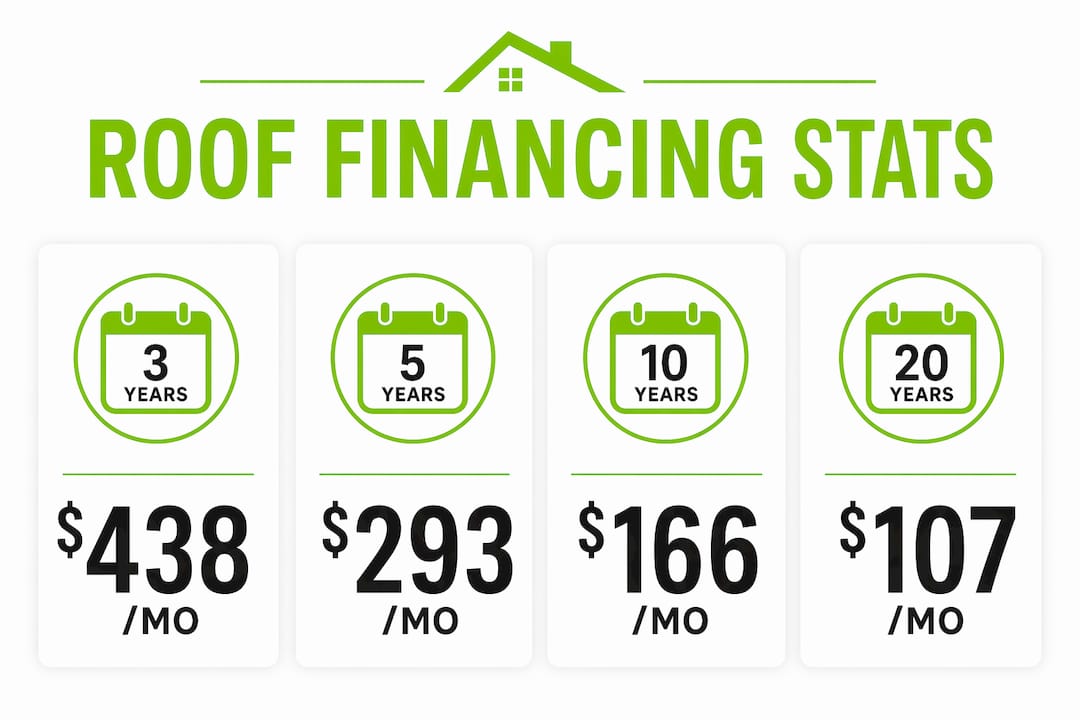
Here is a concrete example. A $14,000 roof at 8% interest costs roughly $70 more per month on a 5-year term compared to a 10-year term. Over 10 years, that same loan accrues more than $3,000 in additional interest. That $70 monthly savings ends up costing you far more in the long run.
The table below shows how term length shifts both figures on a $14,000 loan at 8% annual interest.
| Loan term | Approx. monthly payment | Approx. total interest paid |
|---|---|---|
| 3 years | ~$438 | ~$1,768 |
| 5 years | ~$284 | ~$3,040 |
| 10 years | ~$170 | ~$6,400 |
| 20 years | ~$117 | ~$14,080 |
Note: Figures are illustrative estimates for comparison purposes only. Your actual payment depends on your lender’s rate and fees.
The numbers make the trade-off clear. A 20-year term nearly doubles the total cost of the roof. Understanding how renovation costs are calculated helps you see why fees and interest stack up faster than most homeowners expect.
Many homeowners also overlook fees when calculating total financing cost. Appraisal and origination fees add 2–5% on top of the loan amount for home equity products. On a $14,000 loan, that is an extra $280 to $700 before you make a single payment.
Pro Tip: Use a free online loan amortization calculator to compare two or three term options side by side before you sign anything. Seeing the total interest column is the fastest way to make a confident decision.
Nuances among financing types that affect your term choice
Not all financing products work the same way, even when the term lengths overlap. The type of financing you choose shapes your rate, your fees, your risk, and your flexibility.
-
Home equity loans and cash-out refinancing offer the longest terms and the lowest rates. The trade-off is that your home secures the loan. Closing costs and appraisal fees add 2–5% to the loan amount, which can offset the rate advantage on smaller roofing jobs. These products make the most sense for large replacements where the lower rate justifies the upfront cost.
-
Personal loans are faster and simpler. No appraisal, no lien, no waiting weeks for underwriting. The downside is that rates run between 9.9% and 19% and terms top out around 7 years. For a mid-size repair in the $5,000 to $12,000 range, a personal loan is often the most practical choice.
-
Contractor promotional financing looks attractive on paper. A 0% interest offer for 12 or 18 months sounds like free money. The risk is real: failure to pay off the balance before the promotional period ends triggers retroactive interest rates of 15–25%. That interest applies to the original balance, not just what remains. Contractor financing is also frequently third-party and may include hidden dealer fees built into the project price, making a cash payment potentially cheaper overall.
-
PACE financing repays through your property tax bill over terms from 10 to 25 years at rates typically between 6.5% and 9.5%. The long term and moderate rate sound appealing. The problem is that PACE’s tax lien takes priority over your mortgage, which can complicate a home sale or refinance. Buyers and lenders may require the PACE balance to be paid off at closing.
-
FHA Title I loans are the least-known option on this list. They carry government insurance, offer terms up to 20 years, and allow borrowing up to $25,000 without requiring home equity. That combination makes them worth exploring if you have limited equity and need a significant repair.
Understanding how roofing costs vary by material and scope helps you match the right financing type to the actual size of your project.
How to choose the right roof financing term for your budget
Choosing a term length is a budgeting decision, not just a financing decision. The right answer depends on four factors: your monthly cash flow, your total interest tolerance, your future plans for the home, and the type of financing available to you.
-
Assess your monthly budget honestly. Calculate what you can comfortably pay each month without straining other expenses. Do not stretch to the shortest term if it means missing other bills.
-
Prioritize the shortest term you can afford. The ideal term balances manageable monthly payments with minimizing total interest paid. Every extra year on a loan adds real dollars to the total cost of your roof.
-
Factor in your plans for the home. If you plan to sell within five years, a 20-year home equity loan or a PACE lien could create complications at closing. A shorter personal loan or a promotional plan you can pay off quickly may serve you better.
-
Read promotional financing terms carefully. Promotional financing only works if you have a clear plan and the cash flow to pay off the balance before the promo period ends. If there is any doubt, choose a fixed-rate loan instead.
-
Account for all fees, not just the rate. Origination fees, dealer fees, and appraisal costs all raise the true cost of financing. Ask every lender for the annual percentage rate (APR), which includes fees, not just the stated interest rate.
-
Check for liens and property impacts. Home equity loans and PACE financing both attach to your property. Review how a lien could affect your ability to sell or refinance before committing to a long term. Florida homeowners dealing with storm damage repairs can also review permit requirements for storm repairs to understand the full scope of their project before choosing a financing term.
Key Takeaways
The shortest affordable roof financing term always produces the lowest total cost, even when a longer term feels easier month to month.
| Point | Details |
|---|---|
| Term length range | Roof financing spans 12 months to 30 years depending on the product type. |
| Monthly vs. total cost | Longer terms lower monthly payments but add thousands in total interest over the loan life. |
| Promotional financing risk | Rates jump to 15–25% retroactively if you miss the 12–18 month payoff deadline. |
| Hidden fees matter | Appraisal, origination, and dealer fees add 2–5% to secured loan costs before interest. |
| PACE lien risk | PACE financing’s tax lien takes priority over your mortgage and can complicate home sales. |
Why I always tell homeowners to run the total cost number first
Most homeowners I talk to focus entirely on the monthly payment. That is understandable. Monthly cash flow is real and immediate. But the monthly payment is the least useful number when comparing financing offers.
The number that actually matters is the total amount you will pay by the time the loan is done. A $170 monthly payment on a 10-year loan sounds manageable until you realize you are paying $6,400 in interest on a $14,000 roof. That is nearly half the cost of the roof again, paid to a lender.
The other thing I see homeowners miss is the fee stack on secured loans. A home equity loan at 6% sounds much better than a personal loan at 12%. But once you add $500 in appraisal fees, $300 in origination fees, and a few hundred in closing costs, the math on a smaller roofing job often favors the personal loan. Why quotes vary so much in home improvement financing comes down to exactly this kind of fee variation.
My honest recommendation: get the APR, not just the rate. Then run the total cost on two or three term options before you decide. Thirty minutes of math can save you thousands. And if a contractor is offering you 0% financing, ask directly whether dealer fees are built into the project price. Sometimes paying cash or using your own lender is the better deal.
— Anthony
Hytzroofing can help you plan your roofing project with confidence
Figuring out the right financing term is easier when you know exactly what your roofing project will cost. Hytzroofing works with Florida homeowners to provide clear, detailed estimates so you can match your financing term to your actual project scope, not a rough guess.
Hytzroofing holds the GAF Master Elite® Contractor designation, earned by fewer than 2% of roofing contractors in North America, along with the GAF President’s Club Award and the Angi Super Service Award 2025. That track record means you get honest guidance on project costs and financing options, not a sales pitch. Ready to get a clear number for your roof? Request your estimate and get the information you need to choose the right term with confidence.
FAQ
What is a typical financing term for a new roof?
Typical roof financing terms range from 12 months for promotional contractor plans to 30 years for home equity loans. Personal loans, the most common option, run 3–7 years.
How long can you finance a roof replacement?
You can finance a roof replacement for up to 30 years through a home equity loan or cash-out refinance. FHA Title I loans offer terms up to 20 years without requiring home equity.
Does a longer roof loan term save money each month?
A longer term lowers your monthly payment but increases the total interest you pay. A $14,000 loan at 8% interest costs over $3,000 more in total interest on a 10-year term versus a 5-year term.
What happens if I miss the deadline on promotional roof financing?
Missing the payoff deadline on a 0% promotional plan triggers retroactive interest rates of 15–25% applied to the original loan balance, not just the remaining amount.
Is PACE financing a good option for roof replacement?
PACE financing offers long terms of 10–25 years at moderate rates, but its tax lien takes priority over your mortgage. That lien can complicate a home sale or refinance and should be weighed carefully before you commit.
Recommended
- The Ultimate Cost of Ignoring a Leaky Roof What Homeowners Need to Know
- Tampa Roofer | GAF Master Elite | Hytz Roofing
- Types of Roof Repairs Florida Homeowners Need Most
- Introducing Enviroshake to Your Hoa
Ready to Work With a Trusted Tampa Roofer?
Hytz Roofing is a GAF Master Elite certified contractor serving Tampa Bay. Explore our services: