
Bank vs. Contractor Roof Loans: Key Differences in 2026
Bank and Contractor Roof Loans generally differ in approval speed, payment flow, and who manages disbursement for a roofing project.
What’s the real difference between bank and contractor roof loans?
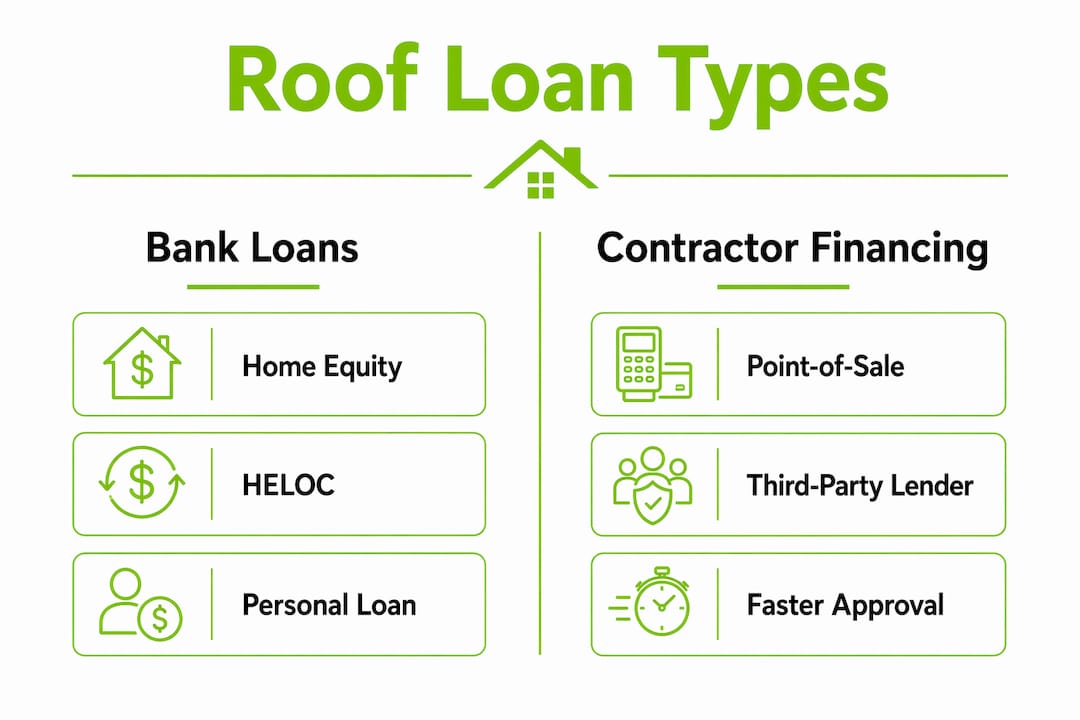
The core difference between bank loans and contractor roof loans comes down to three things: who holds the loan, what it costs you, and how fast you can get the money. Bank loans, whether a home equity loan, a HELOC, or a personal loan, are issued directly by a financial institution and often secured by your home. Contractor financing is a point-of-sale loan funded by a third-party lender affiliated with your roofing contractor, approved in minutes, and typically unsecured.
Here’s a quick side-by-side to frame the decision:
| Factor | Bank loans | Contractor financing |
|---|---|---|
| Loan type | Secured (home equity) or unsecured (personal) | Unsecured POS loan via third-party lender |
| APR range | competitive rates on home equity loans; higher for personal loans | 6.99%–35.99% |
| Loan amounts | Up to $100,000 (home equity) | Up to $100,000 |
| Approval speed | typically several weeks (home equity); same day (personal) | Often under 60 seconds |
| Repayment terms | 5–20 years | 12–180 months |
| Collateral required | Yes (home equity); No (personal loan) | No |
| Fees and costs | Appraisal, closing costs | Dealer fees embedded in rate |
| Tax implications | Interest may be tax-deductible | Not tax-deductible |
| Application convenience | Bank branch or online, more documentation | Through contractor at point of sale |

The bottom line: if you need a roof fixed this week after a storm, contractor financing wins on speed. If you’re planning a full re-roof and want the lowest total cost, a home equity loan almost always wins on rate.
Key distinctions at a glance:
- Bank home equity loans carry lower APRs but require an appraisal and 2–4 weeks to close.
- Contractor financing approvals can happen in under 60 seconds, but APRs may vary widely and can be comparatively high.
- “0% interest” contractor offers are often deferred-interest traps, not true zero-interest loans.
- You remain legally obligated to repay the lender even if your contractor walks off the job.
- Home equity loan interest may be tax-deductible; contractor financing interest is not.
How contractor financing for roofing actually works
Contractor financing is not a loan from your roofer. It’s a point-of-sale product funded by a third-party lender, such as GreenSky, Service Finance, Regions, or Foundation Finance, that your contractor has partnered with. You apply on-site or via a link the contractor sends you, and approval often takes under 60 seconds.
The APR range is wide: 6.99% to 35.99%, with loan amounts up to $100,000 and terms spanning Loan terms ranging from 12 to 180 months (one to 15 years). Where you land in that range depends heavily on your credit score. Programs typically require scores from 540 to 700+, and a lower score usually means a higher APR or outright denial.
No collateral is required, which is the main appeal. Your home is not on the line if you miss payments. But that unsecured structure is exactly why rates run higher than home equity products.
What to watch for with contractor financing:
- Dealer fees: The lender often charges the contractor a fee, which gets built into your project price. You may be paying more for the roof itself without realizing it.
- Deferred-interest promotions: A “0% for 12 months” offer is usually a deferred-interest loan, not a true zero-interest product. If you carry any balance past the promotional deadline, interest charges apply retroactively from day one of the loan.
- Lien risk: Because the lender funds the contractor, not you directly, unpaid material suppliers can still file a mechanic’s lien on your property if the contractor doesn’t pay them. Always request a lien release document before making your final payment.
- Contractor failure: Your legal obligation to repay the lender does not disappear if the contractor abandons the job or does substandard work. You still owe the money.
Pro Tip: Read the actual loan agreement from the lender, not just the brochure your contractor hands you. The CFPB advises treating contractor financing as a separate financial product with its own terms, fees, and risks.
What bank loans for roofing look like in 2026
Bank loans for roofing fall into three main categories, and each fits a different situation.
Home equity loans are secured by your property and offer the lowest rates available for roof financing. In 2026, APRs run 6.5%–9.5%, and interest paid on the loan may be tax-deductible when the funds go toward a qualifying home improvement. The trade-off is time: closing takes 2–4 weeks and requires a property appraisal. Your home serves as collateral, so missed payments carry real consequences.
HELOCs (home equity lines of credit) work like a credit card secured by your home. You draw funds as needed rather than taking a lump sum, which makes them well-suited for phased roofing projects or when final costs are uncertain. Rates are variable, meaning your payment can shift over time. Navy Federal, for example, offers HELOC rates starting as low as 7.000% APR with a 20-year draw period.
Personal loans skip the collateral requirement entirely and fund much faster, often the same day you apply. Navy Federal’s personal expense loan, for instance, carries APRs from 8.74%–18.00% with terms up to 60 months and loan amounts ranging from a few hundred dollars up to mid-five figures. Rates are fixed, so your monthly payment stays predictable. The ceiling on loan amounts is lower than home equity products, and rates are higher, but for a mid-size roof repair you need funded quickly, a personal loan from a bank beats contractor financing on cost.
Bank loan highlights:
- Home equity loans offer repayment terms from 5 to 20 years, giving you room to keep monthly payments manageable.
- Interest on home equity loans used for home improvements may be tax-deductible under current IRS rules, a benefit contractor financing cannot match.
- Approval for home equity products takes longer, but the structured process protects you: the lender verifies your property value and your ability to repay before committing funds.
Rate snapshot (2026):
- Home equity loan APR: competitive fixed rates
- HELOC starting APR: beginning at moderate variable rates
- Bank personal loan APR: moderate rates depending on credit and loan terms
- Contractor financing APR: a wide range spanning lower to higher rates
Head-to-head: contractor financing vs. bank loans for your roof
The roofing loan comparison below goes deeper than rates. The right choice depends on your timeline, your credit, and how much risk you’re comfortable carrying.
| Criteria | Home equity loan | HELOC | Bank personal loan | Contractor financing |
|---|---|---|---|---|
| APR | 6.5%–9.5% | From 7.000% (variable) | 8.74%–18.00% | 6.99%–35.99% |
| Max loan amount | Up to six figures | Up to 80% of home equity | Up to $50,000 | Up to $100,000 |
| Approval speed | typically several weeks | 2–4 weeks | Same day (most cases) | Under 60 seconds |
| Repayment terms | 5–20 years | 20-year draw + 20-year repayment | Up to 60 months | 12–180 months |
| Collateral | Yes (home) | Yes (home) | No | No |
| Foreclosure risk | Yes | Yes | No | No |
| Tax-deductible interest | Potentially yes | Potentially yes | No | No |
| Dealer/origination fees | Appraisal + closing costs | Appraisal + closing costs | Minimal | Embedded dealer fees |
| Application convenience | Bank branch or online | Bank branch or online | Online/branch, fast | Through contractor, instant |
When contractor financing makes sense:
A storm tears through Tampa in july and your roof is actively leaking. You need a contractor on-site within days, not weeks. Contractor financing gets you approved before the crew even starts measuring. For urgent, smaller repairs where the total cost stays well below $50,000, the speed advantage is real and the higher rate is a reasonable trade-off.
When a bank loan wins:
You’ve been planning a full roof replacement for spring. You have equity in your home, a credit score above 700, and six weeks to spare. A home equity loan at 6.5%–9.5% APR will cost you meaningfully less over a 10- or 15-year term than contractor financing at 20%+ APR. The tax deduction potential adds another layer of savings. For larger planned projects, the math almost always favors going through your bank.
Common pitfalls with each option:
- Contractor financing: Signing a deferred-interest deal and not paying it off before the promotional period ends. The retroactive interest charge can be a nasty surprise.
- Home equity loans: Underestimating closing costs or appraisal timelines, which can delay your project start.
- Personal loans: Borrowing the maximum available when a smaller amount would cover the job, then carrying unnecessary interest.
- HELOCs: Variable rates mean your payment can rise if interest rates climb during your draw period.
How to choose the right roofing loan for your situation
Start with two questions: How soon do you need the money? And are you comfortable using your home as collateral?
If your roof needs attention now, contractor financing or a bank personal loan are your realistic options. Both are unsecured and fund quickly. The difference is cost: a bank personal loan will almost always carry a lower APR than contractor financing for borrowers with good credit, so if you have even a few days to apply through a bank or credit union, that’s worth doing.
If your project is planned and your timeline is flexible, a home equity loan or HELOC gives you access to lower rates and potentially a tax benefit. Read the CFPB’s HELOC guidance before committing to a variable-rate product so you understand how rate changes affect your payment.
Factors to weigh before you decide:
- Credit score: Contractor financing programs accept scores as low as 540, but you’ll pay for it in APR. A score above 700 opens up better bank products at significantly lower rates.
- Project size: Smaller repairs under $15,000 are well-suited to personal loans or contractor financing. Full replacements over $30,000 favor home equity products.
- Urgency: Storm damage, active leaks, and insurance-related timelines push you toward fast-approval options. Learn more about storm damage financing before you commit to the first offer a contractor presents.
- Total cost: Always calculate the total amount you’ll repay, not just the monthly payment. A 180-month contractor loan at 20% APR costs far more than a 10-year home equity loan at 8%.
- Promotional offers: If a contractor offers 0% financing, ask the lender directly whether it’s a true zero-interest loan or a deferred-interest product. The CFPB is clear that these are fundamentally different products.
Pro Tip: Before making your final payment on any contractor-financed project, request a signed lien release from your contractor. Without it, unpaid suppliers can place a mechanic’s lien on your home, which can block a future sale or refinance.
When evaluating roofing materials alongside your financing decision, it helps to consider key roofing factors that affect long-term value and project cost.
Expert insights on roof loan options in 2026
Financial advisors and industry practitioners consistently point to the same divide: speed versus cost. Contractor financing or personal loans suit urgent, smaller projects where getting the work done fast matters most. Home equity options fit planned, larger renovations where a lower interest rate over a longer term saves real money.
The CFPB’s position on contractor financing is worth taking seriously. The bureau advises homeowners to treat contractor financing as a distinct credit product and to review the full lending terms independently, not just the summary a sales rep provides. Promotional offers with deferred interest are a particular concern: if you don’t pay the full balance before the deadline, interest charges apply retroactively from the loan’s start date, often making the effective cost far higher than the advertised rate suggested.
Lien release reminder: Receiving a lien release after project completion is a legal protection, not a formality. Mechanic’s liens filed by unpaid subcontractors or material suppliers can complicate or block your ability to refinance or sell your home, even if you paid your contractor in full.
Pro Tip: Ask your lender for the loan’s total repayment amount, not just the monthly payment or the promotional rate. That single number tells you exactly what the financing will cost you.
Hytzroofing holds the GAF Master Elite® Contractor designation, earned by fewer than 2% of roofing contractors across North America, along with the GAF President’s Club Award and the Angi Super Service Award 2025. When you’re evaluating contractor financing, working with a credentialed contractor matters: a contractor with a verifiable track record and proper licensing is far less likely to leave a job incomplete, which is the scenario that makes contractor financing most dangerous. You can review Hytzroofing’s completed projects to get a sense of the quality and scope of work they stand behind.
Ready to get your roof done right?
Whether you’re leaning toward contractor financing for speed or a bank loan for savings, the contractor you choose matters just as much as the loan you pick. Hytzroofing is a GAF Master Elite® Contractor, BBB Accredited with an A+ rating, and holds Florida Contractor License #CCC1332551. Every project comes with full general liability insurance and workers’ compensation coverage.
Get a clear, honest estimate before you commit to any financing. Hytzroofing’s team can walk you through project costs, realistic timelines, and what to expect from the financing process, so you’re never signing anything you don’t fully understand.
Request your free estimate and let Hytzroofing help you make the right call for your roof and your budget.
Key Takeaways
Contractor financing offers speed and convenience, but bank loans almost always cost less over the life of the loan for homeowners with solid credit and available home equity.
| Point | Details |
|---|---|
| APR gap is wide | Contractor financing runs 6.99%–35.99% APR; home equity loans run 6.5%–9.5% APR. |
| Speed vs. cost trade-off | Contractor financing approves in under 60 seconds; bank home equity loans take 2–4 weeks to close. |
| Deferred interest risk | “0% offers” from contractors are often deferred-interest loans that charge retroactive interest if not paid off in time. |
| Lien release is non-negotiable | Always get a signed lien release before final payment to protect your home from mechanic’s liens. |
| Credit score shapes your options | Contractor programs accept a range of credit scores, but higher scores provide access to better bank loan rates. |
Recommended
- Roof Financing Term Length: What Homeowners Need to Know | Hytz Roofing
- Choose the Best Roofing Contractor in Tampa Bay, Florida: Your Guide | Hytz Roofing
- Roof Repair in Tampa Bay: Your Guide to Florida’s Elements | Hytz Roofing
- Enviroshake Roofing in Tampa Bay: Ultimate Durability & Value | Hytz Roofing
Related Hytz Roofing Services
Frequently Asked Questions
- Can I finance a new roof in Florida with bad credit?
- Yes. Several roof financing programs in Florida — including contractor-arranged financing and PACE programs — approve homeowners with credit scores as low as 580. Hytz Roofing works with multiple lenders to find the best option for your situation. Call (813) 436-0761 for a free estimate and financing consultation.
- What is the typical interest rate for roof financing in Florida?
- Rates vary by program: 0% promotional financing is available for qualified buyers through GAF's financing program, while personal loans typically range from 6–18% APR. PACE programs (Property Assessed Clean Energy) offer fixed rates of 5–9% repaid through your property tax bill.
- How long does roof financing approval take?
- Most contractor-arranged financing programs provide same-day approval decisions. PACE financing typically takes 24–48 hours. Bank loans and HELOCs take 2–4 weeks.
- Is 0% financing for roofing too good to be true?
- No — 0% promotional financing is a real product offered through manufacturer programs like GAF's financing. The contractor pays a fee to the lender to subsidize the rate, and you pay nothing in interest if you pay off the balance within the promotional period (typically 12–18 months).
- Does Hytz Roofing offer financing?
- Yes. Hytz Roofing offers 0% financing for qualified homeowners through our GAF financing program, as well as flexible monthly payment options for those who prefer a longer repayment term. Call (813) 436-0761 or visit our roof cost guide for details.