
Deferred Payment Roof Financing Options: 2026 Guide
Deferred Payment Roof Financing helps homeowners spread roofing costs and covers plan types, timelines, application steps, and key questions to ask.
Deferred payment roof financing options are plans that let you pay for a roof repair or replacement over time, often with no money due upfront and no interest charged during a promotional period. The industry term for the most common version is “deferred interest financing,” sometimes called “same-as-cash.” Florida homeowners dealing with storm damage or aging roofs use these plans to avoid a large lump-sum payment. The catch is real: retroactive APRs between 22% and 29% kick in on the full original balance if you miss the payoff deadline. Understanding the structure before you sign protects you from a bill that can dwarf the original roof cost.
What are the main deferred payment roof financing options available to Florida homeowners?
Florida homeowners have more roof payment plans available than most realize. The right choice depends on your credit score, home equity, and how quickly you can pay off the balance.
Contractor point-of-sale financing
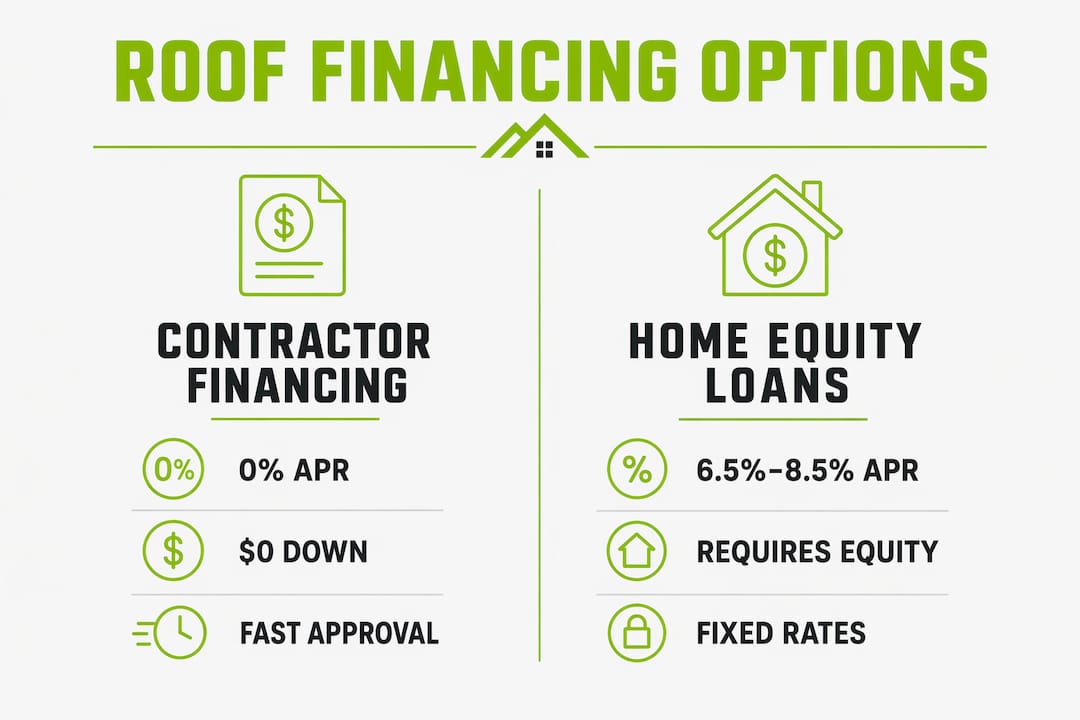
Contractor financing is the most common starting point. Approval takes 2–3 minutes with $0 down, making it the fastest path to getting your roof fixed after a storm. These programs come in two distinct types: true 0% loans and deferred interest plans. Knowing which one you are signing is the single most important question you can ask.
Home equity loans and HELOCs

If you have built up equity in your home, this is the lowest-cost route. Home equity loans carry fixed APRs of 6.5%–8.5% with terms from 5 to 30 years. That rate is far below what any deferred interest plan charges retroactively. The downside is time. Approval takes weeks, not minutes, which matters when a hurricane has left your roof open to the sky.
Personal loans
Personal loans work well for homeowners who lack equity but have solid credit. They are unsecured, meaning your home is not collateral. Rates run 8%–14% APR with faster approval than home equity products. You pay a predictable monthly amount with no deferred interest trap waiting at the end.
Credit cards with 0% introductory APR
A 0% intro APR credit card can cover smaller repairs if you pay the balance before the promotional period ends. The credit limit is often too low for a full replacement, and the standard APR after the promo period is high. Use this option only for repairs under $5,000 that you can realistically clear within 12 months.
PACE financing and government programs
PACE loans require no credit check and attach repayment to your property tax bill, with effective rates around 7%–9%. They suit homeowners with damaged credit who cannot qualify elsewhere. Florida also has limited state and county grant programs for low-income households after declared storm disasters. Availability varies by county, so check with your local housing authority directly.
| Financing type | Typical APR | Down payment | Best for |
|---|---|---|---|
| Contractor deferred interest | 0% promo, then 22%–29% | $0 | Fast approval, short-term payoff |
| Home equity loan | 6.5%–8.5% | $0 | Lowest long-term cost |
| Personal loan | 8%–14% | $0 | No equity, good credit |
| PACE financing | 7%–9% effective | $0 | Poor credit, property tax repayment |
| 0% intro APR card | 0% promo, then 20%+ | $0 | Small repairs only |
How do deferred interest plans work, and what are the risks?
A deferred interest plan looks like a 0% loan on the surface. The lender defers all interest charges during the promotional window, typically 6–24 months. If you pay the full balance before that window closes, you owe nothing extra. If you do not, the lender charges interest on the original full amount from day one, not just the remaining balance. That is the retroactive trap.
Here is a real-world example. You finance a $12,000 roof replacement on a 12-month deferred interest plan at 26% APR. You make minimum payments and have $2,000 left at month 12. The lender does not charge 26% on $2,000. It charges 26% on $12,000 for the entire 12 months, adding roughly $3,120 to your bill overnight.
The minimum payment problem makes this worse. Minimum payments are usually set too low to clear the principal before the deadline. Lenders design it that way. Paying only the minimum on a $12,000 balance over 12 months leaves a significant balance at the end of the promo period.
- Always calculate the monthly payment needed to zero out the balance one month before the deadline.
- Set that amount as your fixed monthly payment from day one, not the minimum shown on your statement.
- Never miss a payment. A single late payment on many plans triggers immediate interest charges.
- Read the fine print on what “same-as-cash” means. It is not the same as a true 0% loan.
Pro Tip: Divide your total financed amount by the number of promo months minus one. Pay that amount every month. This gives you a one-month buffer before the deadline and guarantees you avoid retroactive interest.
What criteria should you use to choose a roof financing plan?
Understanding the exact plan type is the first filter. True 0% loans, like the Zero Interest Loan structure offered by some regional lenders, charge no interest at all if paid on time. Deferred interest plans charge retroactive interest if you miss the deadline. Ask your contractor in writing which type they are offering before you sign anything.
Credit score and approval requirements
Credit score requirements range from 540 to 700+ depending on the plan. A score below 640 usually means higher APRs or limited plan options. Check your credit report before applying so there are no surprises. Pre-qualification for most contractor financing uses a soft credit pull, which does not affect your score. The final approval, however, triggers a hard credit inquiry that can lower your score by a few points.
Hidden dealer fees
Contractors pay dealer fees of 5%–15% to their lending partners for offering financing. Those fees get built into your project quote. A $12,000 roof quote through a financed offer may reflect $600–$1,800 in dealer fees that a cash or home equity loan customer would not pay. Ask your contractor if the price changes for a cash or bank-financed payment. The answer tells you a lot.
Loan term and monthly payment fit
Match the loan term to your actual budget. A 24-month deferred interest plan only makes sense if you can realistically pay it off in 20 months. If your budget is tight, a personal loan or home equity loan with a fixed 5-year term and predictable payments is safer than a short deferred window you might miss.
Pro Tip: Get quotes from at least two financing sources before committing. Compare the total amount repaid, not just the monthly payment. A lower monthly payment on a longer term often costs more overall.
| Criteria | What to check | Why it matters |
|---|---|---|
| Plan type | True 0% vs. deferred interest | Deferred interest has retroactive penalties |
| Credit score | 540 minimum, 700+ for best rates | Determines APR and plan eligibility |
| Dealer fees | Ask if price drops for cash payment | Fees of 5%–15% inflate financed quotes |
| Monthly payment | Can you pay it off early? | Minimum payments often leave a balance |
| Loan term | Matches your payoff timeline | Shorter promo windows carry higher risk |
How do you apply for and manage roof financing successfully?
Preparation before you apply saves money and stress. Pull your free credit report at AnnualCreditReport.com before contacting any contractor. Dispute any errors you find, since even a 20-point score improvement can move you into a better rate tier. Review your monthly budget and set a firm maximum monthly payment before you hear any sales pitch.
When you meet with a contractor, ask these questions directly:
- Is this a true 0% loan or a deferred interest plan?
- What is the retroactive APR if I miss the payoff deadline?
- Are dealer fees included in this quote, and does the price change if I pay cash?
- What triggers early interest charges, such as a late payment?
- Can I pay extra each month without a prepayment penalty?
Once you sign, set up automatic payments immediately. Auto-payments set to fully clear the balance before the promo window closes are the best defense against retroactive interest. Do not rely on memory or manual transfers. Log into your loan account monthly to confirm payments are posting correctly and the balance is declining on schedule.
If you hit a financial shortfall midway through the promo period, act early. Contact the lender before the deadline and ask about refinancing into a standard installment loan. Many lenders will convert the balance to avoid a default. Waiting until after the deadline costs you the full retroactive interest charge. Before you even start the financing process, knowing what types of roof repairs your home actually needs helps you borrow only what is necessary.
Pro Tip: Set a calendar alert 60 days before your promo period ends. Use that time to confirm your remaining balance and make a lump-sum payment if needed. Sixty days gives you time to move money without panic.
Key Takeaways
Deferred payment roof financing options require you to know the plan type, calculate your exact payoff amount, and automate payments before the promotional deadline to avoid retroactive interest charges.
| Point | Details |
|---|---|
| Know your plan type | Always confirm whether you have a true 0% loan or a deferred interest plan before signing. |
| Retroactive interest is real | Missing the payoff deadline triggers 22%–29% APR on the full original loan amount. |
| Minimum payments are not enough | Calculate and pay the amount needed to zero the balance one month before the deadline. |
| Dealer fees inflate quotes | Ask if the price drops for cash payment to reveal hidden financing costs of 5%–15%. |
| Home equity loans cost less | If you have 20% equity, a home equity loan at 6.5%–8.5% APR beats most contractor financing. |
What I have learned after years of watching homeowners finance roofs
The deferred interest trap catches smart, financially responsible people every year. Not because they are careless, but because the plan is designed to look like a 0% loan. The promotional window feels long enough. The minimum payment feels reasonable. Then month 13 arrives and a $3,000 interest charge appears on a balance the homeowner thought was nearly gone.
My honest advice is this: if you cannot pay off the full balance in two-thirds of the promo period, do not use a deferred interest plan. Use a personal loan or a home equity product instead. The slightly higher stated interest rate on those options is almost always cheaper than the retroactive penalty you risk with deferred interest.
The dealer fee issue is the other thing contractors rarely volunteer. Balancing convenience with total financing cost is the real financing decision. A contractor offering easy in-house financing is not doing you a favor for free. That convenience costs 5%–15% of your loan, baked into the quote. Always ask what the cash price is. Always.
Work with contractors who show you both numbers without being asked. Transparency on pricing and financing terms is the clearest signal that a contractor respects you as a customer. If a contractor gets evasive when you ask about dealer fees or plan type, that tells you everything you need to know. Florida has plenty of urgent roof issues that genuinely cannot wait, but the financing decision is one you should never rush.
— Anthony
Hytzroofing makes roof financing clear and straightforward
Financing a roof should not feel like reading a legal contract in a foreign language. Hytzroofing is a GAF Master Elite® Contractor serving Tampa and the surrounding Florida area, holding an honor earned by fewer than 2% of roofing contractors across North America. That credential means Hytzroofing meets GAF’s rigorous standards for licensing, insurance, training, and customer service.
Hytzroofing offers $0 down financing with a quick application process and transparent pricing. You will know upfront whether you are looking at a true 0% plan or a deferred interest structure, and exactly what the payoff timeline looks like. No hidden dealer fee surprises. Whether you need a storm repair or a full replacement, explore your options through Hytzroofing’s roofing services and get a personalized consultation from a team that puts the numbers on the table.
FAQ
What is deferred interest financing for roofing?
Deferred interest financing is a roof payment plan that charges no interest during a promotional period of 6–24 months, but applies retroactive APRs of 22%–29% on the full original balance if you do not pay it off in time.
How do I avoid paying retroactive interest on a roof loan?
Calculate the monthly payment needed to zero your balance one month before the promo deadline, set it as an automatic payment, and confirm your balance monthly to stay on track.
What credit score do I need for roof financing?
Most contractor financing plans accept scores starting at 540, but the best rates and plan options require a score of 640–700 or higher.
Are home equity loans better than contractor financing for roofs?
Home equity loans offer fixed APRs of 6.5%–8.5%, which is significantly lower than the retroactive rates on deferred interest plans, making them the lower-cost option for homeowners with sufficient equity.
Do contractor financing quotes include hidden fees?
Yes. Contractors pay dealer fees of 5%–15% to lending partners, and those costs are typically built into the financed project price. Ask your contractor for the cash price to see the difference.
Recommended
- The Ultimate Cost of Ignoring a Leaky Roof What Homeowners Need to Know
- Tampa Roofer | GAF Master Elite | Hytz Roofing
- Types of Roof Repairs Florida Homeowners Need Most
- Introducing Enviroshake to Your Hoa
Related Hytz Roofing Services