
Personal Loan for Roofing: A Homeowner’s Guide
Personal roofing loan provides unsecured financing to cover roof repairs or replacements when homeowners prefer not to use home equity.
A personal loan for roofing is an unsecured, lump-sum loan you repay in fixed monthly installments, used specifically to cover roof repairs or replacement. No home equity required, no lien on your property. The quick verdict: it’s the right move when you need fast funding for an emergency repair or a smaller replacement and don’t want to tap your home’s equity.
Quick pros and cons:
- ✅ Funds often arrive within one to two days, so you can act fast on a leak or storm damage
- ✅ Your home isn’t used as collateral, which means no foreclosure risk tied to this loan
- ❌ APRs typically run 6%–36%, higher than home-equity products for most borrowers
- ❌ Origination fees can add real cost if you don’t compare lenders carefully
Use a personal loan when speed and flexibility matter most. For a large, planned replacement where you have solid equity, a home-equity option often costs less overall.
Table of Contents
- How does a personal loan for roofing actually work?
- When does a personal loan make sense for your roof?
- What does a roofing personal loan actually cost?
- How do you apply for a personal loan for your roof?
- How do personal loans compare with other roofing financing options?
- How do you choose the right lender for your roof project?
- Red flags and pitfalls to avoid when financing a roof
- Lenders and resources worth checking
- Key Takeaways
- Why the financing decision and the contractor decision are the same decision
- Ready to pair your financing with a contractor you can trust?
- Useful sources and tools for your next steps
How does a personal loan for roofing actually work?
Personal loans for roofing are unsecured and fixed-rate, meaning no collateral and the same payment every month from day one. You borrow a lump sum, the lender deposits it directly into your bank account, and you repay it over a set term, typically 2–7 years.
Lenders evaluate your application based on four things: credit score, debt-to-income ratio (DTI), income, and employment stability. Because there’s no home appraisal involved, the process moves fast. Approval and funding often happen within a day or two, compared with home-equity products that can take weeks.
A few terms worth knowing:
- Unsecured vs. secured: Unsecured means no collateral. Secured loans (like a HELOC) use your home as collateral.
- APR vs. nominal rate: APR includes fees and interest; the nominal rate is just the interest. Always compare APR.
- Origination fee: A one-time fee some lenders charge upfront, up to about 10% of the loan amount in some cases, though many lenders charge nothing.
- Prequalification vs. hard pull: Prequalifying uses a soft credit inquiry that doesn’t affect your score. A formal application triggers a hard pull.
Stat to know: Lenders rely primarily on your credit score and DTI to approve unsecured personal loans, especially when you have limited home equity to offer as security.
When does a personal loan make sense for your roof?
Not every roofing situation calls for a personal loan. Here’s how to think through it quickly.
Personal loan is a strong fit when:
- You have an active leak or storm damage and need repairs within days, not weeks
- You have limited home equity or haven’t built enough to qualify for a HELOC
- You want to avoid putting a lien on your property
- The project is a smaller repair or a mid-range replacement within a modest budget
Consider alternatives first when:
- You have substantial home equity and time to go through a longer approval process (a home-equity loan or HELOC will likely cost less)
- The damage was caused by a storm or a covered peril. Check your insurance before financing anything. Filing a claim first could reduce your out-of-pocket cost to just your deductible.
- You’re planning a full replacement months in advance. That lead time gives you room to explore lower-cost options.
The repair-vs.-replacement distinction matters here. A $3,000 repair after a hail event is a natural fit for a personal loan. A full replacement on a planned timeline is worth exhausting insurance and equity options first.
What does a roofing personal loan actually cost?
Average roof replacement costs run near $9,000–$10,000, which makes the $10,000 loan a practical benchmark. Larger homes or premium materials push that figure higher, and personal loan amounts commonly range from $1,000 up to $50,000 or more depending on the lender.
Cost context: A personal loan at typical APRs over several years costs a significant monthly payment and substantial total interest—higher APRs increase that cost notably. The APR gap is real money.
Here’s a sample payment table across common loan sizes, APRs, and terms:
| Loan Amount | APR | Term | Monthly Payment | Total Interest |
|---|---|---|---|---|
| $10,000 | — | 3 years | — | — |
| $10,000 | — | 5 years | — | — |
| $10,000 | — | 5 years | — | — |
| $50,000 or more | — | 5 years | — | — |
| $50,000 or more | — | 7 years | — | — |
| $50,000 or more | — | 7 years | — | — |
Figures are estimates for illustration. Your actual payment depends on your lender’s exact APR and any origination fees.
To estimate your own payment quickly, use a loan calculator at Bankrate or NerdWallet. Enter your loan amount, APR, and term in months. Always calculate total interest paid, not just the monthly number. A longer term lowers your monthly payment but raises your total cost. For more on how term length affects what you pay, the roof financing term guide at Hytzroofing walks through the tradeoffs clearly.
How do you apply for a personal loan for your roof?
The process is straightforward. Here’s the order that works best:
- Get a contractor estimate first. You need a written scope and dollar amount before you apply. Lenders want to know what the money is for, and a detailed estimate speeds underwriting.
- Check your insurance. For storm or hail damage, document everything thoroughly and contact your insurer before signing any loan. A covered claim could cut your out-of-pocket cost significantly.
- Pull your credit score and calculate your DTI. Know where you stand before lenders do. Your DTI is your monthly debt payments divided by gross monthly income.
- Gather your documents. You’ll typically need: government-issued ID, recent pay stubs or tax returns, bank statements, and your contractor’s written estimate.
- Prequalify with multiple lenders. Use soft-pull prequalification tools so your score isn’t affected. Compare APR, origination fees, and term options side by side.
- Submit your formal application. Once you’ve chosen a lender, the hard credit pull happens here. Approval can come within hours.
- Accept the loan and receive funds. Many lenders deposit funds the same day or the next business day after acceptance.
Pro Tip: Bring the contractor’s written scope to your lender. A detailed estimate tied to a specific project helps justify the loan amount and can speed the underwriting decision.

How do personal loans compare with other roofing financing options?
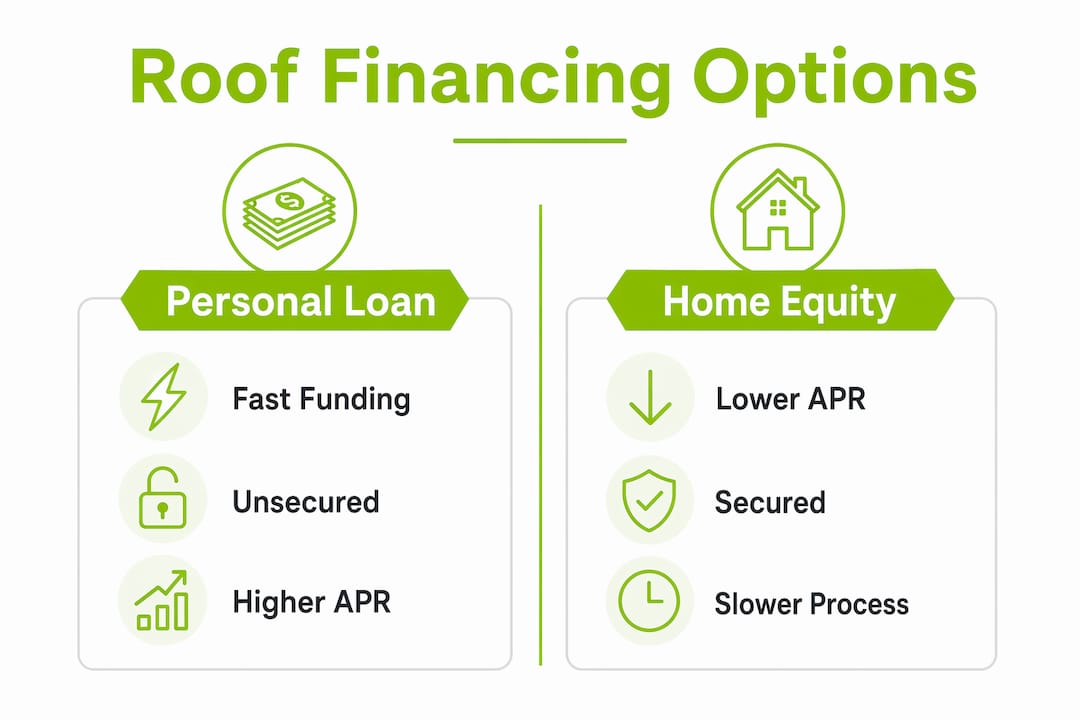
Personal loans offer speed and no lien, but typically carry higher APRs than secured home-equity products. Here’s how the main options stack up:
| Option | Typical APR | Funding Speed | Lien on Home? | Best For |
|---|---|---|---|---|
| Personal loan | 6%–36% | 1–2 days | No | Emergency repairs, limited equity |
| Home-equity loan | Lower (secured) | 2–4 weeks | Yes | Large planned replacements |
| HELOC | Variable (secured) | 2–4 weeks | Yes | Phased projects, ongoing repairs |
| Contractor financing | Varies widely | Same day | Sometimes | Convenience, but compare total cost |
| Credit card | 6%–36% | Immediate | No | Very small repairs only |
| Insurance claim | Deductible only | Varies | No | Storm/covered damage |
Key tradeoffs to understand:
- Home-equity loan or HELOC: Lower APR is the main advantage, but you’re putting your home on the line and the process takes weeks. The CFPB’s HELOC guide explains the lien and risk structure clearly.
- Contractor financing: Convenient, but often the most expensive option when you read the fine print. Always compare the contractor’s offer against an independent personal loan. The difference between bank and contractor roof loans is worth understanding before you sign.
- Insurance: Almost always the cheapest path for covered damage. Your responsibility is typically limited to your deductible. File first, finance the gap if needed.
- Credit cards: Reasonable only for very small repairs if you can pay the balance quickly. The APR on most cards exceeds even mid-range personal loan rates.
When cost is the priority and you have time, home-equity products win. When speed is the priority and you need your roof fixed this week, a personal loan is hard to beat.
How do you choose the right lender for your roof project?
The APR spread on personal loans is wide, so lender selection directly affects what you pay. Focus on these criteria:
- Total cost, not just monthly payment. Calculate total interest paid over the full term.
- Origination fees. Some lenders charge up to 10% upfront. A “low APR” loan with a 5% origination fee can cost more than a slightly higher-APR loan with no fee.
- Fixed vs. variable rate. For roofing, always choose fixed. You want predictable payments.
- Prepayment penalties. Confirm there are none. You may want to pay the loan off early.
- Funding speed. If you have an active leak, a lender that funds in 24 hours matters more than one that takes a week.
- Prequalification availability. Use lenders that offer soft-pull prequalification so you can compare real offers without dinging your score.
Questions to ask every lender:
- What is the exact APR, including all fees?
- Is there an origination fee, and is it deducted from my loan proceeds or added to the balance?
- Is the rate fixed for the full term?
- Are there prepayment penalties?
- How quickly will funds be deposited after I accept?
Your credit score shapes every offer you receive. Most lenders require at least a 620 score; the best rates go to borrowers at 690 or above. If your score is below 620, consider a co-signer or spend 60–90 days paying down revolving balances before applying.
Red flags and pitfalls to avoid when financing a roof
A few mistakes show up repeatedly when homeowners finance roofing projects. Here’s what to watch for:
- Deferred-interest promotions. These can look like 0% financing but may retroactively apply interest to the full original balance if you don’t pay it off before the promotional period ends. Always get the exact contractual language in writing. The deferred payment guide at Hytzroofing explains how these structures work.
- Undisclosed origination fees. Some lenders bury fees in the fine print. Always ask for the APR including all fees before you apply.
- Pressure to accept contractor-arranged financing on the spot. A contractor who pushes you to sign financing paperwork at the estimate appointment is a red flag. You have the right to shop independently.
- No written loan terms. Never accept a verbal offer. Get every rate, fee, and term in writing before signing.
- ❌ Financing a full replacement without checking insurance first. Storm damage is often covered. Skipping that step could cost you thousands.
- ❌ Confusing a teaser rate with the actual APR. Advertised rates are often the best-case scenario. Your actual offer depends on your credit profile.
Pro Tip: Before signing any contractor agreement or financing document, require a written loan estimate and a detailed contractor scope that ties the loan amount to specific work. If either party won’t provide it in writing, walk away.
Lenders and resources worth checking
These are names you’ll see frequently when researching personal loans for roofing. They’re starting points for comparison, not endorsements.
- LightStream (a division of Truist Bank): Known for competitive rates on home-improvement loans, no origination fees, and same-day funding for qualified borrowers. Generally favors borrowers with strong credit.
- OneMain Financial: Works with a broader credit range, including borrowers below 690. Rates are higher, but it’s an accessible option when other lenders decline. Trustpilot reviews reflect a wide range of borrower experiences.
- LendingTree: A marketplace that lets you compare multiple lender offers with a single form. Useful for seeing real APR ranges across lenders without multiple hard pulls.
- Credit unions: Often offer lower rates than online lenders for members. Worth checking before going with a national bank.
- Your primary bank or credit union: Existing relationships sometimes unlock better rates or faster processing.
The smartest move is to prequalify with at least three sources before accepting any offer, including any financing your contractor suggests. Soft-pull prequalification tools let you see real numbers without affecting your credit score.
Key Takeaways
A personal loan for roofing gives you fast, unsecured funding with no home lien, but the higher APR means it costs more than home-equity options over the life of the loan.
| Point | Details |
|---|---|
| Speed vs. cost tradeoff | Personal loans fund in 1–2 days but carry APRs of 6%–36%, higher than secured home-equity products. |
| Run the real numbers | Use sample payments at your actual APR and term; total interest on a $50,000 or more loan at — over 7 years exceeds $27,000. |
| Check insurance and equity first | Storm damage may be covered; a HELOC or home-equity loan costs less if you have sufficient equity and time. |
| Compare at least three lenders | Prequalify with multiple lenders using soft pulls; origination fees up to 10% can erase a low-APR advantage. |
| Hytzroofing as your vetted contractor | Pair your financing with a GAF Master Elite® contractor like Hytzroofing to protect the long-term value of your investment. |
Why the financing decision and the contractor decision are the same decision
Here’s something most financing guides skip entirely: the quality of your contractor determines whether your loan was money well spent or money you’ll spend again in five years.
Homeowners often treat financing and contractor selection as two separate steps. They’re not. A roof installed with inferior materials or poor workmanship will fail prematurely, and no loan term is long enough to cover a second replacement. The cheapest monthly payment on a bad roof is still a bad deal.
Hytzroofing holds the GAF Master Elite® designation, earned by fewer than 2% of roofing contractors in North America. That credential requires documented licensing, insurance, ongoing training, and a verifiable community reputation. Hytzroofing has also earned the GAF President’s Club Award, the 2024 Brava Roof Tile Excellence Award, and the Angi Super Service Award 2025. The BBB A+ rating and Florida Contractor License #CCC1332551 round out a credential set that most contractors in the market simply can’t match.
When you’re borrowing money to fix your roof, you want to know the work will last. Financing a durable installation from a vetted contractor is a sound investment. Financing a cheap job from an unverified crew is a liability.
Ready to pair your financing with a contractor you can trust?
Financing a roof is only half the equation. The other half is making sure the work is done right the first time, so you’re not financing it again.
Hytzroofing serves homeowners across Florida as a GAF Master Elite® and President’s Club contractor, backed by the Angi Super Service Award 2025, a BBB A+ rating, and Florida Contractor License #CCC1332551. We provide free estimates, help you document damage for insurance claims, and can connect you with financing options that fit your project.
Whether you’re dealing with an active leak that needs emergency roof repair today or planning a full replacement, reach out to Hytzroofing for a no-obligation estimate. We’ll give you a detailed written scope you can take straight to any lender. Visit our residential roofing page to get started or request an estimate now.
Useful sources and tools for your next steps
Use these to check rates, calculate payments, and verify your options before you commit:
- CFPB HELOC guide: Explains how home-equity lines of credit work, including lien rights and repayment structure. Read this before choosing between a personal loan and a HELOC.
- HUD Title I loan program: A federally backed home-improvement loan option worth checking if you don’t qualify for standard personal loans.
- USDA Single Family Housing Repair program: Low-income homeowners in eligible rural areas may qualify for repair loans or grants.
- LendingTree rate comparison: Compare multiple lender offers in one place using a soft pull.
- Bankrate or NerdWallet loan calculators: Enter your loan amount, APR, and term to see monthly payment and total interest. Always calculate total cost, not just the monthly figure.
This article is general information, not financial or legal advice. Confirm current rates, program eligibility, and loan terms directly with lenders or a qualified financial professional before making any borrowing decision.
Recommended
- Roof Financing Term Length: What Homeowners Need to Know | Hytz Roofing
- Bank vs. Contractor Roof Loans: Key Differences in 2026 | Hytz Roofing
- Deferred Payment Roof Financing Options: 2026 Guide | Hytz Roofing
- Choose the Best Roofing Contractor in Tampa Bay, Florida: Your Guide | Hytz Roofing
Related Hytz Roofing Services
Frequently Asked Questions
- Can I finance a new roof in Florida with bad credit?
- Yes. Several roof financing programs in Florida — including contractor-arranged financing and PACE programs — approve homeowners with credit scores as low as 580. Hytz Roofing works with multiple lenders to find the best option for your situation. Call (813) 436-0761 for a free estimate and financing consultation.
- What is the typical interest rate for roof financing in Florida?
- Rates vary by program: 0% promotional financing is available for qualified buyers through GAF's financing program, while personal loans typically range from 6–18% APR. PACE programs (Property Assessed Clean Energy) offer fixed rates of 5–9% repaid through your property tax bill.
- How long does roof financing approval take?
- Most contractor-arranged financing programs provide same-day approval decisions. PACE financing typically takes 24–48 hours. Bank loans and HELOCs take 2–4 weeks.
- Is 0% financing for roofing too good to be true?
- No — 0% promotional financing is a real product offered through manufacturer programs like GAF's financing. The contractor pays a fee to the lender to subsidize the rate, and you pay nothing in interest if you pay off the balance within the promotional period (typically 12–18 months).
- Does Hytz Roofing offer financing?
- Yes. Hytz Roofing offers 0% financing for qualified homeowners through our GAF financing program, as well as flexible monthly payment options for those who prefer a longer repayment term. Call (813) 436-0761 or visit our roof cost guide for details.