Commercial Roof Replacement Cost in 2026: A Budget Guide
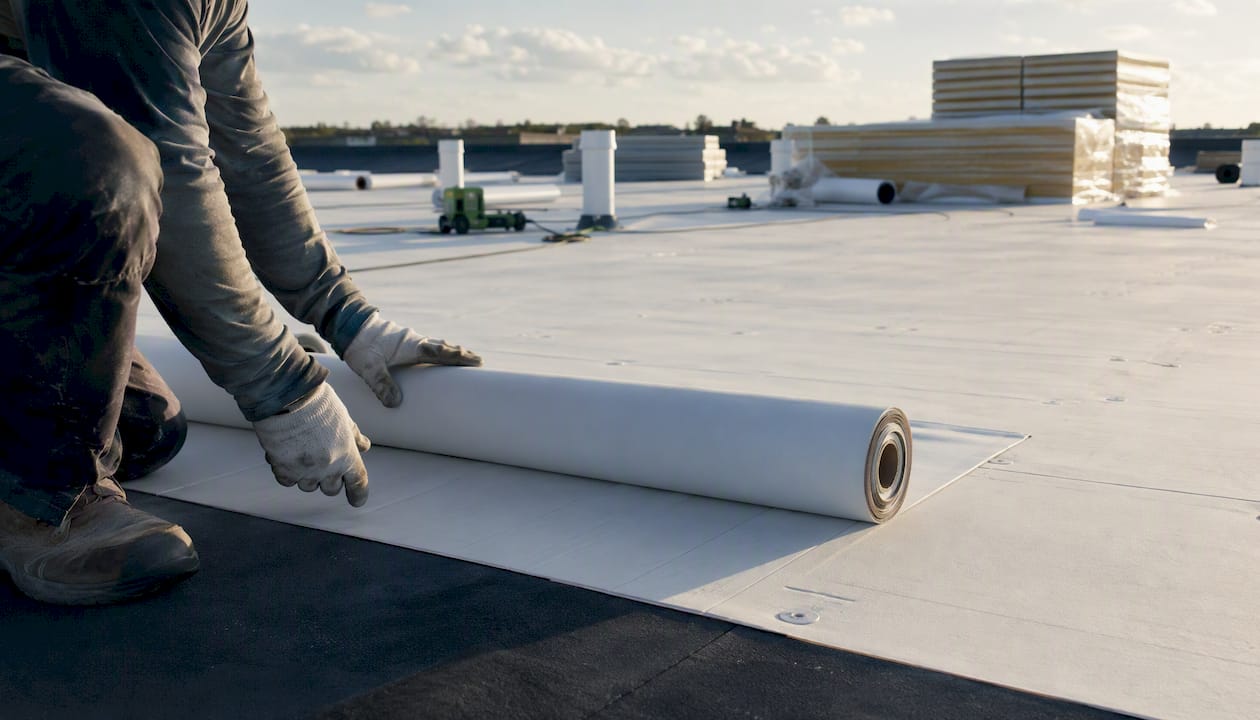
Most commercial roof replacements cost between about $5 and $26 per square foot installed, with warehouse and industrial buildings typically landing in the $7 to $12 per square foot band. A 10,000 sq ft building usually runs roughly $70,000 to $120,000 for a standard low-slope system, while smaller roofs under 5,000 sq ft often run higher per square foot because mobilization costs don’t spread out as much.
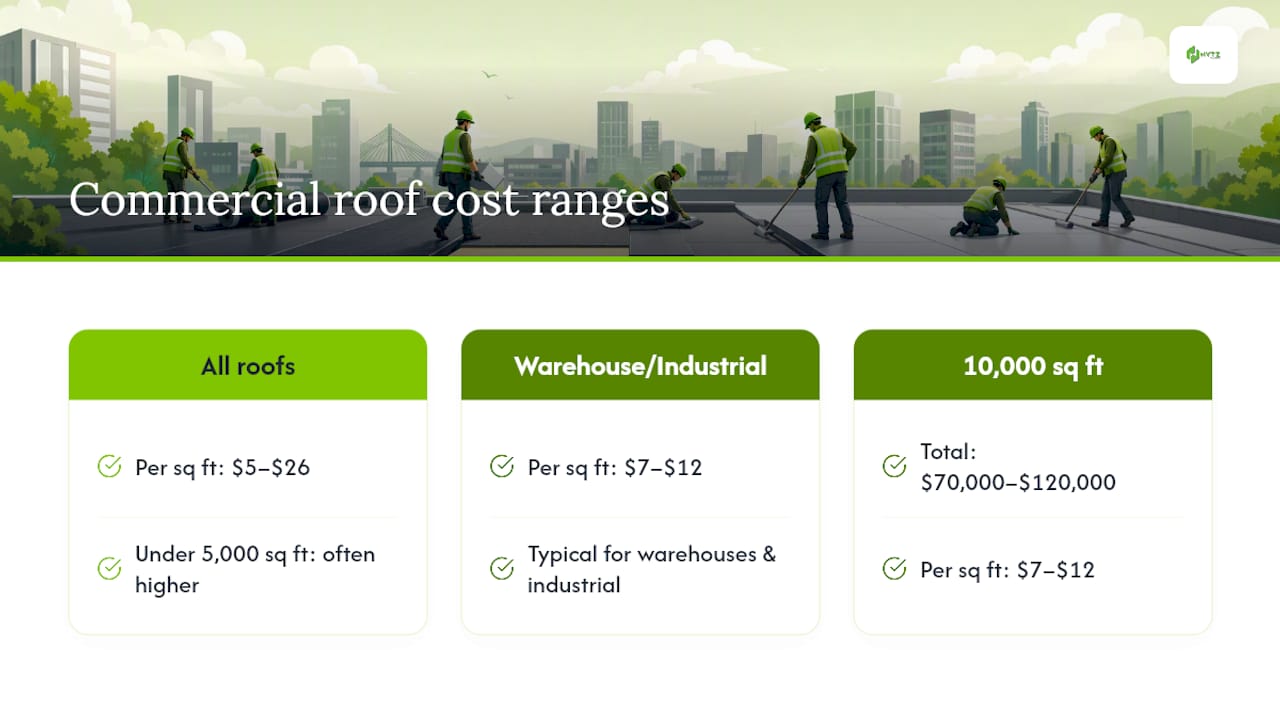
Small to mid-size roofs vary considerably in installed cost depending on size and system, with smaller buildings often costing more per square foot due to fixed fees.
Pro Tip: Get three itemized bids after an on-site inspection with a core cut, not a drive-by estimate. Florida’s wind-zone codes and permit rules change fastener patterns and pricing, so a bid written for another state won’t match what you actually need here.
Key Takeaways
Commercial roof replacement cost depends on system choice, tear-off scope, and insulation needs far more than square footage alone, and itemized bids following an on-site inspection are the only reliable way to compare contractors.
| Point | Details |
|---|---|
| National cost range | Most commercial roofs install for $5 to $26 per sq ft, with warehouses typically at $7 to $12. |
| Material choice matters most | TPO, EPDM, PVC, metal, BUR, and modified bitumen carry different cost and lifespan tradeoffs. |
| Hidden costs add up fast | Tear-off, tapered insulation, and fastener density can each add several dollars per sq ft. |
| Insist on itemized bids | Require mil-thickness, R-value, attachment method, and warranty type on every proposal. |
| Hytz Roofing estimates locally | Hytz Roofing builds line-item bids from an on-site core cut, backed by GAF Master Elite® credentials and Florida license #CCC1332551. |
Table of Contents
- What Does Commercial Roof Replacement Cost by System?
- What Actually Drives the Price on Your Bid?
- How Much Would My Roof Actually Cost?
- How Do I Get an Estimate I Can Actually Trust?
- How Long Does a Commercial Roof Replacement Take?
- Does a Higher-Cost Roof Save You Money Long-Term?
- Can Insurance or Financing Lower My Net Cost?
- How Hytz Roofing Builds an Accurate Commercial Estimate
- Ready to Replace Your Commercial Roof in Tampa Bay?
- Sources
- FAQ
What Does Commercial Roof Replacement Cost by System?
Your material choice swings the price more than almost any other decision you’ll make. Here’s how the six systems most commonly installed on commercial buildings compare on cost, lifespan, and fit.
A full commercial replacement in most U.S. markets runs $4.00 to $12.00 per square foot installed, with labor alone commonly accounts for roughly a portion of that number. TPO sits near the middle of that range, and pricing depends heavily on membrane thickness and how it’s attached to the deck.
- Membrane thickness matters: 60-mil TPO is the market standard; 80-mil membranes and fully adhered installs add roughly 15 to 30% to material cost.
- Attachment method changes speed and price: mechanically attached systems install faster and cheaper on large roofs, while fully adhered systems cost more but resist wind uplift better.
- Insulated panel upgrades and cool-roof coatings raise upfront cost but lower long-term energy bills, which matters in Tampa Bay’s near year-round HVAC load.
What Actually Drives the Price on Your Bid?
Two roofs of the same square footage can come in $30,000 apart, and the gap almost always traces back to the same handful of line items.
- Tear-off depth: removing multiple existing roof layers adds labor and disposal cost; a full tear-off commonly adds $2 to $4 per sq ft over a recover job.
- Insulation and tapered systems: correcting ponding water with tapered insulation can add $2.50 to $5.50 per square foot on its own.
- Fastener density and wind-spec: coastal buildings need tighter fastener patterns to meet ASCE 7 and IECC-driven wind and insulation standards, which raises material count.
- Cover board, flashing count, and rooftop penetrations: every HVAC curb, drain, and skylight adds labor hours that a flat per-square-foot number won’t show.
- Height and access: roofs requiring crane lifts or extended hoisting add mobilization days you’ll see as a separate line item.
Building size also changes your per-square-foot number. A 1,200 sq ft roof carries the same mobilization, permit, and setup costs as a 10,000 sq ft roof, so those fixed costs get spread thinner as the roof gets bigger.
Pro Tip: Ask every contractor to confirm the exact R-value, membrane mil-thickness, and fastener pattern tied to your wind zone before you compare bids. If one number is missing, you’re not comparing apples to apples.
How Much Would My Roof Actually Cost?
Here’s what the math looks like across three common sizes, using the mid-market TPO band as the baseline before add-ons.
- 1,200 sq ft: at $7 to $15 per sq ft, that’s $8,400 to $18,000. A small building like this often skews toward the top of the range because mobilization and disposal fees barely change with size.
- 5,000 sq ft: at $7 to $15 per sq ft, expect $35,000 to $75,000. Adding tapered insulation for drainage correction could push the total up another $12,500 to $27,500.
- 10,000 sq ft: at $7 to $12 per sq ft, expect $70,000 to $120,000. A crane day for rooftop equipment or extra tear-off layers can add several thousand dollars on top.
| Roof size | Low estimate | High estimate |
|---|---|---|
| 1,200 sq ft | $8,400 | $18,000 |
| 5,000 sq ft | $35,000 | $75,000 |
| 10,000 sq ft | $70,000 | $120,000 |
Notice the pattern: per-square-foot pricing drops as the roof gets bigger, because fixed overhead costs spread across more area on a larger job.
How Do I Get an Estimate I Can Actually Trust?
A cheap number on paper means nothing if it’s missing half the scope. Here’s how to make sure every bid you get covers the same ground.
Before the bid, insist on an inspection that includes:
- A core cut to confirm deck condition and existing layer count
- A moisture scan to catch wet insulation before it’s covered up
- A count of drains, curbs, and rooftop penetrations
- Documentation of current insulation R-value
On every written bid, require these details:
- Membrane mil-thickness and attachment method (mechanically attached vs. fully adhered)
- Insulation R-value and whether tapered insulation is included
- Cover board specification, if any
- Fastener count and pattern tied to your wind zone
- Tear-off assumptions, including number of existing layers removed
- Warranty terms, including whether it’s material-only or a No Dollar Limit (NDL) system warranty, and any associated fees
A material warranty covers the membrane itself; an NDL warranty backs labor and materials together and typically costs more upfront but protects you further down the road. Our guide to reading roofing estimate line items breaks down exactly what should appear on a legitimate proposal, and our inspection process guide walks through what a proper pre-bid inspection should document.
How Long Does a Commercial Roof Replacement Take?
- Small roofs (under 5,000 sq ft): typically 2 to 5 days from mobilization through punchlist.
- Mid-size roofs (5,000 to 15,000 sq ft): typically 1 to 3 weeks, weather permitting.
- Large roofs (15,000+ sq ft): often 3 to 6 weeks, especially with phased tear-off to keep the building dry.
- Florida permits typically require inspection scheduling that adds several days to the front end of a project.
- Summer storm season in Tampa Bay can push timelines out, since crews often halt tear-off ahead of afternoon thunderstorms to avoid exposing the deck.
- Disposal costs rise when crews find wet insulation or, in older buildings, materials requiring asbestos testing before removal.
- Crane rental and rooftop access premiums typically add cost on multi-story buildings or sites with limited ground clearance.
Does a Higher-Cost Roof Save You Money Long-Term?
Upfront price only tells part of the story. A 45-mil TPO system might save you money today but need replacement years sooner than a 60-mil or 80-mil system, and that gap in membrane thickness changes your lifecycle math significantly.
- Standing-seam metal costs more upfront but can outlast two or three single-ply replacements over a 40 to 60 year lifespan.
- Cool roof membranes and higher R-value insulation reduce HVAC load, which matters in Florida’s climate where cooling runs nearly year-round, as described in our partner article on maximizing energy savings through roofing.
- NDL warranties cost more but reduce the risk of unbudgeted repair expenses mid-lifespan.
The Department of Energy points to roof insulation and reflective surfaces as two of the more reliable ways to cut ongoing energy costs, particularly when paired with code-minimum R-values under the IECC. Our insulation guide covers how R-value choices affect both energy bills and long-term roof performance.
Can Insurance or Financing Lower My Net Cost?
Insurance typically covers replacement only when damage traces to a covered peril, like wind or hail, not gradual wear or age-related failure. Adjusters generally want documented photos, a dated inspection report, and a clear cause-of-loss narrative before approving a claim.
- Utility rebates and energy program credits can offset cool-roof or insulation upgrades; check current DOE program guidance before finalizing your spec.
- A recover (overlay) job can run 40 to 70% less than a full tear-off, but it’s only viable when the existing roof passes a moisture scan.
- Financing through a contractor or third-party lender can spread cost over time, which helps when a claim doesn’t cover the full scope.
Pro Tip: Budget 10 to 15% contingency for change orders. Wet decking or hidden insulation damage found during tear-off is one of the most common reasons a “final” number grows mid-project.
How Hytz Roofing Builds an Accurate Commercial Estimate
We price every commercial job line by line: membrane, insulation, cover board, tear-off scope, flashing, fastener count, and disposal or crane logistics, confirmed by an on-site core cut and moisture scan before we write a number down.
- Hytz Roofing is a GAF Master Elite® Contractor and GAF Certified™ Commercial Contractor, backed by Florida Contractor License #CCC1332551 and full insurance.
- We factor in Tampa Bay’s wind-zone fastener requirements and coastal high-wind premiums, plus realistic permit timing, before finalizing a bid.
- Ask us for certificates of insurance and licensing during the bidding process. A legitimate contractor should hand these over without hesitation.
A Note on Common Budgeting Mistakes
Too many owners chase the lowest bid without confirming it matches the same mil-thickness, insulation R-value, and warranty type as the other bids on the table. Our baseline recommendation for most Florida commercial buildings: 60-mil TPO over R-25 polyiso insulation with a cover board, unless your building’s use calls for a premium system like PVC or metal.
Ready to Replace Your Commercial Roof in Tampa Bay?
Hytz Roofing handles commercial roof replacement across Tampa Bay with the same line-item transparency this guide just walked you through, so you’re never left guessing what’s inside your number. Every estimate starts with an on-site inspection and core cut, not a phone quote, which means the price you see matches the roof you actually have.
If you manage a warehouse, restaurant, or retail property anywhere in the Tampa Bay area, request a free commercial roofing estimate and ask specifically for an itemized, line-by-line proposal with your inspection. If TPO is already the system you’re leaning toward, our TPO roofing team in Tampa can walk you through mil-thickness and attachment options specific to your building. Either way, get the core cut done before you sign anything.
Sources
- Commercial Roof Replacement Cost 2026: Per Sq Ft | TRB
- Flat Roof Replacement Cost 2026 (Per Sq Ft) | TRB
- TPO Roof Cost Calculator (2026) — 45/60/80-mil Installed
FAQ
How much does it cost to replace a roof on a commercial building?
Most commercial roof replacements cost between $5 and $26 per square foot installed, with warehouse and industrial buildings typically falling between $7 and $12 per square foot depending on system and region.
What is the 25% rule for roofing?
The 25% rule refers to a building code provision in some jurisdictions requiring a full roof replacement, rather than a partial repair, once damage or repair work covers 25% or more of the total roof area; local code requirements vary, so confirm the exact threshold with your municipal building department.
Is a commercial roof replacement tax deductible?
Commercial roof replacement costs can often be depreciated or, in some cases, deducted under current tax provisions for qualifying improvements, but the specific treatment depends on your entity structure and the tax year, so consult a tax professional before assuming a deduction.
How much does a 1,200 sq ft roof cost?
A 1,200 sq ft commercial roof typically costs between $8,400 and $18,000 installed, depending on the system chosen and whether tear-off or insulation upgrades add to the scope.