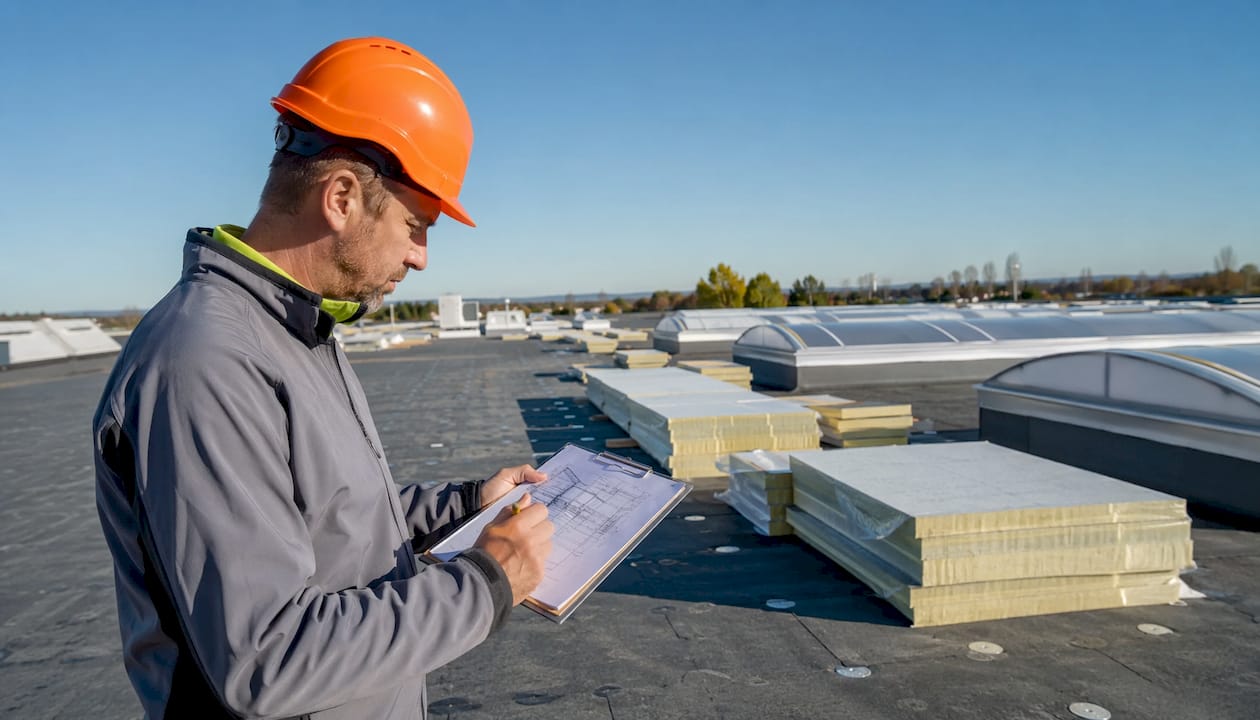
Commercial Roof Insulation: What Every Building Owner Should Know
Commercial roof insulation reduces heat transfer, helps control moisture, and supports energy-efficient performance across commercial roofing systems.
Roof insulation is the continuous thermal and moisture control layer that reduces energy use, protects your membrane, and extends the life of your entire roofing system. If you manage a commercial building in Tampa Bay or anywhere in Florida, getting insulation right is one of the highest-ROI decisions you can make.
Here’s what insulation actually does for your roof:
- Reduces heat transfer by creating a thermal barrier measured in R-value per inch
- Controls condensation and moisture inside the roof assembly, preventing mold and structural damage
- Protects the membrane from thermal cycling, reducing the expansion and contraction that cracks and splits membranes over time
- Supports drainage and slope correction through tapered insulation systems
- Improves fire performance and acoustics as secondary but code-relevant benefits
Standards like ASHRAE 90.1 set the minimum continuous insulation (ci) requirements by climate zone, and contractors like Hytzroofing integrate those requirements into every commercial specification from day one.
Table of Contents
- Why insulation matters more than most owners realize
- Which insulation types work best on commercial low-slope roofs?
- How insulation affects energy performance and code compliance
- Key design and installation decisions that determine performance
- What drives cost and how insulation affects your roof’s lifespan
- How to choose the right insulation for your building
- Why contractor credentials matter as much as material selection
- Key Takeaways
- Hytzroofing handles your commercial insulation from spec to warranty
- Useful sources and further reading
Why insulation matters more than most owners realize
The benefits of roofing insulation go well beyond comfort. They directly affect your operating budget, your roof’s service life, and your compliance status.
Energy savings are the most visible payoff. Proper insulation upgrades, paired with correct envelope detailing, can significantly reduce heating and cooling costs depending on your baseline and climate. For a commercial building running HVAC year-round in Florida’s heat, that range translates to real dollars every month.
Insulation also stabilizes roof deck and membrane temperatures, reducing the damaging expansion and contraction cycles that shorten membrane life. A roof that experiences fewer temperature swings simply lasts longer. Moisture control is equally critical. Insulation raises the dew point above the deck surface, which prevents condensation from forming inside the assembly. Left unchecked, that condensation feeds mold and quietly degrades structural components before you see any visible damage.
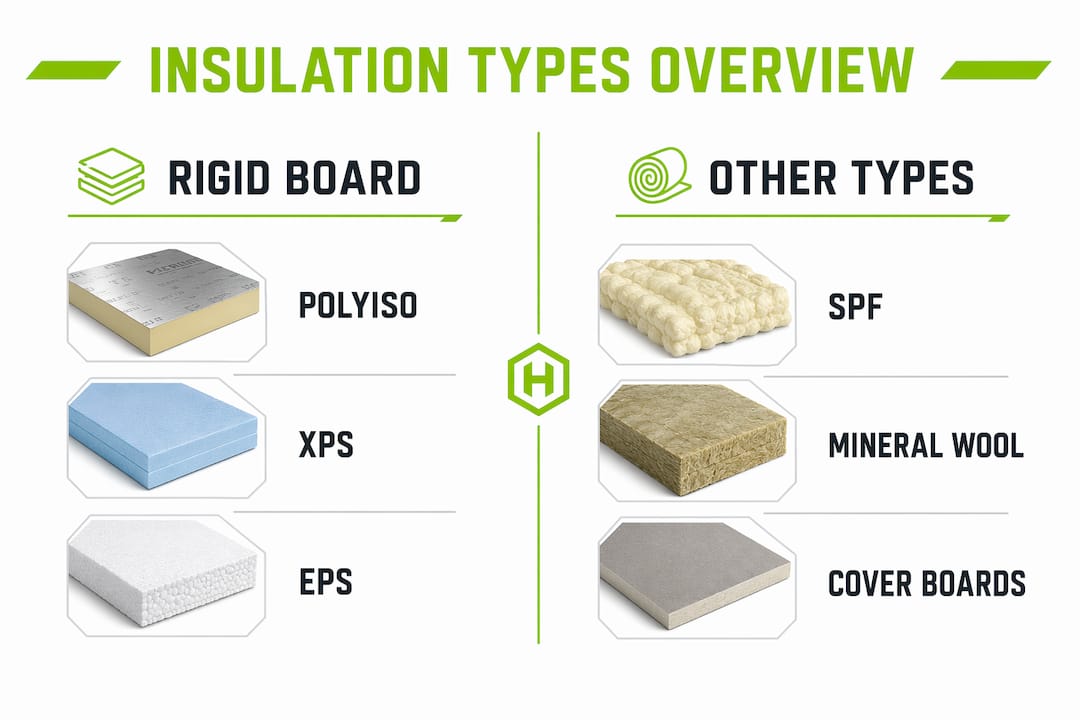
Fire performance and acoustics round out the picture. Certain insulation types, particularly mineral wool, offer Class A fire ratings that support code compliance and may reduce insurance premiums. Acoustic dampening is a secondary benefit that matters most for occupied buildings near airports, highways, or industrial zones.
Business impacts at a glance:
- Lower monthly HVAC operating costs
- Reduced membrane repair frequency
- Longer roof service life
- Better indoor air quality and mold prevention
- Improved fire and acoustic performance
Which insulation types work best on commercial low-slope roofs?
There are six material categories you’ll encounter when specifying insulation for a commercial flat or low-slope roof. Each has a different performance profile, and the right choice depends on your assembly, climate, and budget.
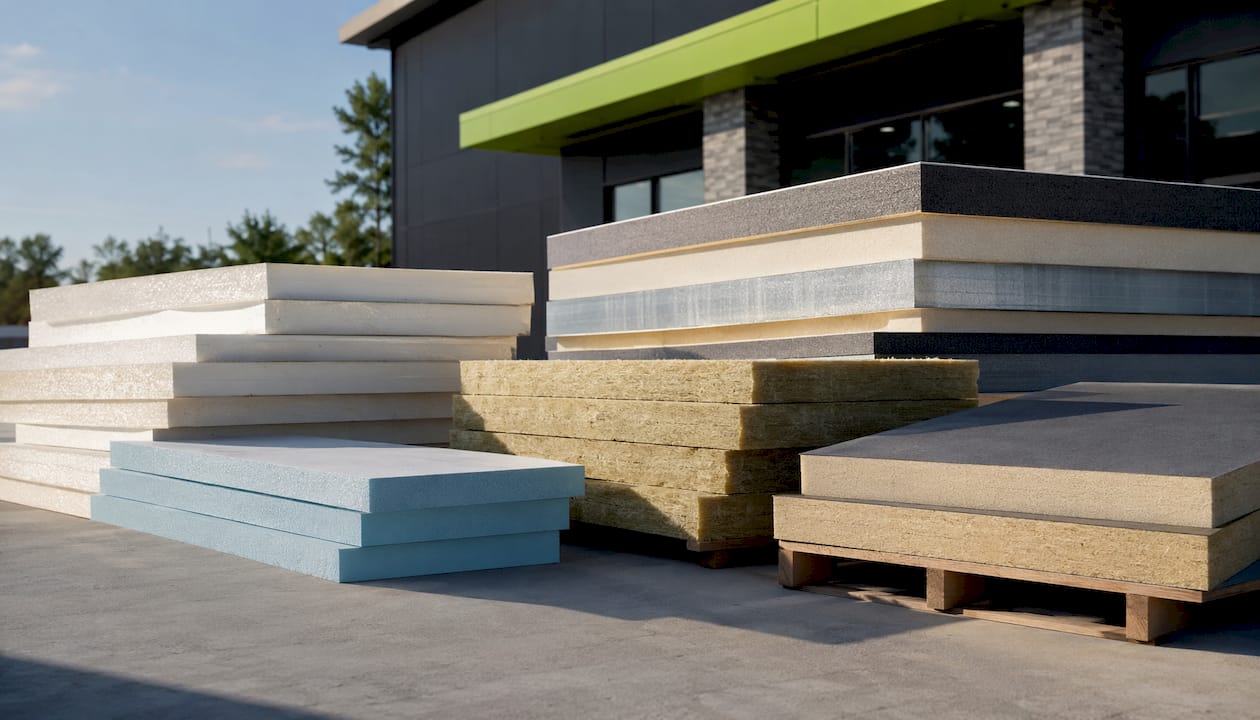
Comparison of common commercial insulation types
| Material | R-value per inch | Fire performance | Compressive strength | Moisture resistance | Typical application |
|---|---|---|---|---|---|
| Polyiso (ISO) | 6.0–6.8 | Requires cover board | Moderate–High | Moderate (face-sensitive) | New build, reroof, adhered |
| XPS | 3.6–5.0 | Requires cover board | High | Excellent | Ballasted, inverted/PMR, high-traffic |
| EPS | 3.6–4.2 | Requires cover board | Moderate | Good (open cell, dries) | New build, cost-sensitive projects |
| SPF (Spray Polyurethane Foam) | 6.0–6.8 | Requires protective coating | High (monolithic) | Excellent (closed cell) | Retrofit, irregular decks |
| Mineral wool | — | Class A, non-combustible | Moderate | Good | Fire-rated assemblies, metal decks |
| Cover boards (gypsum, perlite, wood fiber) | Low (not primary insulation) | Varies by type | High surface hardness | Varies | Over primary insulation in nearly all assemblies |
Polyisocyanurate (Polyiso) is the most widely used rigid board insulation for low-slope commercial roofs, and the R-value per inch explains why. At 6.0–6.8 per inch, you hit code-required R-values with less thickness than any other rigid board option. The tradeoff: Polyiso’s R-value drops in cold temperatures, and its facer can absorb moisture if exposed. A cover board is almost always required.
Extruded Polystyrene (XPS) delivers higher moisture resistance and compressive strength than EPS, making it the go-to for ballasted and inverted assemblies where the insulation sits above the membrane. R-value per inch runs 3.6–5.0, so you’ll need more thickness to match Polyiso’s performance.
Expanded Polystyrene (EPS) is the budget-friendly option. It performs well in dry climates and can actually dry out after moisture exposure, unlike XPS. Compressive strength is lower, so it’s less suited for high-traffic roofs without a cover board.
Sprayed Polyurethane Foam (SPF) is unique because it functions as both insulation and waterproofing in a single monolithic layer. It’s particularly useful for retrofit projects on irregular or complex decks where rigid boards are hard to fit. A protective coating is required over SPF to prevent UV degradation.
Mineral wool (stone wool) is the fire-resistance specialist. It’s non-combustible, which simplifies code compliance for assemblies near mechanical equipment or in fire-rated wall/roof junctions. Lower R-value per inch means more thickness, but the fire performance often justifies it.
Cover boards (gypsum fiberboard, perlite, high-density wood fiber) are not primary insulation. The National Roofing Contractors Association endorses cover boards in nearly all low-slope assemblies because they protect the primary insulation from membrane adhesive bleed-through, hail impact, and foot traffic damage. In Florida, gypsum fiberboard is common because it resists wind uplift and moisture.
Pro Tip: Tapered Polyiso systems can solve two problems at once: they build in the slope your flat roof needs for drainage while delivering the R-value your energy code requires. Pricing is higher than flat boards, but the drainage benefit often pays for itself by preventing ponding-related membrane failures.
How insulation affects energy performance and code compliance
Insulation is the primary tool for meeting ASHRAE 90.1 and IECC continuous insulation requirements. These codes set minimum R-values by climate zone and require that insulation be continuous across the roof deck, with no thermal bridging through fasteners or structural members.
Here’s what you need to know for compliance:
- Continuous insulation (ci) means the insulation layer runs uninterrupted across the entire roof deck. Fasteners and supports that penetrate it create thermal bridges that reduce effective R-value.
- Climate zone R-value targets vary. As a reference point, Climate Zone 5 assemblies often require continuous insulation around R-25 for low-slope roofs under current code editions.
- Reroof triggers matter. When you expose the deck during a full tear-off, current code editions typically require the new assembly to meet today’s minimum insulation values, not the values in place when the building was originally constructed. This is one of the most common budget surprises in commercial reroofing.
- Long-Term Thermal Resistance (LTTR) is the metric that accounts for insulation aging. Polyiso’s R-value degrades over time as blowing agents dissipate. Always request manufacturer LTTR data sheets, not just initial R-value claims, when specifying Polyiso.
Code note: Florida falls primarily in Climate Zones 1 and 2, which have lower minimum R-value requirements than northern states. That said, ASHRAE 90.1 compliance is still enforced on commercial projects, and a reroof that exposes the deck triggers a full upgrade to current minimums.
Key design and installation decisions that determine performance
Insulation must be designed as part of the roof assembly. Installer sequencing and detailing matter more than product selection alone. A high-performance Polyiso board installed over a wet deck without a vapor retarder will fail faster than a modest EPS system installed correctly.
Critical installation factors to specify and inspect:
- Vapor retarder placement: In hot-humid climates like Florida, vapor retarders typically go below the insulation to prevent warm, moist interior air from reaching the cold deck surface. Placement varies by climate zone and assembly type.
- Tapered insulation for drainage: Tapered systems build slope into the insulation layer itself, correcting drainage problems that are nearly impossible to fix after a new membrane is in place. This is the most cost-effective time to address chronic ponding.
- Attachment methods: Mechanically attached, fully adhered, and ballasted systems each have different wind uplift ratings, labor costs, and compatibility requirements. FM/UL approvals are assembly-specific.
- Cover boards: Required in most assemblies to protect the primary insulation from membrane adhesive, hail, and foot traffic.
- Moisture testing before reroof: Infrared scans and core cuts identify wet insulation before you install a new membrane over it.
Pro Tip: Never recover over wet insulation. Trapping moisture under a new membrane causes premature failure even when the new membrane looks perfect from the outside. If infrared scans find saturated sections, remove and replace them before the new membrane goes down. Your warranty depends on it.
New roof vs. reroof vs. retrofit: the choices change by scenario.

On a new build, you have full control over assembly design, vapor retarder placement, and tapered slope. On a reroof, the deck condition and existing insulation state drive decisions. A partial tear-off of wet sections followed by a recover is sometimes code-compliant and cost-effective. A full retrofit over an occupied building often favors SPF or a recover board system to minimize disruption.
For commercial roof inspections that include moisture scans, the data you get before specifying a reroof is worth far more than the inspection cost.
What drives cost and how insulation affects your roof’s lifespan
Installed cost for commercial insulation varies widely, and understanding the drivers helps you evaluate bids accurately.
Primary cost drivers:
- Insulation type and thickness (Polyiso costs more per board than EPS but requires less thickness)
- Tapered systems vs. flat boards (tapered adds cost but solves drainage)
- Cover board requirement (adds material and labor but protects the primary insulation)
- Wet insulation removal (tear-off and disposal of saturated boards is a significant line item)
- Attachment method (fully adhered costs more in labor than mechanically attached)
- Code-triggered upgrades (a full tear-off that exposes the deck requires meeting current R-value minimums)
Timeline ranges: A commercial overlay on a well-maintained existing assembly can be completed in days for a mid-size building. A full tear-off, insulation replacement, and new membrane installation on a large low-slope roof typically runs one to three weeks depending on size, weather, and crew availability. To understand what each line item on your bid represents, reading your estimate carefully before signing is worth the time.
Insulation’s effect on lifespan is direct. By reducing thermal cycling, it protects the membrane from the expansion and contraction stress that causes splits and seam failures. By controlling moisture, it prevents the deck degradation that turns a membrane replacement into a full structural repair. The combination of energy savings and reduced repair frequency means higher-performance insulation typically pays back its cost premium over a 10–15 year roof life.
Financing options and utility rebates can offset upfront costs. Many utilities offer incentives for commercial insulation upgrades, and third-party roofing loan options are available for building owners who want to spread the investment.
Financing and rebate sources to check:
- Your local utility’s commercial energy efficiency program
- ENERGY STAR commercial building incentives
- Florida-specific utility rebate programs (Duke Energy, FPL)
- Third-party roofing financing through your contractor
How to choose the right insulation for your building
Match insulation to your climate zone, roof assembly, moisture risk, and budgeted lifecycle cost. That single rule eliminates most bad decisions before they happen.
Owner decision checklist:
- Define your R-value target based on your climate zone and current ASHRAE 90.1 or IECC edition requirements.
- Inspect for wet insulation with infrared scanning before any reroof. Wet boards must be removed, not recovered.
- Decide on continuous vs. layered insulation. Two layers of staggered boards eliminate through-joints and thermal bridges better than a single thick layer.
- Choose material priorities. High R-value per inch? Polyiso. Maximum moisture resistance? XPS or closed-cell SPF. Fire rating priority? Mineral wool. Budget-sensitive new build? EPS with a cover board.
- Specify attachment and cover board requirements in your bid documents, not as afterthoughts.
- Request LTTR values and compressive strength data from manufacturer data sheets, not just marketing summaries.
Questions to ask every contractor you bid:
- What’s your experience with commercial flat and low-slope roofs in Florida’s climate?
- How do you detect and handle wet insulation before installing a new membrane?
- Which FM/UL-approved assemblies do you install, and can you provide the approval documentation?
- What manufacturer warranties cover the full assembly, including insulation and cover board?
- Can you provide references for similar commercial projects in the Tampa Bay area?
Sample specification items to require in bids:
- LTTR values for Polyiso (not just initial R-value)
- Compressive strength rating for insulation and cover board
- Manufacturer installation instructions as part of the submitted assembly
- FM or UL assembly number for the proposed system
Why contractor credentials matter as much as material selection
Contractor credentials materially reduce installation risk. The best insulation product installed incorrectly will fail. The right contractor brings manufacturer-backed training, assembly-specific knowledge, and warranty coverage that protects your investment.
Credentials to require from any commercial roofing contractor:
- GAF Master Elite® designation (fewer than 2% of contractors in North America qualify)
- GAF Certified™ Commercial Contractor status for flat and low-slope systems
- State contractor license (Florida: verify at the DBPR)
- FM/UL assembly approvals for the specific system being installed
- Full general liability and workers’ compensation insurance
- BBB accreditation and verifiable third-party ratings (Angi, Google)
- Manufacturer warranty documentation covering the full assembly
Hytzroofing holds the GAF Master Elite® designation, the GAF President’s Club Award (reserved for the top-performing Master Elite contractors), and GAF Certified™ Commercial Contractor status. The company carries Florida Contractor License #CCC1332551, BBB Accreditation with an A+ rating, and received the Angi Super Service Award 2025. You can review past commercial installations to verify the quality of work before you commit.
Documentation to request during procurement:
- Manufacturer assembly documents showing the full system (deck, vapor retarder, insulation, cover board, membrane)
- Warranty forms naming both the manufacturer and the installing contractor
- FM or UL approval numbers for the proposed assembly
- Contractor license number and insurance certificates
Key Takeaways
Insulation is the single most important component in a commercial roof assembly for energy performance, moisture control, and membrane longevity.
| Point | Details |
|---|---|
| Energy savings potential | Insulation upgrades can significantly reduce commercial heating and cooling costs when paired with proper envelope detailing. |
| Moisture control is critical | Wet insulation must be removed before reroofing; covering it traps moisture and shortens the new roof’s life. |
| Code compliance triggers upgrades | ASHRAE 90.1 and IECC require current minimum R-values when a deck is exposed during a full tear-off. |
| Material choice depends on priorities | Polyiso leads on R-value per inch (6.0–6.8); XPS leads on moisture resistance; mineral wool leads on fire performance. EPS provides 3.6–4.2 R-value per inch for budget-sensitive projects. |
| Hytzroofing for Tampa Bay | Hytzroofing holds GAF Master Elite® and GAF Certified™ Commercial Contractor status, serving commercial properties across Tampa Bay and Central Florida. |
Hytzroofing handles your commercial insulation from spec to warranty
Getting commercial insulation right means more than picking the right board. It means moisture diagnostics before the new membrane goes down, code-triggered R-value upgrades built into the spec, and a contractor whose warranty actually covers the full assembly.
Hytzroofing installs and specifies commercial roof insulation for flat, low-slope, and TPO systems across Tampa Bay and Central Florida. We handle moisture scans, tapered drainage systems, cover board integration, and code-compliance upgrades as part of every commercial project. Our credentials back every job:
- ✅ GAF Master Elite® Contractor (fewer than 2% of North American contractors qualify)
- ✅ GAF President’s Club Award recipient
- ✅ GAF Certified™ Commercial Contractor
- ✅ Angi Super Service Award 2025
- ✅ BBB Accredited, A+ rating
- ✅ Florida License #CCC1332551, fully insured
Financing options and insurance claim support are available for qualifying projects. Ready to find out what your commercial roof actually needs? Request a commercial roof inspection and get a full assessment, including moisture scans and an insulation evaluation, from a certified commercial contractor.
Useful sources and further reading
These are the primary references worth bookmarking when you’re specifying commercial insulation or reviewing a contractor’s proposed assembly:
- ASHRAE 90.1 via Commercial Building Authority — Covers continuous insulation requirements, climate zone R-value minimums, and reroof triggers that force code upgrades. Start here before reviewing any bid.
- IECC Commercial Energy Efficiency (ICC) — The model energy code adopted by most states; use this to verify minimum R-values for your jurisdiction and assembly type.
- ENERGY STAR Insulation Fact Sheet — Plain-language explanation of how insulation works, R-value basics, and moisture control principles applicable to commercial assemblies.
- CCPIA: Types of Low-Slope Roof Thermal Insulation — Detailed breakdown of rigid board types, cover boards, tapered systems, and SPF with installation context for inspectors and owners.
- CCPIA: Advantages and Disadvantages of Thermal Insulation in Commercial Roofing — Balanced look at performance tradeoffs across insulation categories; useful when comparing bids with different material specs.
- RCABC Roofing Practices Manual: Insulating the Roof — Technical reference for assembly sequencing, vapor retarder placement, and thermal bridging prevention; most relevant for design and specification review.
- Polyiso.org: Polyiso Benefits — Manufacturer association resource for Polyiso R-value data, LTTR testing methodology, and FM/UL approval guidance. Request LTTR data sheets from this source when evaluating Polyiso bids.
- Hytzroofing Commercial Roofing Tampa — Hytzroofing’s commercial services page covering TPO, flat roof, and metal systems in Tampa Bay and Central Florida, with credential verification and inspection request options.
When reviewing any insulation bid, always request the manufacturer’s LTTR data sheet and the FM or UL assembly approval number. Marketing R-values and real-world installed performance are not always the same number.
Recommended
- Why Commercial Roofs Need Inspections: A Property Manager’s Guide | Hytz Roofing
- Preventive Roof Maintenance: A Property Owner’s Guide | Hytz Roofing
- Roofing Loan Types Compared: Your 2026 Guide | Hytz Roofing
- Roof Financing Term Length: What Homeowners Need to Know | Hytz Roofing
Related Hytz Roofing Services
Frequently Asked Questions
- What is the best roofing system for a commercial flat roof in Florida?
- TPO (Thermoplastic Polyolefin) is the most popular commercial flat roofing system in Florida due to its heat-weld seams, UV reflectivity, and wind uplift resistance. For roofs with heavy foot traffic, EPDM rubber membrane is more durable. Modified bitumen is a cost-effective option for smaller commercial buildings.
- How long does a commercial flat roof last in Florida?
- A properly installed TPO or EPDM roof lasts 20–30 years in Florida's climate. Modified bitumen systems typically last 15–20 years. Regular maintenance — annual inspections, drain clearing, and prompt seam repairs — is critical to achieving maximum lifespan in Florida's UV-intense environment.
- How much does commercial roofing cost in Florida?
- Commercial roofing costs in Florida typically range from $5–$12 per square foot installed, depending on system type, roof size, and access conditions. TPO runs $6–$10/sq ft; EPDM $5–$9/sq ft; metal standing seam $12–$20/sq ft. Hytz Roofing provides free commercial roofing assessments.
- Does commercial roofing require a permit in Florida?
- Yes. All commercial roofing work in Florida requires a permit from the local building department. Hytz Roofing pulls all permits under our Florida License #CCC1332551 and coordinates required inspections.
- How do I know when my commercial roof needs replacement vs. repair?
- If repairs cost more than 25–30% of replacement cost, or if the roof has exceeded its design life, replacement is typically more economical. Hytz Roofing provides honest assessments — we will recommend repair when it is the right solution.