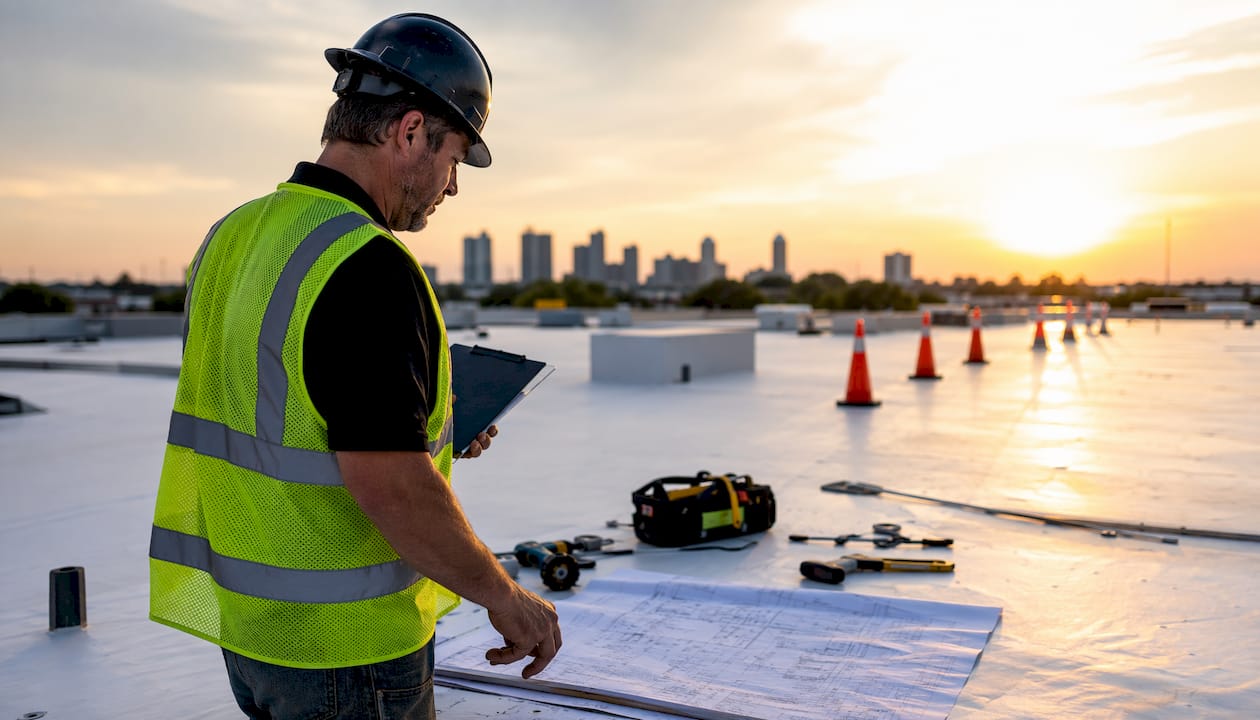
What Is a Roofing Membrane? Your Flat Roof Guide
Flat roof membrane refers to the continuous waterproof layer installed on low-slope roofs that protects the building from water infiltration.
A roofing membrane is a continuous, manufactured watertight layer designed specifically for flat and low-slope roofs. Unlike shingles, which shed water by overlapping, a membrane creates a single sealed surface that holds up even when water pools. The National Roofing Contractors Association (NRCA) and ASTM International both publish standards that govern how these systems are specified, tested, and installed. If you own a flat-roof building or are planning a re-roof, here’s what you need to know right away:
- EPDM (synthetic rubber) is flexible, economical, and available in 45–90 mil thicknesses — a solid all-around choice for most climates.
- TPO is the go-to for warm climates where energy costs matter; its white reflective surface cuts cooling loads.
- PVC leads on chemical and grease resistance, making it the standard pick for restaurants and food-processing facilities.
- BUR (built-up roofing) layers asphalt and felt for a time-tested, durable multi-ply system.
- Modified bitumen blends asphalt with polymers for improved flexibility and is common on residential low-slope roofs.
Hytzroofing holds GAF Certified™ Commercial Contractor status and installs flat and TPO systems across Tampa Bay and Central Florida, so the guidance here reflects real field experience, not just specs.
Table of Contents
- What are the common types of roofing membranes?
- How does a roofing membrane actually work?
- How do the main membrane types compare?
- What does a membrane roof cost, and how long will it last?
- Why does professional installation matter so much?
- How should you maintain and inspect a membrane roof?
- How do you choose the right membrane for your building?
- Which membrane should you choose for your specific situation?
- Key Takeaways
- What experienced contractors actually prioritize
- Get a certified flat-roof inspection or commercial quote from Hytzroofing
- Useful sources for deeper research
What are the common types of roofing membranes?
Flat roof membranes fall into two broad categories: single-ply (one layer of sheet material) and multi-ply (multiple layers built up on the roof). Within those, you have thermoset, thermoplastic, and modified bitumen options.
EPDM is a thermoset synthetic rubber made from ethylene, propylene, and a small amount of diene monomer. It comes in large sheets, typically 45–90 mil thick, and is bonded with adhesives or seam tape. It handles thermal movement well and has been a commercial staple since the 1960s.
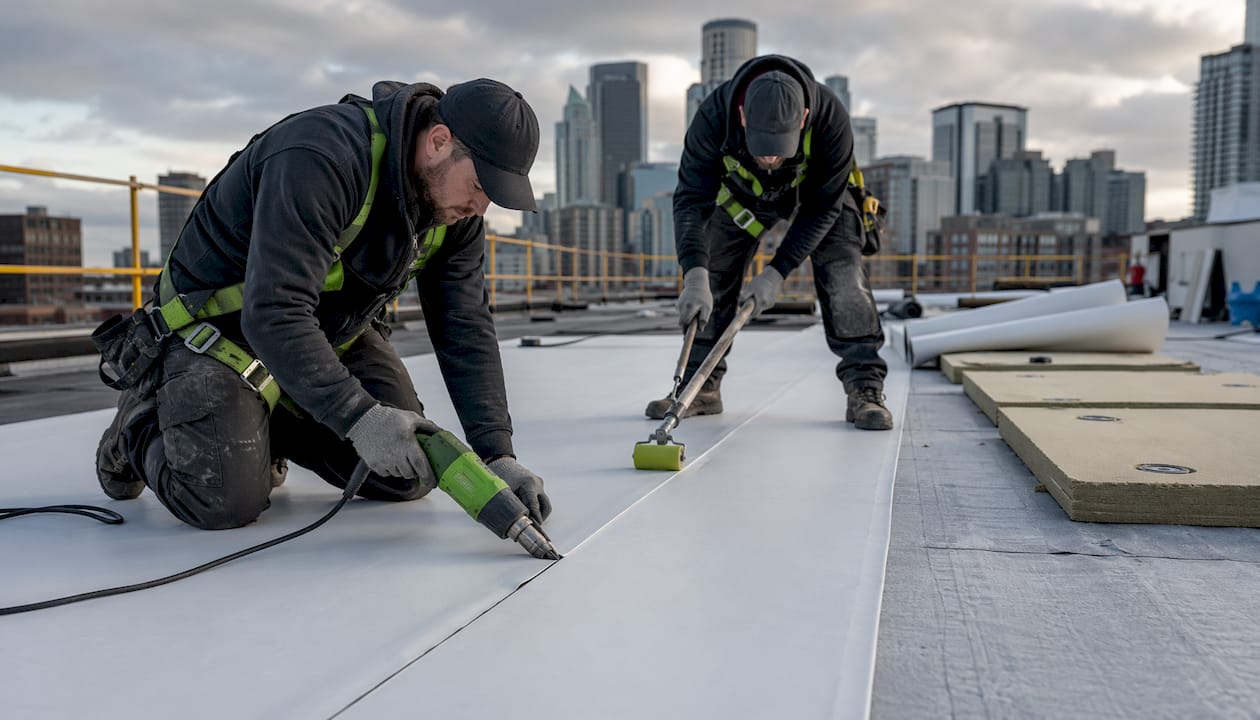
TPO (thermoplastic polyolefin) is a single-ply thermoplastic membrane with a bright white surface. Thermoplastic seams are heat-welded, creating joints that behave almost like one continuous sheet. TPO installs fast and costs less than PVC, which is why it has become the most widely specified single-ply option for commercial buildings.
PVC (polyvinyl chloride) is also thermoplastic and heat-welded, but its formulation gives it superior chemical and grease resistance compared to other single-ply membranes. It typically runs 1.2–2.0 mm thick and is available reinforced with polyester or fiberglass.
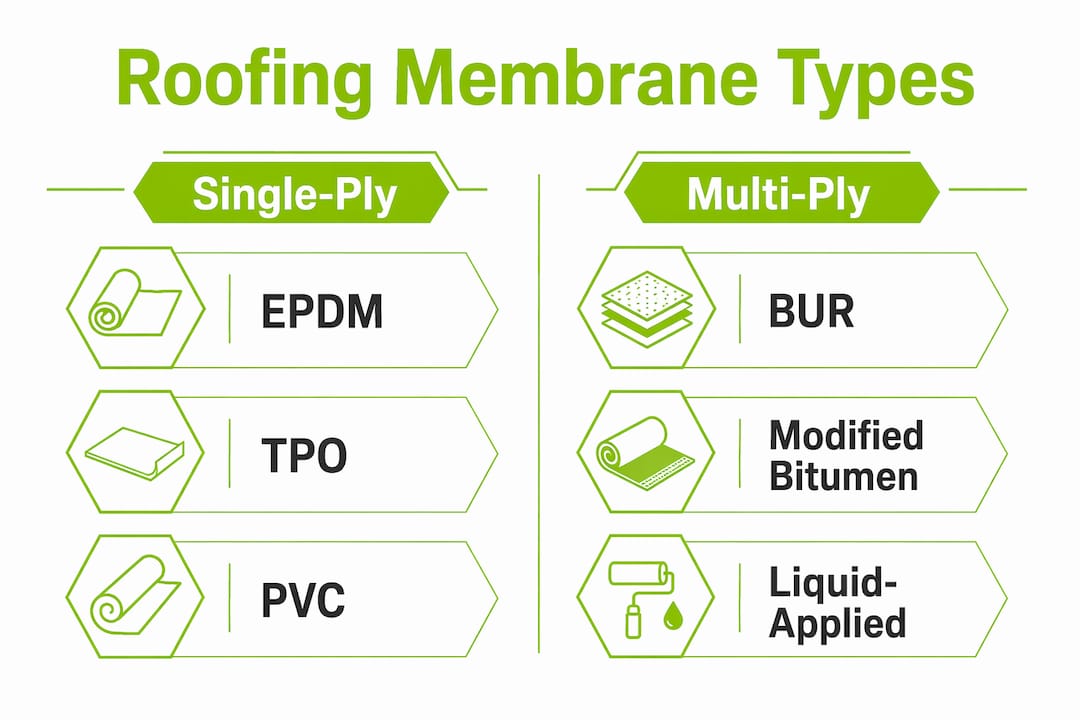
BUR (built-up roofing) is the original multi-ply system: alternating layers of bitumen and reinforcing felt, topped with gravel or a cap sheet. It’s heavy, proven, and still widely used on large commercial roofs where redundancy matters.
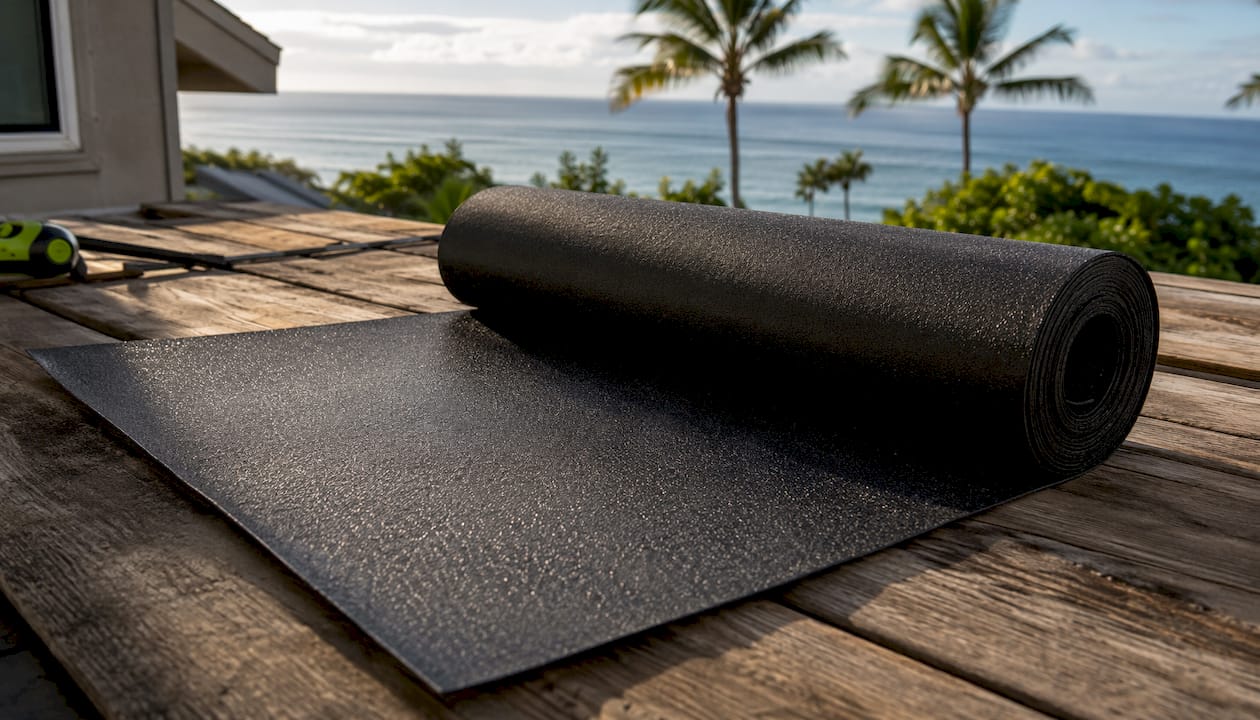
Modified bitumen takes asphalt and blends in polymers (most commonly APP or SBS) to improve flexibility and temperature resistance. It comes in rolls and is installed by torch, hot-mop, cold adhesive, or self-adhering methods.
Beyond these five, liquid-applied membranes are worth knowing. They’re applied as a coating that cures into a seamless film, which makes them ideal for complex roof geometries or re-roofing over existing surfaces where tear-off isn’t practical.
How does a roofing membrane actually work?
A membrane roof works on a fundamentally different principle than a shingle roof. Shingles shed water by gravity and overlap. A membrane creates a continuous waterproof surface designed to hold up even when water sits on it, which is exactly what happens on a low-slope roof after rain.
Here’s what a complete membrane roof system includes:
- Roof deck: The structural base (concrete, steel, or wood) that everything else attaches to.
- Insulation layer: Rigid foam board (polyisocyanurate is common) that provides thermal performance and creates a smooth substrate.
- Membrane: The waterproof layer itself, either single-ply sheet, multi-ply built-up, or liquid-applied.
- Seams: Where membrane sheets overlap and are bonded. On thermoplastics, seams are heat-welded; on thermosets like EPDM, they’re taped or glued.
- Flashings: Metal or membrane details at walls, curbs, pipes, and parapets that seal transitions where the flat field meets a vertical surface.
- Drains and scuppers: Outlets that remove standing water; their condition directly affects how long the membrane lasts.
A simple cross-section from bottom to top looks like this: structural deck → insulation board → membrane field → seam laps → flashing at parapet → drain at low point. Every one of those layers has to be right. A perfectly installed membrane fails early if the flashing at a rooftop HVAC curb is sloppy.
How do the main membrane types compare?
| Material | Best for / common uses | Typical lifespan | Typical installed cost (ballpark) | Seam type | Reflectivity | Chemical/grease resistance | Ease of repair | Warranty availability |
|---|---|---|---|---|---|---|---|---|
| EPDM | Warehouses, low-slope residential, cold climates | 20 years | $4–$8/sq ft | Tape or adhesive | Low (black); white available | Moderate | Easy (patch kits) | Yes, manufacturer + system |
| TPO | Warm-climate commercial, energy-conscious buildings | 15–25 years | $5–$9/sq ft | Heat-welded | High (white) | Moderate | Moderate | Yes, manufacturer + system |
| PVC | Restaurants, airports, chemical exposure | 20 years | $6–$9 per square foot | Heat-welded | High (white) | Excellent | Moderate | Yes, manufacturer + system |
| BUR | Large commercial, high-traffic roofs | 20 years | $5–$9 per square foot | Hot-mopped layers | Low (gravel) | Good | More complex | Yes, manufacturer |
| Modified Bitumen | Residential low-slope, re-roofing | 15 years | $4–$8/sq ft | Torch, cold adhesive, or self-adhering | Moderate (granule cap) | Moderate | Moderate | Yes, manufacturer |
Quick best-for callouts:
- EPDM suits warehouses and cold-climate buildings where thermal movement is a concern and budget is tight. Its flexibility at low temperatures is hard to beat.
- TPO is the smart pick for Florida and other warm-climate commercial buildings. A reflective white surface reduces heat absorption and can lower cooling costs, which adds up fast on a large commercial roof.
- PVC is the standard for any roof with grease exhaust, cooking fumes, or chemical exposure. Restaurants, food processing plants, and airport terminals all rely on it for this reason.
- BUR works well on large, flat commercial roofs where redundancy and foot-traffic durability matter more than light weight.
- Modified bitumen is a practical choice for residential low-slope additions and re-roofing projects where compatibility with existing asphalt products is an advantage.
What does a membrane roof cost, and how long will it last?
Lifespan and cost vary by material, installation quality, climate, and maintenance. Here’s a realistic reference:
| Material | Typical lifespan | Ballpark installed cost |
|---|---|---|
| EPDM | 20 years | $4–$8 per sq ft |
| TPO | 15–25 years | $5–$9 per sq ft |
| PVC | 20 years | $6–$9 per square foot |
| BUR | 20 years | $5–$9 per square foot |
| Modified Bitumen | 15 years | $4–$8 per sq ft |
These ranges are ballpark figures. Actual costs in Tampa Bay and Central Florida depend on roof size, access, tear-off requirements, insulation thickness, and current material prices. The factors that shorten a membrane’s life fastest are:
- Neglected drains causing chronic ponding
- UV degradation on uncoated black EPDM in high-sun climates
- Poor seam or flashing work from the original installation
- Incompatible overlay materials applied without a substrate inspection
If you’re budgeting for a re-roof, financing options can spread the cost without delaying a system that’s already past its service life. A certified inspection gives you an accurate scope and a defensible number before you commit to a contract.
Why does professional installation matter so much?
Correct installation and strict adherence to manufacturer specs are the single biggest predictors of how long a membrane system lasts. That’s not a marketing claim. Poor seam management and incorrect attachment are the leading causes of early failure and moisture intrusion, and most warranty claims trace back to installation errors rather than material defects.
Common failure causes to know before you hire anyone:
- Seam failure: Adhesive seams on EPDM that weren’t properly primed or pressed; heat-weld seams on TPO/PVC that were under-welded or over-welded.
- Poor flashing details: Gaps or voids at parapet walls, HVAC curbs, and pipe penetrations are where most leaks start.
- Ponding water: A roof that holds water for more than 48 hours after rain is either improperly sloped or has blocked drains.
- Improper attachment: Mechanically fastened membranes with wrong fastener spacing can blow off in high winds.
- Substrate problems: Installing over a wet, deteriorated, or structurally compromised deck voids most warranties and accelerates failure.
- Incompatible overlays: Applying a new membrane over an existing one without a professional substrate inspection can trap moisture and create adhesion failures.
Pro Tip: Ask any contractor bidding your job to show you how they test seam integrity. On thermoplastic membranes, a probe test on heat-welded laps is standard. On EPDM, check that seam tape is fully rolled and adhered with no fishmouths. If a contractor can’t explain their seam QC process, that’s a red flag.
Red flag to watch for: A bid that skips a pre-installation inspection of the existing deck, or a contractor who can’t provide manufacturer certification for the system they’re proposing. Manufacturer warranties on commercial systems typically require certified installers. If the installer isn’t certified, the warranty isn’t valid.
How should you maintain and inspect a membrane roof?
Membrane roofs are low-maintenance compared to shingles, but “low maintenance” doesn’t mean “no maintenance.” A simple routine keeps small problems from becoming expensive ones.
Twice-a-year inspection checklist (spring and fall, plus after any major storm):
- Walk the roof and check all seams for lifting edges, bubbles, or separation.
- Inspect flashings at every wall, curb, and penetration for gaps or peeling.
- Clear all drains and scuppers of debris; confirm water flows freely.
- Look for standing water or low spots that suggest ponding.
- Check for punctures, cuts, or surface blistering in the membrane field.
- Verify that any rooftop equipment hasn’t shifted and damaged the membrane around its base.
What owners can safely do themselves:
- Clear roof drains and gutters of leaves and debris.
- Remove standing water with a squeegee or pump after heavy rain.
- Document any visible damage with photos before calling a contractor.
When to call a professional:
- Any seam that has lifted or separated.
- Flashing that has pulled away from a wall or curb.
- Blistering or bubbling larger than a few inches.
- Any sign of interior water intrusion.
For routine preventive maintenance on commercial membranes, a documented inspection by a certified contractor also protects your warranty. Most manufacturer warranties require proof of regular professional inspections to remain valid.
How do you choose the right membrane for your building?
Work through these questions before you talk to a contractor. The answers narrow your options fast.
Step-by-step decision checklist:
- What’s your climate? High UV and heat (Florida, Southwest) favor reflective TPO or PVC. Cold climates with freeze-thaw cycles favor EPDM’s flexibility.
- Is there chemical or grease exposure? Any roof near cooking exhaust or industrial chemicals needs PVC.
- What’s the roof’s current condition? If you’re overlaying, you need a substrate inspection first.
- What’s your budget range? EPDM and modified bitumen are typically the most cost-effective entry points; PVC is the premium single-ply option.
- How long do you need it to last? If you’re planning to hold the building 25+ years, prioritize systems with strong manufacturer warranties and certified installation.
- What does the building use require? High foot traffic favors BUR or a protected membrane assembly.
Questions to ask every contractor:
- What seam method do you use, and how do you test seam integrity?
- Are you certified by the membrane manufacturer for this specific system?
- What warranty does the manufacturer offer, and what does it require of the installer?
- Will you provide a written inspection report of the existing substrate before work begins?
- What attachment method are you specifying, and why?
The single most important question: “Can you show me your manufacturer certification for this system?” A contractor who hesitates or deflects on that question is telling you something important. Certified installation is what activates the manufacturer warranty. Without it, you have a roof but no warranty.
For help vetting contractors in Tampa Bay, Hytzroofing’s guide on choosing a roofing contractor walks through exactly what to look for.
Which membrane should you choose for your specific situation?
Here are direct picks for the most common scenarios:
- Restaurant or food-service building: PVC, every time. Grease from exhaust fans degrades EPDM and TPO over time. PVC’s chemical resistance is purpose-built for this exposure.
- ☀️ Warm-climate commercial office or retail (Florida, Texas, Arizona): TPO is the practical choice. The white reflective surface reduces cooling loads, and heat-welded seams hold up well in high-UV environments.
- Cold-climate warehouse or industrial building: EPDM handles freeze-thaw cycling better than most alternatives. Its flexibility at low temperatures reduces stress on seams and flashings.
- Residential low-slope addition or flat-roof home: Modified bitumen is a proven, cost-effective option that’s compatible with existing asphalt systems and straightforward to repair.
- Budget-constrained re-roof over existing membrane: A liquid-applied membrane can go over the existing surface without tear-off, saving removal costs. Substrate condition must be verified first.
Pro Tip: Before any overlay or re-roof, have a certified contractor probe the existing membrane for moisture with an infrared scan or nuclear gauge. Wet insulation trapped under a new membrane accelerates failure and voids most warranties. This one step can save you from doing the job twice.
For commercial flat-roof installation in Tampa Bay, Hytzroofing’s GAF Certified™ Commercial Contractor status means the manufacturer warranty is fully activated on every system we install.
Key Takeaways
The right membrane for a flat or low-slope roof depends on climate, building use, and installation quality, with seam integrity being the single factor most likely to determine long-term success.
| Point | Details |
|---|---|
| Membrane types and their strengths | EPDM suits cold climates and tight budgets; TPO leads on reflectivity; PVC is best where chemical exposure exists. |
| Seam method matters most | Thermoplastic heat-welded seams (TPO, PVC) are stronger than adhesive seams; most warranty claims trace to seam failures. |
| EPDM thickness range | EPDM is available in 45–90 mil thicknesses; thicker sheets offer better puncture resistance and longevity. |
| Inspect twice a year | Check seams, flashings, and drains every spring and fall, plus after any major storm, to catch problems early. |
| Hytzroofing for certified installation | Hytzroofing holds GAF Certified™ Commercial Contractor status, activating full manufacturer warranties on flat and TPO systems in Tampa Bay. |
What experienced contractors actually prioritize
The biggest mistake property owners make is treating membrane selection as the main decision. It isn’t. The material matters, but the installation is what determines whether you get 15 years or 30 years out of a system. Seam quality and installer skill matter more than the nominal material choice. That’s a consistent finding across the industry, and it matches what we see in the field.
The second mistake is skipping the pre-installation inspection. Overlaying a new membrane over a wet or deteriorated deck traps moisture, creates adhesion problems, and voids the warranty. A 30-minute infrared scan before the job starts can prevent a complete system failure five years in.
When you’re evaluating a contractor, the credentials to verify are straightforward: manufacturer certification for the specific system being installed, a valid Florida contractor license, and proof of general liability and workers’ compensation coverage. For commercial flat-roof work in Florida, GAF Master Elite® and GAF Certified™ Commercial Contractor designations are meaningful signals. Fewer than 2% of roofing contractors in North America hold Master Elite status. Hytzroofing holds both, along with Florida Contractor License #CCC1332551, BBB Accreditation with an A+ rating, and the GAF President’s Club Award. Those credentials aren’t just marketing. They’re the proof that the manufacturer warranty will actually be honored.
Get a certified flat-roof inspection or commercial quote from Hytzroofing
If you’re managing a flat-roof building in Tampa Bay or Central Florida, the smartest next step is a certified inspection before you commit to any material or contractor. A professional inspection documents the substrate condition, identifies failure points, and gives you an accurate scope for insurance, financing, or a re-roof bid.
Hytzroofing offers commercial TPO and flat-roof installation, certified roof inspections, emergency repairs, and flexible financing options across Tampa Bay and Central Florida. We hold GAF Master Elite® Contractor status, GAF Certified™ Commercial Contractor designation, the GAF President’s Club Award, and BBB Accreditation with an A+ rating. Every job is backed by Florida Contractor License #CCC1332551 and full insurance coverage.
Ready to get started? Request a commercial roofing estimate today and get a clear, honest assessment from a team that stands behind its work.
Useful sources for deeper research
These are the authoritative references behind the technical claims in this article. Use them to verify specs, check standards, or dig into manufacturer guidance.
- NRCA (National Roofing Contractors Association) — The industry’s primary technical authority for roofing standards, installation guidelines, and best practices. Best for: property owners and contractors verifying installation specs.
- U.S. Department of Energy: Cool Roofs — Explains how reflective roofing membranes (TPO, PVC) reduce heat absorption and lower cooling costs. Best for: owners evaluating energy performance and lifecycle cost.
- GSA: Types of Flat Roofing and Factors Affecting Deterioration — Federal-level overview of flat-roof system types and common deterioration causes. Best for: technical readers and property managers.
- EPA: Green Roofs — Covers sustainable roofing assemblies and how membrane systems integrate with green-roof designs. Best for: owners considering environmental impact and stormwater management.
- Wikipedia: Membrane Roofing — Broad technical overview of membrane types, history, and material categories. Best for: readers who want a quick technical reference.
- Roof Coatings Manufacturers Association (RCMA) — Technical note on roof coatings and their interaction with membrane systems. Best for: owners considering coatings as a maintenance or restoration option.
Recommended
- Roofing Loan Types Compared: Your 2026 Guide | Hytz Roofing
- What Is a Roofing Scope of Work? Your Clear Guide | Hytz Roofing
- Choose the Best Roofing Contractor in Tampa Bay, Florida: Your Guide | Hytz Roofing
- Roof Repair in Tampa Bay: Your Guide to Florida’s Elements | Hytz Roofing
Related Hytz Roofing Services
Frequently Asked Questions
- What is the best roofing system for a commercial flat roof in Florida?
- TPO (Thermoplastic Polyolefin) is the most popular commercial flat roofing system in Florida due to its heat-weld seams, UV reflectivity, and wind uplift resistance. For roofs with heavy foot traffic, EPDM rubber membrane is more durable. Modified bitumen is a cost-effective option for smaller commercial buildings.
- How long does a commercial flat roof last in Florida?
- A properly installed TPO or EPDM roof lasts 20–30 years in Florida's climate. Modified bitumen systems typically last 15–20 years. Regular maintenance — annual inspections, drain clearing, and prompt seam repairs — is critical to achieving maximum lifespan in Florida's UV-intense environment.
- How much does commercial roofing cost in Florida?
- Commercial roofing costs in Florida typically range from $5–$12 per square foot installed, depending on system type, roof size, and access conditions. TPO runs $6–$10/sq ft; EPDM $5–$9/sq ft; metal standing seam $12–$20/sq ft. Hytz Roofing provides free commercial roofing assessments.
- Does commercial roofing require a permit in Florida?
- Yes. All commercial roofing work in Florida requires a permit from the local building department. Hytz Roofing pulls all permits under our Florida License #CCC1332551 and coordinates required inspections.
- How do I know when my commercial roof needs replacement vs. repair?
- If repairs cost more than 25–30% of replacement cost, or if the roof has exceeded its design life, replacement is typically more economical. Hytz Roofing provides honest assessments — we will recommend repair when it is the right solution.