
Top Home Improvement Loans for Roofing: 2026 Guide
Home Improvement Loans for Roofing outline funding options, eligibility, timelines, and tips to compare rates and terms for planning a roof project in 2026.
For most homeowners replacing or repairing a roof, a home equity product or a competitive unsecured personal loan is the fastest path to low all-in cost. If you have significant equity in your home, a HELOC or home equity loan typically delivers the lowest APR. No equity? A personal loan from LightStream or SoFi can fund in 1–3 days with no appraisal required. With the average roof replacement running about the typical cost range. Most homeowners finance a moderate amount, and the difference between the right and wrong loan can cost significantly in interest.
Here is the quick-reference shortlist:
- LightStream — Best for strong-credit borrowers who need same-week funding on larger projects.
- SoFi — Best for fixed monthly payments and fast online prequalification.
- Upgrade — Best for fair-to-good credit borrowers who want a transparent online process.
- Upstart — Best for borrowers with shorter credit histories but solid income.
- Best Egg — Best for mid-size roofing projects with a simple unsecured loan.
- First Tech Federal Credit Union — Best for credit union members who qualify for preferential rates.
- Happen Bank — Best for rate-shopping an additional marketplace option.
- Hytzroofing — Best for Tampa Bay homeowners who want one point of contact for inspection, insurance claims, and contractor-arranged financing.
Three immediate next steps:
- Get a certified contractor inspection and written estimate before applying for any loan.
- Run a soft-rate prequalification check (no hard credit pull) with 2–3 lenders to compare real APRs.
- Calculate total financed cost, not just the monthly payment, including all fees and interest.
Quick note: If your roof damage was caused by wind, hail, or a storm, file an insurance claim first. A certified inspection and documented damage often mean you only pay your deductible.
Table of Contents
- Which lenders offer the top home improvement loans for roofing?
- Lender profiles: which option fits your situation?
- How do you choose the right roofing loan for your situation?
- What loan types actually work for a roofing project?
- What does a $10,000 roofing loan actually cost you?
- How we selected and rated these lenders
- Why Hytzroofing is worth considering as your financing partner
- Key Takeaways
- The financing decision most homeowners get wrong
- Hytzroofing: get your roof financed and installed in Tampa Bay
- Useful sources and further reading
- FAQ
Which lenders offer the top home improvement loans for roofing?
Advertiser disclosure: Hytzroofing may receive compensation from some lenders listed. This does not influence our editorial recommendations. APR ranges reflect recent market benchmarks and will vary by borrower credit profile. Always prequalify directly with a lender to confirm current rates.
| Lender / Option | Best For | Est. APR Range | Loan Amount | Min. Credit Score | Loan Type | Funding Speed | Fees | Roofing Notes |
|---|---|---|---|---|---|---|---|---|
| Hytzroofing | Bundled inspection, insurance claims + financing | Varies by partner | $5,000+ | Varies | Contractor financing | 1–5 days (post-estimate) | Varies by partner | GAF Master Elite®; single point of contact |
| LightStream | Strong credit, large projects | ~7.49%–25.49% | $5,000–$100,000 | ~660+ | Unsecured personal | Same day–2 days | No origination fee | No appraisal; fast for urgent repairs |
| SoFi | Fixed payments, member perks | ~8.99%–29.99% | $5,000–$100,000 | ~650+ | Unsecured personal | 1–3 days | No origination fee | Fixed monthly payment; easy prequalification |
| Upgrade | Fair-to-good credit | ~9.99%–35.99% | $1,000–$50,000 | ~580+ | Unsecured personal | 1–4 days | Origination fee 1.85%–9.99% | Transparent disclosures; accessible credit range |
| Upstart | Short credit history, solid income | ~7.40%–35.99% | $1,000–$50,000 | ~300+ | Unsecured personal | 1–3 days | Origination fee up to 12% | Alt. underwriting considers employment/education |
| Best Egg | Mid-size roofing projects | ~7.99%–35.99% | $2,000–$50,000 | ~600+ | Unsecured personal | 1–3 days | Origination fee 0.99%–9.99% | Simple online process; wide term availability |
| First Tech | Credit union members | ~8%–18% (est.) | Varies | ~620+ | Unsecured personal / personal loan | 2–7 days | Low/no origination | Member-focused; potentially lower rates |
| Happen Bank | Rate-shopping, marketplace comparison | Varies | Varies | Varies | Personal / marketplace | Varies | Varies | Alternative for additional rate quotes |
| HELOC / Home Equity Loan | Homeowners with 15%+ equity | 7.5%–10.5% | $10,000–$500,000+ | ~620+ | Secured (home equity) | 2–6 weeks | Closing costs apply | Lowest APR option; not for emergencies |
| FHA Title I | No-equity / lower-credit borrowers | ~6%–11% | Up to $25,000 | ~580+ | Government-insured | 2–5 weeks | Varies by lender | Underused; good for no-equity situations |
Two columns to watch first:
- Funding speed if you have an active leak or storm damage.
- APR range if you are planning a full replacement and want to minimize long-term cost.
Lender profiles: which option fits your situation?
LightStream
LightStream is a strong first call for homeowners with good-to-excellent credit who need a larger loan fast. Loan amounts go up to $100,000 with no origination fee, and funding can arrive the same day you apply if you complete the process before a daily cutoff. The trade-off: you need solid credit to access the best rates, and there is no soft-pull prequalification on the main site, so you will trigger a hard inquiry when you apply.
- Best for: Replacement projects over $15,000 where speed and rate matter.
- APR shape: Rates start competitively for excellent credit; climb steeply for fair credit.
- Red flag: No prequalification means a hard pull before you see your actual rate.
SoFi
SoFi’s unsecured home improvement loan offers fixed monthly payments, no origination fee, and a soft-pull prequalification that lets you check your rate without affecting your credit score. Member benefits include unemployment protection and financial planning access. Funding typically arrives in 1–3 days.
- Best for: Borrowers who want predictable payments and a quick online experience.
- Limitation: Loan amounts cap at $100,000, which covers most residential roofs comfortably.
Upgrade
Upgrade opens the door for borrowers in the fair-to-good credit range (roughly 580+) who might not qualify for LightStream’s best rates. The application is fully online, disclosures are clear, and you can check your rate with a soft pull. Origination fees of 1.85%–9.99% are worth factoring into your total cost calculation before signing.
- Best for: Mid-range credit borrowers who want a straightforward digital process.
- Watch: Origination fees can add meaningful cost on smaller loan amounts.
Upstart
Upstart’s underwriting model looks beyond your credit score. It factors in education, employment history, and income, which can help borrowers with shorter credit files get approved at better rates than traditional models would offer. Origination fees can reach up to 12%, so run the total-cost math carefully.
- Best for: Recent graduates or career-changers with solid income but a thin credit file.
- Red flag: High origination fees on some offers; always compare the APR, not just the rate.
Best Egg
Best Egg keeps things simple: a fully online application, loan amounts from $2,000 to $50,000, and funding in 1–3 days. It suits homeowners financing a mid-size repair or partial replacement without needing a large loan. Origination fees range from 0.99% to 9.99%.
- Best for: Repairs or partial replacements in the $5,000–$20,000 range.
First Tech Federal Credit Union
First Tech is a credit union, which means membership is required, but qualifying members often access lower rates and more flexible terms than they would find at a traditional bank. If you are already a member or eligible to join, it is worth a rate check before committing to a marketplace lender.
- Best for: Existing members or those who qualify and want a relationship-based lending experience.
Happen Bank
Happen Bank appears in home improvement loan comparisons as an additional marketplace option. Its primary value is as a rate-shopping stop: pull a quote alongside your other offers to confirm you are getting a competitive deal. Specific terms are not publicly standardized, so treat it as one data point in your comparison, not a primary recommendation.

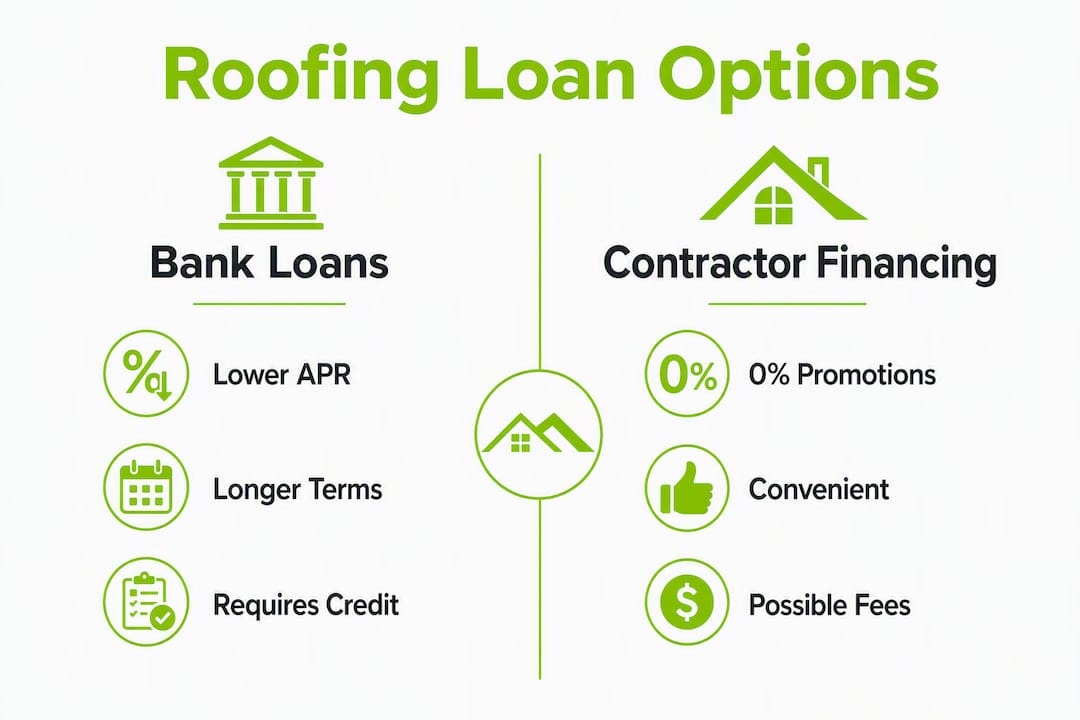
Contractor financing (0% promos)
Contractor-arranged financing through programs like GreenSky or Service Finance can look attractive at 0% APR. The catch: dealer fees of 8%–12% are often baked into the project cost, which raises your effective cost if you do not pay off the balance before the promotional period ends. Deferred-interest structures mean a retroactive interest charge hits if even one dollar remains at the promo’s expiration.
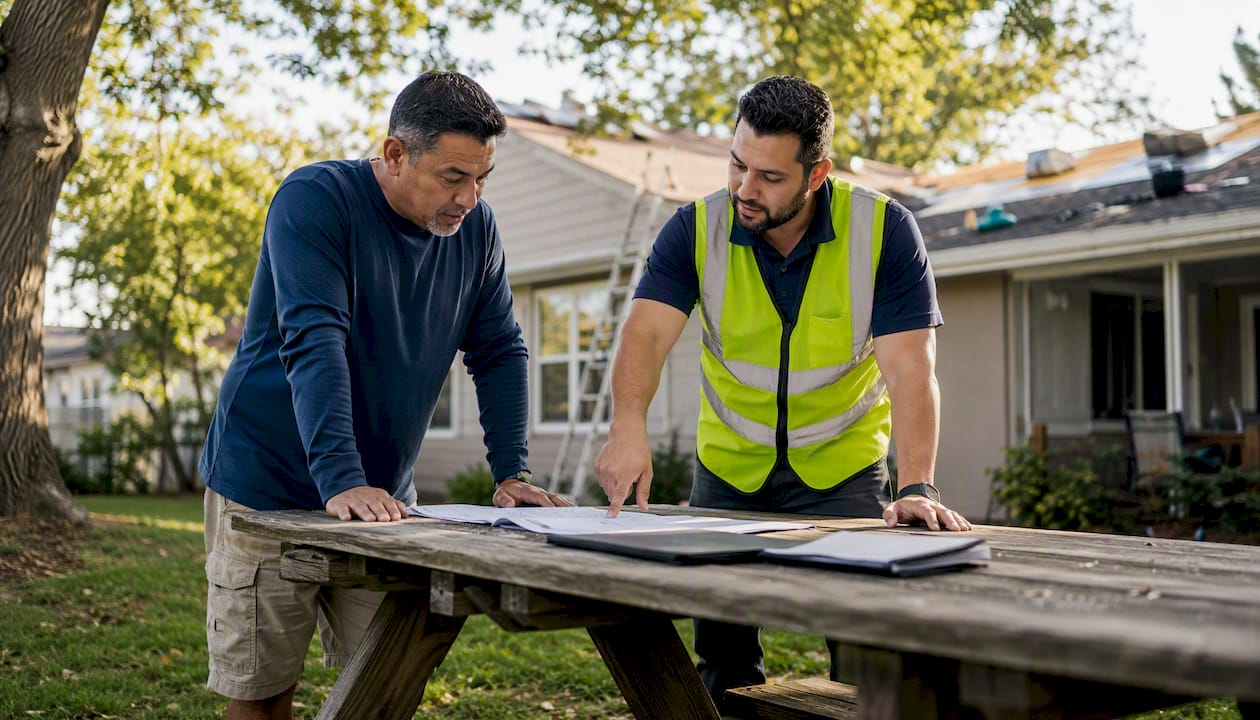
Pro Tip: Before signing a contractor financing agreement, ask the contractor to show you the project price without the financing program applied. That gap is the dealer fee.
Check your personal loan options for roofing before defaulting to a contractor promo, especially for projects under $15,000.
How do you choose the right roofing loan for your situation?
Decision checklist by homeowner profile
** Emergency repair (active leak, storm damage):**
- Check insurance first. Wind, hail, or storm damage may be covered. Document the damage and file a claim before financing anything.
- If you need funds fast and insurance will not cover it, an unsecured personal loan (LightStream, SoFi, Best Egg) funds in 1–3 days without an appraisal.
- Avoid HELOC or home equity loans for emergencies. Approval timelines run 2–6 weeks.
** Moderate replacement ($8,000–$20,000, planned):**
- Check your equity. If you have 15%+ equity, a home equity loan or HELOC at 7.5%–10.5% APR will likely cost less over time than a personal loan.
- If equity is limited, compare SoFi, LightStream, and Upgrade with soft-pull prequalifications.
- Factor in origination fees. A 5% origination fee on a $15,000 loan adds $750 to your cost upfront.
Large replacement with equity ($25,000+):
- A home equity loan gives you a fixed rate and a predictable payoff schedule.
- A HELOC offers flexibility if the project scope might change.
- Consider FHA Title I (up to $25,000) if your equity is limited but your credit is reasonable.
Questions to ask every lender or contractor
- What is the total amount I will repay, including all fees and interest?
- Is there a prepayment penalty if I pay off early?
- Is this a deferred-interest structure, or true 0% APR?
- What happens to my rate if I miss a payment?
- Will a lien be placed on my property?
- How long until funds are available after approval?
Red flags to watch for
| Red Flag | What It Means |
|---|---|
| “0% APR” with no mention of dealer fees | Fees are likely baked into the project price (8%–12%) |
| Deferred-interest language | Full retroactive interest charges if balance remains at promo end |
| Prepayment penalty clause | You pay extra for paying off early |
| Lender-placed insurance requirement | Adds cost; check if your homeowners policy already covers it |
| Pressure to sign same day | Legitimate lenders give you time to review |
| Vague lien notice | Understand whether a lien is placed on your home before signing |
For a deeper look at how bank loans and contractor loans differ, including lien implications, that guide covers the key distinctions clearly.
Typical approval-to-funding timelines
| Loan Type | Typical Timeline |
|---|---|
| Unsecured personal loan | 1–3 days |
| Contractor financing | 1–5 days (post-estimate) |
| HELOC | 2–6 weeks |
| Home equity loan | 2–6 weeks |
| FHA Title I | 2–5 weeks |
| Cash-out refinance | 4–8 weeks |
What loan types actually work for a roofing project?
Understanding your options takes about five minutes and can save you thousands. Here is what each product means in practical roofing terms.
Unsecured personal loans are the go-to for speed. No appraisal, no home equity required, and funds can arrive in 1–3 days. Fixed monthly payments make budgeting straightforward. The trade-off is a higher APR than secured products, typically 9%–23% depending on your credit. They work best when you need urgent funding, have good credit, and do not want to put your home up as collateral.
HELOC and home equity loans deliver the lowest APRs available for most homeowners, roughly 7.5%–10.5% at mid-2026 benchmarks. A home equity loan gives you a lump sum at a fixed rate, while a HELOC works more like a credit line with a variable rate. Both require an appraisal, closing costs, and take weeks to approve, making them unsuitable for emergency repairs. Missing payments on either product puts your home at risk, since they are second mortgages.
Contractor and point-of-sale financing is convenient but requires careful reading. The 0% promotional offers can make sense if you are disciplined about paying the full balance before the promo period ends. If you are not, deferred interest can hit hard. Always ask for the project price without the financing program to identify any dealer fee embedded in the quote. Learn more about deferred-payment financing structures before committing.
Government-insured options are underused. The FHA Title I Property Improvement Loan caps at $25,000 for a single-family home, carries APRs of roughly 6%–11%, and does not require equity. Approval takes 2–5 weeks. VA and USDA programs offer additional paths for eligible borrowers. The HUD lender list at hud.gov is the authoritative starting point for finding approved Title I lenders.
Credit cards are rarely the right answer for a full roof replacement. A 0% introductory APR card can work for a small repair if you can pay it off within the promo window, but the standard APR after that period is typically far higher than any personal loan rate.
What does a $10,000 roofing loan actually cost you?
With the average roof replacement at roughly $9,800, a $10,000 loan is a realistic benchmark. The table below shows how the same loan amount plays out across different products and terms.
| Loan Type | APR | Term | Monthly Payment | Total Interest | Total Cost |
|---|---|---|---|---|---|
| Personal loan (good credit) | 9% | 5 years | ~$207 | ~$2,424 | ~$12,424 |
| Personal loan (fair credit) | 18% | 5 years | ~$254 | ~$5,240 | ~$15,240 |
| Home equity loan | 8% | 10 years | ~$121 | ~$4,559 | ~$14,559 |
| HELOC (variable) | 7.5% est. | 10 years | ~$119 est. | ~$4,280 est. | ~$14,280 est. |
| Contractor 0% promo (paid off in time) | 0% | 18 months | ~$556 | $0 | $10,000* |
| Contractor 0% promo (not paid off) | 26.99% deferred | 18 months | ~$556 | Retroactive | $10,000 + back interest |
*Assumes no dealer fee baked into the project price. If an 8%–12% dealer fee was embedded, the effective cost of the “0%” loan rises to $10,800–$11,200 before any interest.
The home equity loan looks cheap at $121 per month, but you pay $4,559 in interest over 10 years. The personal loan at 9% costs more per month but less total interest over 5 years. Term length has a bigger impact on total cost than most homeowners realize.
Pro Tip: Before signing any financing agreement, ask the lender for the total amount repayable, not just the monthly payment. Then add any origination fee or dealer fee to that number. That is your true cost of credit.
A note on tax treatment: Interest paid on a home equity loan or HELOC may be tax-deductible when the funds are used to buy, build, or substantially improve the home securing the loan, subject to IRS limits. The IRS guidance on credits and deductions covers energy-efficiency improvements that may also apply to certain roofing upgrades. Consult a tax advisor to confirm what applies to your situation.
How we selected and rated these lenders
Every lender and loan type in this guide was evaluated on six criteria:
- APR range — mid-2026 market benchmarks, sourced from authoritative financial publications.
- Loan amount range — whether the product can cover typical roofing costs ($5,000–$50,000+).
- Funding speed — critical for homeowners with active damage who cannot wait weeks.
- Borrower credit profile — minimum score requirements and underwriting flexibility.
- Documented fees — origination fees, prepayment penalties, and dealer fees disclosed publicly.
- Roofing relevance — whether the product’s structure (collateral, timeline, amount) fits a roofing project.
APR benchmarks and timeline data are drawn from The Roofing Brief, Business Insider, LendingTree, and CostPrism. Lender-specific APR ranges are sourced from each lender’s published disclosures and may change. Always prequalify directly with a lender to confirm your actual rate.
Last fact-checked: June 2026. Rates are subject to change. This article is for general informational purposes and does not constitute financial advice. Confirm current rates and terms directly with lenders before applying.
Why Hytzroofing is worth considering as your financing partner
Hytzroofing is not a lender. It is a GAF Master Elite® certified roofing contractor in Tampa Bay that coordinates installation and third-party financing under one roof, which changes the workflow significantly for homeowners who do not want to manage a lender and a contractor separately.
Credentials that matter:
- GAF Master Elite® Contractor — earned by fewer than 2% of roofing contractors in North America.
- ✅ BBB Accredited, A+ Rating — Florida Contractor License #CCC1332551, full general liability and workers’ compensation coverage.
How the Hytzroofing financing workflow works:
This bundled approach suits homeowners who are short on time, dealing with insurance simultaneously, or simply want a single accountable contractor rather than coordinating a lender, an adjuster, and a roofing crew independently. For Tampa Bay homeowners, the residential roofing services page covers the full scope of what Hytzroofing offers.
Financing is arranged through third-party lenders. Availability and terms vary by credit profile and program.
Key Takeaways
For most homeowners, the right roofing loan comes down to one decision: how fast you need the money and whether you have equity to borrow against.
| Point | Details |
|---|---|
| Emergency repairs: use personal loans | Unsecured personal loans fund in 1–3 days with no appraisal, making them the practical choice for urgent roof work. |
| Equity homeowners save on APR | HELOC and home equity loans carry mid-2026 APRs of 7.5%–10.5%, typically the lowest available for qualified borrowers. |
| Always calculate total cost | Origination fees, dealer fees, and total interest paid matter more than the monthly payment figure alone. |
| Get the estimate first | A certified inspection and written estimate should come before any loan application, not after. |
| Hytzroofing bundles it all | For Tampa Bay homeowners, Hytzroofing coordinates inspection, insurance claims, and third-party financing through one GAF Master Elite® contractor. |
The financing decision most homeowners get wrong
Most homeowners shopping for a roofing loan focus on the monthly payment. That is the wrong number to anchor on. A $10,000 loan at 18% over 5 years costs $5,240 in interest. The same loan at 9% over 5 years costs $2,424. The monthly and total interest cost differences can be substantial depending on the APR. That is real money, and it comes entirely from the rate, not the roof.
The second mistake is treating contractor financing as automatically convenient. Convenience has a price. When a dealer fee of 8%–12% is baked into the financed project cost, a “$10,000 roof” at 0% APR can quietly become an $11,000 roof at 0% APR. If you do not pay it off before the promotional period ends, retroactive interest at rates sometimes exceeding 25% applies to the original balance.
What actually protects you is simple: get a written estimate that separates the project cost from the financing cost, run the total-cost math on every offer, and confirm whether your roof damage qualifies for an insurance claim before you borrow anything. A certified inspection is not just a formality. It is the document that makes your insurance claim defensible and your loan application credible.
One more thing worth saying plainly: warranty transferability matters if you plan to sell your home. Some manufacturer warranties transfer to a new owner; others do not. A GAF Master Elite® contractor like Hytzroofing can offer enhanced warranty coverage that a non-certified contractor cannot. That warranty has real value on a home sale, and it is worth confirming in writing before you sign any contract.
Hytzroofing: get your roof financed and installed in Tampa Bay
Sorting through lenders, comparing APRs, and managing an insurance claim at the same time is a lot. Hytzroofing simplifies it. As a GAF Master Elite® contractor with a BBB A+ rating and the Angi Super Service Award 2025, Hytzroofing handles the inspection, the insurance documentation, and the connection to third-party financing partners, so you are not juggling three separate conversations.
Whether you need an emergency repair or a full replacement, the process starts with a certified inspection. That single step gives you the estimate you need for a loan application, the documentation you need for an insurance claim, and the scope of work you need to compare contractor bids fairly.
Ready to get started?
- Schedule your inspection and estimate with Hytzroofing.
- Review your financing options through Hytzroofing’s third-party lending partners.
- Sign, schedule, and get your roof done by a certified crew.
For storm or hail damage, emergency roof repair in Tampa is available any time. Financing arranged through third-party lenders; availability and terms vary by credit profile and program. Florida Contractor License #CCC1332551.
Useful sources and further reading
The figures, APR benchmarks, and timeline data in this guide are drawn from the following authoritative sources. Rates change frequently. Confirm current APRs and prequalification offers directly with lenders before applying. Last checked: June 2026.
- How to Finance a Roof — Business Insider
- Best Roof Financing Options: 7 Loans to Consider — LendingTree
- Roof Replacement Financing Guide 2026 — CostPrism
- FHA Title I Lender List — HUD.gov
- IRS Credits and Deductions Under the Inflation Reduction Act — IRS.gov
- HELOC Consumer Guide — CFPB
FAQ
What are the best financing options for roof replacement?
For homeowners with equity, a home equity loan or HELOC at roughly 7.5%–10.5% APR is typically the lowest-cost path. For speed or no-equity situations, an unsecured personal loan from a lender like LightStream or SoFi funds in 1–3 days with no appraisal required.
What is the easiest home improvement loan to get approved for?
Upstart is among the most accessible because its underwriting considers employment history and education alongside credit score, accepting applicants with credit scores as low as 300. FHA Title I loans are another accessible option for homeowners without equity, with APRs of roughly 6%–11% and a $25,000 cap for single-family homes.
How much will a $10,000 loan cost per month?
At 9% APR over 5 years, a $10,000 personal loan has monthly payments of about $207 and total interest of approximately $2,424; at 18% APR over 5 years, the same loan costs about $254 monthly with $5,240 in total interest. The APR has a greater effect on total cost than the term length alone.
Is it better to finance a roof through a bank or through the contractor?
A bank or direct lender typically gives you a cleaner APR with no dealer fee embedded in the project price. Contractor financing is convenient but often includes dealer fees of 8%–12% baked into the financed balance, which raises your effective cost. If you use contractor financing, confirm the project price without the financing program before signing. Hytzroofing connects homeowners with third-party financing partners while keeping the inspection, insurance claims, and installation under one point of contact.
Does roof financing affect your credit score?
Checking your rate with a soft-pull prequalification (available at SoFi, Upgrade, and Upstart) does not affect your credit score. Submitting a full application triggers a hard inquiry, which typically lowers your score by a few points temporarily. Multiple hard inquiries within a short window (usually 14–45 days) are often treated as a single inquiry by credit bureaus when rate-shopping for the same loan type.
Recommended
- Roofing Loan Types Compared: Your 2026 Guide | Hytz Roofing
- Personal Loan for Roofing: A Homeowner’s Guide | Hytz Roofing
- Bank vs. Contractor Roof Loans: Key Differences in 2026 | Hytz Roofing
- Deferred Payment Roof Financing Options: 2026 Guide | Hytz Roofing
Related Hytz Roofing Services