
PACE Financing vs Personal Loan for Roofing: What Homeowners Should Choose
PACE Financing vs Personal Loan offer different terms, costs, and eligibility for roofing projects and this article explains the key differences.
For most homeowners, a personal loan is the better choice for roof work. PACE financing makes sense only in narrow cases: eligible energy-efficient or storm-resilient roofing products, limited personal credit, and properties located in PACE-active states like Florida, California, or Missouri. Before you sign anything, run the total-cost math, check your mortgage lender’s policy on PACE liens, and call Hytzroofing to confirm whether your project qualifies for PACE-eligible products. The DFPI and Fannie Mae have both flagged PACE lien complications that can stall a sale or block a refinance.
Table of Contents
- How does PACE financing work for roofing projects?
- What is a personal loan for roofing and how does it work?
- PACE vs personal loan: side-by-side comparison for roofing
- What are the eligibility rules and timelines for each option?
- How do APR, fees, and term length affect your real total cost?
- How does a PACE assessment affect selling or refinancing your home?
- How do you choose the right financing for your roof?
- Key Takeaways
- Why transparent financing advice matters more than a low monthly payment
- Hytzroofing makes financing your roof straightforward
- Useful sources
- FAQ
How does PACE financing work for roofing projects?
PACE (Property Assessed Clean Energy) is not a government subsidy. It is private financing collected through your property tax bill. A PACE program pays your contractor upfront, and you repay the assessment over time, typically 5–30 years, as a line item on your property tax statement.
Approval is based on your home’s equity and your property tax payment history, not your personal credit score. That makes it accessible to homeowners who might not qualify for a traditional loan. But the trade-off is significant.
What PACE covers for roofing:
- Cool roofing systems and reflective materials
- Impact-resistant shingles and storm-resilient roofing products
- Renewable energy-integrated roofing (solar-ready systems)
- Specific eligible improvements only, not general repairs or cosmetic replacements
Pros of PACE:
- 100% upfront financing with no out-of-pocket cost at project start
- Longer terms (up to 30 years) can reduce monthly payments
- Approval does not depend on your credit score
Cons and gotchas:
- Creates a senior lien on your property
- Can complicate or block a home sale or refinance
- Higher total interest paid over long terms
- Only available in states with active PACE programs
- Program and product eligibility must be verified locally
Regulator warning: The DFPI cautions that PACE assessments are collected through property tax systems and carry distinct consumer-protection concerns. Some programs have required additional protections after cases of misrepresentation. Always demand full written disclosure of the lien terms, all fees, and the total repayment amount before signing.
Pro Tip: Ask the PACE program administrator for the total repayment amount, not just the monthly payment. A 20-year term at 7% on a $20,000 assessment costs you nearly $37,000 by payoff.
What is a personal loan for roofing and how does it work?
A personal loan for roofing is an unsecured lump-sum loan with fixed monthly payments. You borrow a set amount, repay it over a fixed term (typically 2–7 years), and your home is never used as collateral. Approval is based on your credit score, income, and debt-to-income ratio.

Personal loan funding can arrive in as little as one to three business days after approval, sometimes same-day. That speed matters when you have a leak, storm damage, or a contractor with a tight schedule.
APRs vary widely. NerdWallet and TRB note personal loan APRs can vary widely depending on your credit profile and lender. Origination fees may apply on some products. Homeowners with strong credit typically land in the lower half of that range.
Pros:
- No lien on your home
- Fast funding, often within days
- Fixed payments make budgeting straightforward
- Works for any roofing project, not just eligible upgrades
Cons:
- Higher APR than home-equity products for most borrowers
- Origination fees can add to total cost
- Approval and rate depend heavily on credit score
Personal loans are usually the best fit for smaller to mid-size roof repairs or replacements, homeowners who plan to sell or refinance within a few years, and anyone who wants to avoid putting their property at risk. You can read more about personal loan basics for roofing on the Hytzroofing blog.
Pro Tip: Check for prepayment penalties before you sign. Paying off a personal loan early can save hundreds in interest, but only if your lender allows it without a fee.
PACE vs personal loan: side-by-side comparison for roofing
Here is how the two options stack up across the dimensions that matter most when you are deciding how to finance a roof.

| Dimension | PACE Financing | Personal Loan |
|---|---|---|
| Allowed uses / eligible projects | Energy-efficient, storm-resilient, renewable-energy roofing only | Any roofing project |
| Security (lien vs unsecured) | Senior lien on property | Unsecured, no home collateral |
| Eligibility basis | Home equity + property tax history | Credit score, income, DTI |
| Typical term length | Several years, often long term | 2–7 years |
| Interest rate / APR & common fees | 6%–8.5% (CA/FL/MO); program-specific fees | 6%–30%; origination fees 0%–6% |
| Approval speed / timeline | 2–4 weeks or longer | Same-day to 1 week; funding in 1–3 days |
| Impact on sale / refinance / mortgage | Senior lien often must be paid off at sale or refinance | No impact on title or mortgage |
| Monthly payment vs total cost | Lower monthly, higher total over long terms | Higher monthly, lower total over short terms |
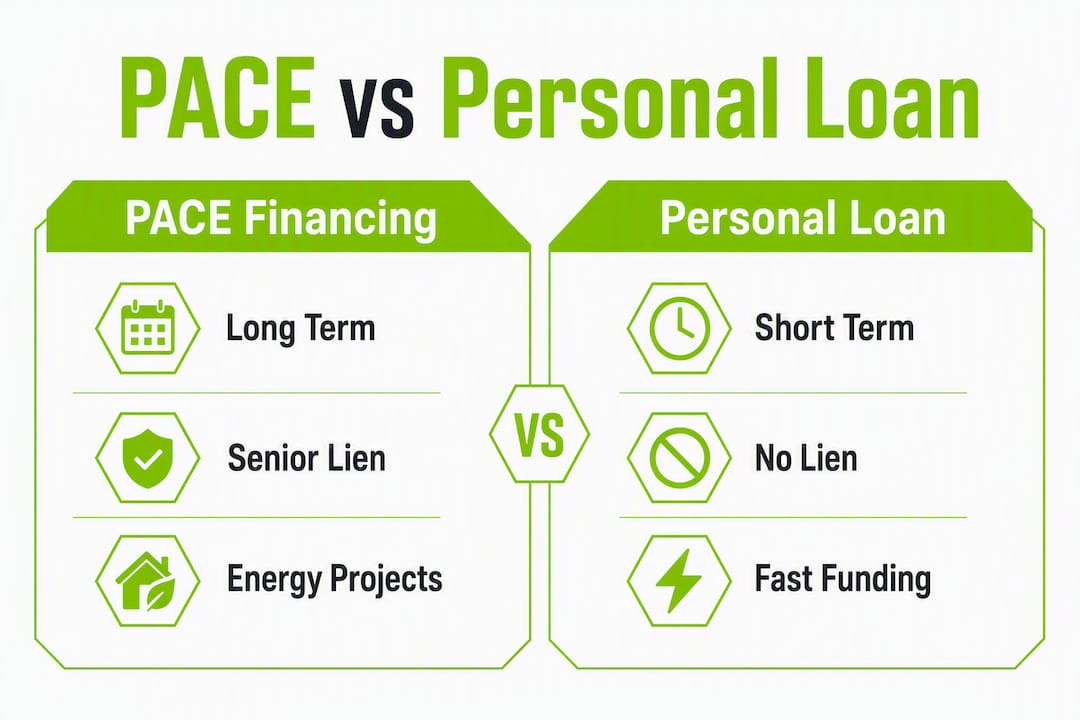
Sample calculation: $20,000 roof
To make this concrete, compare two financing packages on a $20,000 roof replacement:
- Personal loan, 7% APR, 5-year term: Monthly payment roughly $396; total repaid roughly $23,760.
- PACE assessment, 7% APR, 20-year term: Monthly payment roughly $155; total repaid roughly $37,200 (plus closing/admin fees).
The PACE option lowers monthly payments but results in a substantially higher total repayment amount over the life of the assessment. That gap is why total-cost math matters far more than the monthly figure.
Quick scenario guide:
- No equity, need storm-resilient roof, limited credit → PACE may work if available in your state
- Good credit, want no lien, plan to sell within 5 years → personal loan
- Large project, significant equity → home-equity loan or HELOC worth exploring (outside the scope of this comparison)
What are the eligibility rules and timelines for each option?
Knowing what you need before you apply saves time and keeps your project on schedule.
PACE eligibility and timeline
- Property must have sufficient equity (program minimums vary)
- Property tax payments must be current, with no delinquencies
- The roofing product must be on the program’s approved list (impact-resistant, cool roof, etc.)
- Property location must be in a state and municipality with an active PACE program
- A property appraisal or assessment is often required
Typical PACE timeline: 2–4 weeks from application to funding, sometimes longer if property verification is required.
Personal loan eligibility and timeline
- Credit score (most lenders prefer 620+; better rates at 700+)
- Proof of income (pay stubs, tax returns, or bank statements)
- Government-issued ID
- Debt-to-income ratio typically below 43%
Typical personal loan timeline: Approval same-day to 3 business days; funding in 1–3 days after approval.
Documents to prepare before applying (either option):
- Recent property tax statements (PACE)
- Mortgage statement showing current balance and equity (PACE)
- Two months of pay stubs or recent tax returns
- Government-issued photo ID
- Contractor estimate or signed contract
⚠️ Contractor scheduling note: PACE’s 2–4 week timeline can push your project start date back significantly. If you have storm damage or an active leak, a personal loan’s faster funding keeps your roof replacement steps on track. Coordinate with your contractor before you commit to a financing path.
How do APR, fees, and term length affect your real total cost?
Monthly payments are a budget tool, not a cost measure. The number that actually matters is what you pay back in total.
| Financing type | Typical APR range | Common fees | Typical term |
|---|---|---|---|
| Personal loan | 6%–30% | Origination: 0%–6% | 2–7 years |
| PACE assessment | 6%–8.5% (CA/FL/MO) | Closing/admin fees vary by program | 5–30 years |
| HELOC / home-equity | 7%–10% | Appraisal, closing costs | 15–20 years |
Two full scenarios:
Scenario A: $15,000 roof repair Personal loan at a moderate APR over several years: total repaid would be in the expected range. PACE at a typical rate over a longer term: total repaid would exceed the loan amount plus fees.
Scenario B: $30,000 full replacement Personal loan at a moderate APR over several years: total repaid would be commensurate with the borrowing amount. PACE at a typical rate over a longer term: total repaid would be substantially higher including fees.
In both scenarios, the shorter personal loan costs less overall despite the higher monthly payment.
Total-cost callout: Always ask for the total repayment amount in writing. A low monthly payment on a 20-year PACE assessment can mask tens of thousands in added interest.
Fee checklist to request from any lender or program:
- Origination or administrative fee (flat dollar or percentage)
- Closing costs or program enrollment fees
- Dealer or contractor financing fees (watch for hidden dealer fees of 8%–12% baked into contractor “0% APR” offers)
- Prepayment penalty (personal loans)
- Late payment penalties (both)
Understanding how term length affects total cost is one of the most practical steps you can take before signing.
How does a PACE assessment affect selling or refinancing your home?
This is where PACE creates the most risk for homeowners, and where a personal loan has a clear advantage.
A PACE assessment creates a senior lien on your property. That lien sits ahead of your mortgage in priority. Mortgage investors including Fannie Mae and Freddie Mac have historically required PACE liens to be paid off in full at the time of sale or refinancing. Lender treatment is not uniform, but the risk of a closing delay or a blocked refinance is real.
Consumer protection warning: Regulators stress that PACE is private financing, not a government program. The assessment is collected through the property tax system, which gives it lien priority that can surprise buyers, title companies, and mortgage servicers at closing. Full written disclosure of lien terms is not optional — it is your right.
A personal loan has none of these complications. Because it is unsecured, it does not appear on your title and does not affect your mortgage servicer’s position.
Practical steps to protect yourself before signing a PACE agreement:
- Contact your mortgage servicer in writing and ask whether a PACE lien will affect your loan terms or trigger a due-on-sale clause.
- Get your servicer’s response in writing before you sign.
- Disclose the PACE assessment to your real estate agent at listing time so it appears in seller disclosures.
- If you plan to sell or refinance within 1–5 years, a personal loan is almost always the safer choice.
Pro Tip: If your mortgage servicer objects to a PACE lien, do not proceed. The assessment cannot easily be removed, and a forced payoff at closing could wipe out equity you were counting on.
How do you choose the right financing for your roof?
Run through these questions before you commit to either option.
Decision framework:
- Do you plan to sell or refinance within 1–5 years? → Personal loan.
- Is your roofing project PACE-eligible (impact-resistant, cool roof, storm-resilient product)? → PACE may apply.
- Do you live in a PACE-active state (Florida, California, Missouri)? → Check local program availability.
- Is your credit score above 680? → Personal loan likely offers competitive APR.
- Do you need funding in less than two weeks? → Personal loan.
Step-by-step checklist before signing:
- Get at least two written contractor estimates with full line-item pricing.
- Request the total repayment amount (not just monthly payment) from every lender.
- Confirm PACE product eligibility with the local program administrator.
- Check your mortgage servicer’s policy on PACE liens in writing.
- Review all fees: origination, closing, dealer, and prepayment.
- Verify full written disclosure of lien terms for any PACE agreement.
Questions to ask your lender or contractor:
- What is the total amount I will repay over the full term?
- Are there origination, dealer, or administrative fees? What is the dollar amount?
- Will this create a lien on my property?
- How will this affect my ability to sell or refinance?
- Is there a prepayment penalty?
- What happens if I miss a payment?
- Is the roofing product on the PACE program’s approved list?
Red flags that should stop you from signing:
- No written disclosure of lien terms
- Pressure to sign the same day
- Dealer fees not disclosed upfront
- Contractor cannot confirm product eligibility in writing
- Monthly payment quoted without a total repayment figure
Hytzroofing can help you confirm whether your roofing project qualifies for PACE-eligible products and coordinate documentation with lenders. That step alone can save weeks of back-and-forth.
Key Takeaways
For most homeowners, a personal loan is the lower-risk, lower-total-cost choice for roofing, while PACE makes sense only for eligible projects in PACE-active states when resale is not imminent.
| Point | Details |
|---|---|
| Personal loan for most projects | No lien, fast funding, and lower total cost on terms under 7 years. |
| PACE lien risk is real | Senior lien can block refinancing or force payoff at sale; check with your mortgage servicer first. |
| Total cost beats monthly payment | A 20-year PACE at 7% on $20,000 costs nearly $13,000 more than a 5-year personal loan at 7%. |
| PACE eligibility is narrow | Only energy-efficient, storm-resilient, or renewable-energy roofing qualifies, not general repairs. |
| Hytzroofing next step | Contact Hytzroofing for a written estimate, PACE product eligibility confirmation, and lender coordination. |
Why transparent financing advice matters more than a low monthly payment
The financing conversation in roofing has a problem: too many homeowners make a $30,000 decision based on a $155-per-month figure without ever seeing the total repayment number. That gap between what looks affordable and what actually costs you is where most financing regret lives.
PACE is a legitimate tool for the right project. Impact-resistant roofing in a hurricane-prone market like Tampa Bay, financed through a properly disclosed PACE program, can make real sense for a homeowner who has no plans to sell and limited credit options. But “no money down” marketing that leads with monthly payments and buries lien terms is a pattern worth resisting.
Personal loans are not perfect either. A 23% APR on a $20,000 roof is expensive. But the absence of a property lien, the speed of funding, and the predictability of a fixed payoff date give homeowners something PACE cannot: a clean title and no mortgage servicer complications.
The right question is not “which payment can I afford?” It is “what is the total cost, and what does this do to my property rights?” Run that math first, then choose.
Hytzroofing makes financing your roof straightforward
Getting a new roof is already a big decision. Sorting through financing options on top of that should not slow you down.
Hytzroofing serves Tampa Bay and Central Florida as a GAF Master Elite® Contractor, one of fewer than 2% of roofers in North America to hold that designation. The team handles roof replacement, storm damage repair, certified inspections for insurance and financing, and full coordination with third-party lenders for both personal loan and PACE-eligible projects. Every estimate includes full line-item pricing and written disclosure of any financing terms, so you know the total cost before you commit.
Your next step is simple:
- Request a free written estimate at Hytzroofing’s residential roofing page.
- Review financing options with the Hytzroofing team, including PACE product eligibility if applicable.
- Schedule your installation with a licensed, insured crew backed by GAF manufacturer warranties.
Need help after a storm? The emergency repair team is available any time. Florida Contractor License #CCC1332551. BBB Accredited, A+ rated.
Useful sources
These primary sources and authoritative guides will help you verify the claims in this article and read full program details before you choose financing.
- DFPI PACE Consumer Guidance: California’s state regulator explains consumer protections, lien risks, and what PACE is and is not. Start here for regulator-level warnings.
- Figure.com PACE Explainer: Plain-language breakdown of what PACE covers, eligible improvements, and alternatives.
- SoFi Roof Financing Guide: Practical overview of personal loans and PACE for roofing, including approval timelines and eligibility basics.
- NerdWallet Best Roof Financing 2026: APR ranges, origination fee benchmarks, and lender comparisons for personal loans.
- The Roofing Brief (TRB) 2026 Financing Rankings: APR benchmarks, total-cost analysis, PACE fee structures, and contractor financing red flags.
- Better Buildings Initiative CPACE: U.S. Department of Energy resource on how PACE assessments work, lien priority, and program structure.
- Florida Senate PACE Statute (163.08): Florida’s enabling legislation for PACE programs, directly relevant to Tampa Bay and Central Florida homeowners.
FAQ
Is PACE financing a good idea for a roof replacement?
PACE can work for eligible projects like impact-resistant or cool roofing in PACE-active states, but the senior lien it places on your property can complicate a sale or refinance. Run the total repayment math and check with your mortgage servicer before signing.
What are the best financing options for roof replacement?
For most homeowners, a personal loan offers the best combination of speed, flexibility, and no lien risk. Homeowners with significant equity may also consider a home-equity loan or HELOC for lower APRs.
Is it better to take out a loan on your house or finance through a roofing company?
Contractor financing often includes hidden dealer fees of 8%–12% baked into the contract price, making it more expensive than it appears. An independent personal loan or PACE assessment typically gives you more transparent pricing.
How hard is it to get approved for roof financing?
Personal loan approval depends on your credit score and income, with most lenders preferring a score of 620 or higher. PACE approval is based on home equity and property tax history rather than credit score, making it more accessible for homeowners with limited credit. Hytzroofing can help you identify which path fits your situation.
Recommended
- Personal Loan for Roofing: A Homeowner’s Guide | Hytz Roofing
- Roof Financing Term Length: What Homeowners Need to Know | Hytz Roofing
- Roofing Loan Types Compared: Your 2026 Guide | Hytz Roofing
- Bank vs. Contractor Roof Loans: Key Differences in 2026 | Hytz Roofing
Related Hytz Roofing Services