Florida Homeowners: Claim Wind Mitigation Credits at Roof Replacement
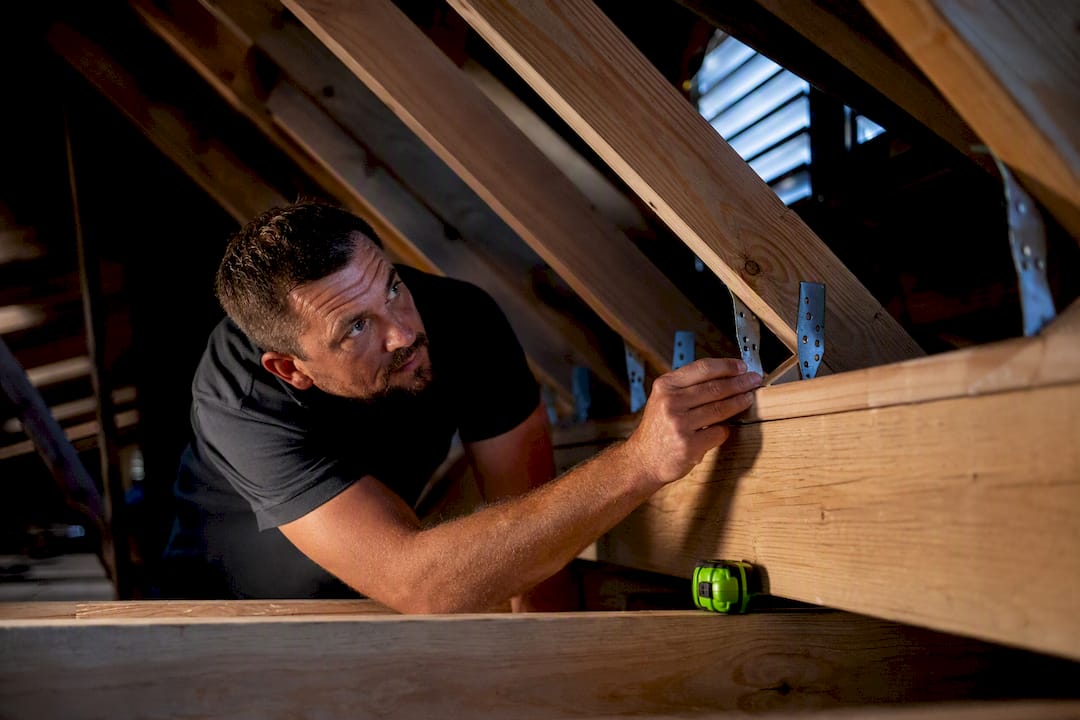
Yes, Florida homeowners can receive state-mandated wind mitigation credits on the windstorm portion of their insurance once an authorized inspector documents qualifying features on the OIR-B1-1802 form. Homes built to the 2001 Florida Building Code or later commonly qualify for a baseline discount, and features like impact windows or roof-to-wall clips can stack on top of that. The savings are real, but they only touch one line item on your bill, not your whole premium.
TL;DR:
- Homes built after 2001 that include impact windows, roof clips, or secondary water barriers can significantly increase their wind mitigation discounts.
- Inspections should be done after roof replacements or upgrades to ensure all new features are properly documented for maximum credit.
- Only qualified professionals such as licensed inspectors, contractors, engineers, or architects can sign and validate the form for insurer acceptance.
- The minimum windstorm discount typically starts at 68 percent, but additional savings depend on installed features and insurer-specific discount tables.
- Proper preparation, including clearing attics, verifying impact ratings, and timing with repairs, improves the chances of securing full mitigation credits.
Table of Contents
- What Features Qualify for Wind Mitigation Credits in Florida?
- What Happens During a Wind Mitigation Inspection?
- Who Is Qualified to Inspect for Wind Mitigation Credits?
- How Much Can Wind Mitigation Credits Save You in Florida?
- When Should You Get a New Wind Mitigation Inspection?
- How Do You Submit Your Wind Mitigation Form to an Insurer?
- Why Wind Mitigation Credits Matter Beyond the Insurance Bill
- How Wind Mitigation Credits Apply Across Different Florida Insurance Policies
- Common Mistakes That Cost Homeowners Their Wind Mitigation Credits
- How to Prepare Your Home for a Wind Mitigation Inspection
- Are There Grants to Help Pay for Wind Mitigation Upgrades?
- A Contractor’s View: Why Replacement Is the Smartest Time to Harden Your Roof
- Get Your Wind Mitigation Inspection Done Right in Tampa Bay
- Official Forms and State Guidance for Wind Mitigation Credits
- Sources
- FAQ
What Features Qualify for Wind Mitigation Credits in Florida?
Before you book an inspection, walk your own roof and attic with a flashlight. A quick self-check tells you whether you’re likely sitting on real savings or wasting an inspection fee on a house with none of the features insurers reward.
Insurers and state consumer guidance look for five categories:
- Roof-to-wall connections: toe nails, clips, single wraps, or double wraps holding the roof frame to the walls
- Roof covering and deck attachment: nail type, size, and spacing pattern used on the roof deck
- Secondary water resistance (SWR): a sealed barrier under the shingles or tile that keeps water out if the roof covering fails
- Opening protection: impact-rated windows, rated shutters, or reinforced garage doors
- Roof shape: hip roofs generally score better than gable roofs because they shed wind more evenly
Pro Tip: A hip roof with double-wrap straps and SWR can qualify for several stacked credits at once, since each feature is scored separately on the inspection form.
What Happens During a Wind Mitigation Inspection?
An inspection usually takes from half an hour to an hour and follows a set sequence, since the OIR-B1-1802 form.pdf?Status=Master) requires documented proof, not just a checkbox.
- The inspector photographs the roof covering and checks the permit or installation date against Florida Building Code editions.
- They enter the attic to inspect roof deck attachment (nail type and spacing) and roof-to-wall connections.
- They check for secondary water resistance under any accessible roof covering.
- They photograph every window, door, and garage opening to verify impact ratings or shutter systems.
- They complete and sign the OIR-B1-1802, attaching photos as evidence, then submit it or hand it to you for filing.
The form updated April 1, 2026 changed some scoring criteria for roof deck attachment and opening protection categories. If your last inspection predates that update, a fresh one might capture credits the old form missed entirely, even on a roof that hasn’t changed.
Who Is Qualified to Inspect for Wind Mitigation Credits?
Not just anyone with a clipboard can sign this form. Citizens Property Insurance lists the authorized categories, and your insurer will reject a report from anyone outside them.
- Licensed home inspectors who have completed required wind mitigation training
- General contractors holding an active Florida license
- Professional engineers (PEs)
- Licensed architects
- Certified building code inspectors employed by local government agencies
Some state programs also require the inspector to qualify as a Wind Certification Entity (WCE), a narrower designation worth confirming if you’re applying through a grant program rather than straight to your carrier.
Pro Tip: Ask to see the inspector’s license number before the appointment, then verify it against the state’s licensing database. A legitimate inspector will not hesitate to share it.
Watch for red flags: an inspector who won’t take photos, hands you an unsigned form, can’t produce a license number, or tries to upsell shutters and impact windows you didn’t ask about. Walk away from any of those.
How Much Can Wind Mitigation Credits Save You in Florida?
Here’s the number that matters most: homes built to the 2001 Florida Building Code or later are eligible for a minimum 68% discount on the windstorm portion of the premium, according to state guidance. That’s not 68% off your whole bill. It applies only to the windstorm coverage line, which on a coastal Tampa Bay policy can still be a meaningful chunk of the total.
Add-on features push savings further, though the exact percentage varies by carrier since each insurer files its own discount table with the state:
- Impact windows or rated shutters on every opening often add a noticeable additional credit
- Roof-to-wall upgrades from toe nails to clips or double wraps can shift you into a better discount tier
- Secondary water resistance frequently adds its own separate credit line
Inspection fees in the Tampa Bay area typically run somewhere between $75 and $150 for a standalone visit, though many roofing contractors include one free with a full roof replacement. That price gap matters: retrofitting straps and SWR into a sealed roof means tearing off shingles you just paid for, while installing the same features during replacement costs a fraction as much because the deck is already exposed.
When Should You Get a New Wind Mitigation Inspection?
Timing your inspection wrong means paying for a report that undersells your house. Four moments call for a fresh one:
Right after a roof replacement, since your old form no longer reflects what’s actually up there. After installing impact windows, storm shutters, or any structural hardening. At renewal, if you notice your credit disappeared or shrank without explanation. And whenever the state updates the form, like the change taking effect April 1, 2026.
Pro Tip: Keep a personal copy of your signed OIR-B1-1802 with photos in a folder, digital or otherwise. Insurers migrate systems and switch carriers more often than homeowners realize, and a lost mitigation record can mean losing the credit until you pay for reinspection.
How Do You Submit Your Wind Mitigation Form to an Insurer?
Getting the paperwork right is half the battle. Here’s the sequence that actually gets credits applied instead of ignored:
- Collect the signed OIR-B1-1802 with all photo attachments and keep a personal copy before it leaves your hands.
- Submit it to your insurance agent or carrier directly, not just the contractor who arranged the inspection.
- Ask for written confirmation of exactly which premium changed and by how much, since insurers are required to disclose this at issuance and renewal.
- Request the Notice of Premium Discounts form if you weren’t automatically sent one.
- If the insurer denies or ignores the credit, ask specifically why, check the form for missing signatures or photos, and consider a reinspection if the original documentation was incomplete.
Most denials trace back to something simple: a missing photo, an unsigned page, or an inspector who wasn’t on the authorized list. Fixing that is usually faster than arguing with a claims adjuster.
Why Wind Mitigation Credits Matter Beyond the Insurance Bill
Insurance savings get all the attention, but the features that earn credits are the same ones that keep your roof attached to your house during a hurricane. FEMA’s guidance on protecting property from severe wind lists roof-to-wall reinforcement and opening protection as core defensive measures, independent of any discount.
That overlap means the inspection pays you twice. You get a lower windstorm premium now, and you get a roof that’s measurably less likely to lose shingles, peel back at the eaves, or let wind-driven rain into your attic during the next named storm. Homes with documented mitigation features also tend to suffer less interior damage when a storm does hit, which means fewer out-of-pocket costs even after insurance kicks in.
There’s a resale angle too. A signed OIR-B1-1802 on file is something a buyer’s agent will ask about in Tampa Bay’s market, where flood and wind risk shape almost every real estate conversation. A seller who can hand over a current mitigation form with strong scores is handing the buyer a lower insurance quote before closing, which can be the difference in a competitive offer. Homes without any mitigation documentation often make buyers nervous, since they have no way to estimate what their windstorm premium will actually look like.
None of this requires exotic materials or a full rebuild. It requires the same roofing work most Tampa Bay homes eventually need anyway, done with the right hardware and documented properly.
How Wind Mitigation Credits Apply Across Different Florida Insurance Policies
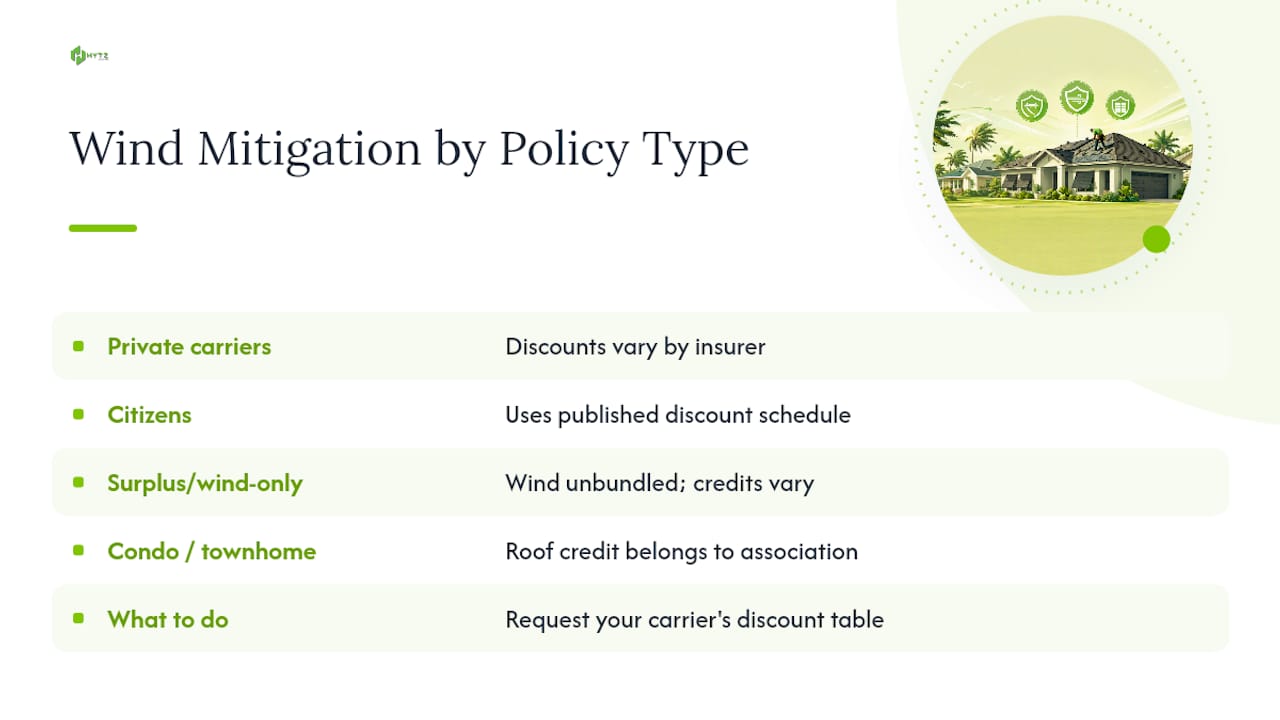
Wind mitigation credits work differently depending on who holds your policy, and homeowners often assume every carrier treats the discount the same way. They don’t.
Private carriers each file their own discount tables with the state, meaning the exact percentage tied to a given feature (say, a double-wrap roof-to-wall connection) can differ from one insurer to the next even though both are working off the same OIR-B1-1802 data. Florida statute 627.0629 requires that these discounts be actuarially reasonable, but it doesn’t force every insurer to offer identical numbers.
Citizens Property Insurance, as the state-backed insurer of last resort, follows its own published discount schedule and tends to be more standardized than smaller private carriers, since it operates under closer regulatory oversight.
Surplus lines and specialty wind-only policies, common for older coastal homes in Pinellas and Hillsborough counties, sometimes apply mitigation credits differently than standard homeowners policies because wind coverage is unbundled from the rest of the policy. If you carry a separate wind policy, confirm directly with that carrier how the OIR-B1-1802 factors into your specific premium, since the standard consumer guidance assumes a bundled homeowners policy.
Condo and townhome policies add another wrinkle. Individual unit owners sometimes qualify for personal mitigation credits on interior features, but the roof itself falls under the association’s master policy, meaning the association, not the individual owner, needs to pursue the roof-level credit.
Bottom line: request your specific carrier’s discount table rather than assuming a number you read elsewhere applies to your policy.
Common Mistakes That Cost Homeowners Their Wind Mitigation Credits
Most homeowners who feel shortchanged on wind mitigation credits made one of a handful of avoidable mistakes, not because the system cheated them.
The biggest one: assuming the discount applies to the entire premium. It doesn’t. It only reduces the windstorm portion of your coverage, so a homeowner expecting a 68% cut on a $3,000 annual bill is going to be disappointed when the actual dollar savings land much lower, because windstorm coverage is only one slice of that total.
The second mistake is letting an unauthorized person fill out the form. A handyman or a friend “who knows roofing” cannot sign an OIR-B1-1802 that any insurer will honor. Only the categories listed earlier, licensed contractors, PEs, architects, trained home inspectors, and building code officials, count.
Third, homeowners assume the credit is permanent. It isn’t automatically. If your roof changes (a repair, a new roof, storm damage that alters the roof-to-wall connections), the old form no longer reflects reality, and insurers can and do adjust the discount downward if they later find the documentation doesn’t match the current structure.
Fourth, and this one trips up a lot of Tampa Bay sellers: assuming an inspection done for a previous owner still counts. It usually doesn’t transfer credit automatically. The new owner typically needs their own current form on file with the insurer.
Finally, some homeowners skip photos or let the inspector skip them to save time. Photos are the evidence an insurer needs to approve the credit without a follow-up dispute. A form without photo backup is one of the fastest routes to a denial.
How to Prepare Your Home for a Wind Mitigation Inspection
A little prep work before the inspector arrives can mean the difference between a mediocre score and one that captures every credit your house has earned.
Start in the attic. Clear a path to the roof structure so the inspector can actually see and photograph the roof-to-wall connections and deck attachment without climbing over storage boxes. If your attic is packed with holiday decorations, move them the week before.
Pull your permit records. If you replaced your roof, added impact windows, or did any structural work, find the permit or the contractor’s invoice showing installation dates and materials. This helps the inspector confirm code compliance faster and avoids guesswork that can undercount your score.
Check every opening. Walk the exterior and confirm which windows and doors have impact ratings versus which ones are original single-pane glass. If you have shutters, make sure they’re accessible or already installed, since an inspector can’t credit a feature they can’t verify in person.
Note your roof shape and age. Knowing whether your home has a hip or gable roof, and roughly when the current roof was installed, helps you have an informed conversation with the inspector rather than being surprised by the score.
Schedule around good weather. A dry, clear day makes attic access and roof-covering photos easier, and it avoids delays that push your inspection date past a renewal deadline.
Consider timing it with other roof work. If you’re already planning repairs or replacement, scheduling the mitigation inspection alongside that project means the new features get documented immediately instead of waiting for a second visit.
Are There Grants to Help Pay for Wind Mitigation Upgrades?
Not every homeowner can absorb the cost of impact windows or a full re-roof out of pocket, and Florida has responded with a few state-level programs aimed at closing that gap.
My Safe Florida Home is the most widely known, offering free wind mitigation inspections and matching grants for eligible homeowners who want to install qualifying upgrades like impact windows, reinforced garage doors, or roof-to-wall hardware. Funding and eligibility windows shift from year to year depending on state budget allocations, so availability isn’t guaranteed at any given moment.
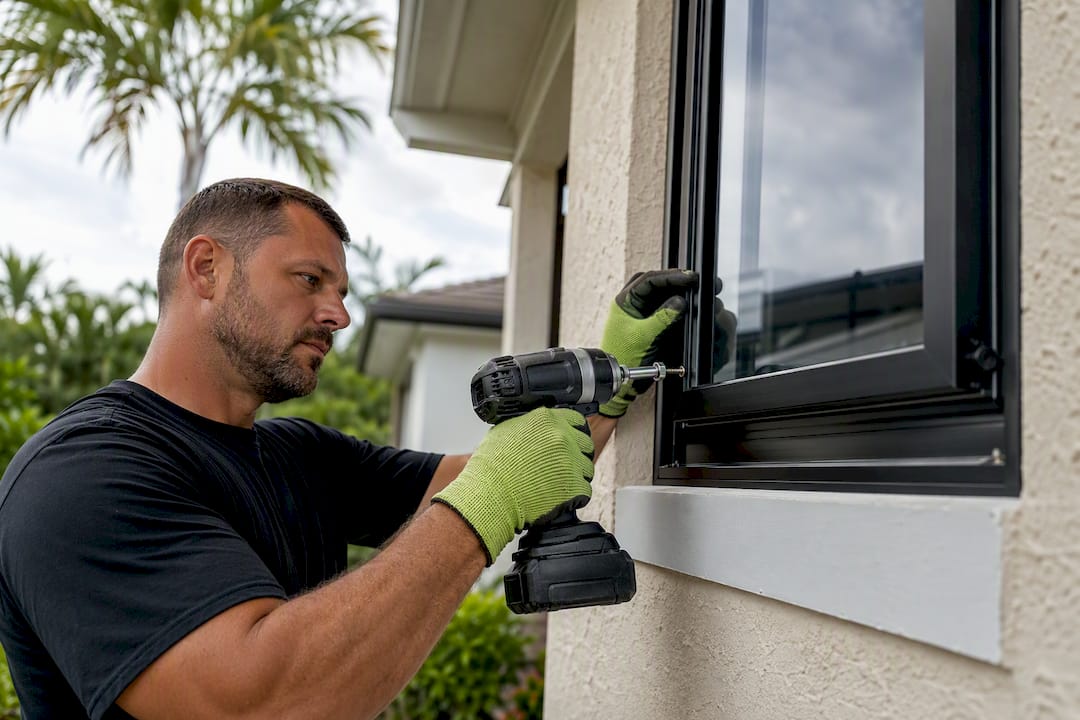
Beyond that program, the Florida Division of Emergency Management’s Hurricane Loss Mitigation Program supports broader hurricane-hardening initiatives, and newer efforts like Elevate Florida have emerged to fund resilience upgrades for at-risk properties.
None of these programs replace the insurance discount process. They help cover the upfront cost of the upgrades themselves, and you’ll still need a separate wind mitigation inspection and a completed OIR-B1-1802 to actually get the resulting insurance credit applied to your policy. Think of them as two different steps toward the same goal: state programs help you afford the hardening work, and the mitigation inspection is what converts that work into a lower premium.
Check current program status before assuming funding is open, since these initiatives periodically pause enrollment when allocated funds run out for the year.
A Contractor’s View: Why Replacement Is the Smartest Time to Harden Your Roof
The math is simple once you’ve stood on enough Tampa Bay roofs: adding roof-to-wall clips or secondary water resistance while the deck is already exposed costs a fraction of tearing off a finished roof to retrofit the same features later. Contractors document every connector and every layer of SWR with photos as the work happens, which then gets referenced directly in the signed OIR-B1-1802 the inspector completes afterward.
Hytz Roofing is a GAF Master Elite® Contractor, a distinction held by fewer than 2% of roofing contractors in North America, and we hold Florida Contractor License #CCC1332551. We treat mitigation documentation as part of the job, not an afterthought bolted on at the end. If you’re already planning a replacement, that’s your window to capture credits that would otherwise cost far more to add later.
— Anthony
Get Your Wind Mitigation Inspection Done Right in Tampa Bay
Hytz Roofing is the practical alternative to booking a standalone inspector and a separate roofing contractor for the same house. We combine certified wind mitigation inspections with the actual roof work, roof-to-wall hardening, secondary water resistance, opening protection, so the features get installed and documented in a single project instead of two disconnected appointments.
As a GAF Master Elite® Contractor and holder of Florida Contractor License #CCC1332551, our crews photograph every connector and barrier as we install it, then hand that documentation straight to your wind mitigation inspector. If your roof was damaged in a storm or you’re weighing replacement, we also handle the insurance claim process alongside the physical work, so you’re not managing two separate paper trails. Schedule a free roof replacement estimate with Hytz Roofing and find out what your home could qualify for before your next renewal.
Official Forms and State Guidance for Wind Mitigation Credits
Download the OIR-B1-1802 inspection form directly from FLOIR, along with broader wind mitigation resources. Review Florida Statute 627.0629 for the legal basis behind insurer discounts, and check FEMA’s severe wind protection guidance for the underlying safety rationale.
Sources
- Premium Discounts for Hurricane Loss Mitigation (Florida consumer guide)
- Florida Statute — Section 627.0629
FAQ
How much discount can you get for wind mitigation in Florida?
Homes built to the 2001 Florida Building Code or later commonly qualify for a minimum 68% discount on the windstorm portion of the premium, with additional credits possible for features like impact windows or roof-to-wall straps. This applies only to windstorm coverage, not your entire bill, and exact figures vary by carrier.
How do I get a free wind mitigation inspection in Florida?
The My Safe Florida Home program offers free inspections for eligible homeowners, subject to current funding availability. Many roofing contractors, including Hytz Roofing, also include a mitigation inspection at no extra cost when you book a full roof replacement.
What is the Florida $10,000 grant for homeowners?
This typically refers to matching grant funds available through the My Safe Florida Home program, which can help cover the cost of qualifying wind mitigation upgrades like impact windows or roof hardening for eligible applicants. Availability and exact grant amounts depend on current state funding and program rules.
How long are wind mitigation inspections good for in Florida?
There’s no fixed statewide expiration date, but the report should be updated any time your roof or openings change, or when the state issues a new form version, such as the update taking effect April 1, 2026. Insurers can also request reinspection if they suspect the documentation no longer matches your home.