Commercial Roof Replacement Timeline: What to Plan For
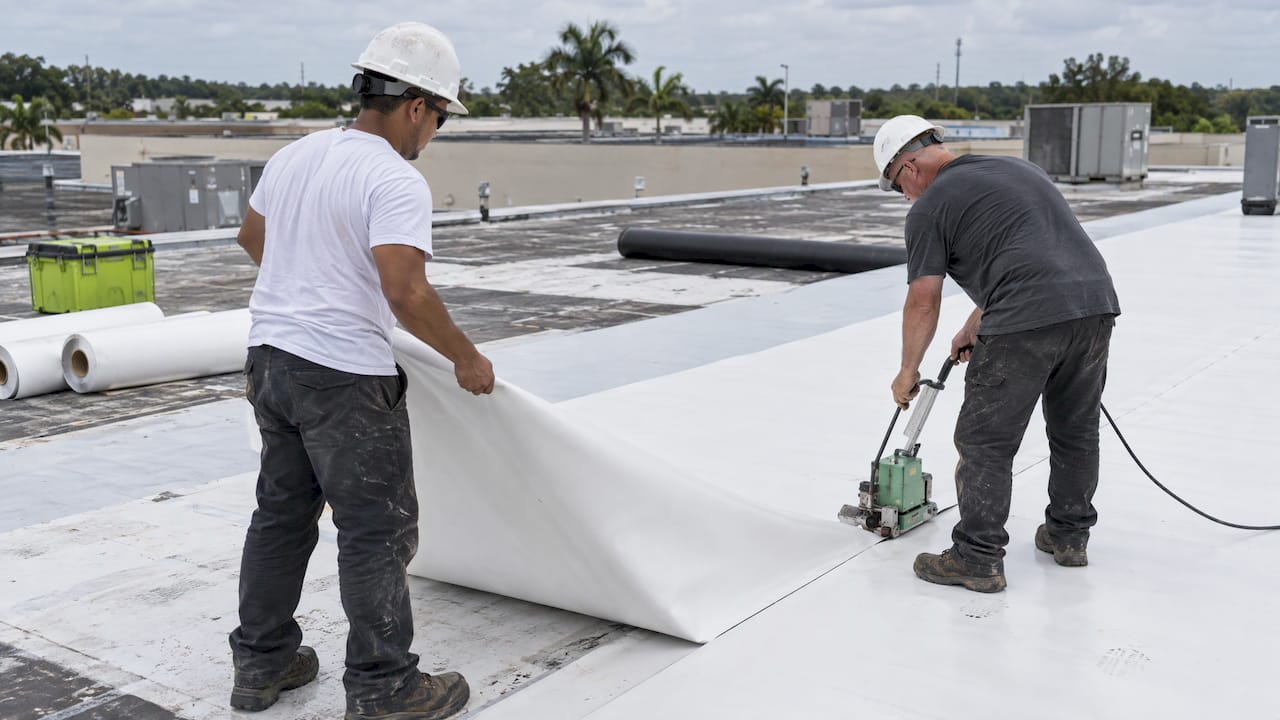
A commercial roof replacement usually takes 2 to 4 months from first inspection to final sign-off, but the crew is on the roof for only a small part of that. A 10,000 sq ft TPO roof can be installed in about a week. The planning, approvals and ordering before that week often take 4 to 8 weeks. 🏢 If you manage a building in Tampa Bay, the schedule you build around the whole process matters more than the install days. Here is how each stage runs, what stretches it, and how we at Hytz Roofing keep Florida projects moving between storms.
TL;DR
- ⏱️ Plan on roughly 4 to 8 weeks of preparation (specs, submittals, pre-job meeting) before any membrane goes down.
- 📐 Installation time depends on size: about 5 to 8 days at 10,000 sq ft, 10 to 15 days at 30,000 sq ft, and 20 to 35 days at 100,000 sq ft for a TPO tear-off.
- 🌧️ Weather days can add 15 to 30% to the install schedule, and Florida’s rainy season and hurricane season make that buffer essential.
- 🏗️ Wet insulation, permit drawings and code upgrades are the most common reasons a schedule grows once the roof is open.
- 📋 An early inspection and a written scope are the cheapest ways to keep the project on its dates.
Table of Contents
- The Short Answer: Planning to Completion
- Stage 1: Assessment and Scope (1 to 3 Weeks)
- Stage 2: Design, Permit and Approvals (2 to 6 Weeks)
- Stage 3: Submittals, Ordering and the Pre-Job Conference (2 to 8 Weeks)
- Stage 4: Installation, by Roof Size
- Stage 5: Inspection, Punch List and Closeout (3 to 10 Days)
- What Stretches the Schedule in Tampa Bay
- Keeping Tenants and Operations Running
- A Sample Timeline: 40,000 Sq Ft Retail Center
- How to Keep Your Project on Schedule
- Promo: A Roof Replacement Plan Built Around Your Building
- Our Perspective
- FAQ
- Sources
The Short Answer: Planning to Completion
Think of a commercial replacement in three blocks:
- Before the crew arrives: assessment, scope, design, permit, material submittals and ordering. Typically 4 to 8 weeks or more.
- On the roof: tear-off, deck repair, insulation, membrane, flashings and edge metal. From about a week on a small building to several weeks on a large one.
- After the install: punch list, final inspection and warranty paperwork. Usually a few days, longer if the inspector or manufacturer reviewer is slow to schedule.
A small building with a clear scope can move faster than this. A large warehouse, a roof with wet insulation, or a project that needs engineered drawings will take longer. The sections below show where the time goes.
Stage 1: Assessment and Scope (1 to 3 Weeks)
Everything starts with knowing what is under the membrane. A visual walk is not enough on a roof that has leaked. Moisture surveys and core cuts show whether the insulation is wet and whether the deck is sound. Those answers decide whether you can recover over the old roof or need a full tear-off, and a full tear-off adds roughly 30 to 40% to the job compared with an overlay, according to industry timeline guidance.
This is also where a documented inspection history helps. If your building has been inspected on a schedule, the scope conversation is quicker because the leak locations and repairs are already on record. Our guides on why commercial roofs need inspections and the commercial roof inspection process explain what a good report contains.
If storm damage prompted the project, bring in the insurance question now, not after the tear-off. Claim approval can set the start date. We offer insurance claim assistance and roof inspections, so the scope and the claim paperwork can be built from the same inspection.
Stage 2: Design, Permit and Approvals (2 to 6 Weeks)
This is the stage that surprises owners most.
Under the 2024 International Building Code, construction documents for a reroofing building permit must be prepared by a registered design professional. The same facility manager’s guide notes that wet insulation must be removed down to the structural deck, and that the energy code can require added insulation when a roof is replaced. Each of those items can add scope and time. Florida adopts its own Florida Building Code, and your city or county building department decides how reroofing is processed, so confirm the local requirement before you promise anyone a date.
The same guide includes a caution from roof design professionals: where a municipality treats reroofing as a repair and no designer is involved, the owner should ask who is designing the roof and whether that person has the right credentials, licenses and insurance. A written, itemized estimate and a clear scope make that question easy to answer. Our article on reading roofing estimate line items shows what to look for.
Before the site opens, a written readiness list keeps small gaps from becoming lost days. A general job site opening checklist is a good model for what to confirm: access, storage areas, safety zones, utilities and documents.
Stage 3: Submittals, Ordering and the Pre-Job Conference (2 to 8 Weeks)
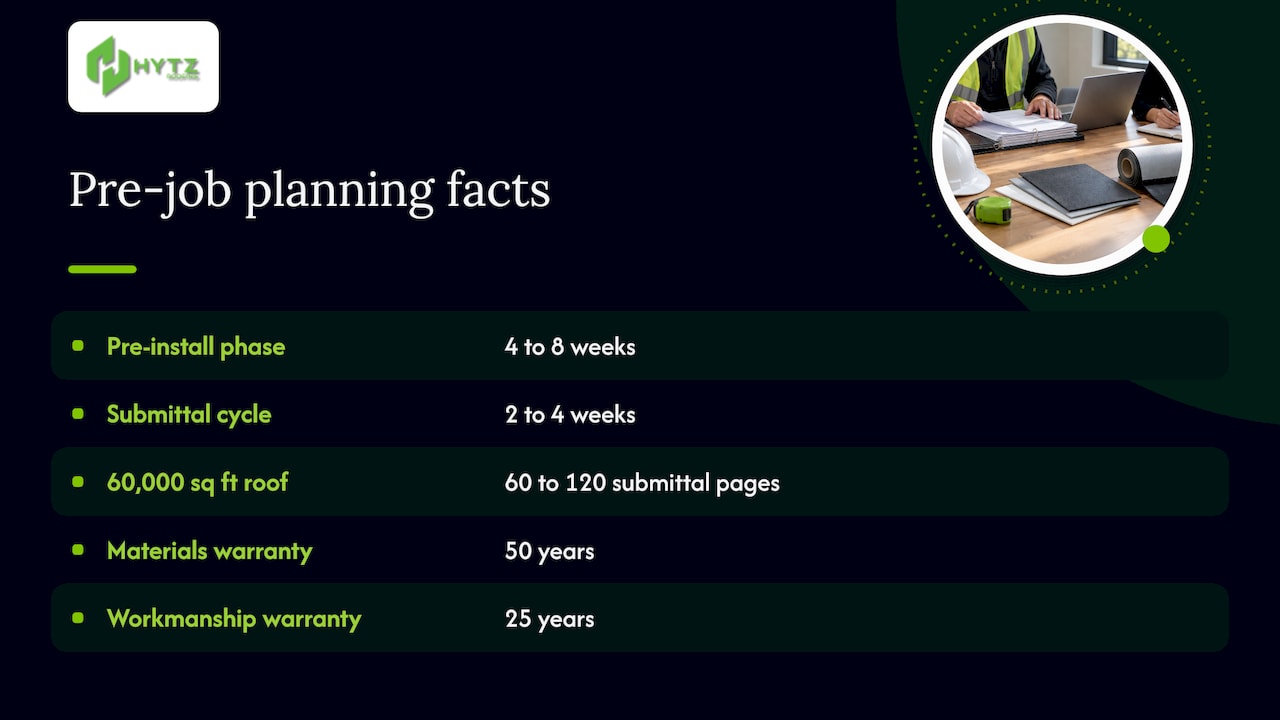
Before the first roll of membrane is cut, the manufacturer’s system has to be specified and approved. The Roofing Brief puts this pre-install phase at 4 to 8 weeks, including spec review, a submittal approval cycle of 2 to 4 weeks, and a pre-job conference with the manufacturer. For a 60,000 sq ft roof, the submittal package alone can run 60 to 120 pages. If a submittal is rejected, the approval cycle starts over.
Submittals are the product data, details and drawings that the building owner or designer reviews to confirm the roof matches the spec. Getting them right the first time is the single best schedule protection you have.
Material lead times matter too. Order early for hurricane-season work, because demand for membranes, insulation and fasteners rises after a major storm across the region.
Warranty terms are set at this stage as well. Our commercial roof warranty checklist explains what to confirm before work starts so a warranty claim is not denied later. Our own offer is a manufacturer-backed warranty with 50 years on materials and 25 years on workmanship.
Stage 4: Installation, by Roof Size
Once the crew arrives, the clock runs on roof area, system type and crew size. The table shows TPO mechanically attached over polyiso insulation with a one-layer tear-off, from The Roofing Brief’s 2026 installation guide:
| Roof size | Typical install duration |
|---|---|
| 10,000 sq ft | 5 to 8 days |
| 30,000 sq ft | 10 to 15 days |
| 60,000 sq ft | 15 to 25 days |
| 100,000 sq ft | 20 to 35 days |
| 250,000 sq ft | 40 to 60 days |
| 500,000 sq ft | 70 to 110 days |
The same source shows production climbing as a job scales: from roughly 1,500 to 2,500 sq ft per day on a small crew to 6,000 to 9,000 sq ft per day on large projects. That is why a roof ten times bigger does not take ten times as long.
System choice moves the numbers. Single-ply membranes such as TPO and EPDM go down faster than multi-layer modified bitumen, and standing seam metal is a more detailed install. Our commercial pricing starts from published ranges: TPO at $5 to $8 per sq ft, EPDM at $4 to $7, modified bitumen at $4 to $8, and metal standing seam at $10 to $20, all on our commercial roofing page. Final pricing depends on the scope you approve.
What a typical install week looks like
- Day 1 to 2: mobilization, safety perimeter, tear-off in sections that can be dried in the same day.
- Day 2 to 4: deck repairs, insulation, cover board.
- Day 3 to 6: membrane, seams, flashings, penetrations, edge metal.
- Last day: cleanup, magnet sweep of the grounds, walk-through.
Section-by-section tear-off is the rule. You never open more roof than the crew can make watertight by the end of the day.
Stage 5: Inspection, Punch List and Closeout (3 to 10 Days)
The job is not over when the last seam is welded. Expect a building inspection, a manufacturer or consultant review if the warranty requires one, and a punch list of small fixes. Schedule the inspector as soon as the permit allows, since inspector availability is outside the contractor’s control. Warranty registration follows, and you should keep the closeout package with your building records.
What Stretches the Schedule in Tampa Bay
Weather
Rain stops installation. Sustained winds above 25 mph stop it. Temperatures below 40°F slow cold-sensitive systems. The Roofing Brief estimates weather days add 15 to 30% to the schedule. In Tampa Bay, cold is rarely the issue. Afternoon thunderstorms in summer and the June to November hurricane season are. A 10-day install should be planned as 12 to 13 days in the wet months.
For that reason, many owners aim for a fall-to-spring install window, starting preparation in the summer so materials and permits are ready when the weather turns dry. Hurricane season officially runs from June 1 to November 30, so the late-fall start is when schedules relax.
Existing roof conditions
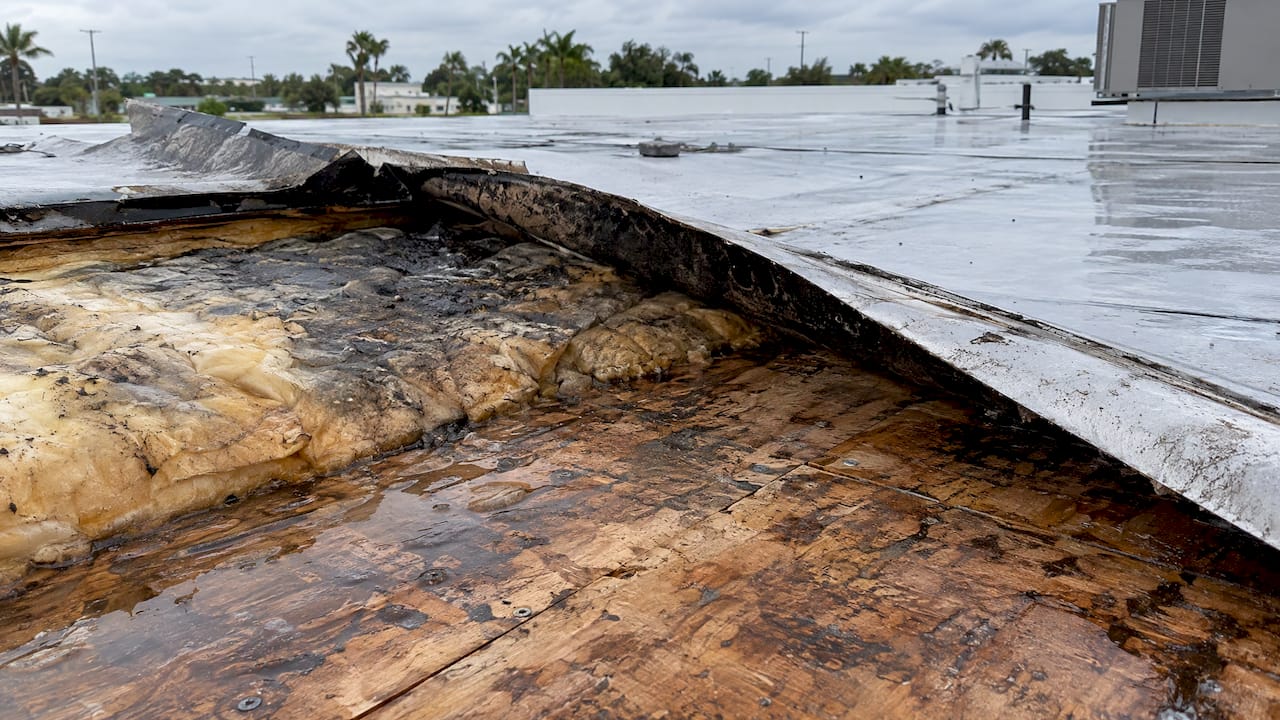
Wet insulation, rotted deck, and extra layers are discovered once the roof is open. Ask for a unit price for deck repair and wet insulation replacement in the contract so a discovery becomes a line item, not a dispute.
Code-driven additions
Insulation upgrades and design-professional requirements can add scope. Our article on commercial roof insulation explains why it also affects energy use and long-term performance.
Storm backlogs
After a major storm, every contractor in the region is booked. A project that was ready to start in three weeks can slip by months. Having an inspection, scope and approved submittals on file before a storm is the best position to be in.
Keeping Tenants and Operations Running
A commercial roof almost never goes on a vacant building. Good planning keeps the business open.
A documented example: a 200,000 sq ft TPO replacement on a Pennsylvania state office building ran April to August 2004 on a 120-calendar-day schedule while a parking garage, a retail store and a photo laboratory stayed open, according to Professional Roofing magazine. The crew moved work to weekends when severe thunderstorms threatened and set up a daily safety perimeter to protect people and vehicles.
The lessons carry over to a Tampa Bay plaza, office park or warehouse:
- Notify tenants in writing with start dates, noisy phases and any parking or entrance changes.
- Mark safety zones under tear-off areas and keep entrances clear.
- Schedule loud work for off-hours where leases or operations require it.
- Protect interiors by moving inventory and covering equipment under work areas.
- Plan weekend or night shifts for sensitive tenants such as medical offices or data rooms.
For homeowners and HOA boards wondering about the residential side, our guide to roof replacement while occupied covers staying in the building during the work.
A Sample Timeline: 40,000 Sq Ft Retail Center
Here is a realistic Tampa Bay example built from the ranges above. It is an illustration, not a quote.
| Phase | Duration |
|---|---|
| Inspection, moisture survey, scope | 1 to 2 weeks |
| Design, permit application | 2 to 4 weeks |
| Submittals and ordering | 3 to 5 weeks |
| Install (tear-off, TPO, flashings) | 3 to 4 weeks, plus weather days |
| Inspection and closeout | 1 week |
| Total | About 10 to 16 weeks |
Some phases overlap, so the total can come in shorter. The point is that the install is about a quarter of the calendar.
How to Keep Your Project on Schedule
- Start early. Begin at the first sign of repeated leaks or at the end of the roof’s expected life, not after a failure. Many systems last 15 to 30 years depending on material, and TPO and EPDM often last 20 to 25 years.
- Get the inspection first. A moisture survey and written scope shorten the design and approval stage.
- Confirm who designs the roof and what your local building department requires.
- Approve submittals quickly. Name one decision-maker with authority to sign off.
- Order materials before the busy season.
- Build in weather days of 15 to 30% for the install.
- Settle the unit prices for wet insulation and deck repair in the contract.
- Plan tenant communication before the first day.
Promo: A Roof Replacement Plan Built Around Your Building
💬 If you are weighing a commercial replacement in Tampa Bay or Central Florida, we can inspect the roof, itemize the scope and lay out the schedule, including the permit and material steps. Hytz Roofing installs TPO, EPDM, modified bitumen and metal standing seam systems, holds Florida Contractor License #CCC1332551, and carries general liability and workers’ compensation coverage. See our commercial roofing services or talk to us through the Hytz Roofing site.
Our Perspective
Most timeline problems we hear about start before anyone climbs on the roof. An owner calls after a leak, expects a start date in two weeks, and learns about drawings, submittals and material orders. None of that is wasted time. It is the part of the job that decides whether the install days go smoothly.
That is why we put the inspection and the itemized estimate first. We are a Master Elite certified contractor, an honor earned by fewer than 2% of roofing contractors in North America, and our approach is built on clear scope, manufacturer-backed warranties and transparent numbers. Over 85% of our business comes from referrals and repeat clients, and we want every owner to know what each week of the schedule is for.
If you manage a building in Tampa Bay, the best thing you can do is get ahead of hurricane season with an inspection and an approved plan. We can handle the inspection, the insurance claim assistance and the installation, so you deal with one team from first walk-through to final sign-off.
Anthony
FAQ
How long does a commercial roof replacement take?
The install itself takes about 5 to 8 days for a 10,000 sq ft TPO roof and 20 to 35 days for 100,000 sq ft. Add 4 to 8 weeks of preparation before the crew arrives. In total, most projects take a few months from inspection to closeout.
Can the building stay open during a replacement?
Yes, in most cases. Work is done in sections, safety zones protect people and vehicles, and noisy phases can be scheduled around tenants. Written notice to tenants before the start is the key step.
What is the best time of year for a commercial roof replacement in Florida?
The drier months, roughly late fall through spring, give the fewest rain delays. Summer afternoon storms and hurricane season add weather days, so build 15 to 30% extra into any install planned between June and November.
Does a full tear-off take longer than a recover?
Yes. A tear-off adds roughly 30 to 40% to the project compared with an overlay, because the old roof must be removed, disposed of and the deck checked. If the insulation is wet, it has to come off anyway.
Sources
- Commercial Roof Installation 2026: System & Phase Guide, The Roofing Brief
- A Facility Manager’s Guide to Roof Replacement, IFMA Facility Management Journal
- Sense and Sensitivity, Professional Roofing