2026 Florida Roof Repair Costs: $275–$33,000 & Tampa Checklist
Florida roof repair costs typically run $275 to $750 for minor fixes, $750 to $2,000 for moderate work, and $2,000 or more for major repairs involving decking or structural damage. Full replacements generally land between $6,000 and $33,000 depending on material. Three factors move these numbers most: the material you choose, your roof’s size and complexity, and whether you’re in a Florida High Velocity Hurricane Zone that requires special permits. If you suspect storm damage, schedule a licensed inspection before rain finds its way into your attic.
TL;DR:
- Repairs involving decking or structural damage typically cost above $2,000, with full replacements often reaching $6,000 to $33,000 depending on materials.
- Material choices significantly impact costs, with clay or tile roofs potentially costing up to 2.8 times more than asphalt shingles, and lasting longer.
- Roof size and complexity, including steep pitches and roof penetrations, can add 10% to 20% to labor and material expenses on your initial quote.
- Florida’s building code and HVHZ requirements can increase costs due to stricter product approval, permits, and waterproofing standards, especially in Miami-Dade.
- Hidden costs such as decking replacement, extra flashing, disposal, and equipment rental can inflate estimates; detailed, itemized quotes help prevent surprises.
Table of Contents
- How Much Does Roof Repair Cost in Florida?
- What Does a Full Roof Replacement Cost by Material in Florida?
- How Roof Size and Complexity Change Your Quote
- Florida Code and Insurance Rules That Change the Price
- Hidden Costs That Can Inflate Your Roof Repair Estimate
- Should You Repair or Replace Your Roof?
- How to Get an Accurate Roof Repair Estimate in Florida
- How Hytz Roofing Prices Jobs in Tampa Bay
- What Should Florida Homeowners Do Before Storm Season?
- Get a Free Roof Estimate From Hytz Roofing
- Sources
- FAQ
How Much Does Roof Repair Cost in Florida?
Not every roof problem costs the same, and lumping them together is how homeowners end up either overpaying for a small fix or underestimating a big one. Florida contractors generally sort repairs into three tiers, and knowing which one you’re in changes how you should shop for quotes.
Minor repairs ($275 to $750) cover the small stuff: a handful of cracked or lifted shingles, a loose ridge cap, minor flashing repair around a vent pipe. Most Florida roofers charge a $300 to $500 minimum service call just to send a crew out, which is why even a tiny fix rarely costs less than that.
Moderate repairs ($750 to $2,000) usually mean a section of shingles blown off in a storm, a slipped tile or two on a barrel-tile roof, or flashing failure around a chimney or skylight that’s let water in. These jobs take longer because the crew has to match existing materials and often patch underlayment, not just the surface layer.
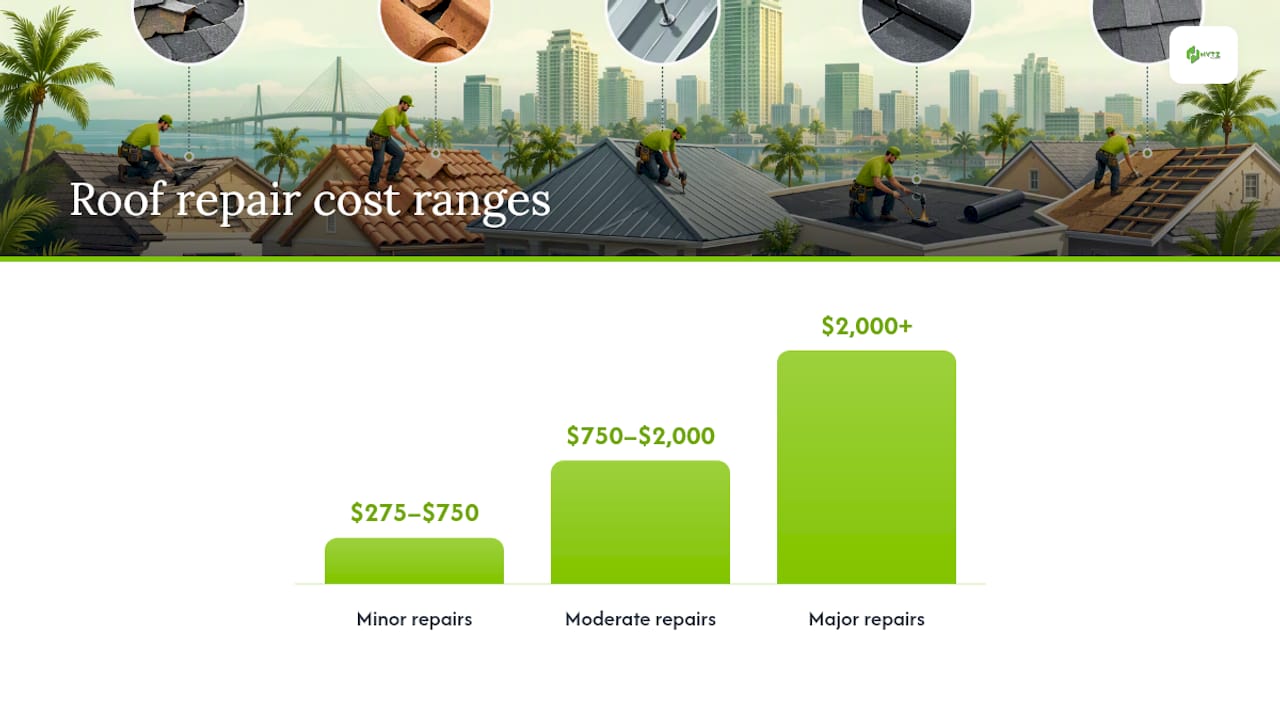
Major repairs ($2,000 and up) involve significant wind or hail damage, multiple leak points, or any repair that exposes rotted decking. Once a contractor has to pull up more than a small patch of decking, the price jumps fast. Statewide, Florida repair costs average around $1,300, but the range runs from about $400 to $3,200 depending on severity and location.
Regional pricing varies more than most homeowners expect:
- Miami: Higher labor and permit costs push repairs toward the top of the range, partly due to HVHZ compliance requirements.
- Tampa: Mid-range pricing, though older neighborhoods with original 1980s and 1990s shingle roofs see more decking-related repairs.
- Orlando: Comparable to Tampa, with slightly lower permit fees in most Central Florida counties.
- Jacksonville: Generally the most affordable metro for repairs, reflecting lower labor rates in North Florida.
Wind is the most common culprit statewide, followed by flashing failure and, on tile roofs, slipped or cracked tiles from foot traffic or debris impact. Once decking gets involved, whether from long-term moisture intrusion or a single bad storm, the repair stops being a patch job and starts looking like a partial replacement. If you’re seeing a pattern of repeat leaks in the same spot, that’s usually decking, not shingles, and it’s worth saying so when you call for an estimate.
What Does a Full Roof Replacement Cost by Material in Florida?
Material choice is the single biggest lever on your final bill, and the spread between options is wider than most homeowners assume going in. Florida replacement costs per square foot in 2026 break down like this:
- Asphalt shingles (3-tab): $3.50 to $6.00 per square foot
- Asphalt shingles (architectural/impact-rated): $6.00 to $11.00 per square foot
- Metal (exposed-fastener panels): $7 to $14 per square foot
- Metal (standing seam): $14 to $23 per square foot
- Concrete or clay tile: $13 to $21 per square foot
- TPO (low-slope/flat roofs): typically priced separately from sloped systems, often comparable to mid-range metal per square foot installed
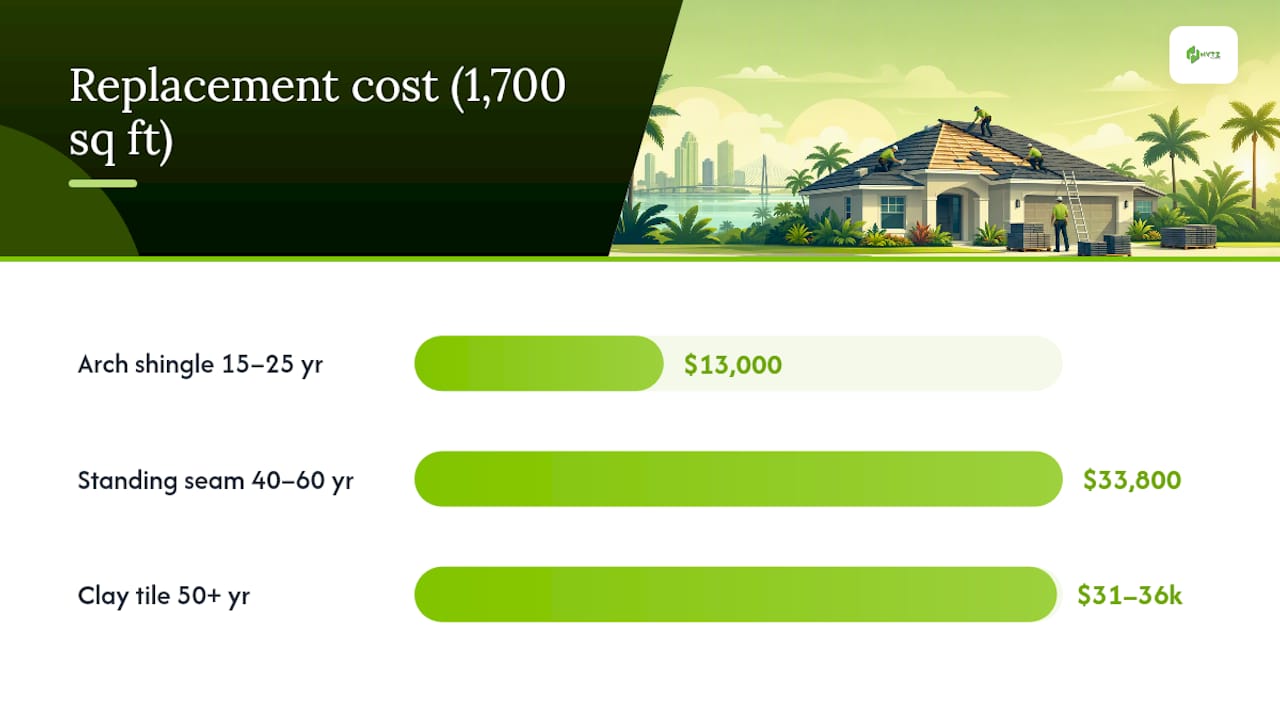
Here’s what that means for actual homes. A 2,000 square foot architectural-shingle replacement in Florida typically runs $10,500 to $22,000, with a median around $14,000. Scale that down to 1,700 square feet and asphalt lands closer to $9,000 to $18,500. A 1,500 square foot asphalt roof generally falls between $8,000 and $16,500.
Switch materials and the totals move fast. Premium systems like standing-seam metal or clay tile often run 2.4 to 2.8 times the asphalt baseline, according to RoofingTechPro’s 2026 Florida guide. That means a 1,700 square foot roof that costs $13,000 in architectural shingles could run $31,000 to $36,000 in clay tile.
Pro Tip: Don’t judge material cost by the sticker price alone. A tile roof that costs twice as much as shingles can outlast three shingle replacements over a 50-year span, which changes the real cost-per-year math significantly.
Lifespan differences matter here. Asphalt shingles typically last 15 to 25 years in Florida’s heat and humidity, metal roofing often reaches 40 to 60 years, and concrete or clay tile can exceed 50 years with proper underlayment maintenance. Energy performance is part of the equation too. Reflective “cool roof” materials can reduce attic heat gain, which matters directly to your summer cooling bills in a state where the AC runs nearly year-round. Homeowners weighing a tile roof replacement in Tampa often find the higher upfront cost justified by lower long-term maintenance and stronger resale appeal, especially in wind-exposed coastal zip codes.
How Roof Size and Complexity Change Your Quote
Roofers don’t price by your home’s square footage. They price by roofing squares, a unit equal to 100 square feet of actual roof surface, and that number is almost always bigger than your floor plan suggests.
- Start with heated floor area. A 1,700 square foot single-story home typically has a roof footprint close to that same number, before accounting for slope.
- Add slope. Most Florida homes have a moderate pitch, adding roughly 15% to 20% more surface area than the flat footprint. That 1,700 square foot home becomes roughly 1,955 to 2,040 square feet of actual roof.
- Convert to squares. Divide by 100. You land around 19.5 to 20.4 squares.
- Apply material pricing. At $6 to $11 per square foot for architectural shingles, that works out to roughly $11,700 to $22,400 for the full job, before permit fees or tear-off costs.
Steeper pitches, multiple dormers, valleys, and chimney or skylight penetrations all add labor time because crews move slower and need more flashing detail at every seam. A simple gable roof with no obstructions is the cheapest shape to cover. A roof with four valleys, two dormers, and three roof penetrations can add 10% to 20% to labor costs alone, even using identical materials.
Florida Code and Insurance Rules That Change the Price
Florida’s building code doesn’t treat every roof the same, and the differences show up directly in your quote. The 25% rule, part of the Florida Building Code’s roofing provisions, determines when a repair legally has to become a full replacement: if the damaged or repaired roof area exceeds 25% of the total roof surface within a defined period, code often requires bringing the entire roof up to current standards rather than patching around the damaged section.
In High Velocity Hurricane Zones, primarily Miami-Dade and Broward counties, requirements get stricter and more expensive. HVHZ rules require Miami-Dade NOA (Notice of Acceptance) product approvals for materials used, often mandate sealed decking, and generally take longer to permit than jobs outside the zone. Homeowners in these counties should expect line items on their estimate that simply don’t exist for a Tampa or Orlando job.
Wind mitigation documentation matters for your wallet too. The OIR-B1-1802 wind mitigation inspection form, maintained through Florida’s Office of Insurance Regulation, documents features like roof-to-wall connections, roof deck attachment, and secondary water resistance. A current wind mitigation report can meaningfully lower your homeowners insurance premium, and it’s worth requesting one after any roof replacement.
- Permit fees vary by county, generally running a few hundred dollars but higher in HVHZ jurisdictions.
- NOA-approved materials in Miami-Dade and Broward typically cost more than equivalent non-NOA products used elsewhere in the state.
- Sealed-deck requirements in HVHZ zones add both material and labor cost that a Tampa quote wouldn’t include.
Hidden Costs That Can Inflate Your Roof Repair Estimate
The number a contractor quotes you first isn’t always the number you pay. Several add-ons routinely surprise homeowners who didn’t ask about them upfront:
- Decking replacement: Rotted or water-damaged plywood typically adds a per-square-foot charge on top of the base roofing price, and you won’t know the full extent until tear-off begins.
- Underlayment upgrades: Switching from standard felt to synthetic or peel-and-stick underlayment adds cost but improves leak resistance in Florida’s rain patterns.
- Extra flashing: Homes with multiple penetrations, chimneys, or complex rooflines need more flashing material and labor than a simple gable roof.
- Disposal and hauling: Tear-off debris has to go somewhere, and dumpster or hauling fees are sometimes billed separately from the main estimate.
- Crane or lift access: Steep or hard-to-reach roofs occasionally require equipment rental that a ground-level job wouldn’t need.
Structural issues, especially rotted soffit or fascia hiding behind the roofline, can turn a straightforward re-roof into a much bigger project once the crew opens things up. This is usually where a “simple” job jumps a few thousand dollars past the original quote.
Pro Tip: Ask every contractor for a line-item estimate that separates labor, materials, permits, and disposal, and request pricing “with and without tear-off” so you can see exactly what decking replacement would add if it’s needed. A vague one-page quote is the easiest way to get blindsided later.
Should You Repair or Replace Your Roof?
The decision usually comes down to four practical questions, and answering them honestly before you call a contractor saves time and money.
- How old is the roof? Asphalt shingle roofs past 15 to 18 years and tile or metal roofs past 30 to 40 years are approaching the point where repair costs stop making financial sense.
- How much visible damage is there? If damage covers more than a handful of squares, or approaches that 25% threshold under Florida Building Code, replacement often becomes the code-required and more economical path.
- Are leaks recurring? A single isolated leak is a repair. The same spot leaking after two “fixes” usually means underlying decking damage that a patch won’t solve.
- Is this an insurance claim or an out-of-pocket job? Document everything: photograph damage immediately, note the date of the storm or discovery, and keep your wind mitigation report and prior roofing invoices on hand.
DIY repairs carry a risk homeowners often overlook. Many insurance policies exclude damage tied to non-professional repair work, meaning a well-intentioned patch job could cost you coverage on a future claim. Typical professional repair fees for small-to-moderate jobs run $300 to $1,500, which is often far cheaper than risking a denied insurance claim down the line. If your roof damage came from a storm, storm damage restoration services that handle both the repair and the insurance paperwork tend to protect homeowners better than going it alone.
How to Get an Accurate Roof Repair Estimate in Florida
Getting three quotes that actually compare apples to apples takes more than asking “how much?” Here’s what to verify before you sign anything:
- Confirm the contractor’s Florida license number and general liability insurance.
- Ask for NOA or product approval numbers if you’re in an HVHZ county.
- Get warranty terms in writing, both manufacturer and workmanship.
- Review the payment schedule and be wary of anyone demanding full payment upfront.
A complete written estimate should include:
- Itemized labor and material costs
- Permit fees and who’s responsible for pulling them
- Tear-off and disposal charges
- Underlayment and flashing specifications
- Warranty length and what voids it
Keep a simple worksheet as you collect bids: contractor name, license number, total price, material spec, warranty years, and start date availability. Side by side, these details expose the quotes that are vague on purpose. For a closer look at what the actual work involves, this step-by-step shingle replacement guide walks through the process most Florida contractors follow.
How Hytz Roofing Prices Jobs in Tampa Bay
Hytz Roofing is a GAF Master Elite Contractor, a distinction held by fewer than 2% of roofing contractors in North America, and holds Florida Contractor License #CCC1332551 with full liability and workers’ compensation coverage. That certification level ties directly to manufacturer-backed warranty terms, which matters when you’re comparing quotes on paper alone.
When we inspect a Tampa Bay roof, we document damage thoroughly, photos, measurements, and moisture readings, so the report holds up if you’re filing an insurance claim. Local pricing here tends to track the statewide moderate-repair band closely, since Tampa sits outside HVHZ but still faces regular wind events.
Before your inspection, gather photos of visible damage, the approximate date of your last roof work, and any existing insurance paperwork. It speeds up the estimate and gives us a clearer starting point.
What Should Florida Homeowners Do Before Storm Season?
If your roof took recent damage, get a tarp on it and photograph everything before you touch anything else. That documentation protects you whether you’re filing an insurance claim or just building a paper trail for a future sale. Schedule a licensed inspection sooner than you think you need to. Small problems, a lifted shingle, a hairline flashing gap, become expensive once June rolls around and Florida’s rainy season starts testing every weak point on your roof.
Prioritize anything touching decking or structural framing first, cosmetic issues second. And always keep your wind mitigation report and repair invoices together. Insurers ask for them exactly when you have the least time to find them.
— Anthony
Get a Free Roof Estimate From Hytz Roofing
Hytz Roofing gives Tampa Bay homeowners a direct path to the pricing clarity this article just walked through, without guessing at ranges from a national calculator that doesn’t account for Florida’s wind codes or HVHZ rules. We handle residential and commercial roof repair, full replacement, storm damage restoration, and insurance claim assistance across asphalt shingle, metal, tile, and TPO roofing systems.
A Hytz estimate includes a full written breakdown: material specs, labor, permit handling, and manufacturer-backed warranty terms, so you’re never comparing a vague number against a detailed one. If your roof took storm damage, we help document it correctly from the first visit, which matters for your claim outcome. Backed by our GAF President’s Club Award and BBB A+ accreditation, our residential roofing services in Tampa are built around getting homeowners a fair, code-compliant quote the first time. Ready to see where your roof stands? Book a free roof replacement estimate and get real numbers instead of statewide averages.
Sources
For homeowners who want to dig into the underlying rules and data behind these numbers, a few sources are worth bookmarking. The Florida Office of Insurance Regulation’s wind mitigation resources explain how the OIR-B1-1802 form can affect your premium. The Department of Energy’s cool roof guidance covers reflective material trade-offs for Florida’s climate. For photographing damage correctly before a claim, this guide to roofing project photos is a practical reference homeowners can use immediately.
- How Much Does Roof Repair Cost in Florida? Cost by City in 2026 — Modernize
- Roof replacement in Florida costs $6,000 to $33,000 for most homes in 2026 — RoofPitch
- Florida Roofing in 2026 — Cost, Hail, Wind & Solar Guide — RoofingTechPro
- DIY vs Pro Roof Repair in Florida (2026 Decision Guide) — BuildPriced
FAQ
What Is the 25% Roof Replacement Rule in Florida?
Florida Building Code’s roofing provisions generally require a full roof replacement, rather than a partial repair, once damaged or repaired area exceeds 25% of the total roof surface within a defined period. This is often called the 25% rule and it’s a major reason repair estimates sometimes turn into full replacement quotes.
How Much Does It Cost to Roof a 1,500 Square Foot House in Florida?
A 1,500 square foot Florida home typically costs $8,000 to $16,500 to re-roof with asphalt shingles, based on 2026 per-square-foot material pricing. Metal or tile roofing on the same home would run significantly higher, often two to three times that range.
How Much Should I Pay for Roof Repairs in Florida?
Expect to pay $275 to $750 for minor repairs, $750 to $2,000 for moderate repairs, and $2,000 or more for major repairs involving decking or structural damage. Statewide averages sit near $1,300, but your final price depends heavily on location and repair complexity.
Can I Get My Roof Replaced for Free in Florida?
There’s no program that provides a fully free roof replacement for every homeowner, but insurance claims can cover most or all of the cost when damage results from a covered peril like wind or hail. Working with a licensed contractor who handles insurance claim documentation improves your odds of a full covered payout rather than a partial one.