30 Day Limit: Federal vs State Blue Tarp Programs for U.S. Homeowners
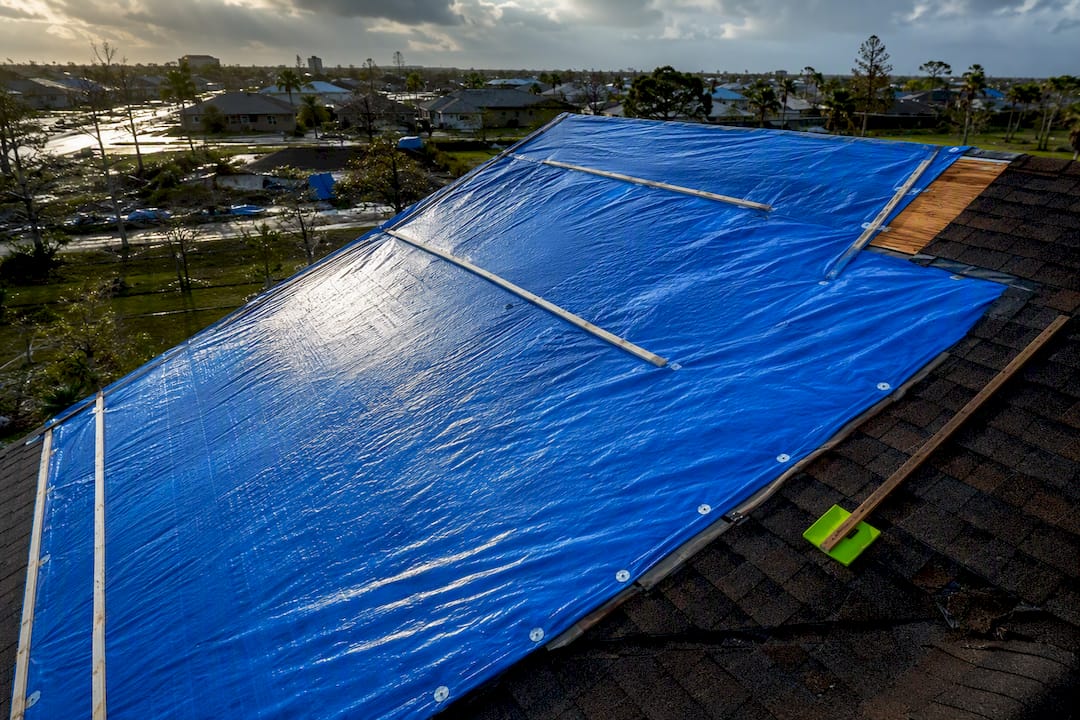
Yes, a blue tarp roof program exists, but it’s not one single thing. Operation Blue Roof, run by the U.S. Army Corps of Engineers for FEMA, installs free temporary roof sheeting after a federal disaster declaration. Separately, state programs like Louisiana’s Blue Tarp Program offers repair grants on their own timelines. Both require activation. Federal help is free but temporary; state grants can fund actual repairs, but only within set application windows.
TL;DR:
- Operation Blue Roof provides free, temporary fiber-reinforced sheeting for primary residences after federal disaster declarations, lasting about 30 days.
- State programs like Louisiana’s Blue Tarp Program offer repair grants with application windows that open independently of FEMA activation.
- Eligibility for federal sheeting excludes flat, clay tile, slate, and asbestos roofs, and requires homeowner signs and proof of damage, occupancy, or ownership.
- Private contractors are a reliable alternative for immediate tarping and documentation, often supporting faster insurance claims and permanent repairs.
- Homeowners should act within the first 72 hours after damage by documenting, calling insurers, and starting temporary coverage, regardless of federal program activation.
Table of Contents
- What Is Operation Blue Roof, and How Do State Programs Differ?
- Who Qualifies, and What Roofs Get Excluded?
- How Do You Apply for Tarp Assistance?
- What to Expect After the Tarp Goes Up
- When Should You Just Hire a Private Contractor?
- Seven Things to Do in the First 72 Hours
- What Homeowners Usually Get Wrong About the Blue Roof
- Where to Check Program Status and Official Rules
- Sources
- FAQ
What Is Operation Blue Roof, and How Do State Programs Differ?
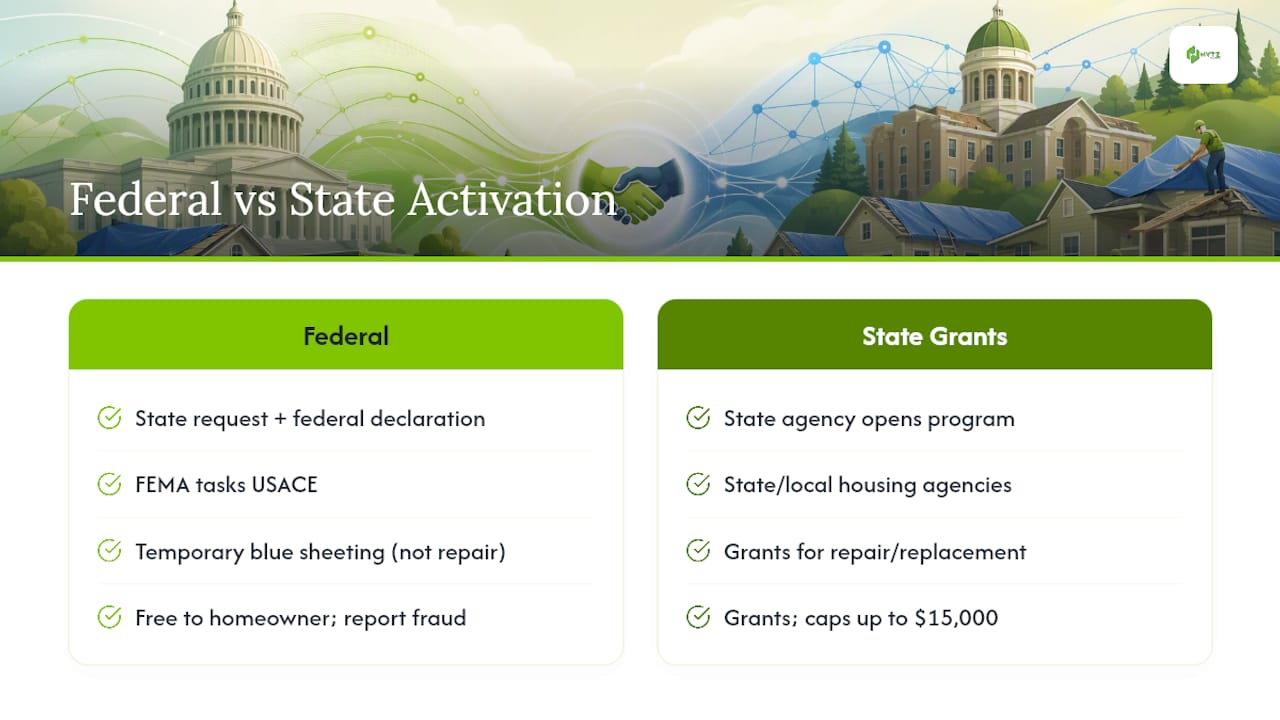
Operation Blue Roof is a free, temporary service. USACE crews install fiber-reinforced sheeting, sometimes called the “blue roof,” over damaged primary residences to keep water out until permanent repairs happen. It’s not a repair. It’s not a replacement. It’s a stopgap, and the Corps is explicit that the service costs homeowners nothing. If someone shows up asking for payment, that’s fraud, and FEMA wants it reported to the Disaster Fraud Hotline at 1-866-720-5721.
State programs work differently. Louisiana’s Blue Tarp Program, run through the Louisiana Housing Corporation, has offered grants for roof repair or replacement in eligible parishes following certain disasters, with local coverage citing grant caps up to $15,000 in past rounds. These programs open and close on their own schedules, often tied to specific parishes or counties named after a particular storm.
Activation is the biggest difference. Operation Blue Roof only exists once FEMA formally tasks USACE, and that only happens after a state requests federal help and a disaster declaration is in place. State grant programs don’t wait on Washington. They open when state agencies decide funding and need justify it, which means a Gulf Coast homeowner could see a state grant window open even in a storm season that never triggers Operation Blue Roof.
Who Qualifies, and What Roofs Get Excluded?
Not every damaged roof qualifies for temporary federal sheeting, and the rules matter more than most homeowners expect.
For Operation Blue Roof, eligibility generally requires:
- The property is a primary residence, not a vacation home, rental, or secondary property.
- Roof framing damage is half or less of the total structure. Beyond that, USACE considers the roof deck too unsafe to hold the lath-and-fastener installation.
- The roof type is compatible with sheeting. Flat roofs, clay tile, slate, and asbestos tile roofs are typically excluded because the installation method doesn’t work safely on them.
- The homeowner signs a Right of Entry form, without which contractors legally cannot step onto the property.
State programs add their own filters on top of that. Louisiana’s Blue Tarp Program has historically required proof of ownership or occupancy, income documentation for grant eligibility, and residency in a parish named in that round’s disaster designation. If your home sits outside the named parish list, it doesn’t matter how much damage you have. Always check the exact eligibility page for the round in question rather than assuming last year’s rules still apply.
How Do You Apply for Tarp Assistance?
When a federal mission is active, the process moves fast, but only if you follow the right channels in the right order.
- Check activation status first. Visit Blueroof or call the hotline at 1-888-ROOF-BLU (888-766-3258) to confirm Operation Blue Roof has been activated in your county.
- Watch your state housing authority. For Louisiana residents, that means the Louisiana Housing Corporation’s website and local press releases, since state grant windows aren’t always announced through the same channels as the federal mission.
- Sign the Right of Entry (ROE) form. This is the legal document allowing Corps contractors onto your property. No ROE, no installation, even if your home otherwise qualifies.
- Gather your documents. Have ID, proof of ownership or occupancy, dated photos of the damage, and your insurance declarations page ready. State grant applications usually also require income proof.
- Submit through official collection points only. ROE forms and program applications should go through the addresses or portals listed on blueroof.gov or your state agency’s site, never through a door-to-door solicitor.
What to Expect After the Tarp Goes Up
The sheeting isn’t a repair. It’s designed to buy time, and it doesn’t buy much of it.
FEMA’s own guidance says the fiber-reinforced covering is built to last about 30 days, installed using wood lath and fasteners over the existing deck. That 30-day window is the number to plan around, not a suggestion.
Pro Tip: Mark the installation date on your calendar the day the crew leaves. Thirty days passes faster than most homeowners expect, especially when insurance paperwork is still moving.
Once the covering is up, a few things need to happen quickly:
- Call your insurer and open a claim if you haven’t already, and note the tarp installation date in that call.
- Request estimates from licensed roofing contractors for the permanent repair or replacement.
- Photograph the sheeting and surrounding damage for your own records, separate from whatever documentation USACE or your insurer collects.
- Track any program deadlines tied to your state’s grant window, since missing a submission date can end your eligibility for that round.
Homeowners who treat the tarp as “handled” instead of “temporary” are the ones who end up with mold and rotted decking by the time permanent storm damage roof repair in Tampa or elsewhere finally gets scheduled.
When Should You Just Hire a Private Contractor?
Federal and state programs are episodic. They activate for named disasters in named counties, and there’s no guarantee either one shows up after your specific storm.
Private roofing contractors fill that gap year round. A licensed crew can tarp your roof within hours of a call, document the damage properly for your insurance file, and often bill the mitigation work directly as part of your claim. That’s a meaningful advantage over waiting on a federal timeline that might never activate for your address.
- Private tarping is available immediately, regardless of whether FEMA has declared a disaster in your area.
- Professional documentation of temporary repairs tends to support insurance claims better than homeowner photos alone.
- Quality matters here: reinforced sheeting properly secured with lath and fasteners prevents wind from tearing it loose during the next system.
- DIY tarping with bungee cords or improvised weights often fails in sustained wind and can void a claim if the insurer decides the mitigation attempt made damage worse.
Pro Tip: If a named storm is bearing down on the Gulf Coast, don’t wait to see if Operation Blue Roof gets activated before calling a contractor. Book emergency roof tarping the moment your roof is compromised. You can always cancel if federal help arrives first.
Seven Things to Do in the First 72 Hours
- Stay off the roof. Structural damage isn’t always visible from the ground, and falls are a leading cause of post-storm injury.
- Photograph damage from safe vantage points, inside and outside the home.
- Call your insurer immediately and document every call, email, and adjuster visit.
- Check blueroof.gov or call 1-888-ROOF-BLU, and monitor your state housing authority for program activation.
- Sign a Right of Entry form only through official Operation Blue Roof collection points, never a random contractor claiming to represent the program.
- If no program is active in your area, arrange professional tarping and keep every receipt for your insurance file.
- Collect multiple estimates for permanent repair so you have a record for both your insurer and your own decision making.
What Homeowners Usually Get Wrong About the Blue Roof
A blue tarp buys thirty days, not thirty weeks. That’s the single biggest misconception we run into with Tampa Bay homeowners after a storm: they treat the temporary sheeting as a finished job instead of a countdown clock. Mold sets in fast under Florida humidity, and structural rot doesn’t wait for your insurance adjuster’s schedule to open up.
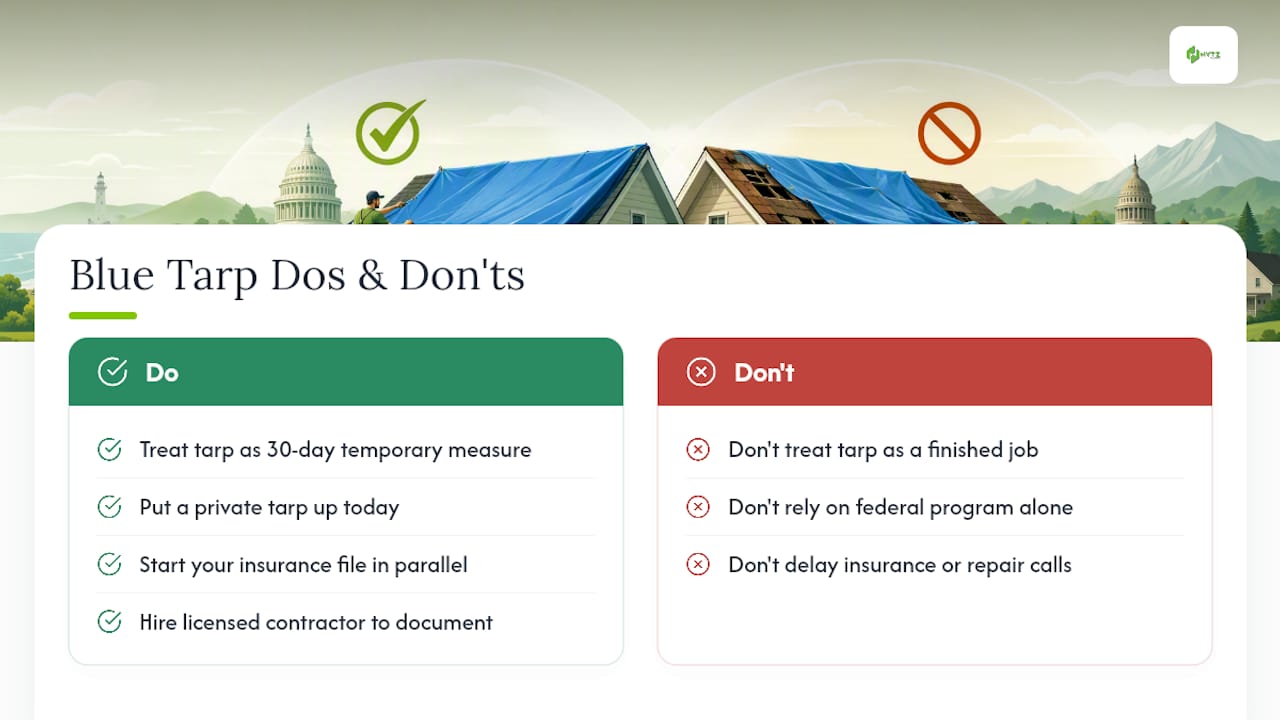
Licensed contractors matter here because they document everything an insurer wants to see: dated photos, material specifics, and a paper trail that speeds up your claim instead of stalling it. Hytz Roofing handles emergency tarping, that documentation, and the permanent roof replacement that has to follow it. Plan for federal help if a hurricane triggers it. Don’t build your whole recovery timeline around a program that might never activate for your street.
If your roof is compromised right now, get a private tarp up today and start your insurance file in parallel. If your storm does trigger Operation Blue Roof or a state grant window, you’ve lost nothing by having already protected the house. For homeowners weighing whether their roof needs insurance claims support or a straight storm damage repair estimate, getting that call made early is the difference between a 30-day fix and a 30-day disaster.
— Anthony
Where to Check Program Status and Official Rules
Bookmark these before storm season, not during it: Operation Blue Roof and blueroof.gov for federal sign-up and Right of Entry details, FEMA’s Operation Blue Roof FAQ for program rules, and the Louisiana Housing Corporation’s Blue Tarp Program page for state grant windows. Roofing material guides from partners like Alpha Solar Solutions and comparisons such as shingle versus metal roofing can also help you understand why certain roof types get excluded from temporary sheeting programs.
Sources
- Operation Blue Roof
- Frequently Asked Questions about Operation Blue Roof
- Louisiana Blue Tarp Program — Louisiana Housing Corporation
FAQ
How do I get a FEMA blue roof for free?
Operation Blue Roof is free whenever FEMA has activated it in your county. Check blueroof.gov or call 1-888-ROOF-BLU to confirm activation, then sign a Right of Entry form to schedule installation.
Is there really a roof replacement program?
Operation Blue Roof only provides temporary sheeting, not replacement. Actual repair or replacement funding comes from separate state grant programs, such as Louisiana’s Blue Tarp Program, or from your homeowner’s insurance claim.
Who is eligible for roof repair grants after a disaster?
Eligibility varies by program and state, but common requirements include owning and occupying the home as a primary residence, living in a parish or county named in the disaster declaration, and meeting income limits set for that specific grant round.
Why do people put blue tarps on their roofs?
Blue tarps and fiber-reinforced sheeting cover storm-damaged roofs to stop water intrusion and prevent mold or structural rot while homeowners wait for permanent repairs. The covering is meant to last about 30 days, not indefinitely.