Tampa Bay Homeowners: 3 Roof Underlayment Types to Demand on Estimates
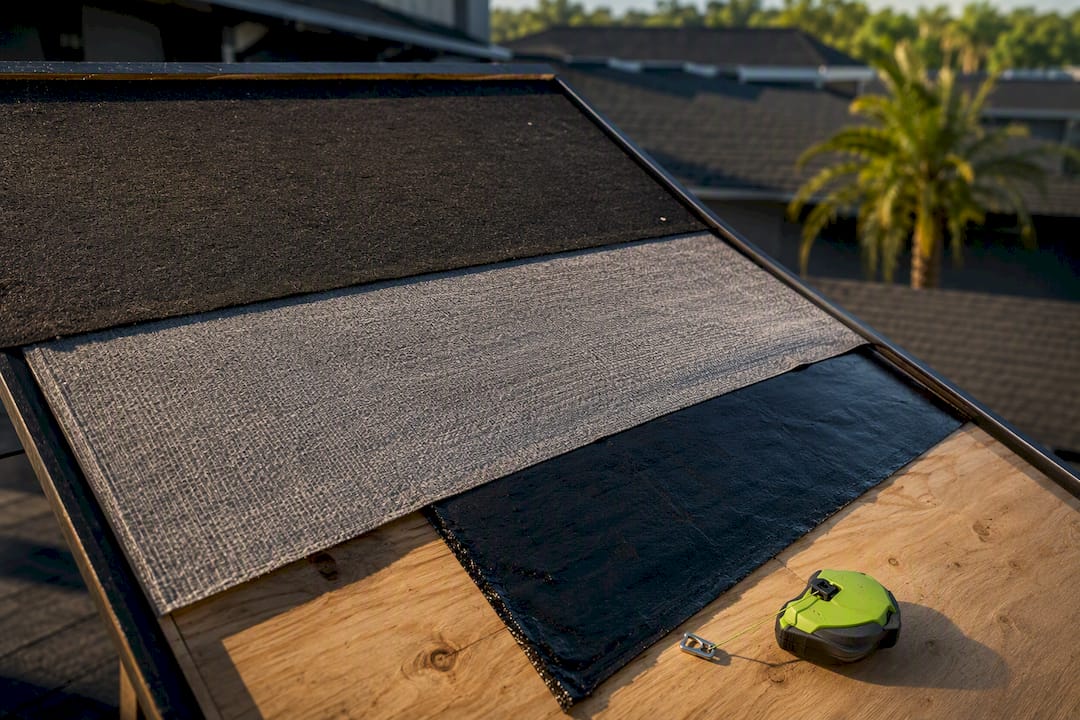
There are three roof underlayment types: asphalt-saturated felt, non-bitumen synthetic sheeting, and self-adhered rubberized asphalt membrane. For most Tampa Bay homes, the practical default is synthetic underlayment across the roof field paired with self-adhered membrane at eaves, valleys, and penetrations. Felt still works as a budget, short-exposure option, but slope, roof covering, and Florida’s building code can shift that recommendation.
TL;DR:
- Most Tampa Bay homes benefit from synthetic underlayment across the roof and self-adhered membrane at critical spots like eaves and valleys for optimal waterproofing.
- Felt remains a budget-friendly option but degrades quickly if left exposed beyond a few days and is less tear-resistant than synthetic alternatives.
- Self-adhered membranes are the only fully waterproof underlayment, ideal for leak-prone areas, but come at a higher cost and are less reusable after installation.
- Florida building codes generally require two layers of underlayment on low-slope roofs and specify standards that guide material selection based on roof slope and climate factors.
- Proper fastener choice and installation timing are crucial for durability, with synthetics needing specific cap nails and longer exposure times offering better protection against storm exposure.
Table of Contents
- Types of Roof Underlayment Explained
- Pros and Cons: What Each Type Trades Off
- What Determines Which Underlayment You Need
- Installation Details That Actually Protect Your Roof
- Cost and Lifespan by Underlayment Type
- Recommended Underlayment Pairings by Roof Type
- How Hytz Roofing Applies These Standards on Tampa Bay Roofs
- Field Tips: What to Check on Your Roofing Estimate
- Request a Roof Underlayment Assessment From Hytz Roofing
- Sources
- FAQ
Types of Roof Underlayment Explained
Every roof needs a barrier between the deck and the finished roofing material, and that barrier comes in one of three families. Each one behaves differently once it’s exposed to Florida sun, wind, and rain.
Asphalt-saturated felt is the traditional choice, made of a paper or fiberglass mat soaked in asphalt. It comes in two weights: 15# felt, thinner and cheaper, and 30# felt, which resists tearing better and holds up longer under foot traffic during installation. Felt is inexpensive but degrades quickly when left uncovered.
Synthetic underlayment is woven or spunbond polypropylene or polyester, often with a non-slip coating. Synthetics generally beat felt on tear strength and UV exposure tolerance, and some can sit exposed for weeks or months instead of days. Permeance varies a lot between products, too:
- Most synthetics act as vapor barriers, which suits ventilated attic assemblies.
- A smaller group of vapor-permeable synthetics exist for tile and cedar roofs that need airflow.
- High-temperature synthetic variants are built specifically for metal roofing.
Self-adhered membranes (rubberized asphalt, often called peel-and-stick) bond directly to the deck and are the only fully waterproof underlayment category. They’re built to ASTM D1970 and reserved for the spots where a leak would do the most damage.
Pros and Cons: What Each Type Trades Off
Comparing bids gets a lot easier once you know what each material gives up in exchange for its price tag.
- Felt costs the least per square and installs fast, but it tears more easily, wrinkles when it absorbs moisture, and can’t handle more than a few days of sun before it starts breaking down.
- Synthetic holds up to foot traffic better, resists UV for far longer than felt, and gives crews safer footing on steep pitches, though it costs more and some products are notably slick when wet, which affects crew scheduling on humid Tampa mornings.
- Self-adhered membrane is the only category that seals around nail penetrations and stays watertight in standing water, but it’s the priciest option and can’t simply be reused if a shingle layout changes mid-install.
Fastener choice matters just as much as material choice. Synthetics require plastic or metal cap nails rather than standard roofing nails, because a bare nail head will pull straight through the thin sheet in a storm. That single line item on an estimate tells you a lot about whether the crew is following manufacturer installation specs, and it also affects whether your roofing material’s warranty stays intact.
What Determines Which Underlayment You Need
Florida’s building code sets the floor, not the ceiling, for underlayment choice. Under IRC R905.1.1, roofs with a slope between 2:12 and 4:12 require two layers of underlayment, while steeper roofs generally need only one. That single code reference explains why a low-slope patio roof or pool cage tie-in often needs a heavier assembly than the main house.
Climate pushes the decision further. Tampa Bay doesn’t deal with ice dams, but it deals with wind-driven rain that finds every gap in a shingle roof during a tropical system, which is exactly the failure mode self-adhered membrane is built to stop. Roofing material matters too:
- Metal roofs need underlayment rated for heat, since dark standing-seam panels can radiate temperatures well above what standard synthetics or felt can tolerate.
- Tile and slate need vapor-permeable underlayment in many cases, since impermeable synthetics can trap moisture under a heavy tile deck.
- Some shingle manufacturers require synthetic underlayment specifically to honor their extended system warranty.
Pro Tip: Ask your contractor to name the exact underlayment product and its ASTM rating on your estimate, not just “synthetic” or “felt.” That single detail tells you whether the warranty will actually hold up if you file a claim later.
Installation Details That Actually Protect Your Roof
The material only performs as well as the installation. Synthetics need plastic cap nails or metal cap fasteners, spaced according to the manufacturer’s pattern, because standard staples pull through too easily in high wind. Felt tolerates ordinary nails but still benefits from caps in coastal wind zones.
Exposure time matters more than most homeowners realize. Felt can typically sit uncovered for only a day or two before it starts to degrade, while many synthetics tolerate several weeks, which gives crews room to work around Florida’s unpredictable afternoon storms without risking water damage to the deck.
Self-adhered membrane belongs at specific trouble spots:
- Eaves, where wind-driven rain backs up under shingles
- Valleys, where water volume concentrates
- Around chimneys, skylights, and vent penetrations
- Full deck coverage on low-slope sections
One compatibility warning worth repeating: check the membrane’s rating before it goes anywhere near copper, Cor-Ten, zinc, or hot-running metal panels. The wrong product can degrade against certain metals or under sustained heat.
Cost and Lifespan by Underlayment Type
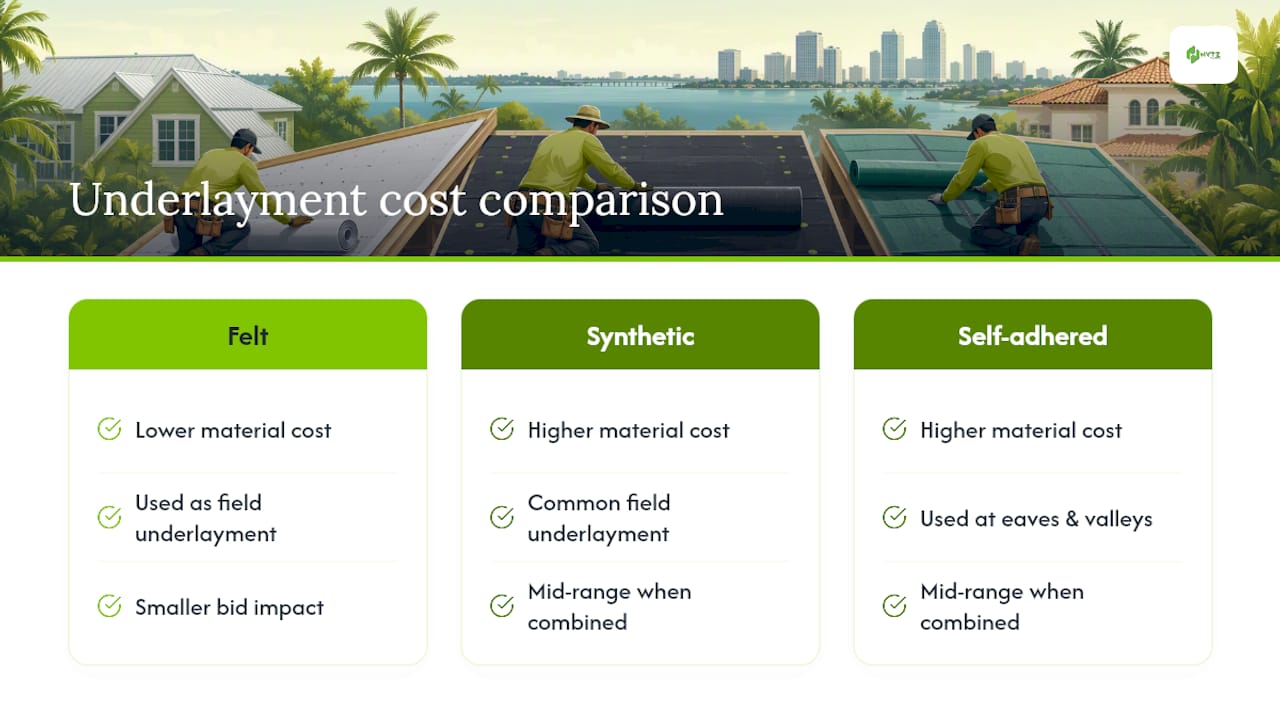
Material-only pricing varies, with felt generally costing less than synthetic and self-adhered membrane options. The exact cost range depends on product and market conditions, and the price difference between felt and self-adhered membrane can significantly affect the total roofing bid.
A common assembly on a standard Tampa Bay shingle roof, synthetic field underlayment plus self-adhered membrane at eaves and valleys, lands in the middle of that range once you blend material costs across the whole deck.
Recommended Underlayment Pairings by Roof Type
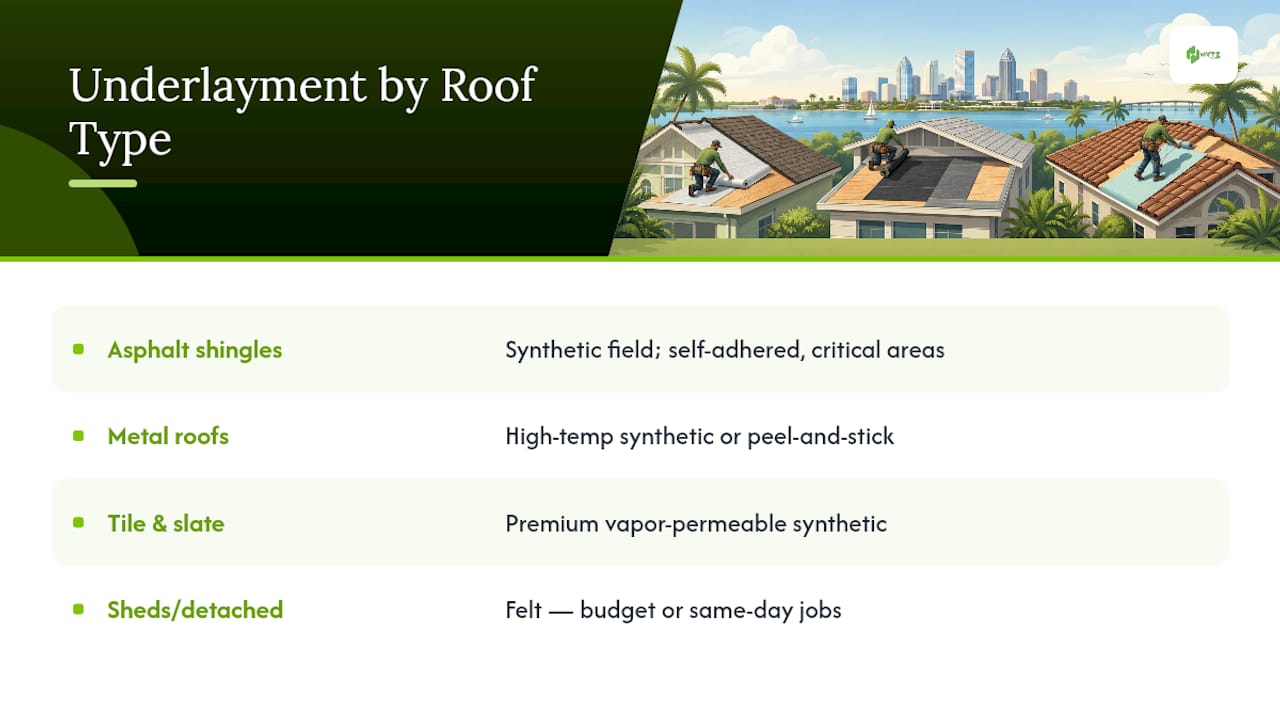
Most asphalt shingle roofs do best with synthetic underlayment across the field and self-adhered membrane at the eaves, valleys, and any penetration. That combination balances durability with waterproofing exactly where leaks tend to start.
Standing-seam and exposed-fastener metal roofs need a high-temperature synthetic or a high-temp peel-and-stick, since standard membranes can soften or degrade under a hot metal panel. Tile and slate roofs generally call for a premium, vapor-permeable synthetic that lets moisture escape from under the heavy covering. Felt still makes sense on detached structures, sheds, or same-day tear-off jobs where budget outweighs long-term exposure concerns.
How Hytz Roofing Applies These Standards on Tampa Bay Roofs
Hytzroofing is a GAF Master Elite® contractor, a distinction held by fewer than 2% of roofing companies in North America, and holds Florida Contractor License #CCC1332551 with BBB A+ accreditation. That background shapes how we spec underlayment on every job:
- Synthetic field underlayment is our standard for most shingle and metal replacements, with extra self-adhered membrane added at rakes and eaves for wind-driven rain protection.
- Felt still gets specified occasionally for same-day, budget-conscious repairs where full exposure protection isn’t the priority.
- Every metal roof spec gets checked against the panel’s heat rating before we choose between standard and high-temp underlayment.
Field Tips: What to Check on Your Roofing Estimate
I always tell homeowners to ask for the exact underlayment product name and its ASTM number, not just “felt” or “synthetic” written on a line item. Ask how many exposure days the product is rated for and what fastener type the crew will use. If self-adhered membrane is planned, confirm exactly where.
Red flags worth walking away from: no product name listed, vague fastener language like “as needed,” or a metal roof spec with no mention of a high-temp underlayment. On most Florida homes, upgrading from felt to synthetic in the field, or adding peel-and-stick at valleys, is a small line-item increase that pays off the first time a named storm rolls through.
— Anthony
Request a Roof Underlayment Assessment From Hytz Roofing
Choosing between felt, synthetic, and self-adhered membrane gets a lot easier when someone is actually looking at your deck, your slope, and your roof covering instead of guessing from a brochure. Hytzroofing specs every underlayment assembly to match Florida’s building code and the manufacturer warranty tied to your shingles, metal panels, or tile.
If your roof is due for replacement or repair, request a free estimate and have your roof’s age, slope, and covering type ready. It speeds up the inspection and gives you a straight answer on which underlayment assembly fits your home and your budget.
Sources
- Roofing Underlayment Types - InterNACHI
- Synthetic roofing underlayments - Fine Homebuilding
- Felt vs Synthetic Roof Underlayment: 2026 Comparison | The Roofing Brief
- Underlayment 101 — Roofing Elements Magazine
- GCP product guidance for GRACE® ice & water shield - GCP
FAQ
What Is the Best Underlayment for a Metal Roof?
A high-temperature-rated synthetic or high-temp self-adhered membrane works best under metal, since standard products can degrade against hot panels or certain metals like copper and zinc.
Is Synthetic Underlayment Better Than Felt?
Synthetic generally outperforms felt on tear strength and UV tolerance, and it can stay exposed for weeks instead of days, though felt costs less upfront.
Where Does Peel-and-Stick Underlayment Go on a Roof?
Self-adhered membrane belongs at eaves, valleys, and penetrations like chimneys and vents, since it’s the only fully waterproof underlayment type available.
Does Florida Code Require a Specific Underlayment?
IRC R905.1.1 requires two layers of underlayment on roofs sloped between 2:12 and 4:12, and specific ASTM standards govern which felt, synthetic, or self-adhered products qualify.
How Long Does Roof Underlayment Last?
Felt typically has the shortest usable life once exposed, while synthetic underlayment is built to match most shingle systems, and self-adhered membrane holds up for the life of the roof covering at that detail.