Roof Condensation in the Attic: Causes, Signs and Fixes
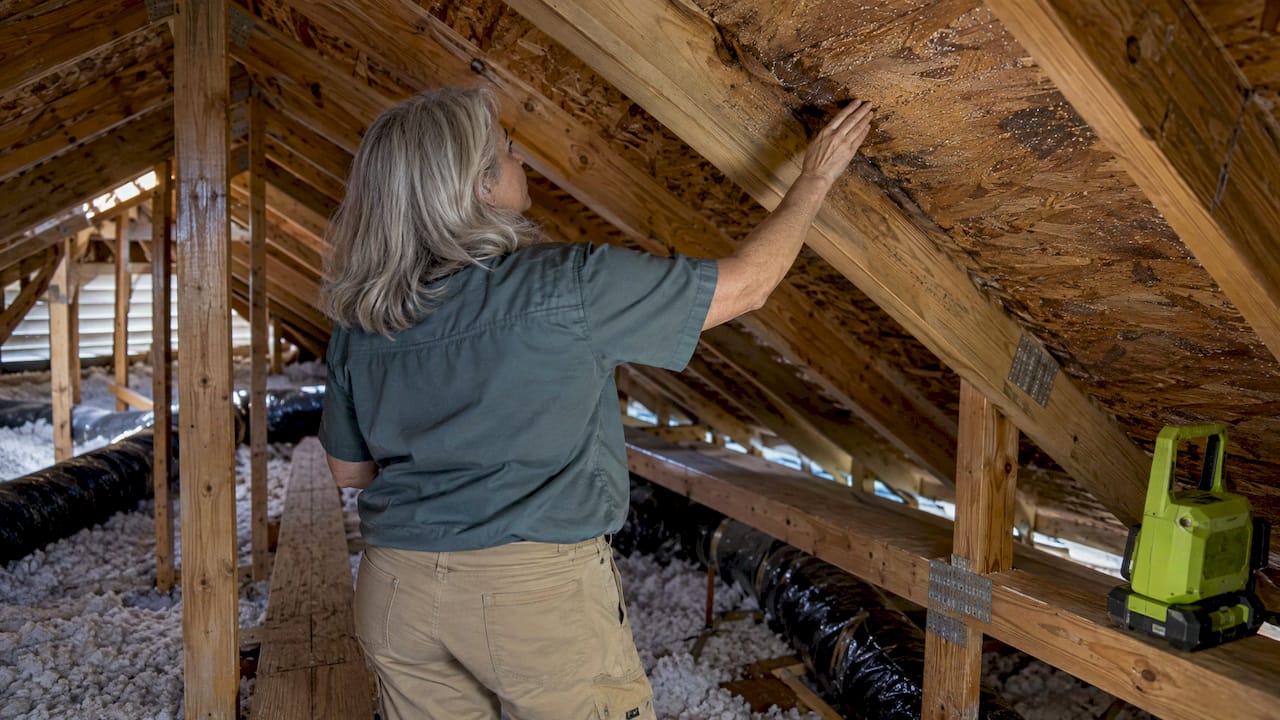
Condensation in an attic happens when warm, moist air reaches a surface cold enough to turn that moisture into water. In a Tampa Bay home, that usually means humid air getting into the attic from the house or the outdoors and touching the underside of the roof deck. The fix is rarely a new roof. It is usually a mix of sealing air leaks, venting the right appliances outside and getting the attic’s airflow balanced. The first step is knowing whether you have condensation or a leak, because the two need different repairs. 💬 If you want a roofer to look at it with you, our team at Hytz Roofing handles roof inspections across Tampa Bay and Central Florida.
TL;DR
- Condensation forms when surfaces fall below the dew point of the air around them, and the Pacific Northwest National Laboratory (PNNL) Building America guide ties it to four things: cold surfaces, air leaking in, humid air and poor drying.
- Broad dampness across many sheathing panels points to condensation. A small, concentrated stain below a vent pipe, chimney or valley points to a leak.
- Repeated condensation can rot wood, corrode fasteners and grow mold, so it is worth fixing early.
- The usual fixes: seal air gaps, send bath fans, dryers and range hoods outdoors, keep soffit vents open and keep insulation off the roof deck.
- If you cannot tell which problem you have, a roof inspection settles it.
Table of Contents
- Why condensation happens in an attic
- What makes Florida different
- Should you worry about it?
- Condensation or a roof leak?
- How to check your attic for moisture
- The usual causes in Tampa Bay homes
- How to fix and prevent attic condensation
- When condensation has already done damage
- Perspective
- Get it looked at before the next rainy season
- FAQ
- Sources
Why condensation happens in an attic
Think of a cold glass of tea on a porch in August. Water beads on the outside because the glass is colder than the dew point of the air touching it. An attic works the same way. When any surface drops below the dew point of the air around it, moisture comes out of that air as liquid.
PNNL’s guide lists four conditions behind attic condensation:
- A surface colder than the dew point of the air it touches.
- A pressure difference plus a hole in the air barrier, so warm, moist indoor air leaks into the attic.
- High humidity in that indoor air.
- Too little ventilation or drying potential to carry moisture away.
Wind, unbalanced mechanical ventilation and leaky attic ducts can all make that pressure difference worse, according to the same guide.
A 2016 literature review from the U.S. Department of Energy’s research network found the main concern is the underside of the roof sheathing, the first surface moisture meets. The review says risk is highest at the roof peak and on north-facing slopes. That matters when you go looking, because those are the places to check first.
What makes Florida different
Most advice on this keyword comes from cold-climate sources and talks about winter frost. Florida has a milder winter story, but the same physics still applies. Cooler nights and cold fronts in winter can chill the roof deck while the house stays humid. In summer, the risk flips toward humid air meeting surfaces cooled by air conditioning, such as ducts and the ceiling plane.
Florida’s own research points the same way. A Florida Building Commission-published lab study from 2019 found no condensation, mold or rot in any tested attic configuration. It did find that sealing attic vents raised roof-deck surface relative humidity from 68% to 82% and deck moisture from 11.5% to 13% in comparable conditions. It also showed higher deck moisture as weather cooled, and named central and north Florida as the main moisture concern.
Take that as a reason to keep your attic’s air path working, whatever your roof type. We cover how venting rules apply here in our guides on the 1:150 rule for Florida attics and on 1/150 versus 1/300 ventilation.
Should you worry about it?
A little moisture is normal. PNNL says well-designed roofs can handle low levels of moisture, but elevated moisture can quickly lead to mold. Repeated or prolonged condensation can also cause:
- Mold growth, which is an indoor air quality issue.
- Rot, swelling and delamination of plywood and OSB roof sheathing (OSB is the pressed wood panel used for many roof decks).
- Corrosion of metal fasteners, which can eventually weaken parts that carry the roof’s load.
Wood moisture numbers help you understand the risk. A Building America resource by building scientist Joseph Lstiburek says wood surfaces are likely to develop mold above about 16% moisture content by weight, and decay begins around 28%. A USDA Forest Service review says decay fungi are completely inhibited below 20%. It also notes that wet wood can take a long time to dry. A damp spot you ignore for a season is not a small problem.
If anyone in your home has asthma or a mold allergy, treat visible mold in the attic as a reason to act quickly and ask your doctor about symptoms.
Condensation or a roof leak?
This is the question that decides your next step, and the two look alike from the ceiling below. Look in the attic for the pattern, not just the stain.
| What you see | More likely condensation | More likely a leak |
|---|---|---|
| Size of the wet area | Very large, covering much of the sheathing | Small and confined |
| Location | Broad discoloration near the ridge or on the north side | Concentrated below a vent pipe, skylight, chimney or valley |
| Timing | Shows up on humid or cool mornings, with no rain | Gets worse during or right after rain |
| Other clues | Droplets or rust on nail tips, widespread mold | A trail running from one point |
The size and mold clues come from Cornell’s extension guide on attic condensation. The stain-location clue comes from a home inspection guide published in August 2026, which says a concentrated stain below a penetration is more consistent with a leak, while broad discoloration near the ridge or north side may suggest condensation.
Wind-driven rain can fool you too. If stains show up only after storms, read about wind-driven rain roof leaks in Tampa Bay. If the stain is on a ceiling below, our guide on what causes water stains on a ceiling walks through the possibilities.
How to check your attic for moisture
Pick a time when the problem is most likely to show. Go up early on a humid morning, or the morning after a cold front, with a flashlight. Watch your footing on the joists, and wear a mask and gloves. Attics in Florida get dangerously hot by midday, so go early.
Look for these signs:
- Water droplets or frost on the roof boards. Cornell says they are often most visible on the ends of roofing nails that poke through the sheathing.
- Wet or compressed insulation, especially near the eaves. The U.S. Department of Energy’s Guide to Durable Attics lists this alongside mold or mildew, warped or rotting wood, bubbled paint at soffits and worn or warped shingles at the roof edges.
- Rusted nails and dark, widespread staining. Both suggest repeated moisture, not a one-time event.
- A musty smell. NC State Extension’s mold and moisture checklist includes it among the things to look for in attic walls, joists and insulation.
If you own a moisture meter, InterNACHI, an inspector association, gives 5% to 12% as a normal reading for wood and up to 17% as acceptable. A reading well above that on sheathing is worth a closer look.
What about summer humidity?
There is no single published number for what summer attic humidity “should” be, because it follows the outdoor air. What you can control is indoor humidity. NC State Extension advises keeping indoor humidity below 60%, with 30% to 50% as the ideal range. In the attic itself, look at the result: dry wood, dry insulation and no musty smell. Family Handyman’s inspection checklist cites a certified inspector saying a summer attic should be cooler than 110°F, a hint that ventilation is working.
The usual causes in Tampa Bay homes
Bath fans, dryers and range hoods venting into the attic
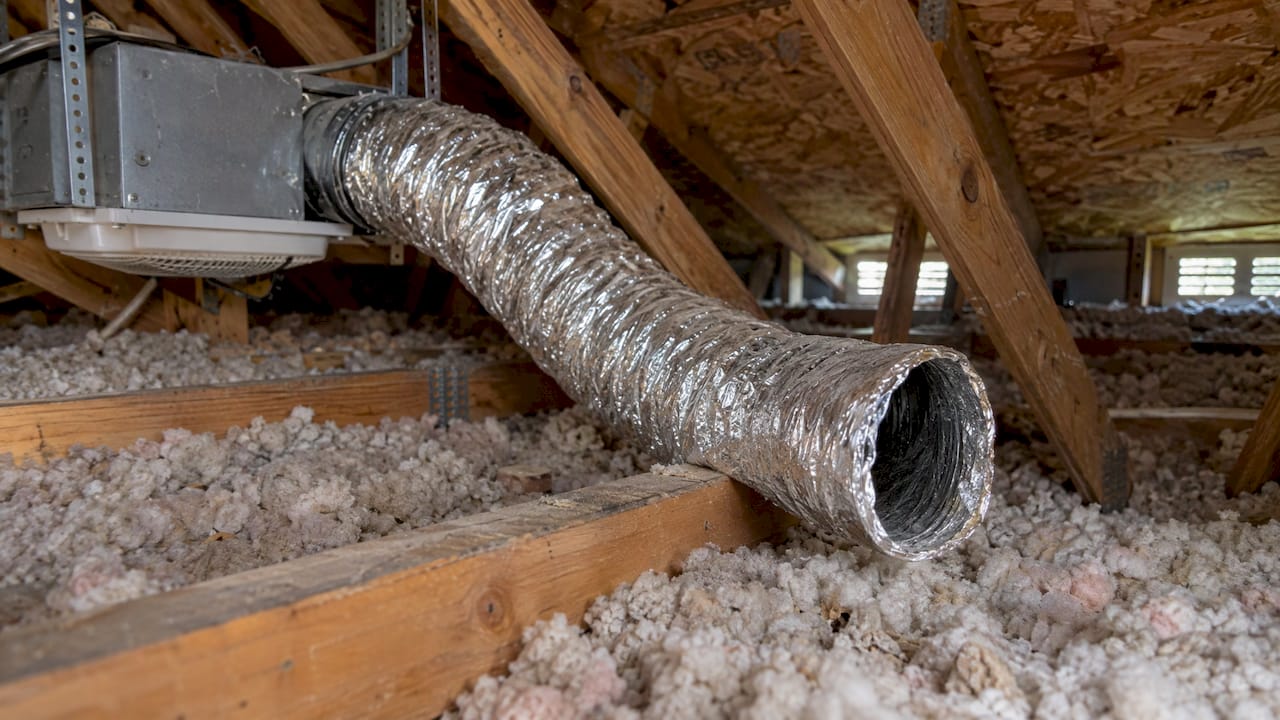
This is the first thing to rule out. The Department of Energy says venting kitchen ranges, bathroom fans or dryers into the attic is a major moisture source, can lead to mold and may violate local building codes. It tells homeowners to correct it immediately. A bath fan duct that has come loose or ends in the attic dumps a shower’s worth of water vapor above your ceiling every day.
Air leaks from the house
Gaps around the attic hatch, duct boots, wires, pipes and recessed lights let moist indoor air drift up. A Bonneville Power Administration field guide lists weatherstripping the hatch, sealing duct boots with mastic or caulk and sealing electrical and plumbing penetrations as standard attic air-sealing steps.
Blocked soffit vents and insulation pushed against the deck
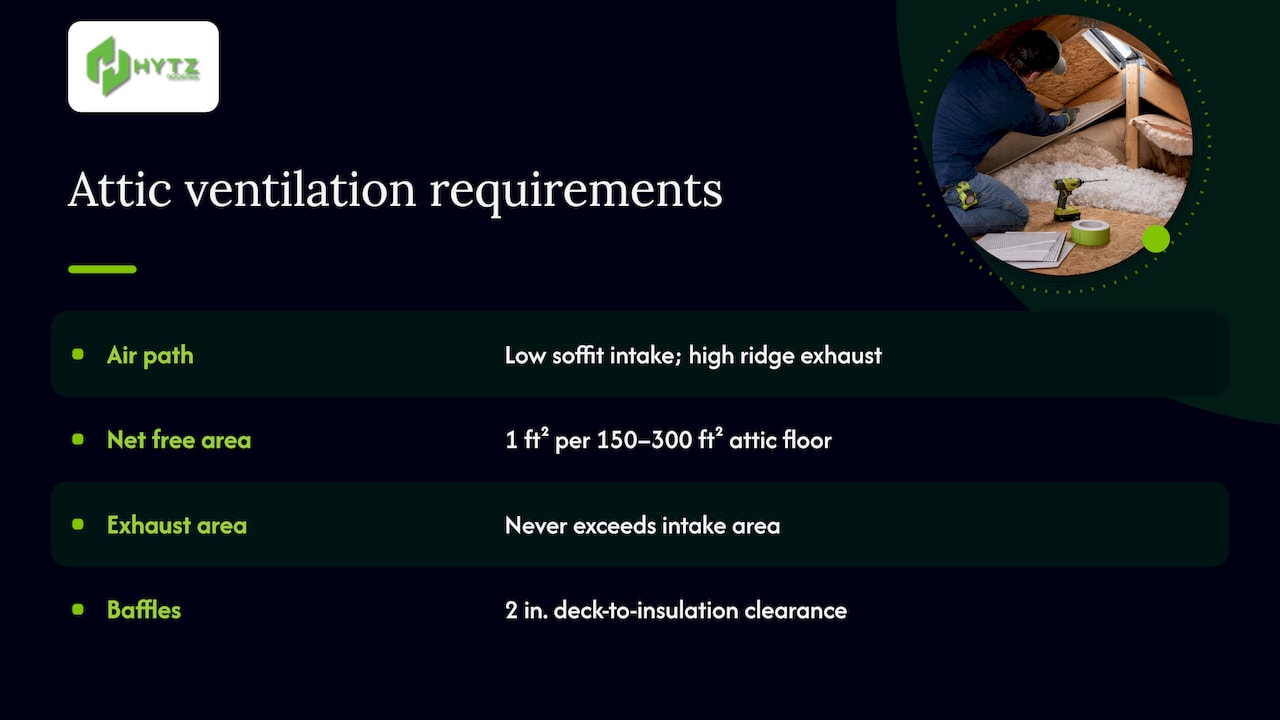
Attic ventilation works as a path: air comes in low at the soffits and leaves high at the ridge. If insulation covers the soffit openings, that path closes. PNNL notes residential codes typically call for 1 square foot of net free vent area per 150 to 300 square feet of attic floor, exhaust area should never exceed intake area, and baffles should hold 2 inches of clearance between the roof deck and the top of the insulation.
Too much exhaust without enough intake backfires. A DOE measure guideline says excess high vents can create suction that pulls air out of the top of the house, and that is exactly the air you do not want in the attic.
Leaky or uninsulated attic ducts
Air conditioning ducts run cold in a hot attic. If they leak, or sweat because they are poorly insulated, you get moisture on the ducts and the framing around them. Ducts are an HVAC matter, so ask an HVAC contractor to check and seal them. Fix the roof-side problems with us at the same time, so the attic stays dry.
How to fix and prevent attic condensation
PNNL describes five approaches: warm the surfaces where condensation forms, limit air leakage, reduce indoor humidity, use materials that can safely store some water and ventilate to speed drying. In practice, work through this order:
- Move moisture sources outdoors. Make sure every bath fan, dryer and range hood ducts through the roof or wall to the outside, not into the attic.
- Seal the air leaks. Start with the hatch, duct boots, wire and pipe holes and light fixtures. Sealing stops the moist air before it reaches the attic.
- Clear the soffits and add baffles. Baffles keep insulation from blocking intake air. The BPA field guide puts them 2 inches from the roof deck and at least 4 inches above the final insulation level.
- Balance intake and exhaust. Soffit intake paired with a ridge vent is the combination the Department of Energy’s durable-attic guide recommends.
- Control indoor humidity. Run bath fans, fix drips and keep the home within that 30% to 50% range. For sealed attics in hot-humid climates, the OSTI review says supplemental dehumidification is sometimes needed.
- Check the roof itself. The DOE’s first step in a durable attic is a good roof with proper flashing, because a leak and condensation often hide each other.
If your home has a sealed (unvented) attic, the logic changes. The OSTI review says moisture control there depends on keeping the first condensing surface warm with continuous insulation and on controlling indoor moisture. Our article on roof venting for a sealed attic in Tampa covers what works locally.
For how much this costs on the roofing side, our published ranges are $350 to $900 for roof leak or flashing repair, and $463 to $1,589 for roof repair overall. Air sealing and duct work are separate from those figures.
When condensation has already done damage
If the sheathing is soft, dark or delaminating, or fasteners are rusting through, ventilation fixes alone will not undo it. Damaged decking has to be replaced, ideally before you re-roof. Wet insulation should be dried out or replaced. Mold on a small patch of wood is a different job from mold across a whole roof deck, so judge by the area.
Bubbled paint on soffits or warped fascia is a visible sign too. We repair fascia and soffits as part of roof repair. If the underlayment under your shingles is old, it also affects how a roof assembly handles moisture, which our guide to roof underlayment types explains.
Perspective
We get asked about attic moisture a lot, and the honest answer is that the roof is only half of it. A shingle roof, a tile roof and a metal roof all depend on the attic below them breathing the way it was designed to.
That is why we start with a look at the whole system: the decking, the vents, the flashing and where the moisture appears. A stain on the ceiling is only a symptom. If you replace shingles over a deck that stays damp, you have spent the money without removing the cause.
As a GAF Master Elite contractor, we care about getting the roof and its ventilation right the first time. Our roof inspections are meant to give you a clear answer on what is wrong and what is not, so you can fix the right thing.
Anthony
Get it looked at before the next rainy season
📋 If you have found damp wood, rusty nails or a musty smell and cannot tell whether it is condensation or a leak, our roof inspection is the place to start. We are a licensed and insured roofing contractor, Florida License #CCC1332551, serving Tampa Bay and Central Florida. If the inspection finds a leak, our roof repair team can fix it, and if the damage is from a storm we can help with the insurance claim.

If the decking or roof is past repair, our roof replacement page shows what a full replacement costs, from $9,000 to $30,000.
FAQ
Is condensation in the attic normal?
Small, short-lived amounts of moisture are normal, and well-designed roofs handle them. Regular droplets, frost, rusted nails or damp insulation are signs the attic is taking in too much moisture or not drying out.
How do I get rid of condensation in my attic?
Find where the moisture comes from first. Vent bath fans, dryers and range hoods outdoors, seal gaps around the hatch, ducts, wires and pipes, and make sure soffit vents and baffles keep air moving. Then have the roof checked so a hidden leak is not adding water.
Does a bigger vent fix condensation?
Not by itself. Exhaust needs matching intake, and adding more exhaust than intake can pull air from your living space into the attic. A balanced soffit and ridge setup works better than simply adding vents.
Can attic condensation look like a roof leak?
Yes. Both can leave stains on the ceiling. Condensation tends to cover large areas of sheathing and shows up without rain, while leaks leave smaller stains below a penetration, valley or flashing and get worse in rain.
Can condensation cause mold?
Yes. PNNL says repeated or prolonged attic condensation can cause mold growth, along with rot and fastener corrosion. Dealing with the moisture early keeps the problem small.
Sources
- PNNL Building America: Condensation Control in Attics and Roofs in Cold Weather
- OSTI: A Literature Review of Sealed and Insulated Attics
- Florida Building Commission: Residential Attic Vent Performance Comparison, 2019
- Lstiburek: Moisture Control for Residential Buildings
- USDA Forest Service: In-Service Moisture and Temperature Conditions
- Cornell: Causes and Cures of Attic Condensation and Roof Ice Damming
- EGA Home Inspection: How to Detect Attic Moisture
- U.S. Department of Energy: Guide to Durable Attics
- NC State Extension: Mold and Moisture Checklist
- InterNACHI: Moisture Meters for Home Inspectors
- Family Handyman: How to Inspect Your Attic for Signs of Trouble
- BPA: Residential Weatherization Best Practices Field Guide
- DOE Building America: Measure Guideline, Guide to Attic Air Sealing