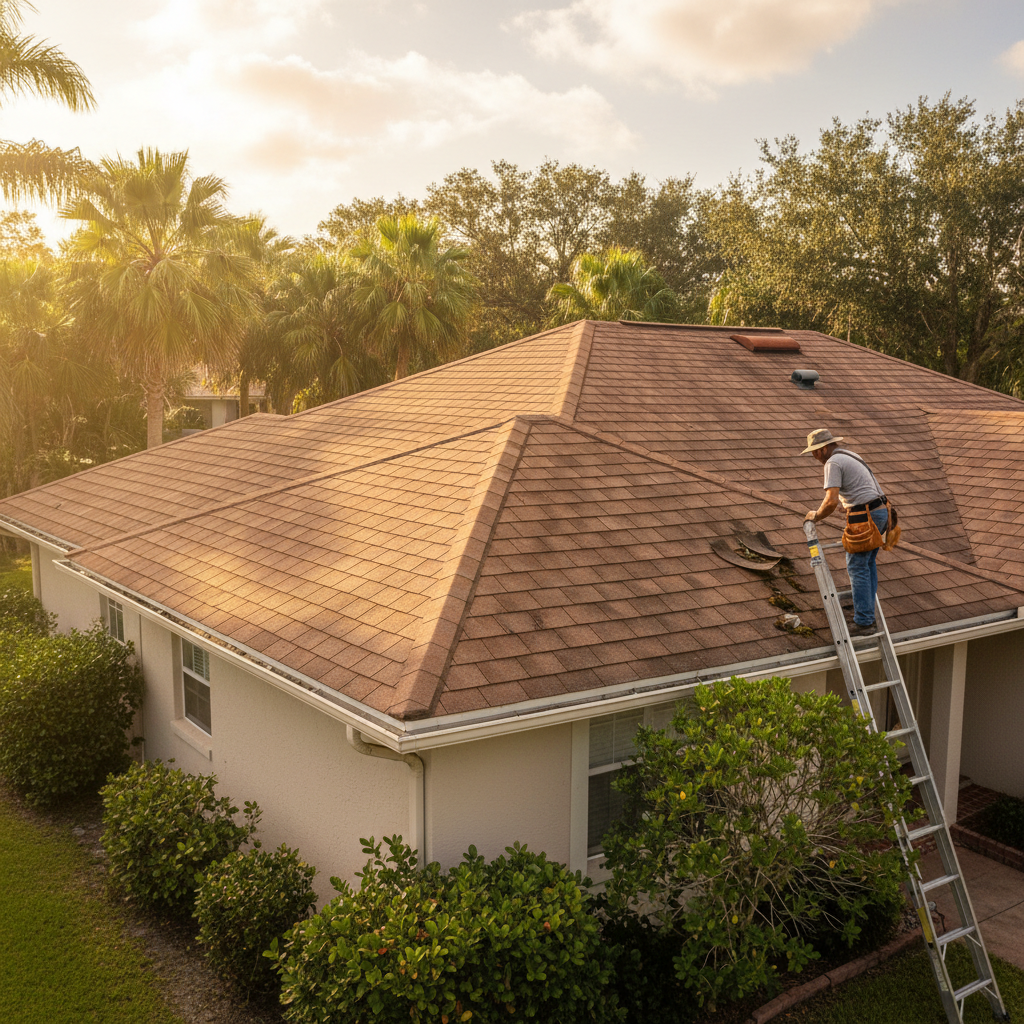
Nobody has studied roofs that were left completely alone, so no honest roofer can give you one number. Here is what the evidence does show. The common baseline of about 20 years for an asphalt shingle roof, from the National Association of Home Builders (NAHB), assumes the roof gets "adequate maintenance." A roof that gets none usually starts leaking at a small part first, such as a cracked pipe boot, a clogged valley, or a loose piece of flashing, often years before the shingles wear out. In Tampa, an unmaintained roof also faces two other deadlines: shingles lose wind resistance as they age, and Florida insurers start looking hard at a roof once it turns 15.
Key Takeaways
- No study has measured a "zero maintenance" lifespan. Published lifespans, including NAHB's roughly 20 years for asphalt shingles, assume the roof is maintained.
- Neglected roofs rarely fail all at once. The first leak usually comes from a small part like a pipe boot, flashing, a valley, or a gutter that backs up, not from worn-out shingles.
- Age matters in a hurricane. In a 2026 study of 623 shingle roofs hit by Hurricane Laura, 60% of roofs that were 2 to 3 years old had no roof cover damage. Only 3% of roofs that were 14 to 15 years old came through undamaged.
- Homeowners insurance pays for sudden damage, not slow decay. Wear and tear, deterioration, and many leaks that run for 14 days or more are commonly excluded.
- In Florida, the deadline you hit first is often insurance, not leaks. Under Florida Statutes section 627.7011, an insurer can require a roof inspection once a roof is 15 years old.
How long will a roof last if I do absolutely zero maintenance?
An unmaintained roof will usually keep the rain out for a good part of its rated life. It will also fail sooner, more suddenly, and more expensively than a maintained roof of the same age. The NAHB Study of Life Expectancy of Home Components (2007) puts asphalt shingles at about 20 years. It also says roof life depends on "local weather conditions, proper building and design, material quality, and adequate maintenance." Take away the maintenance and the 20-year figure no longer applies.
A shingle roof rarely dies because every shingle wore out at once. It dies when one weak spot lets water into the deck, and nobody notices until the ceiling stains. On a neglected roof, that leak goes unseen for months, so a fix that could have been a small repair turns into decking, insulation, and drywall work. In practice, how long a roof lasts with zero maintenance comes down to how long its weakest small part holds and how long the damage goes unnoticed after it fails.
What fails first on a roof that nobody maintains?
The parts that fail first on a neglected roof are rarely the shingles. They are the joints, seals, and drainage paths. The table below lists the usual early failures and how each one shows up.
| Roof component | What zero maintenance allows | How it usually shows up |
|---|---|---|
| Pipe boots (plumbing vent flashings) | Rubber collars on standard boots crack or split where they grip the pipe, a weak point Fine Homebuilding calls out on commodity boots | A ceiling stain near a bathroom or kitchen, often far from where the water got in |
| Valleys and the roof surface | Pine needles and oak leaves pile up, hold moisture against the shingles, and slow drainage | Water working under shingle edges, plus algae and moss on damp areas |
| Gutters and downspouts | Clogs send water back toward the fascia and the roof edge | Rotted fascia, stained soffits, and openings that let animals into the attic |
| Flashing at walls, chimneys, and skylights | Sealant dries and pulls away, and exposed fasteners loosen | Leaks that show up only in wind-driven rain |
| Overhanging branches | Limbs rub off granules and drop debris every day | Bald patches, scuffed shingles, and faster aging under the canopy |
| Shingle field | Granule loss and aging seal strips go unchecked, and lifted or creased shingles are never fixed | Blow-offs in the first strong storm |
Tampa Bay trees make the debris problem worse than the national averages assume. Slash pines drop needles all year, and live oaks drop leaves in heavy late-winter and spring bursts. Our guide to how pine needles and oak leaves damage a roof covers that difference in detail.
How does roof age change hurricane performance in Tampa?
Older shingle roofs lose more of their covering in hurricanes, and a roof nobody maintains is more likely to have problems that make that loss worse. In a paper published in the Journal of Building Engineering in 2026, researchers from the National Institute of Standards and Technology (NIST) and their co-authors studied 623 asphalt shingle roofs in Louisiana after Hurricane Laura (2020). They compared roofs that faced similar wind speeds. Damage "notably increases" for roofs older than about 8 years, and 97% of the 14- to 15-year-old roofs in the sample had some level of failure.
The spread between new and old roofs was wide. Sixty percent of 2- to 3-year-old roofs had no roof cover damage, compared with 3% of 14- to 15-year-old roofs. Only 2% of the youngest group lost more than 75% of their roof covering, versus 18% of the oldest group. The authors note that the 8-year break is specific to their data, not a universal rule. They also say future studies need to separate roof age from construction quality and maintenance history, so the study does not measure neglect directly. It does show that the years a neglected roof spends aging are the same years its storm resistance drops.
Florida officials have heard the same point. In February 2025, FOX 13 Tampa Bay reported that Michael Newman of the Insurance Institute for Business & Home Safety (IBHS) told a Florida Senate committee that IBHS research concludes "asphalt shingle roof covers will not survive 100 mile per hour winds after ten years of age." In the same report, Mike Silvers of the Florida Roofing and Sheet Metal Contractors Association (FRSA) said shingle sealants have improved a lot over the last decade. Newer roofs may hold up better than the older ones in those studies, but no one has shown that a neglected roof keeps its rated wind performance.
Does roofing material change how long a neglected roof lasts?
Yes. Material sets the ceiling, and neglect decides how close the roof gets to it. The baseline figures below come from the NAHB study. Its Florida-relevant materials are shown with the main thing neglect threatens on each.
| Roofing material | NAHB life expectancy (2007) | What neglect threatens most |
|---|---|---|
| Asphalt shingles | About 20 years | Pipe boots, flashing, debris-packed valleys, and lifted shingles before storm season |
| Modified bitumen (low-slope) | About 20 years | Ponding water, clogged drains, and open seams |
| Clay or concrete tile | Lifetime (tile itself) | The underlayment beneath the tile, plus cracked or slipped tiles that expose it |
| Simulated slate | About 50 years | Flashing and penetrations rather than the panels |
The tile figure needs a caution. NAHB rates the tile itself as lasting a lifetime, but the underlayment underneath does the waterproofing and wears out far sooner. A tile roof that looks perfect from the driveway can be leaking through worn underlayment. Our article on tile roof underlayment lifespan in Florida explains why. For a full material-by-material lifespan comparison, see our Florida roof lifespan guide.
Will homeowners insurance cover a leak on a roof that was never maintained?
Often it won't, because property policies pay for sudden, accidental damage, not slow decay. Standard homeowners forms exclude "wear and tear, marring, deterioration," as Insurance Journal's Bill Wilson notes. He also cites the International Risk Management Institute (IRMI) description of these exclusions as covering damage that is predictable or "detectable and preventable with proper maintenance."
Homeowners often misread two other parts of the policy:
- The "neglect" exclusion is about what you do after a loss. In the Insurance Services Office (ISO) Homeowners 3 form, neglect means failing "to use all reasonable means to save and preserve property at and after the time of a loss," as the Property Insurance Coverage Law Blog explains. Years of skipped upkeep usually fall under wear and tear instead. Not tarping a hole after a storm is the kind of thing the neglect exclusion targets.
- Slow leaks run into a clock. Many Florida policies exclude damage from "constant or repeated seepage or leakage of water" over 14 or more days. In Hicks v. American Integrity (Fla. 5th DCA 2018), the court found that wording ambiguous as to the first 13 days of damage. Even so, an unnoticed leak in an attic nobody checks can easily run past two weeks.
Coverage depends on your own policy wording, so read it or ask your agent. Wind or hail damage to an older roof can still be covered. A roof with no maintenance record just makes it easier for an adjuster to blame age instead of the storm.
When does a neglected roof become an insurance problem in Florida?
For many Tampa homeowners, the insurance deadline arrives before the roof gives out. Florida Statutes section 627.7011(5) says an insurer may not refuse to issue or renew a homeowners policy solely because a roof is less than 15 years old. Once a roof is 15 or older, the insurer must let you get an inspection from an authorized inspector, at your expense, before requiring replacement. If that inspection shows at least 5 years of useful life left, the insurer can't refuse coverage based on roof age alone.
That inspection is where neglect costs you. A maintained 16-year-old roof with documented repairs can show 5 years of life left. The same roof with cracked boots, lifted shingles, and debris rot is much harder to certify. Citizens Property Insurance Corporation applies a similar test. Its 2023 roof rule bulletin requires a 4-point or roof inspection form showing at least five years of remaining useful life for shingle roofs older than 25 years and for tile, slate, concrete, or metal roofs older than 50 years.
Does skipping maintenance void a shingle manufacturer's warranty?
Skipping maintenance usually doesn't cancel the warranty. It does leave the manufacturer's coverage with little to pay for. Shingle warranties cover manufacturing defects, not damage from outside causes. The GAF Shingle & Accessory Limited Warranty (form RESWT160L) excludes damage from "traffic on the roof or foreign objects," which includes debris blown onto the roof, along with inadequate ventilation. It also requires notice to GAF within 30 days after you notice a problem. A leak from a clogged valley or a cracked pipe boot is not a shingle defect. A defect claim filed months after the problem started also risks missing the notice window. Our article on everyday actions that put a shingle warranty at risk goes through the full list.
What is the least maintenance a Tampa roof actually needs?
The least maintenance a Tampa roof needs is far less than most homeowners fear. It is mostly looking and clearing, not repairing:
- Look at the roof from the ground twice a year and after every named storm. Check for missing or lifted shingles, bare patches, and sagging gutters. Use binoculars instead of a ladder.
- Keep valleys and gutters clear, especially under pines and oaks. Have a roofer remove debris from the roof surface instead of walking on hot shingles yourself.
- Trim limbs back from the roof so they can't rub the shingles or drop branches.
- Check the attic after heavy rain for damp decking, stains around vent pipes, or a musty smell.
- Get a professional inspection every few years and before the roof turns 15. Pipe boots, flashing, and sealant are the parts that fail quietly, and an inspection report is the documentation an insurer or warranty claim will ask for.
Hytz Roofing, a GAF Master Elite contractor (Florida license #CCC1332551) with more than 30 years of experience, offers roof inspections in Tampa that check these parts and document the roof's condition for insurance purposes.
Frequently Asked Questions
Can an asphalt shingle roof go 20 years with no maintenance at all?
Some do, especially on simple roofs with few penetrations and no trees nearby. It is a gamble, though, not a plan. The 20-year figure assumes maintenance. Most neglected roofs develop a leak at a boot, flashing, or valley well before that, and in Tampa an unmaintained 15-year-old roof also has to pass an insurance inspection that it may fail.
Is a roof inspection worth it if nothing is leaking?
Usually, yes. The early failures on a roof, like a split pipe boot collar or sealant pulling away from flashing, often leak into the attic or wall for a while before a ceiling stain appears. An inspection finds those while they are still small repairs. It also gives you a dated record of the roof's condition, which helps if an insurer later blames damage on age or wear.
How can I tell whether a neglected roof needs repair or full replacement?
Repair usually makes sense when the problems are limited to specific parts, such as a few boots, a section of flashing, or a handful of lifted shingles, and the decking underneath is still solid. Replacement becomes the better choice when granule loss and brittle shingles cover most of the roof, when water has rotted large areas of decking, or when the roof can't pass the remaining-useful-life inspection your insurer requires. A roofer has to look at the deck and attic to tell which case you're in.
Sources
- National Association of Home Builders / Bank of America Home Equity, Study of Life Expectancy of Home Components (February 2007)
- Mohamed, Kovar, Lombardo, and Brown-Giammanco, "Effects of Roof Age on Asphalt Shingle Performance During High Wind Events," Journal of Building Engineering (2026), NIST
- FOX 13 Tampa Bay, "Asphalt shingles may not last as long as once thought" (February 11, 2025)
- Insurance Institute for Business & Home Safety, Asphalt Shingle Durability
- Florida Statutes section 627.7011, Homeowners' policies; offer of replacement cost coverage and law and ordinance coverage
- Citizens Property Insurance Corporation, Roof Rule Changes (March 31, 2023)
- Insurance Journal, "Wear and Tear Exclusions Worn and Torn" (September 18, 2023)
- Property Insurance Coverage Law Blog, "The Neglect Exclusion Does Not Apply to Pre-Loss Neglect" (2016)
- Mondaq, on Hicks v. American Integrity Insurance Co. of Florida (Fla. 5th DCA 2018)
- Fine Homebuilding, "Better Boot Flashings Last Longer, Seal Better"
- GAF Shingle & Accessory Limited Warranty, RESWT160L