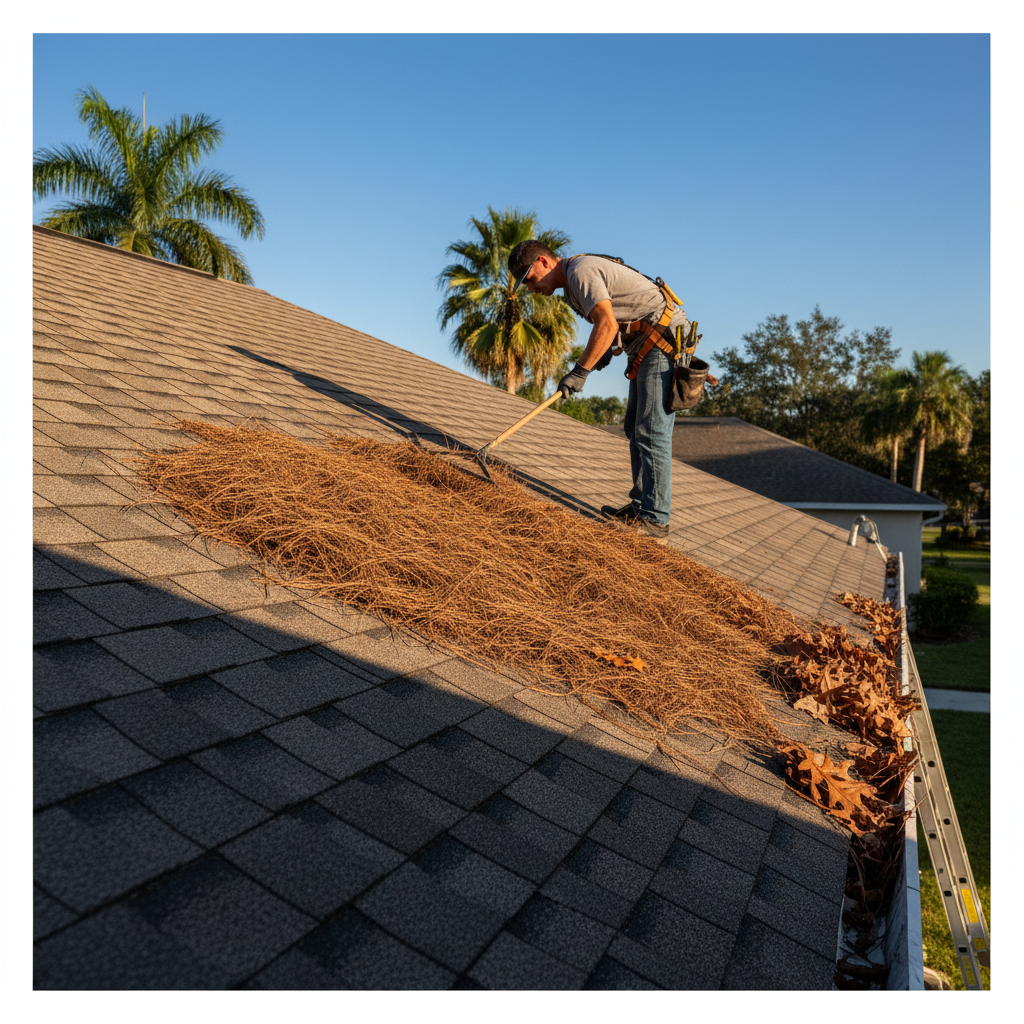
Pine needles damage a roof by packing tight. They interlock into dense, wet mats in valleys and gutters, slip through coarse gutter guards, and keep falling all year from Florida slash pines, so the buildup never really stops. Oak leaves damage a roof in heavy seasonal bursts: broad leaves pile up behind chimneys and in valleys, dam water against the shingles, and come with shade that slows drying. Over the years, both do the same core harm, which is holding moisture on the roof long enough to wear away shingle granules and feed algae and moss.
Key Takeaways
- Pine needles are a constant, low-level load. Slash pine needles fall throughout the year, according to the University of Florida Institute of Food and Agricultural Sciences (UF/IFAS), and they break down and knit into mats that hold water and resist wind.
- Oak leaves are a seasonal flood. Live oaks shed in late winter and spring as new leaves emerge, while laurel oaks drop brown leaves in fall and winter. A Tampa yard with both can get two heavy drops a year.
- The shared damage is trapped moisture. GAF, the shingle manufacturer, warns that wet leaf piles erode shingle granules and raise the chance of water getting in at valleys.
- Pine needles do not make your roof acidic. That is a common myth; extension research shows fresh needles are mildly acidic but cannot meaningfully change pH, and the real problem is the water they hold.
- Gutter protection differs by tree. Most guards stop oak leaves. Only fine micro-mesh reliably stops pine needles.
How Do Pine Needles Damage a Roof Over Time?
Pine needles damage a roof mainly through slow, steady accumulation that turns into a water-holding mat. Slash pine, one of the most common pines in the Tampa Bay area, carries needles 6 to 12 inches long, and UF/IFAS notes that the needles "seem to fall from the tree all during the year." That means a roof under a pine never gets a clean season.
The shape of a pine needle matters. A single needle is thin and stiff, so it slides into places a leaf cannot: under the bottom edge of a shingle course, into the gap where a roof plane meets a wall, and through the openings of screens and brush-style gutter guards. In a This Old House review of gutter guards for pine needles, expert Bill Hunt explains that needles "will break down and interlock to form mats," unlike leaves, which blow out more easily. Once a mat forms, wind no longer clears it.
Over the years, a pine needle mat on a shingle roof causes three problems:
- Constant dampness. The mat stays wet for days after a Florida afternoon storm, so the shingles beneath it rarely dry out.
- Slowed drainage in valleys. Needles collect in roof valleys, where two roof planes meet and where water volume is highest, and they back water up toward the shingle laps.
- Clogged gutters that overflow. Needles packed into gutters and downspouts send water over the edge, against fascia boards and the home's foundation.
How Do Oak Leaves Damage a Roof Over Time?
Oak leaves damage a roof through volume and coverage rather than through slipping into small gaps. A live oak leaf is 2 to 5 inches long and, as UF/IFAS describes it, "stiff and leathery." A laurel oak leaf is narrow, smooth, and 3 to 5 inches long. These broad, flat leaves lie over shingles like shingles of their own, and when they stack up behind a chimney, a skylight, or in a valley, they form a dam.
The timing of oak leaf drop is what catches many Tampa homeowners off guard. Most people expect leaves in autumn, but live oaks are semi-evergreen. Florida State University's facilities team, which manages a campus full of live oaks, notes that these trees shed only in late winter into spring, often weeks apart from one another, while long pollen catkins drop at the same time. Laurel oaks, by contrast, "normally drop brown in the fall and winter," according to UF/IFAS. A lot shaded by both types can collect a fall-winter drop and then a spring drop on top of it.
Oak trees bring two long-term risks beyond the leaves themselves:
- Shade that feeds algae. A broad oak canopy keeps roof slopes shaded and slow to dry. GAF notes that overhanging branches can create too much shade and keep a roof from drying after rain, and afternoon shade from oak canopies is one of the conditions that favors the dark streaks of roof algae in Florida.
- Weak limbs on laurel oaks. UF/IFAS reports that laurel oaks live 50 to 70 years and that their trunks and large branches "often hollow from decay and wood rot," with wood that is "susceptible to breakage." A mature laurel oak over a roof is a branch-impact risk in a storm, not just a leaf problem.
Are Pine Needles or Oak Leaves Worse for a Tampa Roof?
Neither pine needles nor oak leaves are worse in every case; each tree damages a roof through a different pattern. Pine needles are harder to keep up with because they never stop falling and they defeat most gutter guards. Oak leaves bring bigger seasonal loads, heavier shade, and, with laurel oaks, a limb-failure risk. The comparison below summarizes how each tree's debris behaves on a roof.
| Factor | Pine needles (slash pine) | Oak leaves (live oak and laurel oak) |
|---|---|---|
| When it falls in Tampa Bay | Throughout the year | Live oak: late winter to spring. Laurel oak: fall and winter |
| Size and shape | Thin needles, 6 to 12 inches long | Broad, flat leaves, 2 to 5 inches long |
| How it builds up | Interlocks into dense mats that wind cannot clear | Piles and dams behind chimneys, skylights, and in valleys |
| Where it does the most harm | Valleys, shingle edges, wall junctions, inside gutters and guards | Valleys, upslope sides of roof penetrations, gutter tops |
| Gutter guard behavior | Slips through screens, brush guards, and reverse-curve openings | Blocked by most guard types |
| Added tree risk | Needle buildup adds fuel near the home in wildfire conditions | Dense shade slows drying; laurel oak limbs prone to decay and breakage |
| Shared long-term damage | Trapped moisture, granule erosion, algae and moss growth, and water backing up at valleys and gutters | |
Do Pine Needles Make a Roof Acidic?
Pine needles do not make a roof or the ground around a home meaningfully acidic. The University of New Hampshire Cooperative Extension explains that pine needles "are acidic but do not have the capacity to appreciably lower the soil pH," and that decomposing organisms gradually neutralize them as they break down. The same logic applies on a roof: the risk from pine needles is the water they hold and the drainage they block, not a chemical attack on asphalt shingles. If a roof under pines looks worn, look for moisture, granule loss, and algae rather than acid damage.
Which Gutter Guards Work for Pine Needles vs. Oak Leaves?
Fine micro-mesh is the gutter guard type that holds up against pine needles, while oak leaves are stopped by most guard designs. In its gutter guard testing (review updated October 2026), This Old House found that "micro-mesh systems were the best type of guard we tested for keeping pine needles out of gutters" and recommended openings of 275 microns or smaller. The same review found that brush guards have gaps large enough for needles to slip through, reverse-curve guards have a front opening needles can enter, standard screens are not fine enough, and foam inserts break down over time.
For a home with only oaks overhead, a sturdy screen or perforated cover usually keeps leaves on top, where they dry and blow off. For a home under pines, a coarse guard can make the problem worse: needles slip through, mat together inside the gutter, and become harder to clean out than if the gutter were open.
How Often Should You Clear Pine Needles and Oak Leaves From a Roof?
The right schedule for clearing roof debris follows your trees, not the calendar on the wall. A roof under oaks needs attention right after each major drop: late winter to spring for live oaks and fall to winter for laurel oaks. A roof under slash pines needs regular checks all year, with extra attention to valleys and gutters, because needles never stop arriving. Any roof should be checked after a tropical storm or strong cold front, when wind strips both needles and leaves at once.
Prevention reduces how often you have to clear anything. GAF recommends keeping at least 6 feet between the roof and the tips of a tree's branches, which cuts down on direct debris fall and lets sun and air dry the shingles. The Florida Forest Service's Firewise landscaping guide also advises keeping pine needles and leaves off roofs and out of gutters, noting that excess pine needle accumulation on a roof makes a home more vulnerable to fire.
How you clear the debris matters as much as how often. GAF cautions that foot traffic and roof rakes can cause granule loss, and that wet leaf piles left in place erode granules on their own. Gentle removal from the ground, or from a ladder at the eave, is safer for both you and the shingles than walking the roof.
When Should a Roofer Inspect Debris Damage?
A roofer should look at the roof when debris has sat long enough to leave signs behind. Watch for dark streaks or green growth where mats sat, bare or shiny patches where granules have worn away, granules collecting at downspout outlets, water stains on the ceiling below a valley, and gutters that overflow even after cleaning. These signs suggest moisture has already been working on the shingles or the decking below.
Hytz Roofing, a GAF Master Elite contractor with more than 30 years of experience serving Tampa Bay (Florida license #CCC1332551), checks valleys, flashing, granule loss, and attic moisture during a free roof inspection in Tampa, with a written report and photos. If shade from oaks is the bigger issue on your home, our guide to removing and preventing roof algae in Florida covers safe cleaning methods.
Frequently Asked Questions
Can a roof rake damage asphalt shingles?
Yes, a roof rake can damage asphalt shingles if it is dragged hard across the surface. GAF lists roof rakes and foot traffic as causes of granule loss, and granules are what protect asphalt shingles from ultraviolet light. If you clear debris yourself, use light strokes from the eave, stay off the roof, and stop if you see granules coming loose.
How far should tree branches be from a roof?
GAF recommends at least 6 feet between your roof and the tips of a tree's branches. That gap reduces how much debris lands directly on the roof, keeps branches from scraping shingles in wind, and lets the roof dry faster after rain. For large oaks or pines, a certified arborist should handle the trimming, especially for laurel oaks, which UF/IFAS notes are prone to internal decay.
Why does a roof under pine trees stay damp even when the gutters are clean?
A roof under pine trees can stay damp because needle mats on the roof surface, not just in the gutters, hold water against the shingles. Mats tend to form in valleys, along wall junctions, and upslope of vents and skylights. Clearing the gutters fixes overflow, but the mats on the roof itself also need to come off for the shingles to dry.
Sources
- UF/IFAS EDIS: Pinus elliottii, Slash Pine (ST463)
- UF/IFAS EDIS: Quercus laurifolia, Laurel Oak (ST549)
- UF/IFAS Florida 4-H: Live Oak Identifying Characteristics
- Florida State University Facilities: The Late Winter Leaf Drop of Campus Live Oaks
- GAF: Why It's Important to Remove Leaves From a Roof
- GAF: Signs of Tree Damage to Your Roof and Prevention Strategies
- UNH Cooperative Extension: Do Pine Trees and Pine Needles Make Soil More Acidic?
- This Old House: Best Gutter Guards for Pine Needles
- Florida Forest Service (FDACS): South Florida Firewise Landscaping Guide