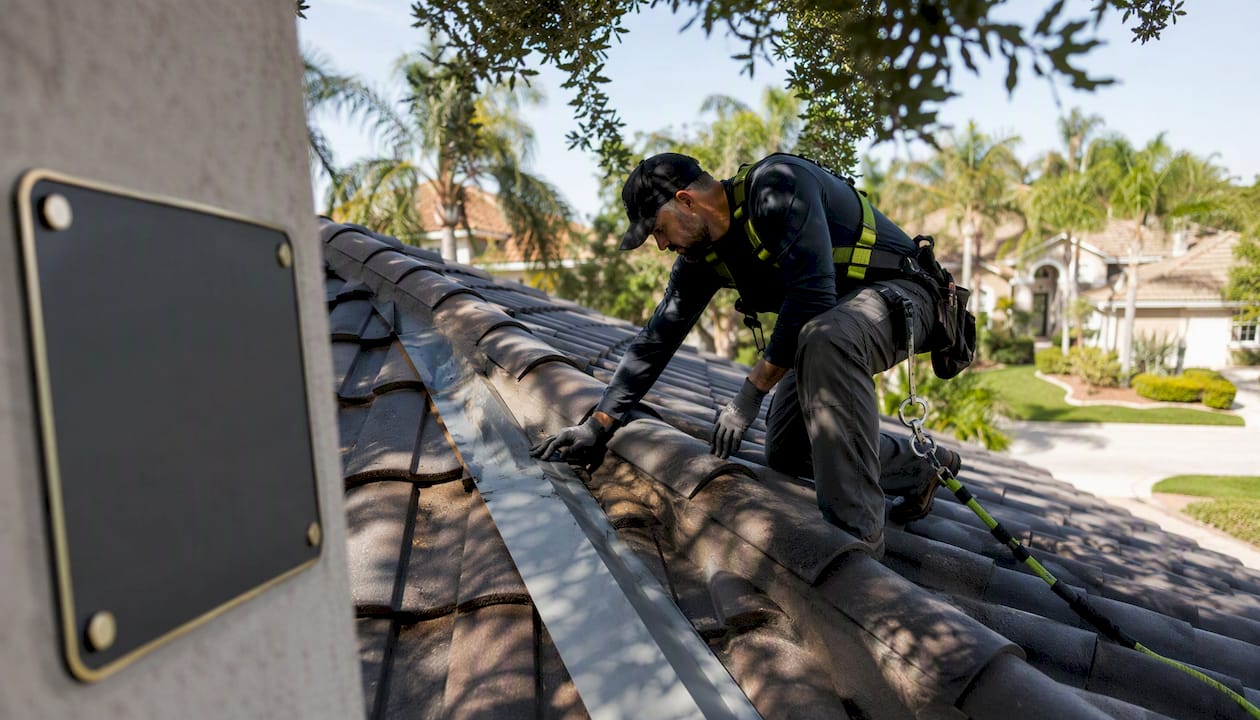
Benefits of Hiring a BBB-Accredited Roofer
BBB-accredited roofer status indicates third-party evaluation, access to dispute resolution, and clearer expectations when selecting a contractor.
Hiring a BBB-accredited roofer gives you a verifiable trust signal, access to structured complaint resolution, and clearer accountability for pricing and timelines. The BBB seal confirms verified business practices, not a workmanship guarantee. That distinction matters, and you should understand both sides before signing anything.
Here’s what you get right away when you hire a BBB-accredited contractor:
- ✅ A visible trust signal — the BBB Seal and rating show the company has passed identity, licensing, and advertising checks
- 📋 Access to dispute resolution — if something goes wrong, you have a formal process to file and track complaints through BBB.org
- 🔍 Verified contact and business info — address, phone, and licensing details are published on the BBB profile and monitored for accuracy
- 🚨 Reduced storm-chaser risk — accredited roofers must maintain a local address and meet ongoing compliance standards that fly-by-night contractors cannot fake
Before you request a written estimate from any roofer, pull up their BBB profile and confirm their accreditation status, rating, and complaint history.
Table of Contents
- What does BBB accreditation actually require of roofing companies?
- What practical benefits do you get from hiring a BBB-accredited roofer?
- What BBB accreditation does NOT guarantee
- How do you verify a roofer’s BBB accreditation and rating?
- Questions to ask your roofer and red flags to watch for
- How does BBB accreditation relate to warranties and manufacturer certifications?
- What verified credentials look like in practice: Hytzroofing
- Hytzroofing: a BBB-accredited option for Tampa Bay homeowners
- Key Takeaways
- Why accreditation changes the conversation before work even starts
- Useful resources for verifying roofing credentials
- FAQ
What does BBB accreditation actually require of roofing companies?
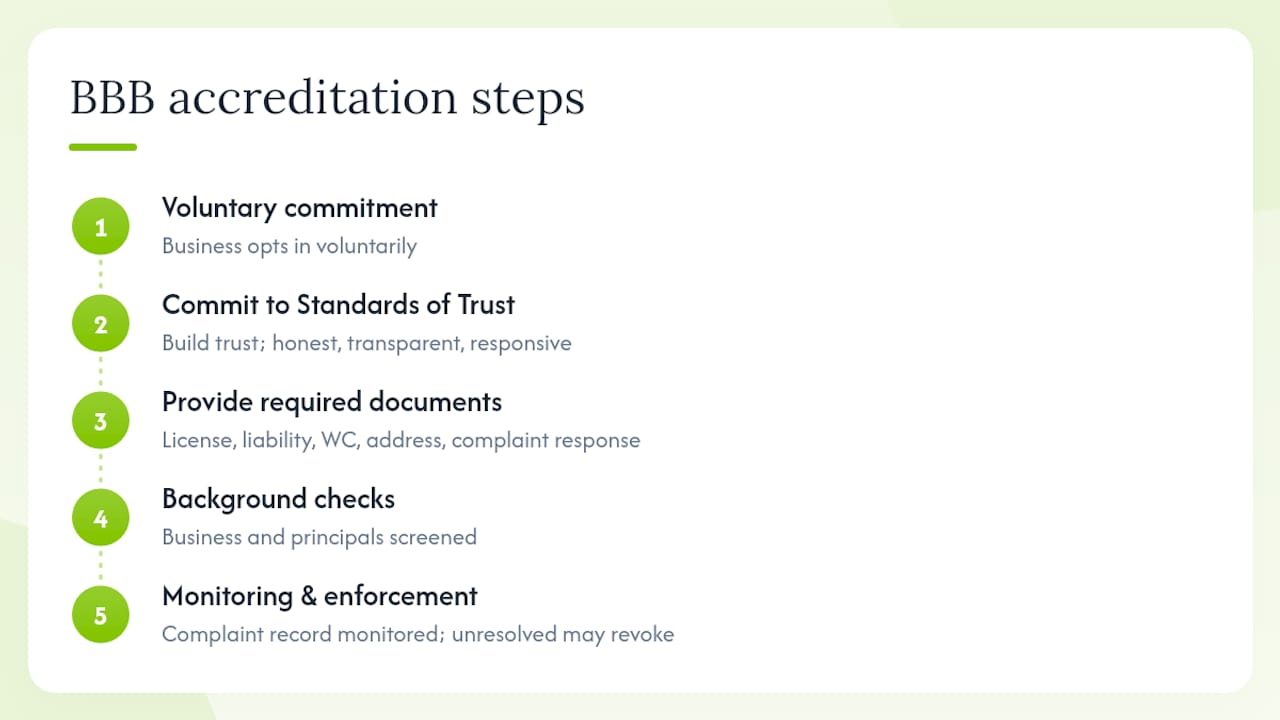
BBB accreditation is voluntary, and that’s exactly why it carries weight. A roofing company that pursues it is committing to a specific set of standards, not just paying for a logo.
The BBB’s 8 Standards of Trust require accredited businesses to build trust, advertise honestly, tell the truth, be transparent, honor promises, be responsive, safeguard privacy, and embody integrity. For a roofing company, that translates into concrete requirements: proof of a valid state contractor’s license, general liability insurance, workers’ compensation coverage, a verifiable physical address, and a commitment to respond to and resolve consumer complaints within defined timeframes.
Before granting accreditation, the BBB runs background checks on the business and its principals. After accreditation, the company’s complaint record is monitored continuously. A pattern of unresolved complaints can result in rating downgrades or revocation of the accreditation entirely.
📊 Consumer trust in BBB ratings is high. The BBB is one of the most consulted sources when homeowners vet service contractors, with millions of business profiles searched each year on BBB.org. That visibility means your roofer’s complaint history is public, searchable, and tied directly to their reputation.
The accreditation process is documented in detail at BBB Programs, which outlines how businesses enroll, what compliance monitoring looks like, and what triggers a review.
What practical benefits do you get from hiring a BBB-accredited roofer?
The advantages of BBB-accredited roofers go beyond a seal on a website. They translate into real protections during your project.
Storm-chaser fraud drops significantly. Accreditation requires a verified local address, proof of licensing, and a commitment to dispute-resolution timelines. Those requirements create a practical barrier that out-of-state storm chasers simply cannot clear. BBB consumer guidance specifically recommends checking the BBB seal before hiring any roofer after a storm.
You have a formal complaint path if things go wrong. If a contractor misses a deadline, uses the wrong materials, or disappears after collecting a deposit, you can file a complaint through BBB.org. The accredited company is obligated to respond and work toward resolution. That accountability changes how contractors behave from day one.
Accredited contractors tend to run more stable businesses. According to RoofPredict’s analysis, accredited roofing firms retain approximately 34% of clients compared to 19% for non-accredited firms. This same retention gap is reflected throughout industry studies: BBB-accredited roofers are significantly more likely to retain clients over time than non-accredited competitors. A contractor with higher retention is more likely to still be in business when your warranty needs honoring.
Pro Tip: Ask your roofer how many of their jobs come from repeat customers or referrals. A high referral rate is a strong signal of consistent workmanship and customer service, and it often correlates with accreditation status.
Here’s a quick comparison of what you typically experience with accredited versus non-accredited contractors:
| Factor | BBB-Accredited Roofer | Non-Accredited Roofer |
|---|---|---|
| Verified local address | Required | Not verified |
| Complaint resolution process | Formal, monitored | No structured process |
| Client retention rate | ~34% | ~19% |
| Licensing/insurance on file | Required for accreditation | Self-reported only |
| Written estimate standards | Encouraged by BBB standards | Varies widely |
| Storm-chaser risk | Lower | Higher |
Cost transparency is another real benefit. Local consumer guidance consistently recommends pairing BBB verification with a request for a written, itemized estimate. Accredited contractors are held to advertising honesty standards, which means the price they quote should match the price they charge. Learning how to read roofing estimate line items before your first meeting puts you in a much stronger position.
What BBB accreditation does NOT guarantee
The BBB seal is a filter for ethical business practices, not a workmanship inspection. Knowing the limits keeps you from over-relying on it.
- ❌ Not a workmanship warranty — the BBB does not inspect installations, evaluate materials, or certify that a roof was installed correctly
Think of BBB accreditation as a first filter, not a final answer. It eliminates a large category of bad actors, but it doesn’t replace a thorough vetting process. Pair it with licensing checks, insurance verification, manufacturer certifications, and written contracts.
How do you verify a roofer’s BBB accreditation and rating?
This takes about five minutes and can save you thousands. Here’s exactly what to do:
-
Go to BBB.org and search the contractor’s business name. Confirm the name, address, and phone number match what the contractor gave you. A mismatch is a red flag.
-
Check the accreditation status and letter rating. Look for “BBB Accredited Business” and a rating of A or A+. An A+ rating signals consistent responsiveness to complaints and can serve as a prequalification signal for larger or more complex projects.
-
Cross-check the license and insurance fields — The BBB profile may list the contractor’s license number. Take that number to your state’s contractor licensing board website and verify it independently. In Florida, you can check through the Department of Business and Professional Regulation.
Pro Tip: Run this check before your first site visit, not after you’ve already received an estimate. Contractors who know you’ve done your homework tend to be more precise in their proposals.
Questions to ask your roofer and red flags to watch for
The BBB profile tells you about the business. The conversation tells you about the contractor. Use both.
Ask these questions during the estimate:
- Does the written estimate include a full scope of work, materials list, and payment schedule?
- Will you pull the required permits, and who handles the inspection?
- Who supervises the crew on-site daily?
- What manufacturer warranty comes with the materials, and what workmanship warranty do you offer?
- Do you hold any manufacturer certifications, such as GAF Master Elite®?
🚨 Walk away if you see these red flags:
- High-pressure sales pitch immediately after a storm, especially from someone who “just happened to be in the neighborhood”
- Cash-only payment requests or demands for a large deposit upfront
- No local address or a P.O. box listed as the business location
- Inability or refusal to provide proof of insurance and a license number
- Offers to use “leftover shingles” from another job at a discount
- No written estimate, or an estimate with vague line items and no materials specification
Pro Tip: Ask the contractor to show you their certificate of insurance on the spot. A legitimate company carries it. If they say they’ll email it later and never do, that tells you everything.
Combining your BBB profile review with these questions gives you a complete picture. The BBB’s own roofing contractor tips reinforce this approach, specifically calling out storm-chaser tactics and the importance of written contracts.
How does BBB accreditation relate to warranties and manufacturer certifications?
These credentials cover different risks, and you need all of them.
BBB accreditation verifies business integrity: the company is who they say they are, they hold a valid license and insurance, and they have a process for handling complaints. It says nothing about how well they install a roof.
Manufacturer certifications like GAF Master Elite® verify installation training and quality standards. GAF awards Master Elite status to fewer than 2% of roofing contractors in North America. Contractors who hold it have met GAF’s requirements for licensing, insurance, ongoing training, and community reputation. That certification directly affects the warranty you receive.
Written warranties are the legal documents that actually protect you. There are two kinds: the manufacturer’s material warranty (covering defective shingles or tiles) and the contractor’s workmanship warranty (covering installation errors). Both should be in writing, both should name who issues them, and both should specify the claim process.
Here’s how the credentials stack up:
| Credential | What It Verifies | What It Does NOT Cover |
|---|---|---|
| BBB Accreditation | Business identity, licensing, complaint handling | Installation quality, materials |
| GAF Master Elite® | Installation training, quality standards | Business ethics, dispute resolution |
| Written Manufacturer Warranty | Material defects | Workmanship errors |
| Written Workmanship Warranty | Installation errors | Material defects |
When an accredited contractor also holds a manufacturer certification, the combination is meaningful. Their documented complaint process and transparency can speed insurer and warranty claims because there’s a paper trail from day one. For storm damage repair, that documentation is especially valuable when working with an adjuster.
What verified credentials look like in practice: Hytzroofing
Hytzroofing is a useful benchmark for what a fully credentialed roofing contractor looks like, because every credential described in this article is publicly verifiable.
Here’s the full credential stack:
- ✅ BBB Accredited, A+ rating — verified business identity, complaint-handling commitment, and ongoing compliance monitoring
- ✅ GAF Master Elite® Contractor — earned by fewer than 2% of roofers in North America; requires licensing, insurance, training, and community reputation
- ✅ GAF President’s Club Award — reserved for the top-performing Master Elite contractors
- ✅ 2024 Brava Roof Tile Excellence Award — recognizes outstanding installation quality with Brava’s synthetic roofing products
- ✅ Angi Super Service Award 2025 — consumer-driven recognition based on consistently high ratings across one of the largest home services platforms in the country
- ✅ Florida Contractor License #CCC1332551 — publicly verifiable through the Florida Department of Business and Professional Regulation
- ✅ Full general liability insurance and workers’ compensation coverage
💬 “When a homeowner comes to us after storm damage, the first thing we do is walk them through the insurance claim process. Our BBB accreditation and GAF Master Elite® status mean the adjuster already has a framework for what to expect from us — documented standards, a verifiable license, and a clear complaint process if anything falls short. That transparency speeds everything up.” — Hytz Roofing Inc.
You can use Hytzroofing’s credentials page as a reference point when evaluating other contractors. If a roofer claims similar credentials, verify each one independently the same way you would verify BBB accreditation: go to the source.
Hytzroofing: a BBB-accredited option for Tampa Bay homeowners
Hytzroofing holds a BBB A+ rating, GAF Master Elite® designation, and Florida Contractor License #CCC1332551, covering Tampa Bay and Central Florida. Every estimate comes with a written scope of work, full materials specification, and clear payment terms. No pressure, no vague line items.
If you’re ready to work with a contractor whose credentials you can verify before the first site visit, request a free residential estimate today. The team responds quickly, walks you through the insurance claim process if needed, and backs every project with manufacturer and workmanship warranties.
Key Takeaways
BBB accreditation verifies a roofer’s business integrity and complaint-handling process, but homeowners must also confirm licensing, insurance, and manufacturer certifications before signing a contract.
| Point | Details |
|---|---|
| Accreditation = business integrity | BBB accreditation confirms verified identity, licensing, and a formal complaint process, not workmanship quality. |
| Client retention gap | Accredited roofing firms retain approximately 34% of clients vs. 19% for non-accredited firms, signaling more stable businesses. |
| Always verify independently | Cross-check the BBB profile, state license board, and insurance certificate before signing any contract. |
| Pair credentials for full coverage | Combine BBB accreditation with manufacturer certifications (e.g., GAF Master Elite®) and written warranties for complete protection. |
| Hytzroofing as a benchmark | Hytzroofing holds a BBB A+ rating, GAF Master Elite® status, and Florida License #CCC1332551, all publicly verifiable. |
Why accreditation changes the conversation before work even starts
Most homeowners focus on price when they get roofing estimates. That’s understandable. But the contractors who cause the most expensive problems are rarely the ones who charged the most. They’re the ones who had no verifiable address, no license on file, and no accountability when the roof leaked six months later.
BBB accreditation shifts that dynamic. It doesn’t make a contractor perfect, but it creates a paper trail before the first nail goes in. The complaint-resolution process alone changes how a contractor behaves during a project, because they know a public record follows every unresolved dispute.
What most homeowners miss is that accreditation is also a signal about a company’s financial stability. Contractors who invest in accreditation, maintain manufacturer certifications, and carry full insurance are running businesses built to last. That matters enormously when a warranty claim comes up three years from now.
My honest advice: use the BBB profile as your first filter, not your only one. Verify the license with your state board. Ask for the certificate of insurance in person. Request a written estimate with line items you can actually read. And if a contractor pushes back on any of those requests, that’s your answer.
Useful resources for verifying roofing credentials
Use these directly when vetting any contractor:
- Is BBB Accreditation for Roofing Companies Worth It? | RoofPredict Blog
- BBB Tip: Roofing contractors
- Better Business Bureau (official site)
- Better Business Bureau: Tips to hire a roofer who will finish …
- Why BBB Accreditation and an A+ Rating Matter When Choosing a Roofing Company in San Jose - Apollo Roofing Company
- What Makes a Roofing Company BBB Accredited (and Why It Matters) | Bear Brothers Roofing
- The Benefits of Hiring a BBB-Accredited Roofing Company | Tedrick’s Roofing
- BBB Programs
FAQ
Should a roofing company be BBB accredited?
BBB accreditation is voluntary, but it’s a meaningful signal. It confirms the company has a verified address, holds a valid license and insurance, and has committed to a formal complaint-resolution process, all of which reduce your risk as a homeowner.
What are the main benefits of hiring a BBB-accredited roofer?
The core benefits include a verified business identity, access to structured dispute resolution through BBB.org, and a contractor who is held to advertising honesty and transparency standards. Accredited firms also retain clients at a higher rate (approximately 34% vs. 19% for non-accredited firms), which signals a more stable business likely to honor warranties.
Does BBB accreditation guarantee quality workmanship?
No. BBB accreditation verifies business practices and complaint handling, not installation quality. For workmanship assurance, look for manufacturer certifications like GAF Master Elite® and require a written workmanship warranty from the contractor.
How do I check if a roofer is really BBB accredited?
Go directly to BBB.org, search the contractor’s business name, and confirm the accreditation status, rating, and complaint history. Never rely solely on a BBB logo on a truck or website. Fraudsters can display fake seals, so always verify at the source.
What is the 25% rule for roofing?
Some building code provisions in various jurisdictions require that when a significant portion of a roof is repaired or replaced within a certain time frame, the entire roof may need to be brought up to current code. Requirements vary by location, so confirm the applicable rule with your local building department or a licensed contractor before starting any project.
Recommended
- What BBB Accredited Means for Roofing: A Homeowner’s Guide | Hytz Roofing
- Is Hytz Roofing Good for Storm Damage? An Honest Look | Hytz Roofing
- Why Choose Hytz Roofing | GAF Master Elite | Tampa Bay’s Top Roofer
- Choose the Best Roofing Contractor in Tampa Bay, Florida: Your Guide | Hytz Roofing
Related Hytz Roofing Services