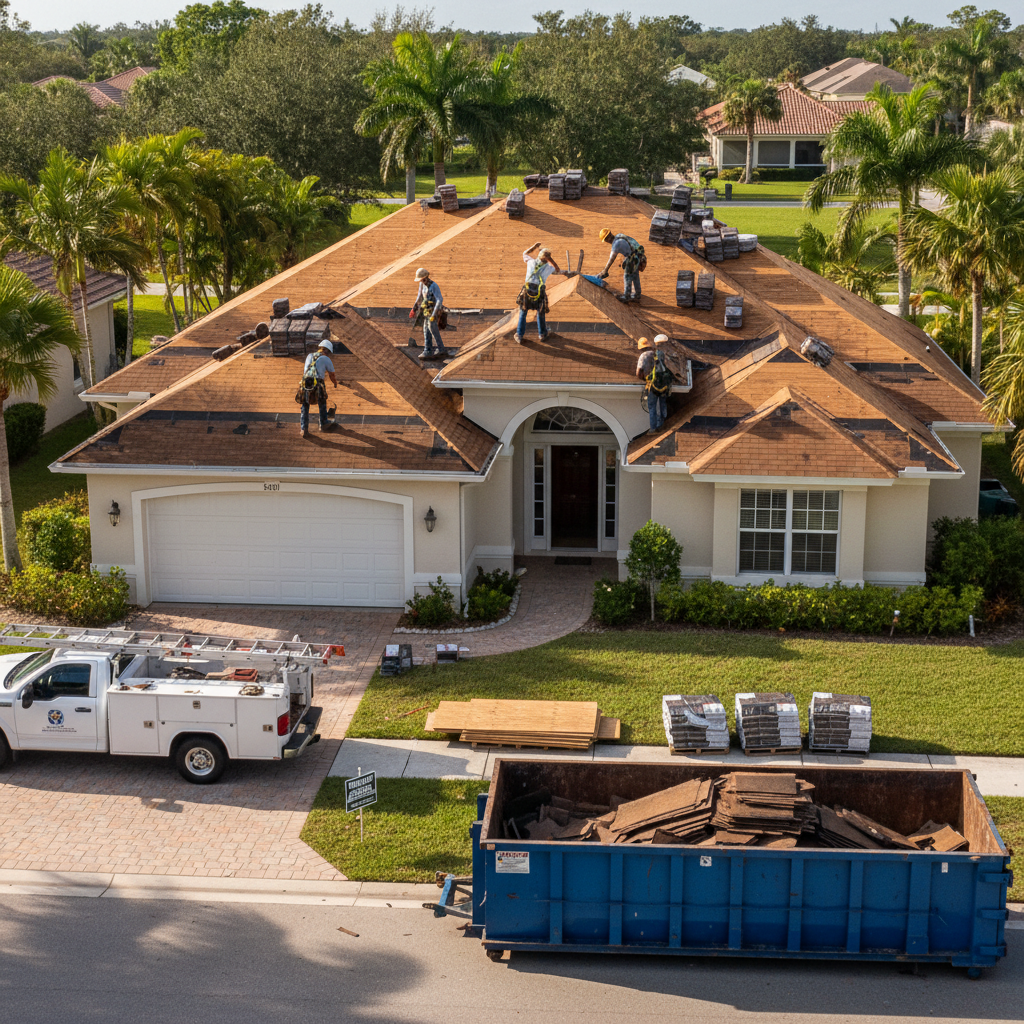
A roofing estimate looks expensive because it is not just shingles and a day of labor. The total pays for a crew doing one of the most dangerous jobs in the country, materials whose prices have climbed sharply since 2020, Florida code work done after the old roof comes off, permits and debris disposal, and the overhead and profit that keep the contractor around to honor a warranty. In most published breakdowns, labor is the single largest share, often more than half the bill.
Below, Hytz Roofing walks through each bucket of a typical Tampa roof replacement estimate, with public figures behind each one, so you can see where your money goes and spot an estimate that leaves something out.
What is the short answer?
- Labor is usually the biggest line. NerdWallet's 2026 cost guide puts labor at more than half of a roof replacement's total cost.
- A roofer's billed rate is not their wage. The U.S. Bureau of Labor Statistics (BLS) reports a median roofer wage of $55,440 a year (about $26.65 an hour), while homeowners are commonly quoted $40 to $90 per worker-hour. The gap covers insurance, payroll costs, equipment, and overhead.
- Shingle-related material prices are up about 45% since January 2020, based on the BLS producer price index for asphalt shingle and coating materials.
- Florida adds required work. Reroofs in Florida trigger deck re-nailing and a secondary water barrier under the Florida Existing Building Code, plus permit and disposal costs.
- A low bid usually cuts scope, not margin. Compare estimates line by line before assuming the cheaper one is the better deal.
Where does the money in a roofing estimate actually go?
A roof replacement estimate splits into six cost buckets. GAF, the shingle manufacturer, says a proper estimate should break out labor, materials, building permits, dump fees, and taxes. Overhead and profit are usually built into those lines or added as a percentage. The table below shows what each bucket pays for and a verified reference figure where one exists.
| Cost bucket | What it pays for | Public reference point |
|---|---|---|
| Labor | Tear-off, deck repair, installation, cleanup, crew safety equipment | Labor is more than half of total cost (NerdWallet, 2026); contractors reported average labor costs up 14% (Roofing Contractor 2026 State of the Industry) |
| Materials | Shingles or tile, underlayment, flashing, drip edge, vents, fasteners, plus a waste allowance | Asphalt shingle and coating materials price index up about 45% from January 2020 to September 2026 (BLS via FRED) |
| Sales tax on materials | Florida contractors pay tax on materials they install | 6% state rate plus county surtax; Hillsborough County surtax is 1.5% (Florida Department of Revenue) |
| Permit | Required building permit and inspections | City of Tampa residential roofing permit: $177, plus state surcharge (City of Tampa fee schedule) |
| Disposal | Dumpster, hauling, and landfill fees for the old roof | Hillsborough County commercial landfill rate: $104 per ton (Hillsborough County, effective June 1, 2026) |
| Overhead and profit | Office staff, insurance, vehicles, warranty backing, reinvestment | No fixed standard; Verisk's Xactimate leaves the percentage to the estimator's judgment |
Exact percentages vary by roof size, material, pitch, and contractor, which is why published breakdowns disagree. Treat any single "labor is X%" figure as a rough guide, not a rule.
Why does roofing labor cost so much more than a roofer's wage?
Roofing labor costs more than the paycheck because the contractor pays for far more than the hour on the roof. BLS data puts the median roofer wage at $55,440 a year as of May 2025. Divided over a 2,080-hour work year, that is about $26.65 an hour. Angi's figures, cited by NerdWallet, put homeowner-facing labor at $40 to $90 per worker-hour.
The difference pays for costs that come with every worker on the crew:
- Workers' compensation insurance. Roofing is among the deadliest trades. The BLS Census of Fatal Occupational Injuries recorded 51.8 deaths per 100,000 full-time workers in the roofing industry in 2023. In Florida, the 2026 assigned-risk rate published by the Florida Workers' Compensation Joint Underwriting Association for class code 5551 (Roofing, All Kinds) is about $6.75 per $100 of payroll, as reported by insurance brokers. Private-market rates differ, but every wage dollar carries this cost.
- Payroll taxes, liability insurance, trucks, lifts, and safety gear. None of these show up as a separate line, yet a licensed crew cannot work without them.
- Time that is not billable. Rain days, travel to the job, loading and staging materials, and inspections all happen on the contractor's clock.
Labor is also getting more expensive. In the Roofing Contractor 2026 State of the Industry survey, 55% of contractors reported higher labor costs and 36% named a lack of qualified workers as a top challenge.
How much have roofing material prices gone up?
Roofing material prices have risen roughly 45% in under seven years. The BLS producer price index for asphalt shingle and coating materials manufacturing stood at 255.2 in January 2020 and 370.4 in September 2026, according to the Federal Reserve Bank of St. Louis FRED database. Over the most recent 12 months (September 2025 to September 2026), that index rose about 3.7%.
That index measures what manufacturers charge, not the retail price your contractor pays, but it shows the direction clearly. A shingle roof estimated in 2026 carries materials that cost far more than the same roof would have in 2019.
Sales tax is part of the material cost too. Under Florida Administrative Code Rule 12A-1.051, contractors are "the ultimate consumers of materials and supplies they use to perform real property contracts" and pay tax on those purchases, according to the Florida Department of Revenue. In Hillsborough County, that means the 6% state rate plus a 1.5% county surtax on materials, folded into your estimate.
What Florida-specific requirements add to a Tampa roofing estimate?
Florida's reroofing rules add work that a roof in many other states would not need. Under Florida Existing Building Code Section 706.7, once the old roof is off, a site-built home's deck must be re-nailed with 8d ring-shank nails at 6 inches on center along the framing, and a secondary water barrier must be installed, such as full peel-and-stick underlayment or sealed deck seams under a standard underlayment. City reroof guides, such as the City of Sebastian's mitigation guide, spell out these options.
Those steps cost real labor and material, and they protect the roof in a hurricane. An estimate that does not mention them either includes them silently or skips them.
Two more Florida line items:
- Permit. The City of Tampa's trade permit fee schedule lists $177 for a residential roofing permit, plus the Florida building permit surcharge. Unincorporated Hillsborough and neighboring cities set their own fees.
- Disposal. New asphalt shingles weigh about 175 to 233 pounds per square (100 square feet), according to the Connecticut Department of Energy and Environmental Protection. As an illustration only, a 25-square roof would produce roughly 2.2 to 2.9 tons of shingles before counting underlayment, nails, and any second layer. At Hillsborough County's $104-per-ton commercial landfill rate, that is about $230 to $300 in tipping fees alone, before dumpster rental and hauling. Construction-debris facilities may charge different rates.
What do overhead and profit pay for in a roofing estimate?
Overhead and profit pay for the business behind the crew. Verisk, the company behind the Xactimate estimating software used by many insurers and contractors, defines overhead as "any additional expense not charged (or attributed) directly to the work being performed," such as office rent, administrative staff, and project managers. Profit is what remains after all costs and is what lets a company reinvest and stay in business.
You may hear that "10 and 10" (10% overhead plus 10% profit) is the industry standard. Verisk's own guidance leaves the percentage to the estimator's judgment, and property-insurance attorney Chip Merlin wrote in September 2026 that the 10-and-10 figure "did not arise from a serious economic study." Real overhead depends on the company's size, insurance costs, and warranty obligations.
Profit matters to you as a homeowner for one practical reason: a workmanship warranty is only as good as the company standing behind it. A contractor that underprices every job to win bids may not be around in year eight when a flashing detail fails.
How can you tell if a roofing estimate is fair?
A fair roofing estimate is itemized, names specific products, and covers the same scope as the other bids you are comparing. Use these checks:
- Look for every bucket. Labor, materials (with brand and product line), permit, disposal, and taxes should all be accounted for, as GAF recommends.
- Check the Florida code items. Ask whether deck re-nailing and the secondary water barrier are included.
- Ask how rotten decking is priced. A per-sheet replacement price in writing beats "TBD."
- Compare scope, not totals. When one bid is far lower, find the missing line before celebrating.
- Know the deposit rule. Under Florida Statutes Section 489.126, a contractor who takes more than 10% of a residential contract price up front must apply for permits within 30 days and start work within 90 days after permits issue, unless there is just cause or you agree in writing to a longer period.
For a section-by-section walk through tear-off, underlayment, flashing, ventilation, and waste factor, see Hytz's guide to reading roofing estimate line items.
How does Hytz Roofing build a roof replacement estimate?
Hytz Roofing builds each estimate from an on-site inspection rather than a satellite guess, so deck condition, roof layers, and code requirements are accounted for before you sign. Hytz is a GAF Master Elite contractor and member of the GAF President's Club, holds Florida license #CCC1332551, and brings more than 30 years of roofing experience to Tampa Bay homes. To see what a full scope looks like for your house, request a free written estimate through Hytz's Tampa roof replacement service.
What else do homeowners ask about roofing estimate costs?
Why does a small roof cost more per square foot than a large one?
A small roof costs more per square foot because several costs stay about the same regardless of size. The permit fee, dumpster delivery, crew travel, material delivery, and setup happen whether the roof is 12 squares or 35. Spread over fewer squares, those fixed costs raise the per-square price even when the materials and labor per square are identical.
Can I save money by buying the roofing materials myself?
Buying your own materials rarely saves much and can cost you coverage. Contractors buy at trade pricing and already pay Florida sales tax on materials they install, so the savings are usually smaller than homeowners expect. Many contractors will not warranty labor on materials they did not supply, and manufacturer enhanced warranties such as GAF's top tiers require installation by a GAF-certified contractor using qualifying components. Ask the contractor in writing how supplying your own materials would affect both warranties before you buy anything.
Why does an estimate include a price for rotten decking if no one has seen it yet?
The estimate includes a decking price because damaged plywood is often invisible until the old roof comes off. GAF notes that rotten decks, rafters, or trusses are sometimes discovered only after tear-off, especially on roofs that have leaked. A per-sheet price in the contract tells you exactly what a surprise will cost and keeps a discovery from turning into an open-ended change order.
Does homeowners insurance pay overhead and profit on a roof claim?
Whether insurance pays overhead and profit depends on your policy language and how the adjuster writes the claim. Xactimate unit prices do not include general overhead and profit; those are added as a percentage when the estimator decides they apply. If your claim estimate leaves overhead and profit out and a general contractor is coordinating the work, ask the adjuster in writing why, and review your policy before you accept the payment.
What sources did this article use?
- NerdWallet: Roof Replacement Cost in 2026
- U.S. Bureau of Labor Statistics: Occupational Outlook Handbook, Roofers
- Roofing Contractor: Roofing Remains a Top 3 Deadliest Occupation (BLS CFOI data)
- Roofing Contractor: 2026 State of the Roofing Industry Report
- Total Work Comp: Roofing Workers Comp Rates in Florida (FWCJUA 2026 class 5551 rate)
- FRED: Producer Price Index, Asphalt Shingle and Coating Materials Manufacturing
- Florida Department of Revenue: TIP 03A01-03 (Rule 12A-1.051)
- Florida Department of Revenue: Discretionary Sales Surtax Information (DR-15DSS)
- City of Sebastian: Guide to Re-Roofing Mitigation Requirements (FEBC 706.7)
- City of Tampa: Trade Permit Fee Schedule
- Hillsborough County: Landfill Disposal Fees
- Connecticut DEEP: Asphalt Shingles
- Verisk Xactware: Overhead and Profit White Paper
- Property Insurance Coverage Law: The Folly of 10 and 10
- GAF: Roofing Cost Estimate vs. Final Price
- Florida Statutes Section 489.126