Why Florida Homes Need Impact Roofing: 2026 Guide
Florida Impact Roofing provides an overview of impact-rated roof options and how they reduce storm and wind damage risks for Florida homes.
Impact roofing is an engineered roofing system designed to protect Florida homes from hurricane-force winds, flying debris, and hail by combining impact-resistant materials with code-specific installation techniques. Florida’s position in one of the world’s most active hurricane corridors makes this protection non-negotiable. The state’s High-Velocity Hurricane Zone (HVHZ) requirements, Citizens Insurance mitigation credits, and the real physics of roof failure during storms all point to the same conclusion: why Florida homes need impact roofing is not a question of preference. It is a question of survival for your home and your finances.
Why Florida homes need impact roofing more than anywhere else
Florida faces a storm threat unlike any other state. The Atlantic hurricane season runs from June through November, and Florida has been struck by more named storms than any other U.S. state. When a hurricane makes landfall, the roof is the first line of defense. Lose it, and you lose the home.
The primary failure mode during Florida hurricanes is wind uplift, which peels shingles off the deck and exposes raw wood to rain within minutes. Standard asphalt shingles rely on heat-activated sealant strips to bond each course. When those strips degrade from years of Florida sun, the roof behaves like a stack of loose cards in a gust. One lifted shingle creates a pressure gap, and the next gust tears off a section.
Water intrusion follows almost immediately after a breach. Once rain penetrates the deck, ceilings collapse, insulation saturates, mold begins within 24 to 48 hours, and structural framing can be compromised. The damage cascade from a single breach is what turns a $15,000 roofing problem into a $150,000 interior reconstruction. Impact roofing is specifically engineered to stop that cascade before it starts.
“The roof is not just a covering. It is the pressure boundary of the entire building envelope. When it fails, everything inside is exposed.” This principle drives every Florida building code requirement for impact-rated roofing systems.
Pro Tip: If your roof is more than 15 years old and has standard three-tab shingles, schedule a wind mitigation inspection before hurricane season. Insurers in coastal zip codes are non-renewing policies on aging roofs at an accelerating rate.
What makes roofing “impact resistant” in Florida
The term “impact resistant” has a specific legal and technical meaning in Florida. It is not a marketing label. Florida Product Approval requires that roofing products pass large-missile impact testing to qualify for use in HVHZ regions. This is a stricter standard than the national UL 2218 Class 4 test, which measures resistance to hail and small debris impacts.
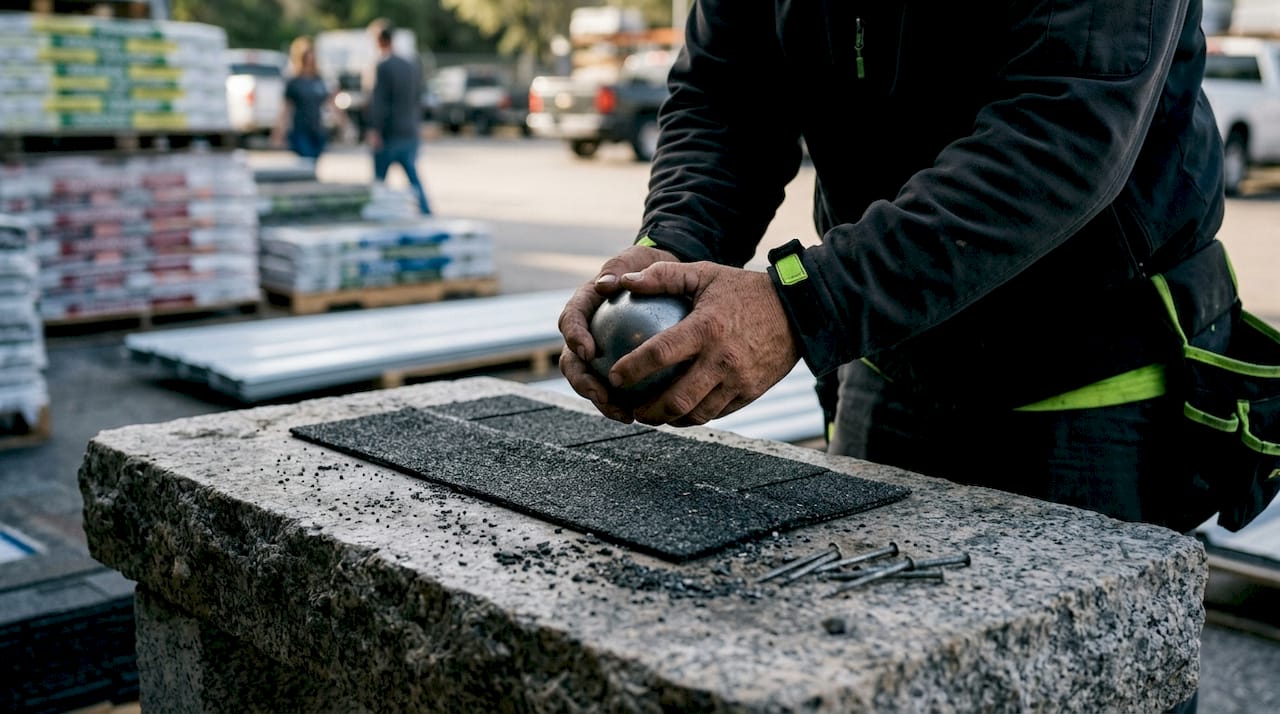
UL 2218 Class 4 is the highest national impact resistance rating, and products like GAF’s Timberline ArmorShield II shingles carry both UL 2218 Class 4 and ASTM wind test certifications. That dual certification matters in Florida because storm damage comes from two directions at once: debris impact and wind pressure. A shingle that survives a hail strike but lifts under 130 mph wind still fails.
Installation details are equally critical. HVHZ compliance is an assemblies problem, not just a materials problem. Edge metal, nail patterns, penetration sealing, and deck attachment all work together. A six-nail fastening pattern instead of the standard four-nail pattern dramatically increases pull-through resistance. Skipping that detail on an otherwise code-compliant shingle can void both the manufacturer warranty and the Florida Product Approval.
| Standard | What it tests | Florida relevance |
|---|---|---|
| UL 2218 Class 4 | Hail and small debris impact resistance | Required for insurance premium discounts |
| ASTM D3161 / D7158 | Wind resistance of shingles | Required for Florida Product Approval |
| Large missile impact test | 2x4 lumber projectile at hurricane wind speed | HVHZ mandatory standard |
| Florida Product Approval | Full assembly performance under FBC | Required for legal installation in HVHZ |
Pro Tip: Always ask your contractor for the Florida Product Approval number for every roofing product used on your home. That number is your proof that the material meets state code. Without it, your installation may not pass inspection.
How secondary water barriers stop damage when shingles fail
A secondary water barrier (SWR) is a self-adhering modified bitumen membrane installed directly over the roof deck, beneath the primary roofing material. Think of it as a waterproof skin on the deck itself. If shingles lift or blow off during a storm, the SWR keeps rain out of the structure. Florida’s HVHZ requirements mandate this layer specifically because primary roofing can and does fail in major hurricanes.
The SWR is the difference between a storm that costs you a new roof and a storm that costs you a new roof plus a gutted interior. Citizens Insurance recognizes this. The uniform mitigation verification form (OIR-B1-1802), with a new revision effective April 1, 2026, includes SWR installation as a verified mitigation feature that directly affects your premium and policy eligibility. Documented SWR can mean the difference between a renewal and a non-renewal notice.
Here is what to verify before accepting any impact roofing installation:
- Confirm the SWR product carries Florida Product Approval for use as a secondary water barrier.
- Verify the membrane covers the full deck surface, not just valleys and eaves.
- Check that all seams overlap by the manufacturer-specified minimum, typically six inches.
- Confirm the membrane is fully adhered with no bubbles, gaps, or lifted edges before shingles go on.
- Request photos of the completed SWR layer before it is covered. This documentation supports your wind mitigation inspection and insurance claim if needed.
Comparing roofing materials for storm protection in Florida
Not all impact-resistant roofing materials perform equally in Florida conditions. Your choice depends on your budget, your location relative to the coast, and how long you plan to own the home.
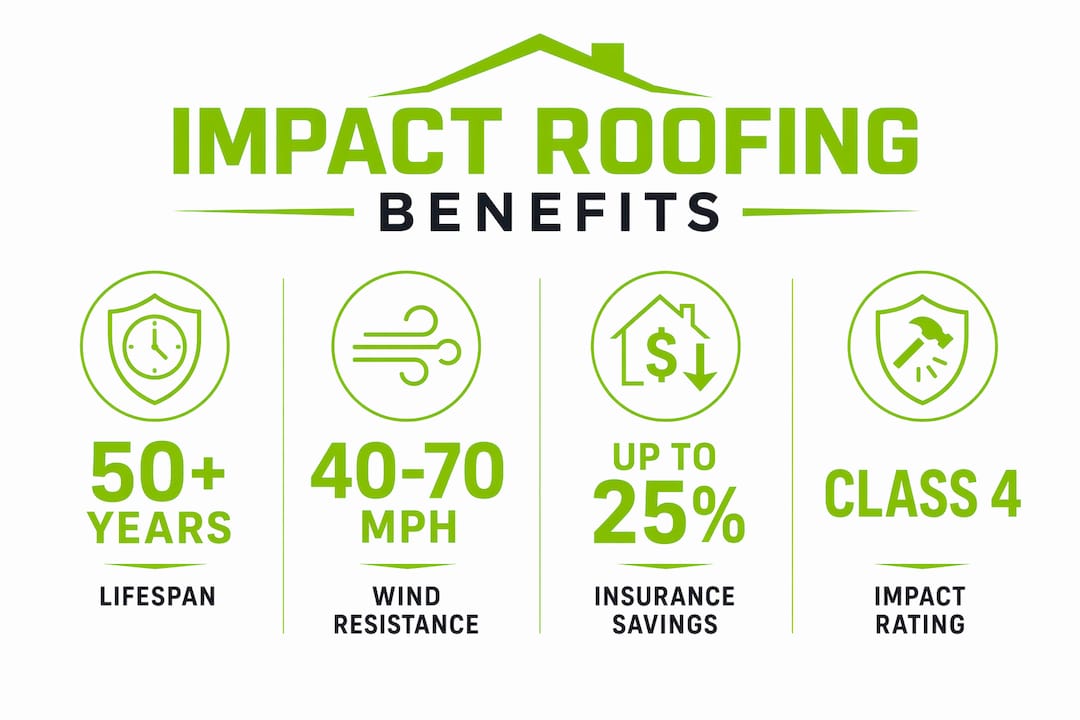
Class 4 asphalt shingles like GAF’s Timberline ArmorShield II use SBS polymer modification to make the shingle more flexible and impact-resistant. They are the most affordable entry point into impact-rated roofing, carry strong Florida Product Approval credentials, and qualify for insurance discounts. The trade-off is longevity. In Florida’s UV environment, even premium asphalt shingles have a realistic lifespan of 20 to 25 years.
Metal roofing offers the longest service life, typically 40 to 70 years, and handles wind uplift exceptionally well when installed with the correct fastener spacing and concealed clip systems. Standing seam metal profiles perform best in HVHZ conditions because there are no exposed fasteners to back out under thermal cycling. The upfront cost is higher, but the per-year cost over a lifetime often beats asphalt.
Concrete and clay tile is the dominant roofing material in South Florida for good reason. Tile is heavy, which provides natural wind resistance, and the material itself does not degrade from UV exposure. The challenge is installation complexity. Tiles require a properly engineered deck to handle the weight, and the mortar or clip attachment system must meet HVHZ standards precisely.
| Material | Impact rating | Approx. lifespan | HVHZ eligible | Relative cost |
|---|---|---|---|---|
| Class 4 asphalt shingles | UL 2218 Class 4 | 20 to 25 years | Yes, with Florida Product Approval | Low to moderate |
| Standing seam metal | Excellent | 40 to 70 years | Yes, profile-dependent | Moderate to high |
| Concrete/clay tile | High (mass-based) | 50+ years | Yes, with proper attachment | High |
| Synthetic tile (e.g., Brava) | Class 4 rated | 50+ years | Yes | Moderate to high |
- Metal roofing requires specific profile and fastener combinations to meet HVHZ uplift requirements.
- Tile roofing requires a structural deck assessment before installation to confirm load capacity.
- Synthetic tile products from manufacturers like Brava combine Class 4 impact ratings with lighter weight than concrete, making them a practical option for re-roofing projects.
How impact roofing affects your home insurance in Florida
Florida’s insurance market is under severe stress. Multiple carriers have exited the state, and Citizens Insurance has become the insurer of last resort for hundreds of thousands of homeowners. The condition and rating of your roof is now one of the primary factors determining whether you can get coverage at all, and at what price.
Roofs with verified UL 2218 Class 4 shingles and documented SWR installation qualify for wind mitigation credits under Florida’s OIR-B1-1802 form. These credits can reduce the wind portion of your premium by a meaningful percentage, and in coastal zip codes, the wind portion often represents 50% or more of the total premium. The savings can offset a significant share of your roofing investment over five to ten years.
Key insurance considerations for Florida homeowners:
- Roofs over 15 years old are being non-renewed by private carriers across coastal Florida counties.
- Citizens Insurance now requires a wind mitigation inspection for homes with roofs approaching the end of their rated lifespan.
- The April 2026 update to the OIR-B1-1802 form adds new documentation requirements for SWR verification. Inspectors will now need photographic evidence of the membrane installation.
- Impact-resistant roofing can also reduce your out-of-pocket repair costs after a storm by limiting the extent of damage, which protects your claims history and keeps your deductible exposure lower.
For practical guidance on protecting your roof before a storm hits, the steps you take now directly affect both your physical protection and your insurance position.
Key takeaways
Impact roofing is the single most effective structural upgrade a Florida homeowner can make to protect against hurricane damage, insurance non-renewal, and cascading interior loss.
| Point | Details |
|---|---|
| Wind uplift is the primary threat | Degraded sealant strips on standard shingles allow uplift that exposes the deck within minutes of a storm. |
| Florida Product Approval is the standard | Marketing terms mean nothing. Require the Florida Product Approval number for every product installed. |
| Secondary water barriers are mandatory | SWR membranes protect the deck when shingles fail and are now a documented factor in Citizens Insurance renewals. |
| Material choice affects long-term value | Metal and tile roofing cost more upfront but deliver lower per-year costs and stronger HVHZ performance over time. |
| Insurance savings are real and measurable | Verified Class 4 shingles and SWR documentation reduce wind premiums and protect against non-renewal in coastal zip codes. |
What 15 years of Florida roofing has taught me
The homeowners I see in the worst situations after a hurricane are almost never the ones who had the wrong materials. They are the ones who had the right materials installed the wrong way. A Class 4 shingle nailed with four nails instead of six is not a Class 4 installation. It is a liability waiting for a Category 3 storm.
The other pattern I see constantly is deferred replacement. Homeowners know the roof is aging. They see a few lifted tabs after a storm and call for roof leak repair instead of a replacement assessment. Then the next storm arrives and the repair becomes a full interior rebuild. The math on proactive replacement almost always wins.
My honest advice: do not shop for the cheapest bid on impact roofing. Shop for the contractor who can show you the Florida Product Approval numbers, the nail pattern they use, and photos of the SWR layer before it gets covered. Those three things tell you more about the quality of the installation than any marketing claim. A GAF Master Elite designation matters because it means the contractor has met GAF’s training and licensing standards, not just bought the product. That distinction is worth paying for.
— Anthony
Get Florida-code-compliant impact roofing from Hytzroofing
Hytzroofing is one of fewer than 2% of roofing contractors in North America to hold the GAF Master Elite® Contractor designation, and the only way to earn it is through verified licensing, insurance, training, and installation quality. Every impact roofing project Hytzroofing completes uses Florida Product Approved materials, six-nail fastening patterns, and fully adhered secondary water barriers documented for your wind mitigation inspection.
Whether you need a full replacement or a storm-readiness assessment, the team at Hytzroofing is ready to help you protect your home and your insurance coverage. Connect with your Plant City roofing contractor today and get a free inspection scheduled before the next storm season.
FAQ
What is impact roofing and why does Florida require it?
Impact roofing is an engineered system combining impact-resistant materials and code-specific installation to resist hurricane-force winds and debris. Florida’s High-Velocity Hurricane Zone building code mandates large-missile impact testing and Florida Product Approval for roofing products used in high-wind regions.
How much can impact roofing lower my home insurance premium?
Verified Class 4 impact-resistant shingles and a documented secondary water barrier qualify for wind mitigation credits under Florida’s OIR-B1-1802 form. In coastal zip codes where wind premiums represent a large share of total cost, these credits can produce meaningful annual savings.
What is a secondary water barrier and do I need one?
A secondary water barrier is a self-adhering modified bitumen membrane installed over the roof deck beneath the primary roofing. Florida’s HVHZ code requires it, and Citizens Insurance now includes SWR documentation as a factor in the 2026 mitigation verification form.
Which roofing material is best for hurricane protection in Florida?
Standing seam metal and properly attached concrete or clay tile offer the strongest long-term HVHZ performance. Class 4 asphalt shingles like GAF Timberline ArmorShield II are the most cost-accessible option and still meet Florida Product Approval requirements when installed correctly.
How do I know if my current roof meets Florida impact standards?
Request a wind mitigation inspection from a licensed Florida inspector. The inspection documents your roof’s covering type, attachment method, and secondary water barrier status using the OIR-B1-1802 form, which determines both your code compliance and your insurance discount eligibility.
Recommended
- Weathering the Storm Expert Tips for Roof Leak Repair in Tampa Fl
- GAF Master Elite Roofer in Tampa, FL | Hytz Roofing
- Introducing Enviroshake to Your Hoa
- Types of Roof Repairs Florida Homeowners Need Most
Related Hytz Roofing Services