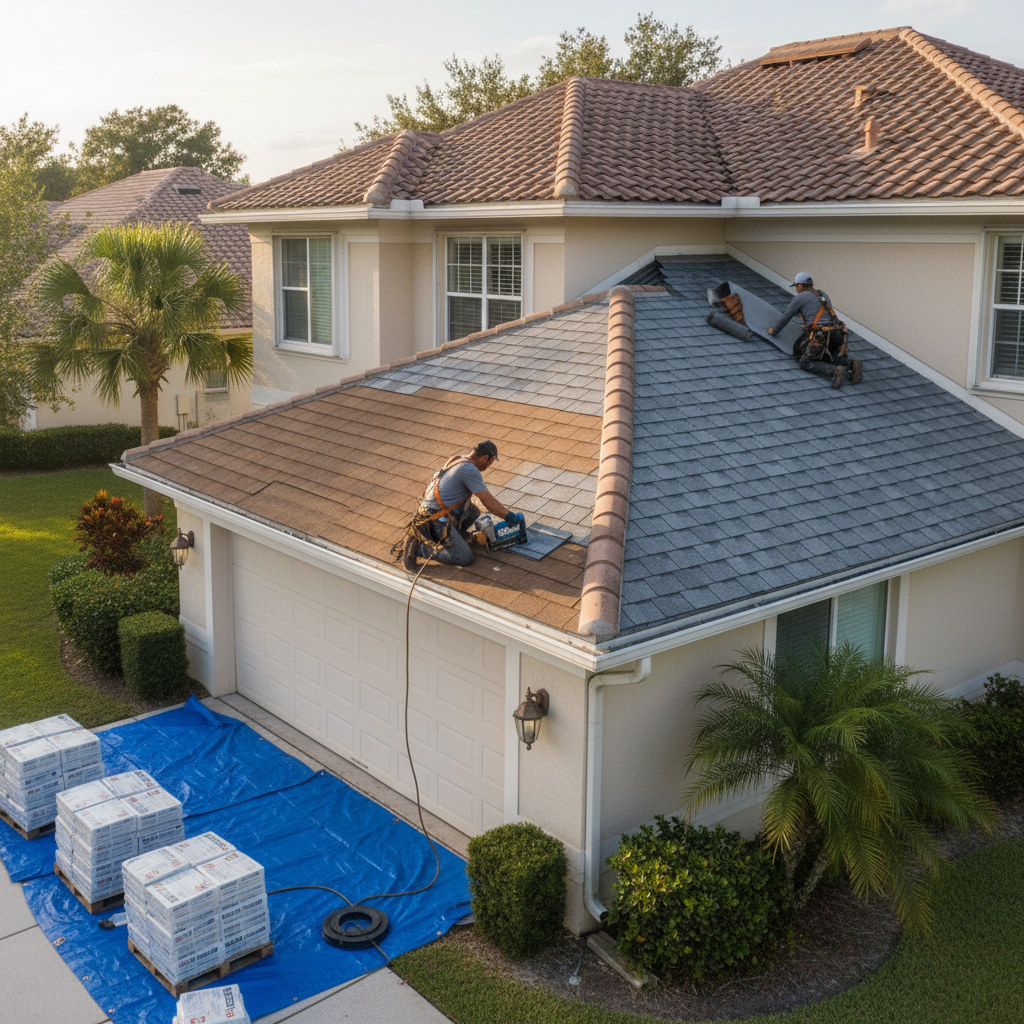
Laying new shingles over old ones saves you roughly the cost of tearing off and hauling away the existing roof. National cost guides put that at about $1,000 to $5,000 for a typical home (NerdWallet), or $1 to $5 per square foot of roof (HomeAdvisor). In Florida, the savings come with a catch most homeowners never hear about: an overlay skips the deck re-nailing and secondary water barrier that state code requires when a roof is removed and replaced, and those are the same features that can earn wind mitigation insurance credits.
So the honest answer is that an overlay trims the upfront bill, but part of what you "save" is hurricane protection you didn't get. Here is how the math works for a Tampa Bay home, what you give up, and when an overlay can still make sense.
Key Takeaways
- The savings equal the tear-off line item. An overlay removes labor and disposal for the old shingles. National guides estimate that at $1,000 to $5,000 per home, or $1 to $5 per square foot.
- Landfill fees are a small slice. At Hillsborough County's $104-per-ton rate, the old shingles on a 20-square roof run roughly $180 to $240 to dump. Most of the savings is labor.
- Florida code limits overlays. A roof-over is only allowed when there is one existing layer in sound, dry condition. Two layers, water damage, deterioration, or tile and slate roofs require a full tear-off.
- An overlay skips Florida's reroof mitigation. Deck re-nailing and a secondary water barrier are triggered when the roof covering is removed and replaced, so an overlay home doesn't get them.
- The next roof costs more. Two layers must both come off at the next replacement, which adds labor and debris weight to that future job.
- Top-tier warranties are off the table. The GAF Golden Pledge Limited Warranty requires all existing materials to be removed to the deck.
How much does a shingle overlay actually save compared to a tear-off?
A shingle overlay saves the cost of removing and disposing of the old roof, and nothing else. You still pay for new shingles, underlayment where used, flashing, ridge caps, the permit, and installation labor. The only line that disappears is the tear-off.
National cost guides disagree on how big that line is, which is why written quotes matter more than averages:
- NerdWallet's 2026 shingle cost guide says removing the old roof "will typically increase costs by $1,000 to $5,000."
- HomeAdvisor's shingle replacement cost guide puts removal at $1 to $5 per square foot, depending on local labor rates, roof pitch, and access. On a 2,000-square-foot roof, that works out to $2,000 to $10,000.
Neither figure is Tampa-specific, and both are national ranges. The practical step is simple: ask any contractor quoting a roof-over to also quote a full tear-off for the same shingle, and compare the two totals. The difference between them is your actual overlay savings.
Where does the tear-off money go in a Tampa Bay reroof?
Most of the money saved by skipping a tear-off in Tampa Bay is labor, not dumping fees. That surprises a lot of homeowners who assume the dumpster is the expensive part.
Here is a rough illustration for a roof with 20 squares (2,000 square feet) of asphalt shingles. The Asphalt Roofing Manufacturers Association (ARMA), as cited by Connecticut's Department of Energy and Environmental Protection, puts new asphalt shingles at roughly 175 to 233 pounds per square. Twenty squares of shingles therefore weigh about 1.75 to 2.3 tons. Hillsborough County's Southeast County Landfill charges $104 per ton (the commercial rate, which residents also pay as of June 1, 2026). That makes the landfill fee for the shingles themselves roughly $180 to $240.
This is a back-of-the-envelope estimate, not a quote. Weathered shingles, old felt, nails, and any rotted decking add weight, contractors pay for dumpster rental and hauling on top of tipping fees, and construction debris may be billed differently than household trash. Still, the math shows why the bulk of the tear-off line on a Tampa estimate is crew time: stripping the roof, cleaning the deck, and protecting landscaping from falling debris.
| Cost item | Full tear-off | Shingle overlay |
|---|---|---|
| Removal labor for old shingles | Included | Skipped |
| Dumpster, hauling, and landfill fees | Included (about $104/ton at Hillsborough's landfill, plus hauling) | Skipped |
| Deck inspection and rotted-sheathing replacement | Done before new roof goes on | Not possible; deck stays hidden |
| Florida deck re-nailing and secondary water barrier | Required when the covering is removed and replaced | Not triggered |
| New shingles, flashing, ridge caps, permit | Paid | Paid |
| Cost of the next replacement | One layer to remove | Two layers to remove |
| GAF Golden Pledge eligibility | Eligible (with a GAF Master Elite contractor) | Not eligible |
Does Florida building code allow new shingles over old shingles?
Florida building code allows a shingle overlay only in limited cases. The Florida Building Code, Existing Building volume, section 706.3 says new roof coverings cannot be installed without first removing all existing layers down to the deck when any of these conditions apply, according to a summary by the Florida Roofing and Sheet Metal Contractors Association (FRSA):
- The existing roof is water-soaked or has deteriorated to the point it is not an adequate base.
- The existing covering is wood shake, slate, clay, cement, or asbestos-cement tile.
- The roof already has two or more applications of any type of roof covering.
- Blisters exist and are not cut or scraped open and secured.
- The existing roof would be used for attachment and the wind securement provisions can't be met.
The City of Sebastian's reroofing guide puts the rule in plain terms: a roof-over "is allowed for a total of two layers of roofing applications," and the permit holder has to inspect the existing roof before installing over it. In practice, that means one existing layer of flat, dry asphalt shingles is the only realistic overlay candidate. Many older Tampa homes already have a second layer from a past repair, which ends the discussion.
The Asphalt Roofing Manufacturers Association adds a product-level caution: most manufacturers do not recommend installing new shingles over existing laminated (architectural) shingles, because the thick, uneven surface won't let the new layer lie flat. ARMA also notes that a recover may affect a shingle's impact rating.
What Florida hurricane protections does an overlay skip?
An overlay skips the two roof upgrades Florida requires when a home's roof is replaced. The Florida Building Commission's notice on hurricane mitigation retrofits states that, "regardless of house value," roof deck attachments must be strengthened or corrected and a secondary water barrier installed when a roof is replaced. The Florida Home Builders Association's 2026 guide quotes the residential code trigger directly: these procedures apply "when a roof covering on an existing structure is removed and replaced."
An overlay doesn't remove the covering, so neither upgrade happens. The City of Sebastian's reroof mitigation Q&A says this outright: installing a new covering without removing the existing one "does not constitute a roof replacement, which is the trigger that initiates the new roofing regulations."
Here is what that means on the roof itself:
- Deck re-nailing. On a tear-off, Florida requires the sheathing to be fastened with 8d ring-shank nails at least 2 1/4 inches long, spaced 6 inches on center along the framing (with qualifying existing nails counting toward that spacing). Older homes built with staples or smaller nails get a much stronger deck. An overlay leaves the original fastening as-is.
- Secondary water barrier. On a tear-off, the contractor must install full peel-and-stick underlayment, taped deck seams under underlayment, or two layers of underlayment installed to code. That layer is what keeps rain out if wind strips shingles off. An overlay doesn't add one.
Those same features matter to your insurance. Florida's Uniform Mitigation Verification Inspection Form (OIR-B1-1802), revised in April 2026, evaluates roof deck attachment and sealed roof deck / secondary water resistance among its nine mitigation features, according to Simpson Strong-Tie's summary of the form. A home that never got those upgrades can't document them on a wind mitigation inspection. Ask your insurance agent how a recover would be treated on your policy before you assume the overlay is the cheaper option over the life of the roof.
What does an overlay cost you later?
An overlay pushes part of today's tear-off cost onto the next roof, and adds to it. Once two layers are on, Florida code requires both to come off at the next replacement. HomeAdvisor notes that the cost of a double tear-off is often more than doing two separate tear-offs. If you sell the home before then, the buyer's inspector will likely note the second layer, and the buyer will price that future cost into their offer.
The other deferred cost is hidden damage. GAF's guidance on overlays warns that if a roof is being replaced because of leaks, an overlay can leave water-damaged decking or mold hidden and untreated. A tear-off is the only time a roofer sees the full deck. Rot found later, after it has spread under two layers, is a bigger repair than rot found and replaced during a tear-off.
Warranty choice is the third trade-off. GAF's Golden Pledge Limited Warranty brochure states that "the roof system must NOT be installed over an existing roof — all existing materials must be removed to the deck," and the system must be installed by a GAF Master Elite Roofing Contractor. An overlay rules out that warranty tier entirely, regardless of who installs it.
When does a shingle overlay make sense for a Tampa home?
A shingle overlay makes sense for a Tampa home only in a narrow set of situations. It's a short-term budget move, not a long-term roof plan. HomeAdvisor describes layering as most reasonable when you plan to replace the roof again within five to ten years, for example ahead of a planned remodel or teardown.
All of these need to be true before an overlay is worth pricing:
- There is exactly one existing layer, and the contractor has confirmed it by lifting shingles in several spots.
- The existing shingles lie flat, with no curling, cupping, or blistering.
- The deck feels solid underfoot and the attic shows no staining, rot, or daylight.
- The existing roof is a three-tab shingle rather than a thick architectural shingle, per ARMA's caution about laminated shingles.
- You've checked with your insurance agent and accept losing the deck and secondary water barrier upgrades.
If any of those fail, the overlay savings are likely to be erased by a future repair, a pricier next tear-off, or a weaker roof in the next hurricane.
How does Hytz Roofing approach overlay versus tear-off quotes?
Hytz Roofing, a Tampa-based roofing contractor (Florida license #CCC1332551) with more than 30 years of experience, holds GAF Master Elite and GAF President's Club status. That certification is what makes the GAF Golden Pledge Limited Warranty available on a full replacement, which an overlay can't qualify for. For homeowners weighing the two options, the most useful document is a side-by-side quote that shows the tear-off line, the code-required deck and secondary water barrier work, and the warranty that comes with each. You can see what a full roof replacement in Tampa with Hytz Roofing includes, and if you're budgeting for surprises, our guide to hidden costs that come up after a roof tear-off covers decking, extra layers, and fascia.
Frequently Asked Questions
Is a roof overlay faster than a tear-off?
Yes, a roof overlay is usually faster because the crew skips stripping the old shingles, cleaning the deck, and loading debris. GAF lists faster installation as one of the main reasons homeowners consider an overlay. The time saved is the same work that would have let the crew inspect and re-nail the deck, so speed and inspection come as a trade-off.
Do I still need a permit to put new shingles over old ones in Florida?
Yes. A roof-over is still reroofing work and needs a building permit in Florida. The City of Sebastian's guide, for example, requires the permit holder to inspect the existing roof before a roof-over system goes on. Your local building department makes the final call on whether your roof qualifies, so a contractor who offers an overlay without pulling a permit is a red flag.
Can I overlay architectural shingles over three-tab shingles?
Code may allow it if the existing layer is single, flat, and sound, but check the specific manufacturer's instructions first. ARMA says most manufacturers don't recommend installing new shingles over existing laminated shingles, and that recovering may affect a shingle's impact rating. Going the other way, putting a new layer over thick architectural shingles, is the scenario manufacturers most often discourage.
Will an overlay change my roof's age for insurance purposes?
That depends on your insurer, so ask before you sign. Florida's wind mitigation form evaluates roof covering type and its compliance documentation, along with deck attachment and secondary water resistance. An overlay produces a new covering but none of the deck or water-barrier upgrades a tear-off includes, so get your agent's answer in writing for your specific policy.
Sources
- NerdWallet: Cost to Replace Roof Shingles in 2026
- HomeAdvisor: Shingle Roof Replacement Cost
- HomeAdvisor: Should You Layer Shingles on Your Roof?
- GAF: Can You Put New Shingles over Old Shingles? (2023)
- GAF: Golden Pledge Limited Warranty Brochure
- Asphalt Roofing Manufacturers Association: Reroofing, Replacement vs. Recover (2024)
- FRSA: When Reroofing, the Choice to Recover or Replace May Not Be Yours
- Florida Building Commission: Hurricane Mitigation Retrofit Requirements for Reroofing
- Florida Home Builders Association: Roof Assemblies and Wind Mitigation (2026)
- City of Sebastian: Guide to Re-Roofing Mitigation Requirements
- City of Sebastian: Re-Roof Mitigation Q&A
- Simpson Strong-Tie: Florida OIR-B1-1802 Uniform Mitigation Verification Inspection Form (Rev. 04/26)
- Hillsborough County: Landfill Disposal Fees (effective June 1, 2026)
- Connecticut DEEP: Asphalt Shingles (citing ARMA shingle weights)