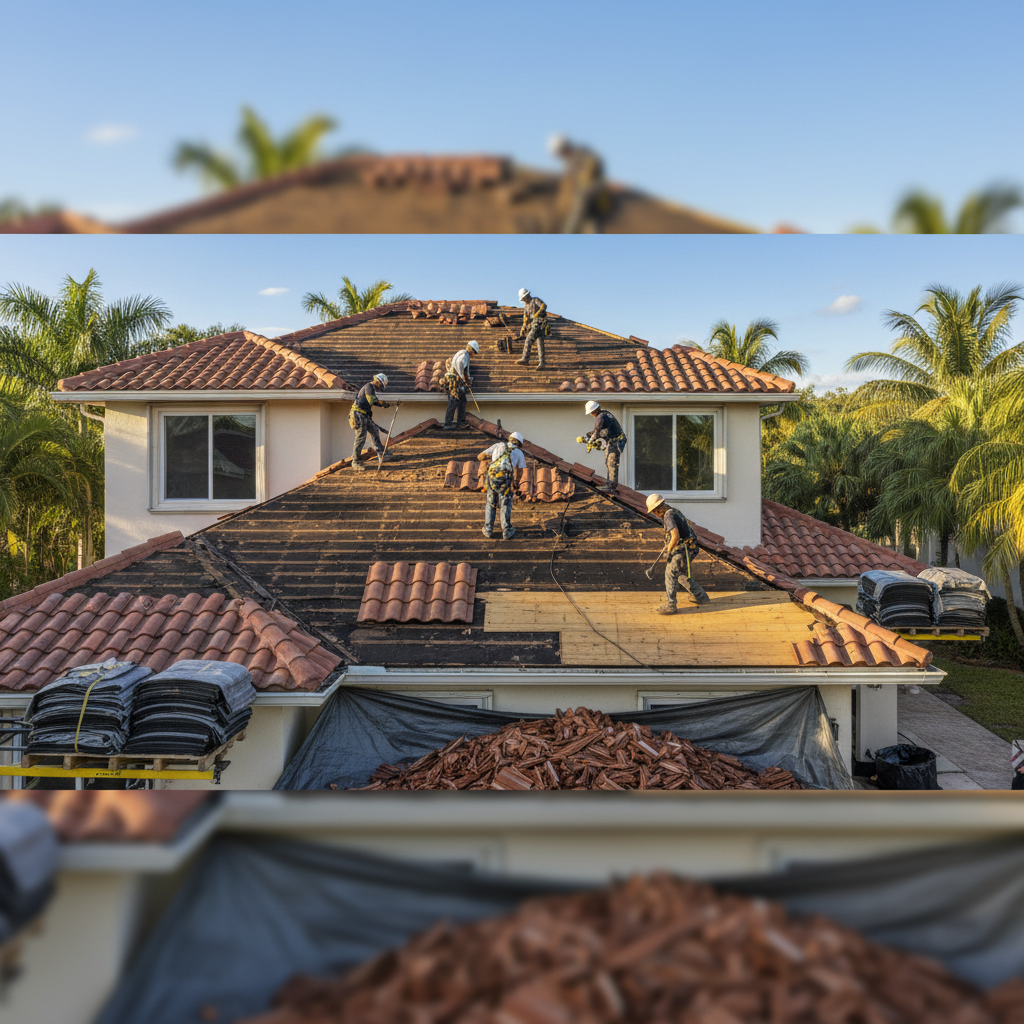
No hidden cost shows up on every roof, but a few show up often. The most common one found after a tear-off begins is rotted or delaminated roof decking (the plywood or OSB sheets under the shingles). After that come extra layers of old roofing, rotted fascia boards, and damaged flashing that can't be reused. In Florida, the deck re-nailing and secondary water barrier the code requires belong in your original bid, not in a change order. A good contract lists a unit price for each item that might come up, so nothing found on the roof turns into an open-ended bill.
Key Takeaways
- Rotted roof decking is the most common surprise after tear-off. It usually can't be measured until the old shingles are off, so the fix is a written per-sheet price, not a promise that it won't happen.
- Florida's reroof mitigation rules (deck re-nailing and a secondary water barrier) apply to every site-built single-family reroof. Any honest Tampa bid already includes them.
- Homes in the wind-borne debris region with an insured or assessed value of $300,000 or more may also need roof-to-wall connection upgrades, capped at 15% of the reroof cost.
- A second layer of old shingles, rotted fascia, and worn-out flashing are the other usual extras. Each one can be priced per unit before you sign.
- Rafter or truss damage is rare but is the one item that can't be fully priced ahead of time, because it may need an engineer.
Why do roofing costs change after the tear-off starts?
Roofing costs change after tear-off because the most important layer of the roof, the wood deck, is hidden until the shingles and underlayment come off. An estimator can walk the roof, look for soft spots, and check the attic for water stains, but nobody can see the condition of every sheet of plywood from above or below. Florida's building code also expects the deck to be sound: the Florida Building Code defines roof replacement as including "repairing any damaged substrate," according to an analysis by the Florida Roofing and Sheet Metal Contractors Association (FRSA). So when the crew finds bad wood, it has to be fixed before the new roof goes on.
That means a change after tear-off is not automatically a sign of a dishonest contractor. What separates a fair change from a padded one is whether the price for it was set in writing before work started.
What hidden costs come up most often during a roof tear-off?
The table below lists the items that most often get added after a roof tear-off begins, why each one stays hidden during the estimate, and how to keep each one from becoming an open-ended charge. Cost ranges are national figures from Angi's 2025 cost guides. Tampa prices vary by contractor and by how much work is needed.
| Item found after tear-off | Why it stays hidden | Typical pricing basis | How to cap it in the contract |
|---|---|---|---|
| Rotted or delaminated roof decking | Covered by shingles and underlayment; damage often isn't visible from the attic | Per sheet (4x8 ft). Angi's 2025 range of $2 to $6 per square foot works out to about $64 to $192 per sheet | Per-sheet price in writing, plus a "notify me before exceeding X sheets" clause |
| Extra layer of old roofing | A second layer can be hard to confirm without lifting shingles at several spots | Per square (100 sq ft) for added tear-off labor and disposal | Ask the estimator to confirm layer count in writing and state the per-square price for each extra layer |
| Rotted fascia board | The top edge of the fascia sits under the drip edge and shingles | Per linear foot. Angi's 2025 range is $7 to $22 per foot installed | Per-linear-foot price for wood or PVC replacement |
| Flashing that can't be reused | Wall, chimney, and valley flashing condition shows only once the shingles around it are removed | Per piece or per linear foot | Confirm in the bid whether all flashing is new or "reused where possible" |
| Roof-to-wall connection upgrades (some Florida homes) | Depends on home value, location, and existing straps or clips in the attic | Required only up to 15% of the reroof cost | Ask before signing whether your home meets the $300,000 threshold and how the 15% cap will be calculated |
| Damaged rafters or trusses | Structural damage may only show once the deck is opened | Usually priced case by case; may need an engineer | Require written approval before any structural work starts |
How much does rotted roof decking add to a roof replacement?
Rotted roof decking usually adds the cost of each sheet replaced, which depends on how many sheets are bad and what the contractor charges per sheet. Angi's 2025 cost guide puts roof sheathing at roughly $2 to $6 per square foot. Because a standard sheet of plywood or OSB covers 32 square feet, that range works out to about $64 to $192 per sheet installed. A few sheets around a leaking vent pipe is a small add. Widespread rot from a long-term leak can run into the thousands.
Angi also notes that oriented strand board (OSB) costs about half as much as plywood, while plywood holds up better under heavy roofing like tile. Before you sign, ask which material the contractor uses for replacement sheets and what thickness. Matching the existing deck thickness matters, because a thinner patch sheet can show through the new shingles as a visible dip.
The best protection is two lines in the contract: a fixed price per sheet, and a requirement that the contractor show you or photograph the damaged wood before replacing more than a set number of sheets.
Which Florida code requirements should already be in a Tampa reroof bid?
Two Florida code requirements apply to every reroof of a site-built single-family home, so they belong in the original Tampa bid and should never appear as a surprise. The Florida Building Commission's hurricane mitigation notice states that, regardless of house value, deck attachments must be "strengthened or corrected" and a secondary water barrier must be installed when a roof is replaced. These rules come from Florida Statutes section 553.844 and appear in section 706 of the Florida Building Code, Existing Building volume.
- Deck re-nailing (FBC Existing Building 706.7.1): City of Sebastian reroofing guidance spells out the standard: 8d ring-shank nails at least 2 1/4 inches long, spaced 6 inches on center along the framing, with qualifying existing nails counting toward that spacing. Many Florida building departments require a sheathing inspection before the roof can be dried in.
- Secondary water barrier (FBC Existing Building 706.7.2): the contractor must use one of three methods: full peel-and-stick underlayment, self-adhering tape over every deck seam with underlayment over the whole roof, or two layers of felt or synthetic underlayment installed to code.
If a contractor tells you mid-job that re-nailing or the secondary water barrier is an extra, treat it as a red flag. Those items are required on every qualifying reroof, so a contractor who left them out of the bid either underbid the job on purpose or didn't plan for code.
When does a Florida reroof require roof-to-wall connection upgrades?
A Florida reroof requires roof-to-wall connection upgrades when the home is a site-built single-family house in the wind-borne debris region with an insured value, or a just (assessed) value for tax purposes, of $300,000 or more. The Florida Home Builders Association's 2026 roof assemblies guide notes the upgrade is not required beyond a 15% increase in the cost of re-roofing. It also is not required when the home was built under a code that already called for a continuous load path from roof to foundation. Lee County's permitting guidance, for example, applies the rule to homes permitted before 1995.
This is the Florida item most likely to surprise homeowners, because many people have never heard of it. Clearwater's roof-to-wall inspection affidavit, revised in May 2026, includes a checkbox for when mitigation costs pass 15% of the reroof cost, so Pinellas homeowners will see the same rule in practice. Before signing, ask your contractor three things: whether your home crosses the $300,000 threshold, whether it sits in the wind-borne debris region, and how the 15% cap will be figured on your job.
Does a second layer of old shingles cost extra to remove?
A second layer of old shingles does cost extra to remove, because it roughly doubles the tear-off labor and the weight of debris going to the landfill. Florida code also leaves no option to roof over it. FRSA's summary of FBC Existing Building section 706.3 lists the conditions that require tearing off to the deck, including when "the existing roof has two or more applications of any type of roof covering" and when the existing covering is water-soaked or deteriorated.
An extra layer is the easiest surprise to prevent. A careful estimator checks the layer count at the roof edge and at a few spots on the field of the roof, then writes it into the estimate. If your bid says "one layer" and the crew finds two, the contract should already say what each extra square costs.
What about fascia, flashing, and other edge damage found during tear-off?
Fascia, flashing, and edge damage are the other common add-ons once a tear-off is underway. Fascia (the board that runs along the roof edge and holds the gutters) often rots at the top edge, where it sits under the drip edge and stays hidden. Angi's 2025 data puts fascia replacement at $7 to $22 per linear foot installed, with wood boards costing less than PVC or aluminum.
Flashing is a scope question more than a surprise. Some bids replace every piece of step flashing, wall flashing, and pipe boot. Others say "reuse existing where possible," which leaves room for add-on charges if the old metal is rusted or bent. Ask for all-new flashing in the base price, or a listed price per piece if the contractor plans to reuse any.
Will Florida's 9th Edition building code change reroof costs?
Florida's 9th Edition building code is not expected to add new tear-off surprises, based on the reroofing changes published so far. FRSA reports that the 2026 Ninth Edition of the Florida Building Code takes effect December 31, 2026. FRSA's summary of the changes to section 706.3 describes them as mostly permissive: one change lets an adequate existing substrate stay in place as the base for a new roof covering, and another lets an existing self-adhered membrane stay on the deck with a new membrane installed over it.
The date can still matter for your project. The code in force when your permit is applied for usually controls the job, so if your Tampa reroof is being permitted around the end of 2026, ask your contractor which edition the permit will fall under.
How do you keep hidden roofing costs from blowing up your budget?
You keep hidden roofing costs under control by pricing the unknowns before tear-off, not after. Use this checklist when you review a roof replacement contract:
- Get a written per-sheet price for decking replacement, including the material (plywood or OSB) and thickness.
- Add a clause requiring photos and your approval before the crew replaces more than a set number of sheets.
- Confirm the number of existing layers in writing, with a per-square price for any extra layer found.
- Make sure deck re-nailing and the secondary water barrier are listed in the base price.
- Ask whether roof-to-wall connections apply to your home and how the 15% cap is calculated.
- Get per-foot fascia pricing and a clear statement on whether flashing is new or reused.
- Keep a contingency of roughly 10% of the contract price set aside so a few extra sheets don't wreck your budget.
The 10% contingency is a planning cushion, not a figure from a pricing study. Older roofs and roofs with a known leak history deserve a larger cushion.
How does Hytz Roofing handle costs found after tear-off?
Hytz Roofing, a Tampa roofing contractor (Florida license #CCC1332551) with more than 30 years of experience, starts every roof replacement in Tampa with a condition assessment, permit planning, and a written estimate. Hytz is a GAF Master Elite contractor and a GAF President's Club award winner. On a Hytz estimate, ask the estimator to walk you through the per-sheet decking price, the layer count, and how any changes found after tear-off will be documented and approved. Hytz also publishes a plain-English guide to roofing estimate line items if you want to check each line before signing.
Frequently Asked Questions
Can a roofer charge more than the contract price without my approval?
A roofer should not charge more than the contract price without a written change order you approve, unless your contract already sets unit prices for items like decking and says how they will be billed. Read the change-order section of the contract before signing. If it gives the contractor open permission to bill "as needed," ask for a cap or an approval step instead.
Can I ask to see the rotted wood that was replaced?
You can ask to see the rotted wood, and a reputable contractor should agree. Ask for date-stamped photos of each damaged area before the new decking goes down, or ask the crew to set the removed sheets aside until you can look at them. Photos also help if the damage came from a covered event and you plan to file an insurance claim.
Does homeowners insurance pay for rotted decking found during a roof replacement?
Homeowners insurance usually does not pay for rotted decking caused by age, wear, or slow leaks, because most policies exclude long-term deterioration. If the deck damage came from a sudden covered event such as a hurricane, it may be part of that claim. Check your policy wording and talk to your insurer or agent, since coverage depends on your specific policy.
Is a low bid with no decking price a warning sign?
A low bid with no decking price is a warning sign worth questioning. It doesn't mean the contractor is dishonest, but it leaves the most common post-tear-off cost unpriced. Ask the contractor to add a per-sheet price in writing so you can compare bids on equal terms.
Sources
- Angi: How Much Does Roof Decking Cost to Replace? (2025 data)
- Angi: How Much Does Fascia Board Replacement Cost? (2025 data)
- Florida Building Commission: Hurricane Mitigation Retrofit Requirements for Reroofing
- Florida Home Builders Association: Roof Assemblies and Wind Mitigation (2026)
- City of Sebastian: Guide to Re-Roofing Mitigation Requirements
- Lee County: Roof Replacement Roof-to-Wall Connection Guidance
- City of Clearwater: Inspection Affidavit for Roof-to-Wall Connections (rev. 05/2026)
- FRSA: When Reroofing, the Choice to Recover or Replace May Not Be Yours
- FRSA: Changes in the 2026 9th Edition of the Florida Building Code
- Hytz Roofing: Roof Replacement Tampa