Roofing Contractor License in Florida: What You Need to Know
Florida roofing contractor license explains state requirements, application steps, and how the license protects homeowners when hiring a roofer.
Last updated: August 8, 2026
A roofing contractor license is a state-issued credential that legally authorizes an individual or company to perform roofing work for compensation in Florida. The Florida Department of Business and Professional Regulation (DBPR) administers this license and sets the requirements every contractor must meet before picking up a single shingle. Those requirements include verified field experience, passing trade and business exams, carrying minimum insurance, and posting a contractor bond. If you are hiring a roofer or considering getting licensed yourself, understanding what this credential covers protects you from serious legal and financial risk.
What are the requirements to get a roofing contractor license in Florida?
Florida’s roofing contractor requirements are among the most detailed in the country. The DBPR issues a Certified roofing license identified by a CCC number, which grants statewide authority to operate. That statewide reach is what separates a Certified license from a locally registered contractor, who can only work within a specific county or municipality.
To qualify for a Certified roofing contractor license, you must meet all of the following:
- Four years of verified field experience in roofing work, documented and submitted to the DBPR
- Passing a trade exam covering roofing systems, materials, and Florida Building Code requirements
- Passing a business and finance exam covering contracts, business law, and financial management
- Carrying a minimum of $300,000 in general liability insurance at all times
- Posting a contractor bond as required by the state
Florida also distinguishes between a full Roofing Contractor license and a Specialty Contractor license. A Specialty license covers a narrower scope of work, such as a single roofing system type. A full Roofing Contractor license covers the complete range of residential and commercial roofing services within its classification.
Pro Tip: Before you sit for the exam, verify your experience documentation is complete. The DBPR requires affidavits from former employers or clients confirming your field hours. Missing paperwork is the most common reason applications stall.

Why does a roofing contractor license matter for Florida homeowners?
A roofing contractor license is not just a formality. It is a legal requirement to operate a roofing business in Florida, and hiring someone without one creates real financial and legal exposure for you as a homeowner.
Unlicensed roofing work can void your homeowner’s insurance claim if a covered event like a hurricane causes damage to a roof that was previously repaired without permits. That means you pay out of pocket for repairs that should have been covered. Beyond insurance, unlicensed work often fails inspections, which can delay a home sale or trigger costly corrections.
The risks of hiring an unlicensed contractor include:
- Voided insurance claims if the prior work lacked proper permits
- Failed building inspections that require licensed re-work at your expense
- No legal recourse if the work is defective, since unlicensed contractors cannot legally enforce contracts in Florida
- No bond protection, meaning you cannot file a claim against a bond if the job goes wrong
Licensing confirms competency and gives the state a mechanism to discipline contractors who perform substandard work. That accountability does not exist with unlicensed operators. For Florida homeowners dealing with storm damage, that distinction is the difference between a protected repair and an expensive mistake. You can learn more about common Florida roof repair needs to understand what licensed work actually covers.
Licensing also affects financing. Financing approval for roofing work typically requires contractors to hold a valid license and insurance to participate as dealers in financing programs. A licensed contractor can offer you manageable payment plans. An unlicensed one cannot, which limits your options when a major repair hits unexpectedly.
How do roofing license types differ in Florida?
Not every roofing license covers the same scope of work. Residential and commercial roofing licenses correspond to different building codes. Residential work falls under the International Residential Code (IRC), while commercial projects follow the International Building Code (IBC). A contractor licensed only for residential work cannot legally take on a commercial re-roof.
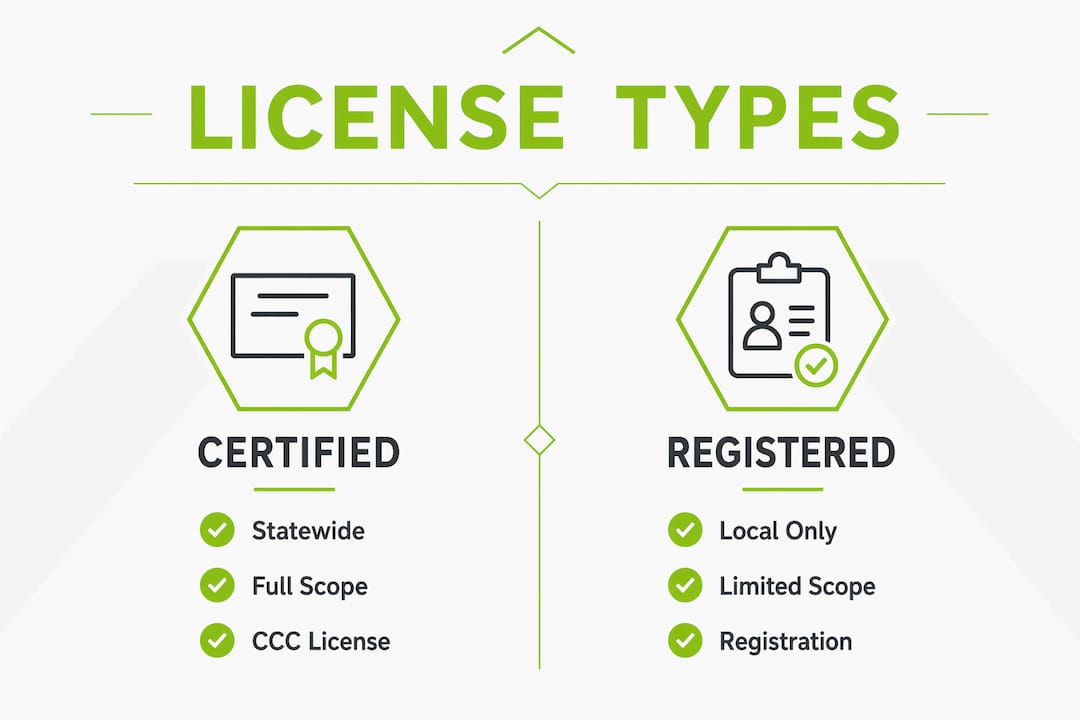
| License Type | Scope | Issuing Authority | Code Standard |
|---|---|---|---|
| Certified Roofing Contractor (CCC) | Statewide, residential and commercial | Florida DBPR | IRC and IBC |
| Specialty Roofing Contractor | Limited system type or scope | Florida DBPR | Varies |
| Registered (Local) Contractor | Single county or municipality | Local jurisdiction | IRC or IBC |
| General Contractor with Roofing Endorsement | Roofing as part of broader construction | Florida DBPR | IRC and IBC |
The CCC designation is the most recognized. Hytzroofing holds Florida Contractor License #CCC1332551, which confirms statewide authority and full compliance with DBPR standards. When you verify a contractor’s license on the DBPR website, the license number tells you exactly what scope of work they are authorized to perform.
Pro Tip: Always verify a contractor’s license type, not just whether they have a license. A contractor licensed for residential work only cannot legally perform commercial roofing. Checking the DBPR’s online license lookup takes less than two minutes and confirms both the license type and its current status.
What is the process for getting and maintaining a roofing license in Florida?
The roofing license application process in Florida follows a clear sequence. Rushing any step delays the entire timeline.
- Gather experience documentation. Collect affidavits or employer records confirming four years of hands-on roofing experience. This is the most time-consuming step for most applicants.
- Register for and pass the trade exam. The Florida roofing trade exam covers materials, installation methods, and the Florida Building Code. Most applicants spend 6–12 weeks preparing.
- Pass the business and finance exam. This exam tests contract law, business management, and financial literacy. Both exams are administered through Pearson VUE testing centers.
- Secure your insurance and bond. You need proof of at least $300,000 in general liability coverage and a contractor bond before the DBPR will approve your application.
- Submit your application to the DBPR. Include all documentation, exam scores, insurance certificates, and the application fee.
- Receive your CCC license number. Once approved, your license is active statewide and appears in the DBPR’s public database.
Florida roofing licenses require renewal every two years. Renewal requires maintaining current insurance and bond coverage throughout the license period. Letting either lapse can trigger automatic suspension. Continuing education requirements may also apply depending on your license classification, so check your renewal notice carefully each cycle.
The full process from starting exam prep to receiving your license typically takes four to six months. Planning ahead matters, especially if you want to be operational before Florida’s busy storm season.
Key Takeaways
A Florida roofing contractor license is a state-issued credential that requires four years of experience, two exams, $300,000 in liability insurance, and a contractor bond, and it is the single most important factor separating legitimate roofing work from costly, unprotected repairs.
| Point | Details |
|---|---|
| License definition | A roofing contractor license is a DBPR-issued credential authorizing legal roofing work for pay in Florida. |
| Core requirements | Four years of experience, trade and business exams, $300,000 liability insurance, and a contractor bond are all required. |
| Homeowner risk | Hiring an unlicensed contractor can void your insurance claim and leave you with no legal recourse. |
| License scope matters | Residential and commercial licenses follow different codes; always verify the exact license type before hiring. |
| Renewal cycle | Florida roofing licenses must be renewed every two years with active insurance and bond coverage maintained. |
Licensing is the floor, not the ceiling
I have seen homeowners make the same mistake repeatedly. They check whether a contractor has a license, confirm it is active, and stop there. That is the minimum. What actually separates a good contractor from a great one is what they have built on top of that license.
A CCC number tells you a contractor passed the required exams and carries the minimum insurance. It does not tell you whether they show up on time, install correctly, or stand behind their work when something goes wrong two years later. I have watched homeowners hire licensed contractors who delivered genuinely poor results, and I have seen the aftermath of unlicensed work that cost families tens of thousands of dollars in repairs and denied insurance claims.
My honest advice: treat the license as the entry requirement, not the finish line. After you confirm the license is valid on the DBPR website, look for manufacturer designations like GAF Master Elite status, which fewer than 2% of contractors in North America earn. Check their BBB rating. Read reviews on Angi. Ask for references from jobs completed in the last 12 months. If a contractor cannot provide those things, the license alone is not enough reassurance.
Florida’s storm exposure makes this more urgent than in most states. A roof that fails during a hurricane is not just a repair problem. It is a safety problem. The contractors who earn and maintain advanced credentials do so because they take that responsibility seriously. That is the standard worth holding to.
— Anthony
Work with a licensed Florida roofing contractor you can trust
Hytzroofing holds Florida Contractor License #CCC1332551 and carries full general liability insurance and workers’ compensation coverage on every job. As a GAF Master Elite contractor in Florida, Hytzroofing meets the licensing, insurance, and training standards that fewer than 2% of North American roofing contractors achieve. Whether you need a residential repair after storm damage or a full commercial re-roof, Hytzroofing brings verified credentials and manufacturer-backed warranties to every project. Request your free inspection or estimate today and work with a contractor whose license, awards, and track record speak for themselves.
FAQ
What is a roofing contractor license in Florida?
A roofing contractor license is a state-issued credential from the Florida DBPR that legally authorizes a contractor to perform roofing work for pay. It requires passing trade and business exams, verifying four years of experience, carrying $300,000 in liability insurance, and posting a contractor bond.
How do I verify a roofing contractor’s license in Florida?
Search the contractor’s name or CCC license number on the Florida DBPR’s online license lookup tool. The search confirms whether the license is active, what scope of work it covers, and whether any disciplinary actions have been filed.
Can unlicensed roofing work void my homeowner’s insurance?
Yes. Homeowner’s insurance can deny claims if prior repairs were completed by an unlicensed contractor without proper permits. Always confirm your contractor’s license before any work begins.
What is the difference between a Certified and a Registered roofing contractor in Florida?
A Certified contractor holds a DBPR-issued CCC license with statewide authority. A Registered contractor is licensed only within a specific local jurisdiction and cannot legally operate outside that area.
Why does roof financing require a contractor license?
Financing programs require contractors to submit proof of a valid license and insurance before they can offer payment plans to customers. An unlicensed contractor cannot participate in these programs, which limits your financing options as a homeowner.
Recommended
- Weathering the Storm Expert Tips for Roof Leak Repair in Tampa Fl
- GAF Master Elite Roofer in Tampa, FL | Hytz Roofing
- Introducing Enviroshake to Your Hoa
- Types of Roof Repairs Florida Homeowners Need Most
Ready to Work With a Trusted Tampa Roofer?
Hytz Roofing is a GAF Master Elite certified contractor serving Tampa Bay. Explore our services: