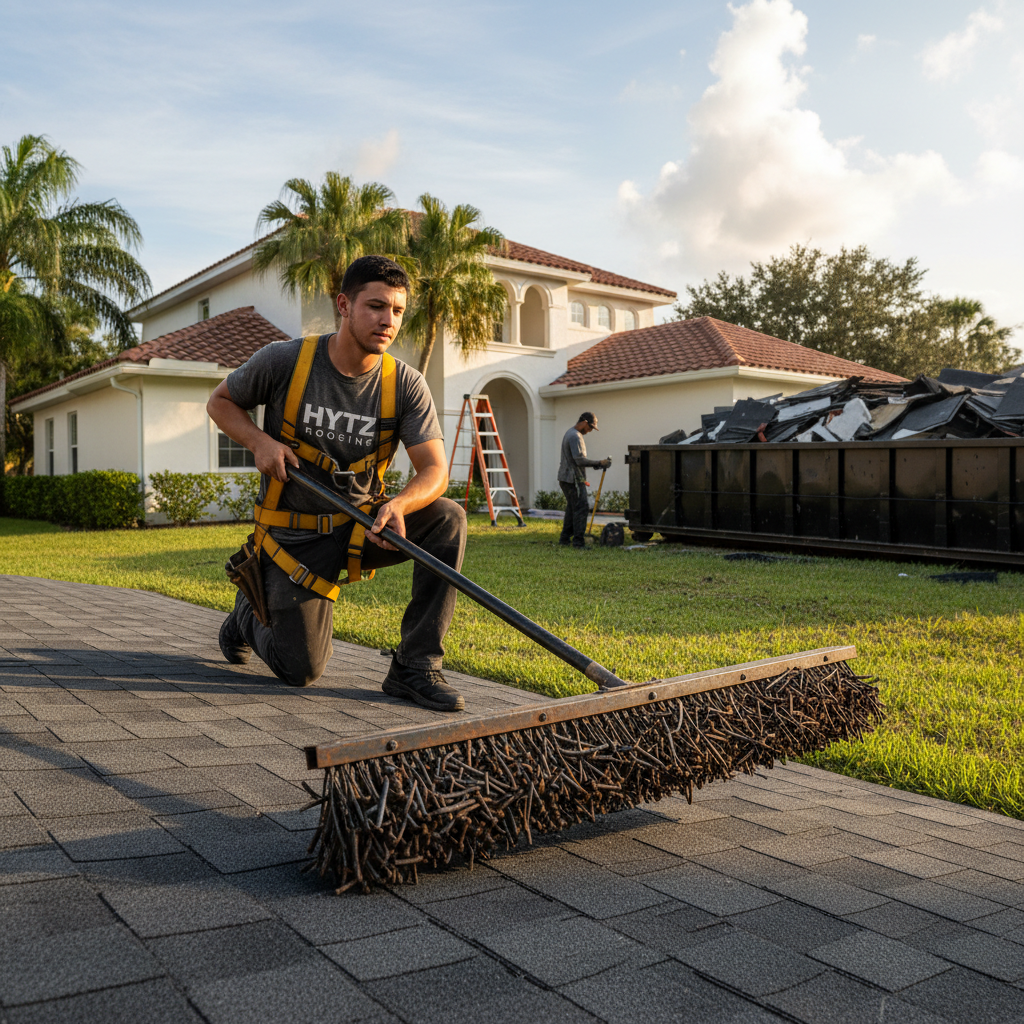
Most roofing messes happen because a tear-off sends thousands of old nails and shingle scraps off the roof, and some of them land where a single fast magnet pass never reaches: thick lawn, mulch beds, gravel, and gutters. Cleanup is part of the job you paid for. To get a roofer back for leftover nails, photograph and mark what you find, send the contractor a dated written request that points to the cleanup terms in your contract, and give a short deadline for a return sweep. If the nails damaged a tire or anything else, ask for the contractor's certificate of insurance and file the damage claim against it.
What Are the Key Takeaways?
- Nails left after a reroof are usually a process problem: one quick sweep, a magnet held too high, or only the driveway getting swept. They are rarely a sign the roof itself was installed badly.
- Florida's most common lawn grass, St. Augustinegrass, forms a dense turf that hides nails from a magnet that rolls over the top of it.
- Aluminum and copper fasteners and plastic cap pieces are not magnetic, so no sweeper will pick them up. Those need hand pickup or raking.
- Put your request in writing, reference the cleanup clause, and ask for a specific return date. Phone calls are easy to lose track of.
- Florida requires licensed roofing contractors to carry at least $100,000 in liability coverage and $25,000 in property damage coverage, so damage from leftover nails has an insurance path.
- Florida small claims court handles money claims up to $8,000 if the contractor won't respond.
Why Do Roofers Leave Nails and Debris Behind After a Roof Replacement?
A roof replacement starts with a tear-off, and every old shingle comes off with the nails that held it. Crews throw that material into a dumpster or trailer, and tarps catch most of what slides off the eaves. Nails still bounce off tarps, roll off the dumpster lip, drop from shingles carried across the yard, and blow sideways on a windy afternoon. Some leftover debris is normal at the end of a tear-off day. A yard that still has nails after the crew has packed up for good means the cleanup was rushed.
The usual reasons a roofing crew misses nails during final cleanup:
- One pass instead of a grid. A single walk with a rolling magnet covers lanes, not the whole yard. Nails between lanes stay put.
- The magnet sits too high. Wheeled sweepers are set to clear the ground, and a nail lying deep in grass can be out of reach of the magnetic field.
- Only the hard surfaces get swept. Driveways are easy and visible. Flower beds, rock borders, and the strip along the foundation are slow, so they get skipped.
- Weak or worn sweepers. Bluestreak Equipment, a magnetic sweeper manufacturer, notes that cheap magnets without a wrap-around housing can drop nails when grass brushes against them.
- The cleanup crew is different from the install crew. On some jobs a separate person does the final sweep and doesn't know where the debris fell.
- Nobody did a final walkthrough with the homeowner. A walkthrough is the moment missed nails get spotted while the crew is still on site.
Where Do Roofing Nails Hide, and What Actually Picks Them Up?
Roofing nails end up in predictable places around a house. The table below shows why a standard magnet sweep misses each area and what works there. Use it to check the crew's work, or to tell the contractor exactly where to go back.
| Area | Why the sweep misses nails here | What works |
|---|---|---|
| St. Augustinegrass lawn | Dense turf and thatch hold nails below the blade tips, under a wheeled magnet's reach | Slow overlapping passes in two directions with the magnet set low; a second pass after the next mowing |
| Mulch and pine-straw beds | Nails sink into loose material; wheeled sweepers can't roll through beds | Hand-held magnetic stick sweeper, then a light raking to bring buried nails up |
| Gravel, river rock, and pavers with gaps | Nails slip between stones and joints | Hand magnet worked close to the surface; raking the rock to turn it over |
| Gutters and downspouts | Nails and granules wash off the roof into the trough | Gutter cleanout by hand at the end of the job |
| Pool deck, screen enclosure, and lanai | Debris lands on screen roofs and in pool water | Checking the screen roof and pool; pool skimming and hand pickup |
| Street and neighbor's yard | Debris carried by wind or dropped beside the dumpster | Sweeping past the property line wherever the dumpster or trailer sat |
| Aluminum, copper, or plastic cap pieces anywhere | These materials are not magnetic | Visual check and hand pickup only |
The University of Florida Institute of Food and Agricultural Sciences (UF/IFAS) describes St. Augustinegrass as the most commonly used lawn grass in Florida and says it produces a dense turf that can build thatch under heavy fertilization and irrigation. Because St. Augustinegrass is Florida's most common lawn grass, one fast sweep is less reliable on a typical Tampa Bay lawn than on a thin, short one.
What Should a Roofer's Cleanup Include?
A roofer's cleanup should leave the property in the condition it was in before work started, with roofing debris removed from every area the job touched. In practice that means tarps or other protection over landscaping during tear-off, debris loaded into a dumpster or trailer instead of piled on the lawn, a magnetic sweep of the yard, beds, driveway, and street, gutters cleared of roofing debris, and a final walkthrough so the homeowner can point out anything missed.
Cleanup standards belong in the written contract, not in a verbal promise. When you compare bids, look for a line that covers site protection, daily debris removal, a final magnetic sweep, and who removes the dumpster. Hytz Roofing lists site protection, cleanup, and material staging among the items a written scope should spell out on its Tampa residential roofing page, which covers what to compare in a roofing scope. If your contract is silent on cleanup, you can still ask for it, but a written clause gives you something specific to point to.
How Do You Get a Roofer to Come Back and Clean Up Magnetic Nails?
Getting a roofer back for nail cleanup works best as a short, documented sequence. A reputable contractor wants the job closed out cleanly, so a clear written request is often enough.
- Stop using the area. Keep kids, pets, and the mower off the lawn and park outside the driveway until the yard is swept.
- Document what you found. Take dated photos of the nails where they lie, with something for scale. Push small flags or golf tees into the ground next to clusters so the crew can find them. Save a few nails in a bag.
- Send a written request. Email or text the project manager or office, not only the crew lead. State the job address and completion date, describe where the nails are, attach photos, quote the cleanup line in your contract if there is one, and ask for a return sweep by a specific date, such as within three business days.
- Ask about the final walkthrough. If the contractor never did one, ask for one now, with you present, as part of the return visit.
- Use the final payment the way your contract allows. Many roofing contracts tie the last payment to completion or a final walkthrough. If cleanup is part of the contracted scope and the job is not complete, say so in writing before you release that payment. Read the payment terms first; holding money outside what the contract allows can create its own dispute.
- Escalate in writing if the deadline passes. Send a second dated message stating that you will hire a cleanup service or buy a sweeper and seek reimbursement. Keep receipts.
- Use small claims court as the last step. Florida's small claims rules cover money claims that do not exceed $8,000, not counting costs, interest, and attorney's fees. A cleanup bill or a tire replacement fits well inside that limit.
This is general information, not legal advice. For a large dispute, a Florida construction attorney can review your contract.
Who Pays If a Roofer's Leftover Nail Damages Your Car, Mower, or Pet?
The roofing contractor is generally the first place to take a damage claim from nails left behind on the job, and in Florida the contractor is required to carry insurance for it. Florida Administrative Code Rule 61G4-15.003 requires roofing and other specialty contractors to carry at least $100,000 in liability coverage and $25,000 in property damage coverage. General and building contractors must carry $300,000 and $50,000.
To make a damage claim from leftover roofing nails:
- Keep the nail that caused the damage and photograph it next to the tire or item.
- Get a written repair estimate or receipt, such as a tire shop invoice or a vet bill.
- Ask the roofer, in writing, for reimbursement and for a copy of their certificate of insurance.
- If the contractor won't pay, ask the insurer named on the certificate how to file a claim directly.
A tire punctured by a roofing nail may or may not be repairable. The U.S. Tire Manufacturers Association (USTMA) says a passenger or light truck tire can be repaired only if the puncture is in the tread area and no more than 1/4 inch in diameter, the tire is removed from the wheel and inspected inside, and the repair uses a plug to fill the hole and a patch to seal the inner liner. A plug alone is not an acceptable repair under USTMA guidance. A nail in the sidewall or shoulder means a new tire, which matters for how much you claim.
Can You Clean Up Roofing Nails Yourself, and How Should You Do It?
You can clean up roofing nails yourself with a rolling magnetic sweeper and a hand-held magnetic stick, and many homeowners do a follow-up sweep even after the crew's cleanup. Doing it yourself does not waive your right to ask the contractor to come back or to cover the cost.
- Set the magnet as low as it will go without dragging, and move slowly.
- Work in a grid. Overlap each lane, then sweep the whole lawn again at a right angle to the first pass.
- Clean the magnet often. A loaded magnet holds fewer new nails. Release or pull off the collected nails every few lanes.
- Hand-sweep the beds and rock. Use the stick magnet close to the surface, then rake and sweep again.
- Sweep again after the first mowing and the first hard rain. Both move buried nails to the surface.
- Look by eye for non-magnetic pieces. Aluminum nails, copper nails, and plastic cap fragments won't stick to any magnet.
Is It Safe to Mow the Lawn After a Roof Replacement?
Mowing a lawn that may still hold roofing nails is risky, so sweep first. The U.S. Consumer Product Safety Commission (CPSC) tells homeowners to check the lawn for debris before mowing and warns that objects struck by a mower blade can be thrown out from under the mower and cause severe injuries and deaths. CPSC estimated that about 35,000 people a year were treated in emergency rooms for walk-behind power mower injuries from 2013 to 2015. A steel nail is exactly the kind of object a blade can throw, so a full sweep comes before the first mowing.
How Can You Prevent a Roofing Mess Before the Job Starts?
Most roofing messes can be prevented with a few questions before you sign. Ask the contractor:
- Where will the dumpster or trailer sit, and will it be on plywood to protect the driveway?
- Will tarps go over landscaping, the pool, and the lanai during tear-off?
- Is debris cleaned up at the end of each day, or only at the end of the job?
- What magnetic sweep is done at the end, and does it include beds, gravel, the street, and the neighbor's side of the fence?
- Will someone do a final walkthrough with you before the final payment?
- Who is the project contact if you find nails after the crew leaves?
On your side, move vehicles, patio furniture, grills, and potted plants away from the house, and tell your neighbors the dates. Hytz Roofing, a Tampa roofing contractor with GAF Master Elite and GAF President's Club recognition from GAF, the roofing manufacturer, and Florida license #CCC1332551, covers the full sequence in its guide to what to expect during a roof replacement.
What Other Questions Do Homeowners Ask About Roofing Cleanup?
Are roofing nails magnetic?
Standard galvanized roofing nails are steel, so they stick to a magnet. Aluminum nails, which some crews use with aluminum drip edge or flashing, and copper nails are not magnetic, and neither are the plastic caps on cap nails used for underlayment. A magnetic sweep will miss all of these, so a visual check and hand pickup are still part of a complete cleanup.
How long after a roof replacement can you keep finding nails?
Nails can keep showing up for a few weeks after a roof replacement, especially in thick St. Augustinegrass and mulch. Rain, irrigation, and mowing move buried nails toward the surface. Sweep again after the first mowing and the first heavy rain, and tell the contractor if you find clusters, since a group of nails in one spot usually marks an area the crew skipped.
Can I ask the roofer to clean up nails in my neighbor's yard?
Yes. Debris that left your property because of the roofing job is still part of the job's cleanup. Ask the contractor to sweep wherever the dumpster sat, along the street, and in any neighbor's yard that borders the work area, and let your neighbor know when the crew will be there.
Sources
- Florida Administrative Code Rule 61G4-15.003, Public Liability Insurance (via Cornell Legal Information Institute): https://www.law.cornell.edu/regulations/florida/Fla-Admin-Code-Ann-R-61G4-15-003
- The Florida Bar News, Florida Rules of Small Claims Court amendment to Rule 7.010: https://www.floridabar.org/the-florida-bar-news/florida-rules-of-small-claims-court-amendment-to-rule-7-010/
- U.S. Tire Manufacturers Association, Tire Repair Basics: https://www.ustires.org/tire-care-safety/tire-repair-basics
- UF/IFAS, St. Augustinegrass for Florida Lawns (LH010): https://ask.ifas.ufl.edu/publication/LH010
- U.S. Consumer Product Safety Commission, Walk-Behind Power Mower Fact Sheet: https://www.cpsc.gov/s3fs-public/5126WalkBehindPowerMowerFactSheet.pdf
- Bluestreak Equipment, How To Clean Up Nails After a Roof Is Installed: https://www.bluestreakequipment.com/how-to-clean-up-nails-after-a-roof-is-installed/