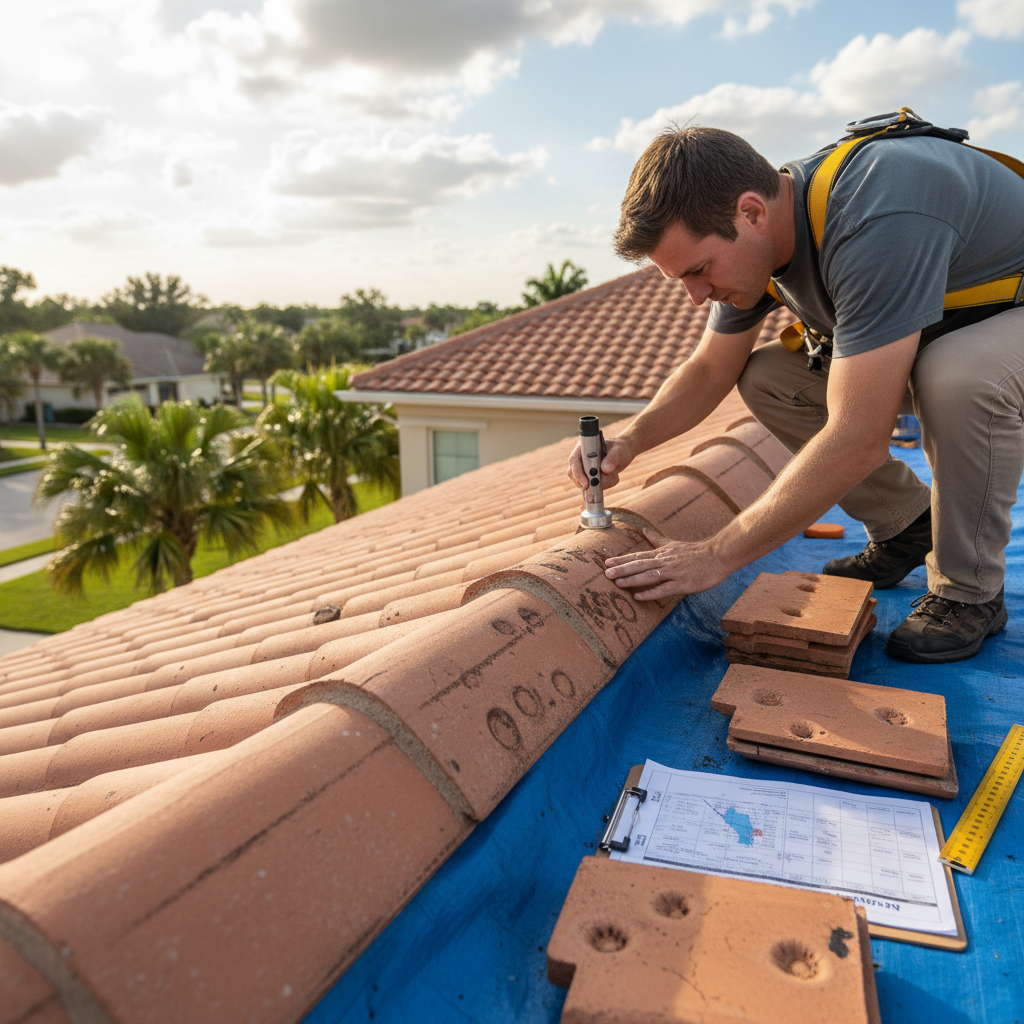
To prove your roof was damaged by hail and not "old age," you need two things the insurer cannot wave away: physical marks on the roof that match how hail behaves, and outside proof that a hailstorm actually hit your address on a specific date. Hail leaves random impact marks, soft "bruises" you can feel, fractures that show on the underside of the shingle, and dents in soft metals like A/C fins and gutters. Aging leaves patterns: worn edges, uniform granule loss, blisters, curling and hairline cracking. Pair a licensed roofer's photo report with a NOAA storm record for your date of loss, and the "wear and tear" argument gets much harder for an adjuster to defend.
Key Takeaways
- Granule loss alone does not prove hail. The Insurance Institute for Business & Home Safety (IBHS) lists edge wear, uniform discoloration, manufacturing defects and even heavy rain as causes of granule loss that are not hail.
- The strongest roof evidence is a fracture or bruise. Haag Engineering's published guidance says a hail-caused fracture in an asphalt shingle starts on the underside and is always detectable there.
- Collateral damage confirms the storm. Dents in A/C condenser fins, gutters, vents and flashing are the easiest way to show a hail event happened, and aluminum fin dents also help estimate hailstone size.
- In Florida, NOAA's record sets your date of loss. Under Florida Statutes section 627.70132(3), the date of loss for a windstorm or other weather event is the date the event is verified by the National Oceanic and Atmospheric Administration (NOAA). You have 1 year from that date to give notice of a new claim.
- Hail in Tampa Bay is local and easy to miss. NOAA's Storm Events Database lists only 12 hail reports for Hillsborough County from 2016 through 2025, so your own documentation often has to fill the gap.
What does an insurer mean when it says roof damage is "old age"?
An insurer that says your roof damage is "old age" is saying the damage came from normal deterioration, which most homeowners policies exclude, rather than from a sudden covered event like a hailstorm. The adjuster is not necessarily saying there is no hail on the roof. The adjuster is saying the hail did not cause damage that matters under the policy.
That distinction usually rests on the idea of functional damage. In a 2009 Professional Roofing article, Scott J. Morrison, P.E., then principal engineer at Haag Engineering Co., defined it this way: a roof is not functionally damaged by hail unless its ability to shed water is reduced or its expected service life is shortened. Haag's guidance is widely used by insurance-side engineers, so it is worth knowing the standard your evidence will be measured against.
Under that standard, a shingle in good condition that loses enough granules to expose the asphalt will also have a fractured mat and a bruise. A shingle that has lost granules without a fracture is, in Haag's view, usually a shingle that was already near the end of its life. That is exactly where "old age" denials come from, and it is why your evidence needs to show fractures and bruises, not just bare spots.
How can you tell hail damage from normal shingle aging?
Hail damage on an asphalt shingle roof is random and impact-shaped, while aging and defects follow patterns tied to sun exposure, edges, installation or manufacturing. The table below combines the look-alikes listed by IBHS, the Nebraska Department of Insurance's hail guide, and Haag Engineering's published criteria.
| What you see | Points toward hail | Points toward aging, defects or other causes |
|---|---|---|
| Distribution of marks | Random pattern of strikes in varied sizes across a slope | A repeating pattern, a diagonal band across three tabs (a manufacturing issue), or damage limited to one area |
| Feel of the mark | Soft spot or "bruise" you can feel with your fingertips, like a bruise on an apple | A popped blister has a pockmark but no bruise underneath |
| Underside of the shingle | Fracture visible on the back of the shingle, often through the reinforcement mat | No underside fracture; granule loss is on the surface only |
| Granule loss | Granules knocked off at an impact point, exposing asphalt, along with a bruise or fracture | Loss along shingle edges, uniform wear or discoloration across the roof |
| Cracks | Cracks or breaks where a stone struck; ridge caps are especially vulnerable | Hairline "craze" cracks in a random web, or straight cracks from asphalt shrinking as it hardens |
| Shape of edges | Not typical of hail | Cupped or curled edges from embrittlement |
| Crescent marks with crushed granules | Not typical of hail | Rounded or horseshoe-shaped marks near the ridge, which point to hammer damage during installation |
| Soft metals nearby | Fresh dents in A/C fins, gutters, downspouts, vents or flashing | No metal dents anywhere on the property |
Tile roofs, which are common across Tampa Bay, follow a similar logic. Haag's guidance says hail fractures in concrete and clay tile usually radiate from a single impact point, while fractures running in straight lines are typically from foot traffic. Tile is only functionally damaged when a fracture exposes the underlayment or fasteners, or opens joints too wide.
What evidence proves a specific hailstorm hit your roof?
The evidence that proves a specific hailstorm hit your roof is a combination of a dated weather record, collateral damage on the property, and close-up documentation of the shingles themselves. No single item wins a disputed claim on its own. Together they answer the two questions an adjuster is really asking: did hail fall here, and did it break something?
| Evidence | What it proves | How to get it |
|---|---|---|
| NOAA storm record | A hail event occurred near your address on a specific date | Search the NOAA Storm Events Database by county and date, and check the Storm Prediction Center's storm reports for recent days (those reports are marked preliminary) |
| Dents in A/C condenser fins | Hail hit the property, and roughly how big it was | Photograph the fins with a ruler. Haag Engineering found a dent's width is typically about 80% of the hailstone's diameter |
| Dents in gutters, vents, flashing and downspouts | Hail struck at roof level, and from which direction | Photograph each dent with a coin or tape measure for scale |
| Spatter marks | A recent impact cleaned grime or algae off a surface | Photograph them soon. Haag reports spatter marks typically fade within about a year |
| Bruises and fractures on shingles | Hail caused functional damage, not just cosmetic marks | A licensed roofer marks and photographs each hit; lifting or removing a sample shows the underside fracture (the opening must be properly resealed or replaced) |
| Pre-storm photos or inspection reports | The roof was intact before the storm date | Look for a 4-point or wind mitigation inspection, a prior insurance inspection, a home purchase inspection, or old real estate listing photos |
| Damage to neighbors' roofs, cars, screens or fences | The storm was widespread enough to cause physical damage | Dated photos and notes on which neighbors filed claims |
The pre-storm baseline is the piece most homeowners overlook. Many Florida homes already have a recent 4-point or wind mitigation inspection on file for insurance, often with roof photos. If those photos show a clean roof and post-storm photos show bruised shingles on the same slopes, the "it was always like that" argument loses most of its weight.
Why does the NOAA storm date matter so much for a Florida hail claim?
The NOAA storm date matters for a Florida hail claim because state law ties your date of loss to it. Florida Statutes section 627.70132 says that for hurricanes, tornadoes, windstorms, severe rain or other weather-related events, the date of loss is the date the event "is verified by the National Oceanic and Atmospheric Administration." The same section bars a new or reopened claim unless notice is given within 1 year after the date of loss, and a supplemental claim within 18 months.
That creates a practical problem in Tampa Bay, because hail here is infrequent and very localized. We pulled the official NOAA Storm Events Database files for 2016 through 2025 to see how often hail actually gets recorded:
- Hillsborough County: 12 hail reports on 10 different days in ten years. Eight of those were 1 inch or larger, which is the National Weather Service's threshold for "severe" hail. The largest was 3.0 inches near Plant City on April 24, 2023.
- Five-county Tampa Bay area (Hillsborough, Pinellas, Pasco, Polk and Manatee): 50 hail reports, 38 of them 1 inch or larger.
- Season: 39 of those 50 reports fell between March and June, during spring and early-summer thunderstorm season.
Two lessons come out of that data. First, if hail hit your home in spring, check the database for that week right away, because a matching record is strong support for both the cause and the date. Second, the database is built from reports that reached the National Weather Service, so a storm that dropped hail on your street can still be missing from it. When there is no record, your collateral damage photos, neighbors' damage and the roofer's documentation have to carry more of the load. Write down the date and time of the storm the day it happens.
Does an older roof make a hail claim harder to win?
An older roof does make a hail claim harder to win, because worn shingles already show the granule loss and cracking that adjusters attribute to age. The claim is still winnable if you can show fresh fractures or bruises that line up with a dated storm.
Research is also shifting. In a 2025 peer-reviewed study in Frontiers in Materials, IBHS researchers found that repeated "sub-severe" hail (stones under 1 inch) can significantly reduce a shingle roof's resistance to later large hail and speed up natural aging. As Insurance Journal reported, shingles exposed to weathering plus small hail were about ten times more susceptible to damage from a later severe storm.
That finding cuts both ways for Florida homeowners. It supports the argument that small hail does real harm, but an insurance defense attorney quoted in the same article pointed out that most policies require a single event causing physical damage, not slow damage across many storms. The takeaway: build your claim around one identifiable storm date, and use the research only to rebut an adjuster who says hail under an inch "can't" damage shingles.
Older roofs also affect how much you are paid, not just whether the claim is approved. If your policy pays roofs on an actual cash value basis or a roof payment schedule, depreciation can shrink the check even on an approved claim. Our guide to how depreciation works on a roof claim covers that math.
What should you do if the adjuster still says "wear and tear"?
If the adjuster still says "wear and tear," respond in writing with evidence that targets that specific reason, and use the deadlines and records Florida law already requires your insurer to keep. Under Florida Statutes section 627.70131:
- The insurer must physically inspect within 30 days of receiving proof-of-loss statements, if the investigation includes a physical inspection.
- The adjuster must give you his or her name and state adjuster license number.
- The insurer must send you a copy of any detailed estimate within 7 days after its adjuster generates it.
- The insurer must pay or deny the claim, or a portion of it, within 60 days of notice, with a reasonable written explanation of the basis for any denial or partial denial.
- The insurer must keep a log of every adjuster who communicated with you and provide that list on request, along with records of each inspection and estimate.
Read the denial's stated reason carefully, then line up your evidence against it. If the letter says granule loss is age-related, answer with the bruises, underside fractures and metal dents. If it says there was no storm, answer with the NOAA record and collateral damage. Ask for a reinspection with your roofer present on the roof.
If that does not resolve it, Florida offers a state mediation program under section 627.7015, run by the Department of Financial Services. The insurer bears the cost of conducting the conference, mediation is nonbinding, and if you sign a settlement you have 3 business days to rescind it unless you have already cashed the check. Appraisal, a hired engineer, a licensed public adjuster or an attorney are the next options, and our guide to what to do after a Florida roof claim denial walks through that full sequence.
One limit to know: under section 489.147, a roofing contractor may not interpret your policy, advise you on coverage, or adjust the claim for you unless the contractor also holds a public adjuster license. A roofer's job is to document the physical damage accurately. The policy argument belongs to you, a public adjuster or an attorney.
How does Hytz Roofing document hail damage in Tampa Bay?
Hytz Roofing documents hail damage with a hands-on roof inspection and photo documentation that separates storm impacts from normal aging, so you have something concrete to show your adjuster. Hytz Roofing is a GAF Master Elite contractor (GAF is one of North America's largest roofing manufacturers) licensed in Florida under #CCC1332551, with more than 30 years of experience on Tampa Bay roofs.
If a spring storm rolled through and you are not sure what it left behind, start with a free hail damage roof inspection in Tampa Bay. You will get clear photos and an honest read on whether you are looking at hail, age or both, before you decide whether to file.
FAQ
Is granule buildup in my gutters proof of hail damage?
Granule buildup in your gutters is not proof of hail damage by itself. Shingles shed granules throughout their life, and IBHS notes that heavy rain alone can knock loose granules off. The Nebraska Department of Insurance says the same: a lot of granules at the downspouts may point to damage, but granule loss does not prove it. Use gutter granules as a reason to get an inspection, not as your main evidence.
Can hail damage show up weeks or months after the storm?
Hail damage can go unnoticed for weeks or months, because bruised and fractured shingles often do not leak right away. The physical evidence fades unevenly, though. Haag Engineering reports that spatter marks typically last about a year, while dents in metal are permanent and record every storm, which makes them harder to tie to one date. In Florida you have 1 year from the NOAA-verified date of loss to give notice of a new claim, so an inspection soon after any hailstorm keeps the strongest evidence intact.
Should I hire an engineer to prove hail damage?
Hiring an engineer to prove hail damage makes sense when the claim is large, the insurer has already relied on its own engineer's report, or the dispute is heading to appraisal or litigation. For most first-round disputes, a licensed roofer's detailed photo report plus a NOAA record and collateral damage photos is enough to request a reinspection. If the insurer's report cites functional damage criteria, an engineer can respond in the same technical language.
Sources
- Insurance Institute for Business & Home Safety: Is It Hail Damage?
- Professional Roofing, "Holy hail!" by Scott J. Morrison, P.E., Haag Engineering Co. (May 2009)
- Nebraska Department of Insurance: Hail Damage, Does My Roof Need Repair?
- NOAA National Centers for Environmental Information: Storm Events Database (bulk CSV files for 2016 through 2025, analyzed November 2026)
- NOAA Storm Prediction Center: Storm Reports
- Florida Statutes 627.70132 (2026): Notice of property insurance claim
- Florida Statutes 627.70131 (2026): Insurer's duty to acknowledge communications regarding claims; investigation
- Florida Statutes 627.7015 (2026): Alternative procedure for resolution of disputed property insurance claims
- Florida Statutes 489.147 (2026): Prohibited property insurance practices; contract requirements
- Meisenzahl, Giammanco and Hedayati, "Sub-severe hail: the missing piece in assessing asphalt shingle risk in North America," Frontiers in Materials (2025)
- Insurance Journal: IBHS Study Shows Smaller Hail May Be More Damaging to Roofs Than Once Believed (Oct. 2, 2025)