GAF Warranty Transfer for Homeowners: How to Register or Pass It On
Yes, eligible GAF residential warranties can be transferred to a new homeowner. You just need to start before the clock runs out. The single fastest move is this: locate your warranty certificate and closing documents, then contact GAF Guarantee Services to submit the transfer request within the required window.
Here’s what you need in hand before you make that call:
- Warranty certificate with its ID number
- Closing statement or deed showing the sale date
- Installation invoice or contractor name
A GAF warranty transfer typically needs to happen within 30 to 90 days of closing, depending on the warranty tier. If you’re a Tampa Bay seller who worked with a GAF Master Elite® contractor like Hytzroofing, that contractor can often help you track down missing paperwork fast.
Key Takeaways
A GAF warranty transfer requires formal submission of documents within a fixed deadline, and missing that window typically forfeits the new owner’s coverage entirely.
| Point | Details |
|---|---|
| Act within the window | Submit your transfer request within the manufacturer’s deadline, commonly 30 to 90 days after closing. |
| Gather documents early | Collect the warranty certificate, installation invoice, and closing statement before you contact GAF. |
| Expect a one-time limit | Many GAF warranty tiers allow only one transfer, so confirm it hasn’t already been used. |
| Missing paperwork isn’t fatal | Contractors and county records can often replace lost certificates or invoices. |
| Local help speeds things up | Hytzroofing, a GAF Master Elite® contractor, can document inspections and assist with transfer paperwork for Tampa Bay homeowners. |
Table of Contents
- What GAF Warranties Transfer, and Who Qualifies?
- How Do You Transfer a GAF Warranty Step by Step?
- What Documents Does GAF Need to Approve a Transfer?
- What Do GAF Warranty Transfers Cost, and Where Do They Fail?
- Should You Register or Transfer Your GAF Warranty?
- What If You Missed the Deadline or Lost the Paperwork?
- Escrow Checklist: What Sellers and Buyers Should Handle
- How Can Hytzroofing Help With Your GAF Warranty Transfer?
- GAF Roofing’s Transfer Policy Is Stricter Than Most Sellers Expect
- Get Help With Your GAF Warranty Transfer in Tampa Bay
- Sources
- FAQ
What GAF Warranties Transfer, and Who Qualifies?
Not every GAF warranty passes to a new owner the same way, and not every subsequent buyer qualifies. GAF’s system warranties, the ones covering the whole roofing system rather than a single shingle, are generally the transferable tier homeowners care about most when selling a house. Workmanship-only coverage tied to a specific contractor tends to work differently and sometimes doesn’t transfer at all.
A few limits show up again and again across manufacturer policies, GAF included:
- Many transferable warranties allow only one transfer in the life of the roof, so if a previous owner already transferred it once, your buyer may not qualify.
- Transfer windows commonly run 30 to 90 days after the closing date, not 30 to 90 days after you remember to call.
- Coverage sometimes steps down after a transfer, with reduced terms tied to the roof’s age at the time of sale.
- Enhanced warranty tiers that required a certified installer at registration may carry stricter transfer conditions than a standard materials warranty.
Pro Tip: Before you list your house, pull out the original warranty certificate and check it for a transfer clause. If a prior owner already used the one-time transfer, your buyer needs to know that before closing, not after.
How Do You Transfer a GAF Warranty Step by Step?
The process is straightforward, but it’s sequential. Skip a step out of order and you’ll be starting over with a support rep instead of moving forward.
- Gather your paperwork first. You’ll need the warranty certificate number, the original installation invoice or contractor’s name, and your closing statement or deed showing the transfer date.
- Contact GAF through an official channel. Use the GAF warranty portal, the warranty-transfer email address, or the phone line listed for GAF Guarantee Services, and complete whatever transfer form they provide.
- Pay any administrative fee and submit documents. Some manufacturer tiers charge a processing fee at this stage.
- Request written confirmation. Don’t consider the transfer done until you have something in writing with your new owner’s name attached to the warranty.
Manufacturer procedures vary on the specifics, but most expect the same core package: deed or closing documents, the original installation invoice, and the warranty certificate number. Before you submit anything, confirm you have:
- The exact submission channel (portal, email, or phone)
- A copy of everything you’re sending, saved somewhere you’ll actually find it again
- A calendar reminder to follow up if you don’t hear back in two weeks
What Documents Does GAF Need to Approve a Transfer?
Think of this as your escrow-ready folder. GAF, like most manufacturers, wants proof of two things: that the roof was installed under warranty, and that ownership actually changed hands.
That means assembling:
- The original warranty certificate, with its ID number visible
- The installation invoice or contractor contract showing who installed the roof and when
- Your deed or closing statement showing the sale date
- Any prior transfer paperwork, if the warranty already changed hands once before
If the certificate is missing, don’t panic; a transferable roof warranty is a resale asset worth protecting, so it’s worth the extra effort to reconstruct it. Contact the original installing contractor for a duplicate invoice, or check county property records for the closing date. When you submit, label files clearly (warranty certificate, invoice, closing statement) and send PDFs or clear photos, not blurry phone shots, through the official portal or email.
What Do GAF Warranty Transfers Cost, and Where Do They Fail?
Transfer fees aren’t unusual. Atlas Roofing, for comparison, charges a $100 transfer fee with a 60-day submission window and a one-time transfer limit, and GAF’s own process follows a similar structure. Your specific fee and window will be printed on the certificate itself, so check there first rather than guessing.
The exceptions that trip people up most often:
- The transfer window already closed before anyone submitted paperwork
- The warranty was already transferred once and the tier doesn’t allow a second transfer
- The coverage in question was a workmanship warranty tied to the original contractor, which usually isn’t transferable at all
Missing the deadline is the costliest mistake here. A late submission commonly means the new owner loses the ability to file any claim under that warranty, full stop, regardless of how solid the roof actually is.
Should You Register or Transfer Your GAF Warranty?
These are two different actions, and confusing them costs people time. Registering a warranty happens when a roof is new. The installing contractor typically registers it with GAF to activate enhanced coverage tiers. Transferring a warranty happens later, when ownership of an already-registered roof changes hands.
Quick way to know which one applies to you:
- Just had a new roof installed? Your contractor handles registration.
- Buying or selling a house with an existing roof? You’re looking at a transfer, not a fresh registration.
- Enhanced warranty tiers often required contractor registration at install to unlock full benefits, so a missed registration years ago can limit what’s available to transfer now.
What If You Missed the Deadline or Lost the Paperwork?
Don’t assume you’re out of luck the moment the window closes. Contact GAF anyway, explain the situation plainly, and ask whether any exception or alternative documentation applies to your case. Manufacturers sometimes have more flexibility than their published policy suggests, but only if you ask.
If your paperwork is gone:
- Call the original installing contractor and request a duplicate invoice.
- Check county property records for the closing date, which can substitute for missing deed paperwork.
- Owens Corning’s guidance on this mirrors most manufacturers: contractors and county records are the standard fallback when original documents disappear.
Pro Tip: Ask a GAF Master Elite® contractor for a documented inspection with dated photos before you approach GAF about a late transfer. It won’t force an exception, but it strengthens your case and gives you a paper trail if anything gets disputed later.
Escrow Checklist: What Sellers and Buyers Should Handle
Warranty transfers get lost in closing paperwork more often than they should. Assign ownership of each task so nothing falls through:
- Seller: Pull the warranty certificate and installation invoice, and hand both to the buyer’s agent or attorney before closing, not after.
- Buyer: At inspection, ask specifically whether the roof warranty is transferable and whether it’s been transferred before.
- Buyer: Within days of closing, submit the transfer request and pay any fee GAF requires.
Quick reference for who does what:
- Seller keeps and hands off records
- Buyer initiates the actual transfer request
- Either party can request confirmation in writing once it’s approved
A pre-purchase building inspection that documents roof condition at the time of sale gives both sides useful backup if a warranty question comes up later.
How Can Hytzroofing Help With Your GAF Warranty Transfer?
As a GAF Master Elite® contractor, Hytzroofing handles the paperwork side of roof ownership changes for Tampa Bay homeowners more often than you’d expect. That includes locating original installation records, producing a documented inspection report with photos, and helping you complete the transfer paperwork GAF requires.
Our team carries a Florida Contractor License, full insurance, and BBB Accreditation, so the documentation we provide holds up whether you’re closing a sale or filing a claim. Local GAF Master Elite® contractors often retrieve or recreate installation records faster than a homeowner working alone can manage it.
GAF Roofing’s Transfer Policy Is Stricter Than Most Sellers Expect
Most homeowners assume a roof warranty just follows the house, the way a mortgage doesn’t but somehow feels like it should. It doesn’t work that way. The paperwork has to move deliberately, on a clock, and that clock starts the day the deed changes hands, not the day someone finally gets around to calling.
The overlooked piece isn’t the transfer process itself, which is genuinely simple once you have the right documents. It’s the assumption that a warranty is permanent, unconditional protection. It isn’t. It’s a contract with conditions, and one of those conditions is timing.
If you’re selling a house with a GAF roof, treat the warranty transfer the same way you’d treat a home inspection contingency: a task with a deadline, assigned to a specific person, checked off before closing. Waiting until after the sale to think about it is how buyers lose coverage they paid for without ever knowing it was at risk.
Get Help With Your GAF Warranty Transfer in Tampa Bay
If you’re staring down a stack of closing paperwork and a warranty transfer deadline at the same time, Hytzroofing is the local shortcut. We’re a GAF Master Elite® contractor, which means we can pull installation records, document your roof’s condition, and help you assemble the exact paperwork GAF asks for, instead of you piecing it together solo from an old filing cabinet.
That’s the real advantage over trying to handle this alone: less time chasing down invoices, fewer emails bouncing between you and a manufacturer support line, and a local team that already knows what GAF’s process requires. Whether you need a documented inspection to support a transfer request or you’re replacing a roof outright before you sell, our roof replacement services in Tampa cover both. Contact Hytzroofing today for a free estimate and let us handle the documentation side of your warranty transfer.
Sources
- How Does a Roof Warranty Transfer? A Simple Guide
- How to Transfer a Roof Warranty
- Atlasroofing
- Mygaf
FAQ
How do I transfer my GAF roof warranty to another person?
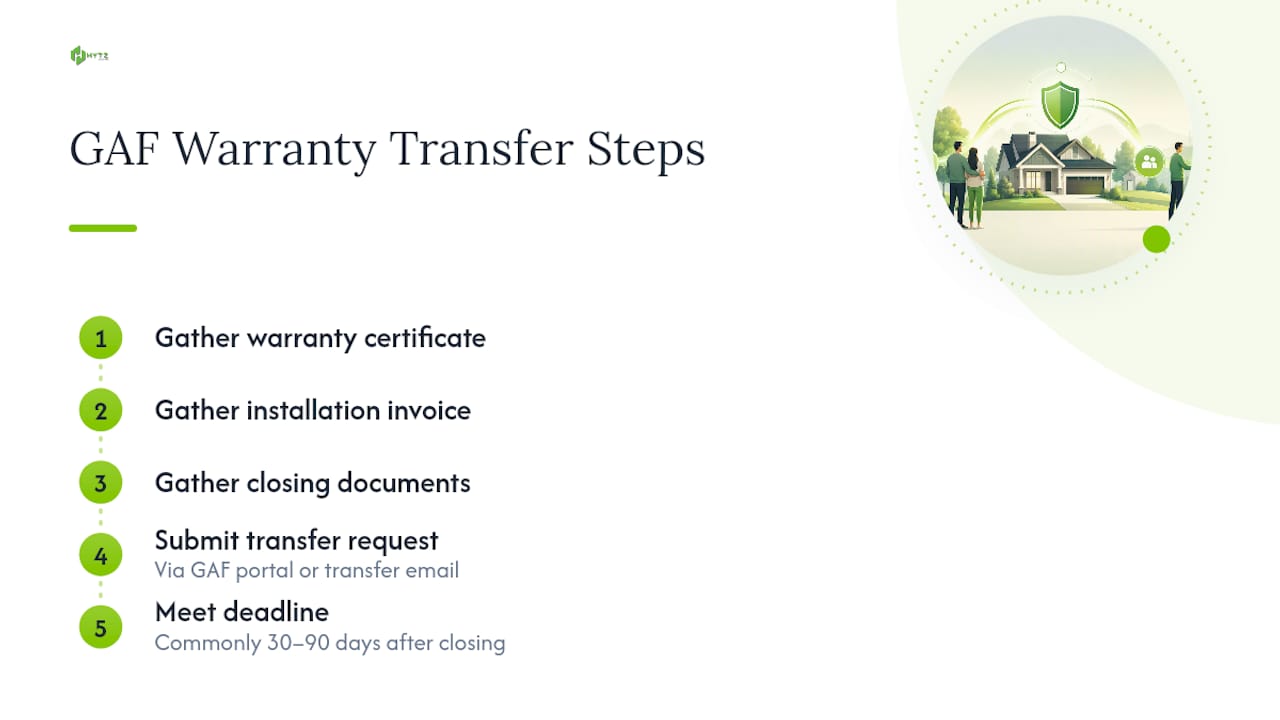
Gather your warranty certificate, installation invoice, and closing documents, then submit a transfer request through GAF’s warranty portal or transfer email within the required deadline, commonly 30 to 90 days after closing.
Do shingle warranties transfer to a new owner automatically?
No. A warranty won’t transfer automatically; the new owner or seller must formally request the transfer and submit the required proof of ownership and installation.
How do I transfer my warranty to a new owner if I lost the paperwork?
Contact the original installing contractor for a duplicate invoice, or check county property records for your closing date, since these are standard substitutes when original documents go missing.
Is there a fee to transfer a GAF warranty?
Many manufacturer warranty tiers charge an administrative fee for transfers, similar to Atlas Roofing’s $100 transfer fee; check your specific certificate for the exact amount GAF requires.
What is the class action lawsuit against GAF shingles?
Specific litigation details vary by case and region, so consult GAF directly or a qualified attorney for current, accurate information rather than relying on general roofing guidance.