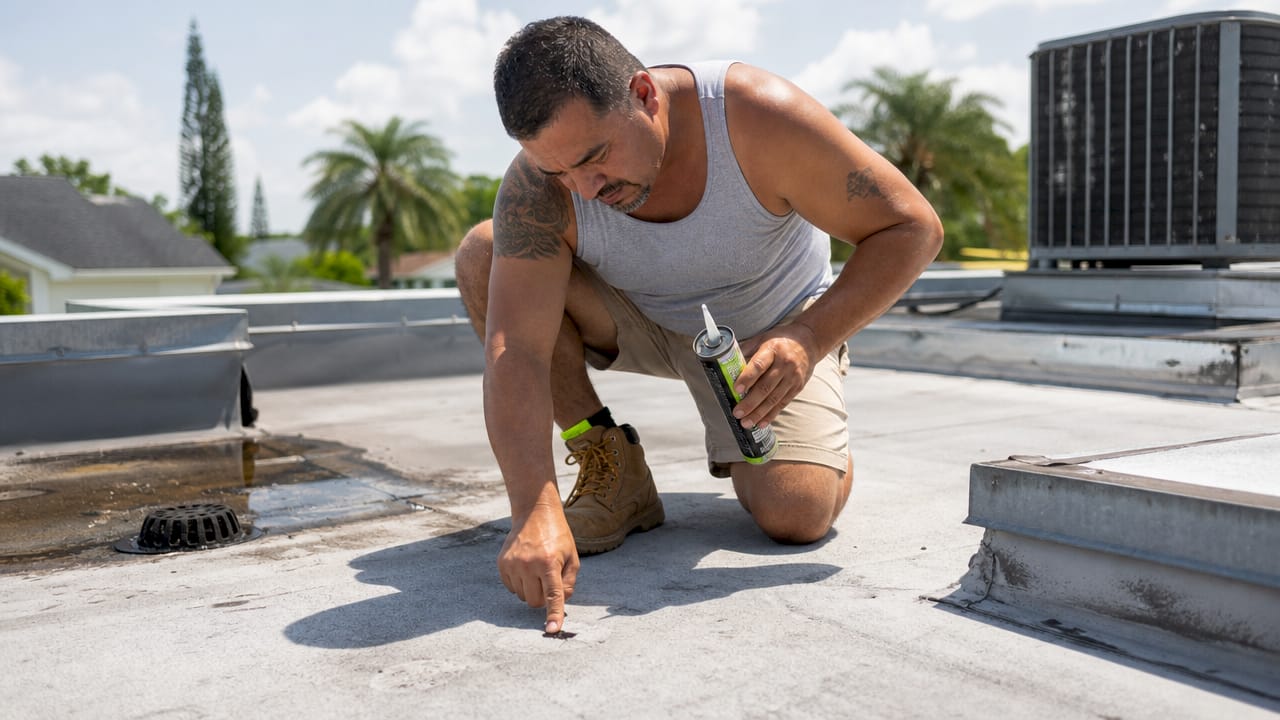
Flat Roof Repair Options List for Florida Homeowners
Flat Roof Repair Options range from temporary patches and membrane repairs to guidance on when a full replacement may be appropriate for Florida homes.
Flat roof repair options are defined by two factors: your roof’s membrane material and the type of damage you’re dealing with. Florida homeowners face a specific combination of challenges — UV degradation, heavy rain seasons, hurricane-force winds, and persistent humidity that accelerates membrane failure. The most common flat roof materials in Florida are EPDM, TPO, PVC, and Modified Bitumen, and each one requires a different repair approach. Whether you’re chasing a leak at a flashing point, patching a blister, or planning a full coating restoration, this flat roof repair guide covers every practical option with real costs and honest advice.
1. Flat roof repair options list by material type
The single most important rule in flat roof repair is this: your repair material must match your existing membrane. Material mismatch causes failure — petroleum-based products dissolve EPDM rubber, and TPO or PVC membranes require specialized heat-welding techniques that standard adhesives cannot replicate. Getting this wrong means your patch fails within months, not years.
Here is a breakdown of the main repair options organized by roof type:
EPDM (Rubber Membrane)
- Peel-and-stick EPDM patches for cracks and punctures under 6 inches
- Liquid EPDM coatings for widespread surface weathering
- Primer-based seam tape for separating seams
- Avoid any petroleum-based solvents or caulks — they degrade the rubber
TPO and PVC Membranes
- Heat-welded patches using a hot-air gun for permanent seam bonds
- TPO-compatible seam tape as a temporary fix
- Liquid TPO coatings for UV restoration on aged membranes
- Never use standard roofing cement — it is incompatible and will void warranties
Modified Bitumen
- Roofing cement with fiberglass mesh reinforcement (the “three-course” method)
- Torch-applied patches for seamless bonding on torch-down systems
- Self-adhesive modified bitumen patches for cold-application repairs
Built-Up Roofing (BUR)
- Hot tar and gravel patches for localized damage
- Asphalt-based coatings to seal surface cracks and restore waterproofing
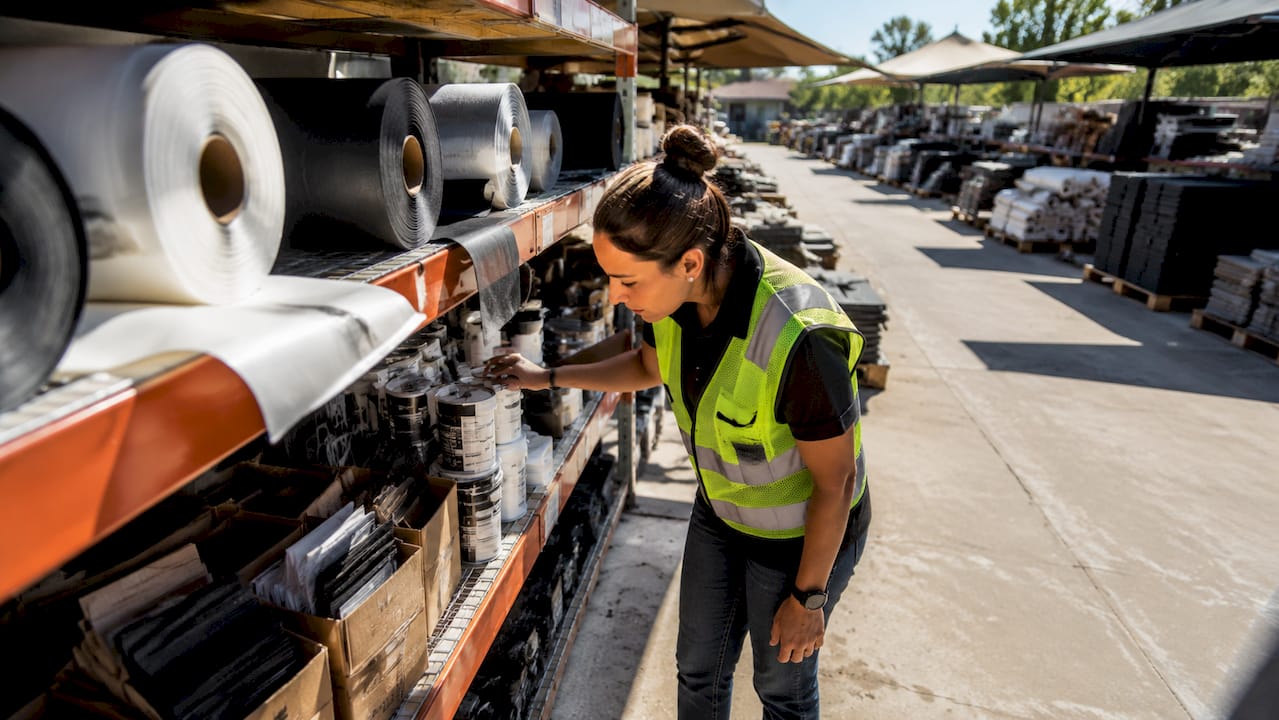
Pro Tip: Before buying any patch material, photograph your existing membrane and bring the photo to your roofing supply store. The color, texture, and seam style will help staff identify your membrane type and recommend a compatible product.
2. Flashing repairs — where most leaks actually start
Over 90% of flat roof leaks originate at flashing points — the metal or membrane strips that seal edges, vents, HVAC units, pipes, and skylights. This means that if you have a leak, the membrane field is rarely the problem. The flashing is. That single fact should redirect where you look first and where you spend your repair budget.
Flashing repair options include:
- Resealing lifted or cracked flashing with compatible roofing sealant
- Replacing deteriorated metal flashing sections around penetrations
- Applying flashing tape or membrane strips over failed seams at edges
- Re-embedding flashing in fresh roofing cement with a fabric reinforcement layer
Florida’s thermal cycling — hot days and cooler nights — causes metal flashing to expand and contract repeatedly, which loosens seals faster than in northern climates. Inspect all penetrations and edge details at least twice a year, especially after hurricane season.
3. Roof coating and restoration systems
Roof coatings are one of the most cost-effective flat roof repair techniques available to Florida homeowners because they address widespread surface degradation without tearing off the existing membrane. Acrylic, silicone, and elastomeric coatings each serve a different purpose.
Acrylic coatings reflect UV radiation and work well on low-slope roofs with minimal ponding. Silicone coatings tolerate standing water better and are the preferred choice for Florida roofs where drainage is imperfect. Elastomeric coatings stretch and contract with temperature changes, making them well-suited for Modified Bitumen and BUR systems. A full coating restoration typically costs between $1,200 and $1,500 for full resealing work, which is significantly less than a full replacement.
Pro Tip: Apply roof coatings only during Florida’s dry season (November through April). Humidity above 85% prevents proper adhesion and can trap moisture under the coating film.
4. Patching small cracks and punctures
Small cracks and punctures under 6 inches are the most manageable flat roof repairs for a homeowner to handle. Small professional repairs for cracks and holes typically cost between $150 and $500, which makes them affordable even on a tight budget. DIY patching can reduce that cost further if you use the right materials and follow proper prep steps.
The patching process for any membrane type follows the same core sequence:
- Clean the damaged area with a manufacturer-approved solvent and let it dry completely
- Cut your patch at least 3 inches larger than the damaged area on all sides
- Round all four corners of the patch — square corners peel easily due to wind and thermal movement
- Apply primer if required by the patch manufacturer
- Press the patch firmly and roll it with a seam roller to remove air bubbles
- Feather and thin the patch edges so water cannot pool against them
Feathering patch edges is the step most DIYers skip, and it is the step that causes the most premature failures. An unfeathered edge creates a small dam that holds water directly against the patch perimeter.
5. Seam repair and re-bonding
Seam separation is the second most common flat roof problem after flashing failure. On TPO and PVC roofs, seams are heat-welded at installation, and when those welds fail, water enters immediately. On EPDM roofs, seams are bonded with contact cement or seam tape, both of which degrade under Florida’s UV exposure over time.
For TPO and PVC, a professional with a hot-air welding gun is the only reliable fix. Seam tape is a temporary measure at best. For EPDM, self-leveling lap sealant applied over cleaned seam edges can restore the bond on seams that have not fully separated. If the seam has pulled apart more than a quarter inch, a full patch over the seam is the correct repair. You can also explore torch-on versus TPO versus EPDM comparisons to understand why each material behaves differently at seams.
6. Blister and bubble repairs
Blisters form when moisture or air becomes trapped between membrane layers, creating raised bubbles on the roof surface. They are common on Modified Bitumen and BUR roofs in Florida because heat accelerates the off-gassing that causes them. Small blisters that are firm and not leaking can sometimes be left alone. Large or soft blisters that have broken the surface must be repaired.
The repair process involves cutting the blister open with a utility knife, allowing it to dry completely, applying compatible adhesive inside the flap, pressing it flat, and covering the entire area with a patch. Never patch over a wet blister. The trapped moisture will cause the patch to fail within one Florida rainy season.
7. Ponding water solutions
Ponding water is defined as water that remains on a flat roof surface for more than 48 hours after rainfall. It is one of the most damaging conditions a Florida flat roof can experience because it accelerates membrane degradation, adds structural load, and creates a breeding ground for algae and mold. The repair options for ponding water go beyond patching.
Solutions include installing tapered insulation to redirect water toward drains, adding or repositioning roof drains and scuppers, applying a silicone coating that tolerates standing water, and in severe cases, re-sloping the roof deck. If your roof has chronic ponding and you are only patching membranes, you are treating the symptom rather than the cause. Addressing drainage is the permanent fix.
8. Emergency temporary repairs
When a storm hits and your flat roof is actively leaking, you need a temporary fix fast. Emergency flat roof repair options include applying a self-adhesive waterproof membrane tape over the breach, spreading a layer of roofing cement over the damaged area, or covering the section with a heavy-duty polyethylene tarp secured at the edges. These are not permanent solutions. They buy you time until a licensed contractor can assess and repair the roof properly.
Delaying permanent repairs after a temporary fix is one of the most expensive mistakes Florida homeowners make. Water infiltration that reaches the roof deck or interior structure multiplies repair costs dramatically.
9. Full membrane replacement and overlay
Roofs older than 15 to 20 years with widespread blistering, ponding, or seam failures are usually better candidates for replacement than repeated patching. At that age, the membrane has lost most of its elasticity and UV resistance, and each new patch simply shifts the leak to the next weakest point.
Two options exist: full tear-off and replacement, or a membrane overlay. A tear-off removes the old membrane and installs a fresh system on clean decking. An overlay installs a new membrane directly over the existing one, which saves labor cost but adds weight and can hide underlying deck damage. For Florida homeowners, a full tear-off is the more reliable long-term choice because it allows inspection of the roof deck for rot or moisture damage before the new membrane goes down.
Comparison of repair options
Choosing the right repair method depends on your budget, roof age, and the size of the damage. This table gives you a side-by-side view of the most common options.
| Repair method | Typical cost | Lifespan of repair | DIY-friendly? | Best for |
|---|---|---|---|---|
| Small patch (under 6 in.) | $150–$500 | 3–7 years | Yes, with right materials | Punctures, small cracks |
| Flashing reseal | $200–$600 | 5–10 years | Partially | Edge and penetration leaks |
| Roof coating/restoration | $1,200–$1,500 | 10–15 years | No | Widespread UV or surface wear |
| Seam re-bond (EPDM) | $300–$700 | 5–8 years | Partially | Separated seams |
| Full membrane replacement | $4,000–$12,000+ | 20–30 years | No | Aged or severely damaged roofs |
Pro Tip: Get at least three quotes before hiring a contractor for any repair over $500. Low bids often cut corners on surface preparation or use incompatible materials, which leads to failure within a few years.
How to diagnose your flat roof problem
Finding the actual source of a flat roof leak requires more than looking at the water stain on your ceiling. Water travels upslope from the breach before it enters the building, so the stain on your ceiling can be several feet away from the actual hole. Use these steps to locate the real source:
- Measure the location of the interior stain from two fixed reference points (walls or columns)
- Transfer those measurements to the roof surface to identify the general zone
- On a dry, sunny day, run a garden hose over the suspected area in sections and watch for water entry below
- Inspect all flashing, seams, and penetrations within 3 feet upslope of the stain location
- Press gently on the membrane surface to feel for soft spots that indicate wet insulation below
For Florida-specific leak diagnosis after a storm, always check HVAC curbs and pipe boots first. These are the penetrations most likely to shift during high winds.
Key takeaways
Flat roof repair success depends on matching your repair material to your existing membrane type, preparing the surface correctly, and addressing flashing before anything else.
| Point | Details |
|---|---|
| Material compatibility is non-negotiable | Petroleum products destroy EPDM; TPO and PVC require heat-welding for lasting repairs. |
| Flashing is the primary leak source | Over 90% of flat roof leaks start at flashing points, not the membrane field. |
| Preparation drives repair success | Surfaces must be bone-dry and cleaned with approved solvents before any patch is applied. |
| Age determines patch vs. replace | Roofs older than 15 to 20 years with widespread damage need replacement, not more patches. |
| Low bids carry real risk | Cheap contractor quotes often reflect skipped prep steps or incompatible materials. |
What I’ve learned after years of Florida flat roof work
Here is something I tell every homeowner who calls us after a failed DIY repair or a cheap contractor job: flat roof repair is 90% preparation and 10% application. That ratio is not an exaggeration. I have seen brand-new patches fail within one rainy season because the surface was not fully dry or was cleaned with the wrong solvent. The patch looked fine on day one. By August, it was peeling at the edges.
Florida makes this harder than most states. The humidity here means a roof that looks dry on the surface can still hold moisture in the membrane layers underneath. That trapped moisture turns into steam under the summer sun and pushes your patch right off. The only way to know a surface is truly ready is to test it with a moisture meter before you apply anything.
The other mistake I see constantly is homeowners focusing on the membrane and ignoring the flashing. You can patch every square inch of your EPDM field and still have a leak if the boot around your HVAC unit has a cracked seal. Start at the penetrations. Check every pipe, vent, and edge detail before you ever cut a patch. That single habit will save you more money than any product upgrade.
For project planning in Tampa, I always recommend scheduling repairs between November and March when humidity drops and surfaces dry faster. A repair done in October after hurricane season ends will bond better and last longer than the same repair done in July.
— Anthony
Get a free flat roof estimate from Hytzroofing
If your flat roof has a leak, visible damage, or has not been inspected in the last two years, now is the right time to act. Small problems become expensive structural repairs when Florida’s rainy season hits.
Hytzroofing is a GAF Master Elite® Contractor and GAF Certified™ Commercial Contractor serving the Tampa area and surrounding communities. The team handles everything from small patch repairs and flashing reseals to full membrane replacements and coating restorations. With an A+ BBB rating, Florida Contractor License #CCC1332551, and the Angi Super Service Award 2025, you get a contractor who stands behind every repair.
Request your free estimate today and get a clear, honest assessment of your flat roof’s condition before the next storm season arrives.
FAQ
What are the most affordable flat roof repair options?
Small patching repairs for cracks and punctures under 6 inches typically cost between $150 and $500, making them the most affordable flat roof repair option. Roof coatings are the most cost-effective solution for widespread surface wear, running $1,200 to $1,500 for a full restoration.
How do I find where my flat roof is leaking?
Do not rely on interior water stains alone. Water travels upslope from the actual breach, so measure the stain location and transfer those measurements to the roof surface, then use a garden hose to test sections on a dry day until you find the entry point.
Can I repair a flat roof myself?
Yes, for small patches under 6 inches and minor flashing reseals, DIY repair is possible with the right materials. Use rounded patch corners, feather the edges, and confirm the surface is completely dry before applying any adhesive or patch.
When should I replace my flat roof instead of repairing it?
Roofs older than 15 to 20 years with widespread blistering, chronic ponding, or multiple seam failures are better candidates for full replacement. Repeated patching on an aged membrane shifts the leak rather than solving it.
Does the type of flat roof membrane affect which repair I need?
Yes, completely. EPDM requires rubber-compatible patches and primers. TPO and PVC need heat-welded repairs. Modified Bitumen uses roofing cement with mesh reinforcement. Using the wrong material for your membrane type causes repair failure and can void your manufacturer warranty.
Recommended
- Weathering the Storm Expert Tips for Roof Leak Repair in Tampa Fl
- GAF Master Elite Roofer in Tampa, FL | Hytz Roofing
- Introducing Enviroshake to Your Hoa
- Types of Roof Repairs Florida Homeowners Need Most
Related Hytz Roofing Services