
Compare Roofing Financing Interest Rates: 2026 Guide
Roofing Financing Interest Rates depend on loan type, term, and fees, so comparing options helps you choose the most cost-effective financing for a roof project.
Roofing financing interest rates are the annual percentage rates (APRs) lenders charge on loans used to pay for roof repairs or replacements. Knowing how to compare roofing financing interest rates can save you thousands of dollars on a single project. A $12,000 roof financed at 18% APR costs over $6,000 in interest over five years. That same roof at 7% APR costs about $2,300. The difference is real money. Florida homeowners have several loan types available, from home equity products to personal loans from lenders like LightStream and SoFi, and each carries a very different cost profile.
What are the main roofing loan options and their rate ranges?
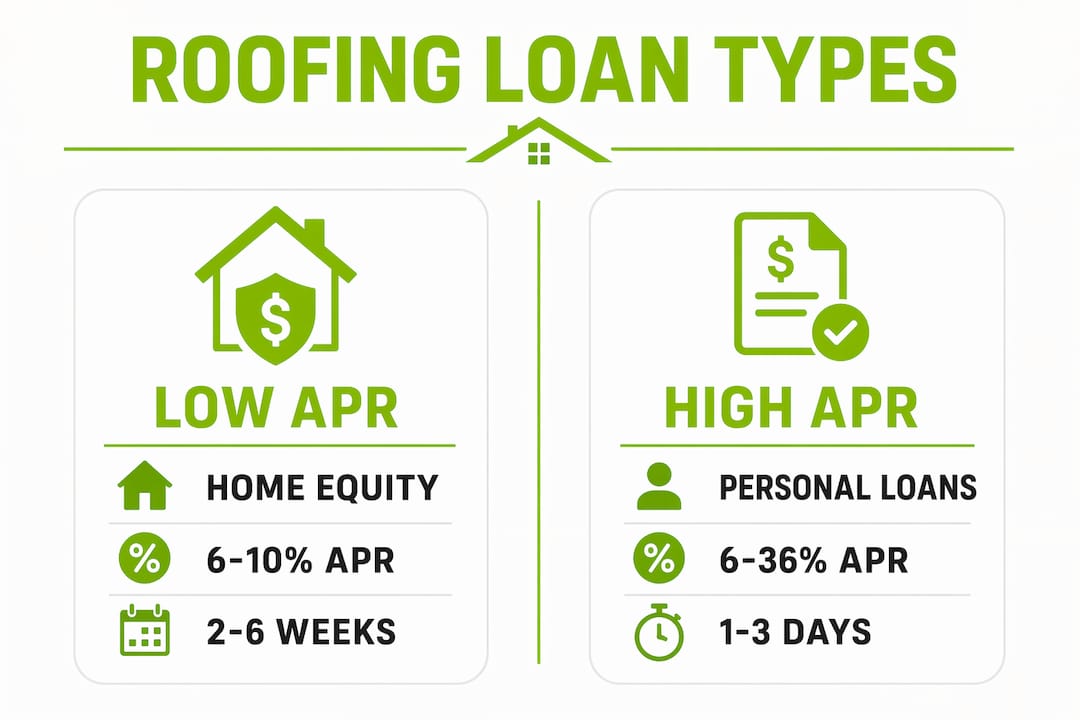
Understanding your roofing loan options is the first step toward finding the best roofing finance rates. Each product has a different APR range, approval speed, and risk profile.
Home Equity Loans and HELOCs
Home equity loans and HELOCs carry the lowest rates available, typically 6–10% APR. They are secured by your home, which reduces lender risk and keeps costs down. The tradeoff is time. Funding takes 2–6 weeks, which makes them a poor fit for urgent storm repairs. If you have equity and a few weeks to spare, this is usually the cheapest path.

Personal Loans
Personal loans fund in 1–3 days with APRs ranging from 6% to 36% depending on your credit score and the lender. LightStream offers rates from 6.99% to 25.49%, while SoFi ranges from 8.99% to 29.99%. These are unsecured, meaning no collateral is required. Speed and flexibility make them a strong choice for most Florida homeowners who need work done quickly.
Contractor Financing
Contractor financing sounds attractive because it often advertises 0% interest for a promotional period. The reality is more complicated. Dealer fees of 5–15% are frequently rolled into the loan principal, adding $1,000–$2,000 to your total cost before interest is even calculated. After the promo period, rates jump to 15–29% APR. Contractors can also approve borrowers with credit scores as low as 580, which makes this option accessible but expensive.
Credit Cards
Credit cards work for small repairs under $2,000 if you can pay the balance quickly. For full roof replacements, the average credit card APR makes this one of the most expensive ways to finance roofing project work.
Insurance Claims
Before you finance anything, check your homeowner’s insurance policy. Filing an insurance claim for storm or hail damage can eliminate the need for a loan entirely, leaving you responsible only for your deductible. This step is overlooked far too often.
Pro Tip: Check your roof’s damage cause before applying for any loan. If wind or hail caused the damage, an insurance claim may cover most or all of the cost.
| Loan Type | Typical APR Range | Funding Speed | Best For |
|---|---|---|---|
| Home Equity Loan | 6–9% | 2–6 weeks | Non-urgent full replacements |
| HELOC | 7–10% (variable) | 2–6 weeks | Flexible, ongoing repairs |
| Personal Loan | 6–36% | 1–3 days | Fast funding, good credit |
| Contractor Financing | 0% promo / 15–29% | Same day | Lower credit scores |
| Credit Card | 20–30%+ | Immediate | Small repairs only |
How do interest rates and loan terms affect your total cost?
The monthly payment is not the number that matters most. The total interest paid over the life of the loan is what determines whether a financing deal was smart or costly.
The real cost of a $12,000 roof
Consider a $12,000 roof replacement financed over five years. At 7% APR, you pay roughly $2,258 in total interest. At 18% APR, that figure rises to $6,291. That is a $4,000 difference for the exact same roof. The only variable is the interest rate. This is why comparing roofing loan interest rates before signing anything is non-negotiable.
Loan term length compounds this effect. A 7-year loan at 10% APR on $12,000 costs more in total interest than a 3-year loan at 12% APR, even though the shorter loan has a higher rate. Longer terms lower your monthly payment but increase total cost. Always calculate the full payoff amount, not just what you owe each month.
The deferred interest trap
Deferred interest loans are the most misunderstood product in roofing project financing. They are not the same as true 0% interest loans. If you do not pay off the entire balance before the promotional period ends, retroactive interest at 26–29% APR is applied to the original loan amount from day one. On a $12,000 loan, that can add thousands in unexpected charges overnight.
Credit score improvement is one of the most direct ways to lower your APR. Raising your score by 30–50 points before applying can move you into a better rate tier and save hundreds over the loan term.
Pro Tip: Ask every lender directly: “Is this a true 0% loan or a deferred interest product?” The answer changes everything about how you should plan your payoff.
How to effectively compare roofing financing interest rates
Comparing loan offers fairly requires a consistent process. Here is a practical approach that works.
- Pull your credit score first. Know your score before you apply anywhere. Your score determines which rate tier you qualify for, and it tells you whether to apply for personal loans or consider home equity products.
- Get at least three quotes. Contact your bank or credit union, one online lender like LightStream or SoFi, and your roofing contractor. Three quotes give you enough data to spot outliers.
- Build a comparison spreadsheet. Track rates, fees, and terms in one place. Include the APR, loan origination fee, any dealer fees, loan term in months, monthly payment, and total interest paid. The total interest column is the one that matters.
- Ask about origination fees explicitly. Some lenders charge 1–6% of the loan amount upfront. A loan with a lower APR but a high origination fee can cost more than a slightly higher-rate loan with no fees.
- Confirm fixed vs. variable rates. HELOCs are typically variable, meaning your rate can rise. Personal loans are usually fixed. Know which you are getting before you sign.
- Factor in funding speed. If your roof is actively leaking, a home equity loan that takes six weeks is not a realistic option. Personal loans that fund in 1–3 days may be worth a slightly higher rate in urgent situations.
When you lay all offers side by side with total cost calculated, the best option becomes clear. Do not let a low monthly payment distract you from a high total cost.
What are the biggest mistakes in roofing financing to avoid?
Most costly financing mistakes are predictable. Knowing them ahead of time keeps you from making them.
- Accepting deferred interest without a payoff plan. If you cannot guarantee you will pay off the full balance before the promo period ends, avoid deferred interest products entirely. The retroactive interest charges are severe.
- Ignoring dealer fees in contractor financing. A contractor may quote you a great monthly payment, but hidden dealer fees of 5–15% mean you are financing a roof that costs $1,000–$2,000 more than the original quote. Always ask for the total financed amount, not just the payment.
- Skipping the insurance claim step. Storm damage is common in Florida. Filing a claim before financing can reduce or eliminate your loan need. Many homeowners skip this step and borrow money they did not need to borrow.
- Choosing the longest term to minimize monthly payments. This is the most common mistake. A longer term feels affordable but increases total interest paid significantly. Pay the loan off as fast as your budget allows.
- Applying without checking your credit score. Walking into a loan application without knowing your score means you cannot evaluate whether the rate you are offered is fair. Check your score first, every time.
Watch out: Contractor financing that approves you quickly with no credit check is almost always a deferred interest product with high post-promo rates. Read every term before signing.
Key takeaways
Choosing the right roofing loan requires comparing total interest paid, not just monthly payments, because rate differences on a $12,000 roof can cost you over $4,000 more across the loan term.
| Point | Details |
|---|---|
| Total cost beats monthly payment | Always calculate full interest paid over the loan term before choosing a product. |
| Home equity loans cost least | APRs of 6–9% make them the cheapest option for homeowners with equity and time. |
| Deferred interest is high risk | Unpaid balances after promo periods trigger retroactive APRs of 26–29% on the full amount. |
| Credit score drives your rate | Improving your score by 30–50 points before applying can save hundreds in interest. |
| Insurance claims reduce loan needs | Florida storm damage may be covered by homeowner’s insurance, cutting your financing need entirely. |
What i’ve learned after years of watching homeowners finance roofs
Most homeowners I talk to focus entirely on the monthly payment. That is the wrong number. The monthly payment is a comfort metric. The total interest paid is the real cost of your decision.
Contractor financing is the most misunderstood product in this space. The 0% promotional offer sounds like a win, but personal loans from reputable lenders with good credit typically yield a lower total cost once you account for dealer fees and the risk of deferred interest. I have seen homeowners end up paying $2,000 more for a roof simply because they signed contractor financing without reading the terms.
The single most effective thing you can do before financing a roof is check your credit score and spend 60 to 90 days improving it if you are below 680. A 40-point improvement can move you from a 15% APR to a 9% APR on a personal loan. On a $12,000 loan over five years, that is real savings.
Florida homeowners also have a step that homeowners in other states often skip. If your roof damage came from wind, hail, or a named storm, file an insurance claim before you apply for any loan. The claim may cover most of the replacement cost. You may only need to finance your deductible, which changes the math entirely. Check your roof repair needs before assuming you need a large loan.
My honest recommendation: get three quotes, build a simple spreadsheet, and calculate the total payoff amount for each option. The best roofing finance rates are not always from the contractor standing in your driveway.
— Anthony
How Hytzroofing helps florida homeowners finance their roof
Hytzroofing is one of Florida’s most trusted roofing contractors, holding the GAF Master Elite® Contractor designation earned by fewer than 2% of contractors in North America. When you work with Hytzroofing, you get honest guidance on financing options alongside expert installation backed by the GAF President’s Club Award and an Angi Super Service Award 2025.
Hytzroofing helps Florida homeowners understand their financing options, review their insurance claim potential, and get accurate project costs before committing to any loan. Whether you need a full replacement or targeted repairs, knowing your roof replacement cost upfront makes every financing comparison sharper. Contact Hytzroofing today for a free consultation and take the guesswork out of roofing finance.
FAQ
What is the average interest rate on a roofing loan?
Average roofing loan rates range from 6% to 29% APR depending on loan type and credit score. Home equity loans sit at the low end (6–9%), while contractor financing after promo periods can reach 15–29%.
Is contractor 0% financing actually free?
No. Contractor 0% financing is usually a deferred interest product with dealer fees of 5–15% rolled into the loan. If the balance is not paid before the promo period ends, retroactive interest at 26–29% APR applies to the full original amount.
How does my credit score affect my roofing loan rate?
Your credit score is the single biggest factor in your APR. Improving your score by 30–50 points before applying can move you to a lower rate tier and save hundreds in total interest over the loan term.
Should i file an insurance claim before getting a roof loan?
Yes, always check first. Florida storm and hail damage is often covered by homeowner’s insurance, which can eliminate or significantly reduce your loan amount, leaving you responsible only for your deductible.
How do i compare roofing loan options fairly?
Build a spreadsheet with each offer’s APR, origination fees, loan term, monthly payment, and total interest paid. The total interest column reveals the true all-in cost and makes the best option clear.
Recommended
- How to Find the Best Roofing Contractor in Tampa
- GAF Master Elite Roofer in Tampa, FL | Hytz Roofing
- Introducing Enviroshake to Your Hoa
- Types of Roof Repairs Florida Homeowners Need Most
Ready to Work With a Trusted Tampa Roofer?
Hytz Roofing is a GAF Master Elite certified contractor serving Tampa Bay. Explore our services: