
Commercial Roofing Contracts: What Property Owners Must Know
Commercial roofing contracts explain the common terms, responsibilities, timelines, payment expectations, and warranty elements property owners should review before hiring a contractor.
Last updated: August 8, 2026
A commercial roofing contract is a legally binding written agreement that defines the scope of work, materials, payment terms, project timeline, warranties, and dispute resolution procedures between a property owner and a roofing contractor. Unlike a handshake deal or a simple quote, this document creates enforceable obligations on both sides. It is the single most important piece of paper you will sign before any roofing work begins on your building. Understanding what belongs in that document, and what to watch for, protects your investment from the first nail to the final inspection.
Before finalizing a scope, property owners can review Hytz Roofing's approach to commercial roofing project planning for low-slope, multi-family, and business properties.
What is a commercial roofing contract and what does it include?
A commercial roofing agreement is a formal written document that runs 3–5 pages or more and covers every material term of the project. That length is not bureaucratic padding. Each section exists to prevent a specific type of dispute or misunderstanding. Here are the core elements every solid commercial roofing contract must contain:
- Scope of work. This section specifies whether the job is a full tear-off, an overlay, or a repair. Vague language here is a red flag. The contract must state exactly what gets removed, what gets replaced, and what areas of the roof are included.
- Material specifications. The contract must name the manufacturer, product line, and model number for every material used, including underlayment, flashing, and decking. General descriptions like “architectural shingle” are too vague and leave the door open for substitutions.
- Payment terms. Commercial contracts typically include a deposit, progress payments tied to project milestones, and a final payment upon completion. Net 30 payment schedules are common and should be spelled out explicitly to avoid disputes.
- Project timeline. The agreement should list a start date, key milestones, and a projected completion date. This gives you leverage if the contractor falls behind.
- Insurance and bonding. Commercial contracts must require the contractor to carry at least $1 million in general liability insurance, plus workers’ compensation coverage. Always ask for certificates of insurance before work begins.
- Warranty coverage. The contract should address both workmanship warranties and manufacturer warranties. Workmanship warranties cover installation quality; manufacturer warranties cover the materials themselves and often require registration by an authorized installer.
- Dispute resolution and termination clauses. These sections define what happens if either party fails to perform, and how disagreements get resolved, whether through mediation, arbitration, or litigation.
Pro Tip: Ask your contractor to provide written confirmation that manufacturer warranties have been registered in your name. Without that registration, you may lose coverage even if the materials fail.
How do commercial roofing contracts differ from residential contracts?

Commercial and residential roofing agreements share a basic structure, but commercial contracts carry significantly more complexity and legal weight. The table below shows the most important differences.
| Feature | Commercial contract | Residential contract |
|---|---|---|
| Document length | 3–5+ pages | 1–2 pages |
| Maintenance plans | Multi-year plans with scheduled inspections | Rarely included |
| Emergency response | Contractual turnaround time obligations | Not standard |
| Insurance requirements | $1 million+ general liability | Lower thresholds |
| Material specifications | Brand, product line, and model number required | Often general descriptions |
| Assignment clauses | Common for property sale scenarios | Rarely included |
The biggest practical difference is the inclusion of multi-year maintenance plans and emergency response terms. A commercial contract can require the contractor to respond to a leak within 24 or 48 hours. That kind of obligation protects tenants, inventory, and building systems in a way that a standard residential agreement never addresses. Commercial contracts also tend to carry higher insurance and bonding thresholds because the financial exposure on a large commercial property is far greater than on a single-family home.
What are the most common contract provisions to watch for?
Knowing how to read a roofing contract means knowing where contractors can leave themselves wiggle room at your expense. These are the provisions that most often cause problems for property managers.
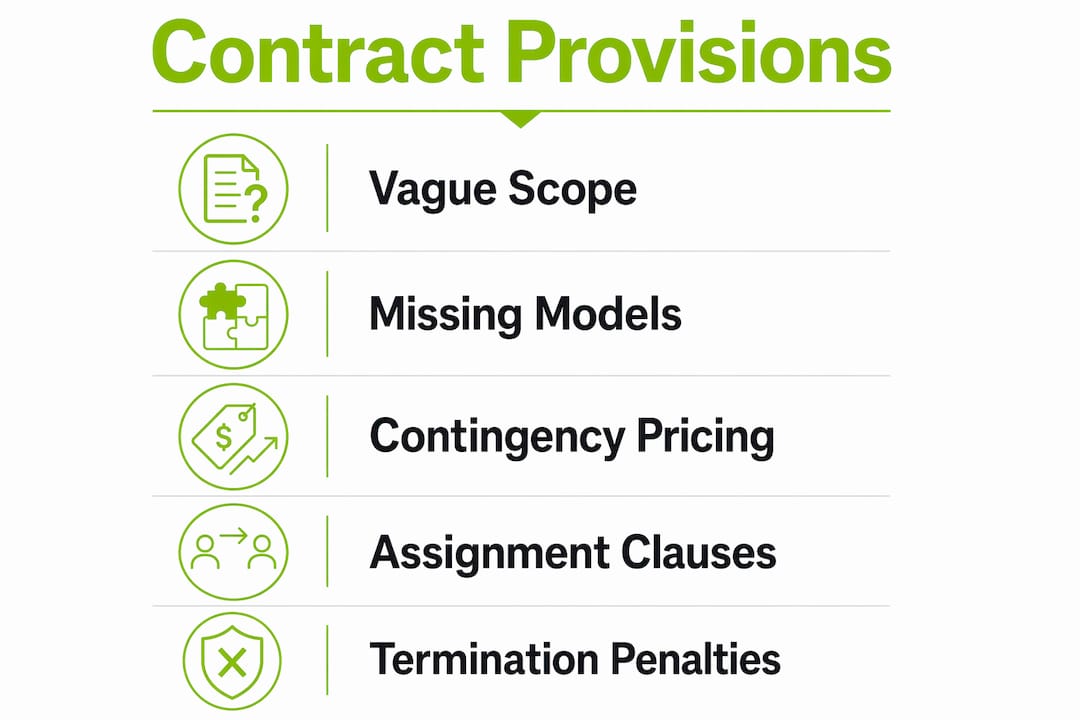
Vague scope language. Phrases like “as needed” or “per code minimum” in the scope of work section are red flags. “As needed” clauses allow a contractor to deliver the bare minimum and still claim the contract was fulfilled. Push for specific language that names every material and describes every task in measurable terms.
Missing material model numbers. If the contract says “TPO membrane” without naming the manufacturer and product line, the contractor can substitute a cheaper product. Exact material specifications prevent this. Require the contract to list the manufacturer name, product line, and model number for every component.
Open-ended contingency pricing. Most commercial roofing projects uncover unexpected damage once the old roof comes off. Damaged decking is the most common surprise. Open-ended contingency clauses often lead to disputes and cost overruns. Negotiate a fixed rate per sheet of decking or per linear foot of damaged material before work starts. That way, you know exactly what additional costs look like before they appear.
Assignment clauses. If you sell the building during or after a roofing project, an unclear assignment clause can create real problems. Without clear assignment terms, contracts may become burdensome or unenforceable after a sale. Make sure the contract specifies whether the agreement transfers to a new owner or terminates at closing.
Termination penalties. Commercial contracts are legally binding once signed. Some jurisdictions offer cancellation windows, but these typically do not apply to commercial agreements. Know the termination terms before you sign, not after.
Pro Tip: Before signing, ask your attorney or a trusted contractor to review the scope of work section line by line. A 30-minute review can prevent a $30,000 dispute.
How to manage a commercial roofing contract for long-term protection
Signing the contract is the beginning, not the end. Here is how to use your commercial roofing agreement as an active management tool throughout the project and beyond.
-
Negotiate maintenance and emergency response terms upfront. Property managers who lock in inspection frequency and emergency turnaround times as contract terms get consistent service without renegotiating every year. Ask for quarterly or semi-annual inspections and a written response time commitment for emergency calls.
-
Document everything during the project. Take dated photos at each project milestone. Keep copies of all change orders, material delivery receipts, and inspection reports. If a dispute arises later, this documentation is your evidence.
-
Verify insurance credentials before work starts. Request a certificate of insurance directly from the contractor’s insurer, not just a copy the contractor provides. Confirm that coverage is active and that your property is listed as an additional insured.
-
Track warranty registration. Manufacturer warranties on commercial roofing systems, such as GAF’s commercial warranty programs, often require registration by a certified installer within a specific window after installation. Confirm in writing that registration has been completed and request a copy of the warranty certificate.
-
Manage change orders through the contract. Any work outside the original scope must be documented as a formal change order with a price and timeline before work proceeds. Verbal agreements for additional work are not enforceable in most states.
-
Plan for property sale scenarios. If you anticipate selling the building, review the assignment clause before listing. Some roofing warranty benefits transfer to new owners and can increase property value. Others do not. Know which category your contract falls into.
Key takeaways
A commercial roofing contract protects your property investment by defining every obligation, material, and cost in writing before work begins.
| Point | Details |
|---|---|
| Define scope precisely | Require specific tasks, materials, and coverage areas; reject vague “as needed” language. |
| Name every material | List manufacturer, product line, and model number to prevent substitutions. |
| Pre-negotiate contingencies | Fix a per-sheet or per-linear-foot rate for unexpected decking damage before work starts. |
| Verify insurance and warranties | Confirm active coverage and written warranty registration before final payment. |
| Plan for ownership changes | Review assignment clauses before any property sale to avoid contract complications. |
What I’ve learned from watching property managers sign the wrong contracts
I have reviewed a lot of commercial roofing agreements over the years, and the pattern I see most often is not fraud. It is ambiguity. Property managers sign contracts that feel complete because they are long and look professional. But length is not the same as specificity.
The most expensive mistakes I have seen come from two places. The first is a scope of work section that uses “per code minimum” language. That phrase sounds reasonable. In practice, it means the contractor can do the least amount of work that passes inspection and walk away. The second is an open contingency clause for decking damage. I have seen projects where the original bid was $80,000 and the final invoice was $115,000 because the contract said “damaged decking will be replaced at contractor’s standard rate.” Nobody defined that rate in advance.
The contracts that actually protect property owners are the ones that read like they were written by someone who expected a dispute. Every material named. Every contingency priced. Every milestone dated. That level of detail is not paranoia. It is how you protect a building worth millions of dollars.
If you are managing a commercial property in Florida, understanding emergency roof leak response is just as important as the contract itself. A contractor who cannot respond fast when a storm hits is a liability, no matter what the paperwork says.
— Anthony
Work with a contractor who puts it all in writing
At Hytzroofing, we hold GAF Certified™ Commercial Contractor status and the GAF Master Elite® designation, earned by fewer than 2% of roofing contractors in North America. That means every commercial roofing agreement we provide is built on manufacturer-backed standards, not guesswork. We spell out every material, every milestone, and every contingency rate before work begins. No surprises on your invoice. No vague scope language. Just a clear, professional contract that protects your property from day one. If you are ready to work with a contractor who stands behind every line of the agreement, visit our commercial roofing services page to request a consultation.
FAQ
What is a commercial roofing contract?
A commercial roofing contract is a legally binding written agreement between a property owner and a roofing contractor that defines the scope of work, materials, payment terms, timeline, warranties, and dispute resolution procedures. It typically runs 3–5 pages and may include multi-year maintenance and emergency response terms.
What should I look for when reading a roofing contract?
Check that the scope of work is specific, all materials are named by manufacturer and model number, contingency pricing is pre-negotiated, and insurance requirements are clearly stated. Reject any contract that uses “as needed” or “per code minimum” language without further detail.
How is a commercial roofing agreement different from a residential one?
Commercial contracts are longer, require higher insurance thresholds (typically $1 million or more in general liability), and often include multi-year maintenance plans, emergency response obligations, and assignment clauses that residential contracts do not.
Can I cancel a commercial roofing contract after signing?
Commercial roofing contracts are legally binding once signed, and most jurisdictions do not offer the same cancellation windows that apply to residential agreements. Review termination clauses carefully before signing and consult an attorney if you need to exit the agreement.
Who is responsible for registering the manufacturer warranty?
The contractor is responsible for registering the manufacturer warranty, but you should request written confirmation that registration has been completed. Without proper registration by an authorized installer, your warranty coverage may be void even if the materials fail.
Recommended
- How to Find the Best Roofing Contractor in Tampa
- GAF Master Elite Roofer in Tampa, FL | Hytz Roofing
- Introducing Enviroshake to Your Hoa
- Types of Roof Repairs Florida Homeowners Need Most
Related Hytz Roofing Services