Why Florida Has Strict Roofing Codes: What Homeowners Need to Know
Florida roofing codes help protect homes by setting enforceable standards for roofing materials, installation, and performance during severe weather.
Florida’s strict roofing codes exist because the state faces some of the most destructive weather conditions in North America, including hurricane-force winds, intense UV radiation, and relentless humidity that can tear apart a poorly built roof in a single storm season. The Florida Building Code sets the standard for what qualifies as a safe, durable roof, and understanding why florida has strict roofing codes helps you make smarter decisions about repairs, replacements, and contractor selection. This article breaks down the key code provisions every Florida homeowner and property manager should know, from the 25% repair rule to secondary water barriers and product approvals.
Why Florida has strict roofing codes: the climate case
Florida sits in the direct path of Atlantic and Gulf hurricanes, making it the most hurricane-exposed state in the country. The Florida Building Code, administered by the Florida Department of Business and Professional Regulation, was substantially strengthened after Hurricane Andrew devastated South Florida in 1992, exposing catastrophic failures in roofing construction. That single storm caused over $27 billion in insured losses, and the resulting code overhaul transformed Florida roofing regulations into some of the toughest in the nation.
The National Roofing Contractors Association notes that Florida roofs age faster than those in most other states due to compounding environmental stressors. UV exposure degrades shingles and sealants year-round. Thermal cycling, the daily expansion and contraction of roofing materials in Florida’s heat, loosens fasteners over time. Add hurricane-force winds and saturating rainfall, and you have conditions that demand materials and installation methods far beyond what works in, say, Ohio or Colorado.
The High Velocity Hurricane Zone (HVHZ), which covers Miami-Dade and Broward counties, represents the most demanding tier of Florida roof safety standards. Roofing products used in the HVHZ must pass additional testing for wind uplift and impact resistance before they can be legally installed. This tiered system reflects a deliberate, science-based approach to building codes in Florida, not bureaucratic overreach.
What is the 25% roof repair rule and why does it matter?
The 25% rule is one of the most misunderstood provisions in Florida roofing regulations. Florida Building Code Section 706.1.1 states that if 25% or more of a roof is repaired or replaced within any rolling 12-month period, the entire roof must be brought into compliance with current code. That means a full upgrade, not just patching the damaged section.
Here is what catches most homeowners off guard:
- The 25% threshold is cumulative. Three separate repairs of 10% each within 12 months add up to 30%, triggering full compliance.
- The rule applies to the total roof area, not just the section being worked on at any given time.
- Roofs permitted before March 1, 2009, are subject to the full replacement mandate once the threshold is crossed.
- For roofs built or permitted on or after March 1, 2009, Senate Bill 4-D established that only the repaired portion must meet current code, regardless of total damage extent.
- Property managers overseeing multi-unit buildings need to track repairs across all units within the rolling window.
Pro Tip: Keep a written repair log with dates and square footage for every roofing job on your property. This record protects you from unknowingly crossing the 25% threshold and facing an unexpected full replacement bill.
The practical impact is significant. A homeowner who patches storm damage in January, then fixes a leak in June, and replaces flashing in October may have crossed the threshold without realizing it. Consulting a licensed contractor before starting any repair work is the most reliable way to stay on the right side of this rule. You can also read more about managing roof repairs in Tampa to understand when patching makes sense versus when a full replacement is the smarter call.
Why does Florida require secondary water barriers in roofing?
A secondary water barrier is a layer of protection installed beneath the primary roofing material, such as shingles or tiles, directly over the roof deck. Its job is to keep water out of your home if the primary roofing cover fails during a storm. In Florida, this is not optional in high-risk areas. Secondary barriers are mandated in the High Velocity Hurricane Zone to maintain watertight protection even when hurricane winds strip away the outer roofing layer.
“Secondary water barriers provide vital protection during hurricanes, maintaining waterproof integrity even if the primary roofing covers fail.” — Florida Building Code Roofing Requirements
This requirement exists because real-world hurricane behavior shows that even well-installed shingles can be lifted or displaced by sustained winds above 100 mph. Without a secondary barrier, the exposed roof deck becomes a direct entry point for water, leading to structural damage, mold, and interior destruction within hours. The secondary barrier buys critical time and protection.
Beyond safety, this code provision has real financial value for homeowners:
- Many Florida insurance carriers offer premium discounts for homes with documented secondary water barriers.
- Proper installation can improve your home’s resale value by demonstrating code compliance to buyers and inspectors.
- It reduces the risk of catastrophic interior damage that often exceeds the cost of the roof itself.
The common misconception is that a quality primary roofing product eliminates the need for a secondary barrier. It does not. The two layers work together, and skipping the barrier to save money on installation is a false economy in a state where a single hurricane can test every component of your roof simultaneously.
How do product approval and permit processes affect roofing in Florida?
Florida operates a statewide product approval system that requires every roofing material installed in the state to carry a valid Florida Product Approval number. The Florida Product Approval system certifies that materials have been tested for wind uplift and impact resistance under Florida Building Code standards. If a contractor installs a product without a valid approval number, the installation is non-compliant regardless of how well it was done.
Here is how the permit and inspection process works for a standard roofing project:
- Contractor pulls the permit before any work begins. This is a legal requirement, not a formality.
- Dry-in inspection occurs after the underlayment and secondary barrier are installed but before the final roofing material goes on. This confirms the structural layers meet code.
- Final inspection takes place after all roofing work is complete. The inspector verifies materials, fastening patterns, flashing, and overall installation quality.
- Documentation is filed, including the Florida Product Approval numbers for all materials used.
Pro Tip: Before hiring any contractor, ask directly: “Will you pull the permit, and can I see the Florida Product Approval numbers for the materials you plan to use?” A contractor who hesitates on either question is a contractor worth avoiding.
Roofing work without permits is a first-degree misdemeanor for contractors under Florida law. For homeowners, the consequences are equally serious. Unpermitted work can void your homeowner’s insurance coverage, create complications when selling your property, and leave you personally liable for code violations. The permit process is not red tape. It is the mechanism that ensures your roof was built to survive Florida’s weather.
How do Florida’s roofing codes address the state’s climate challenges?
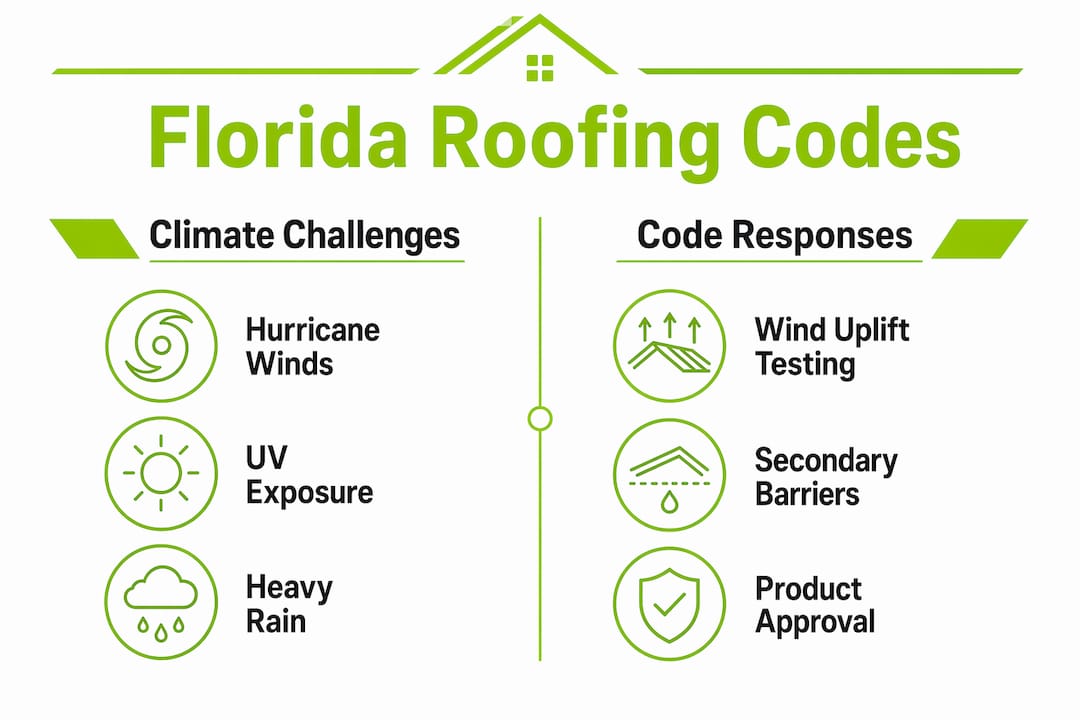
Florida’s climate creates four distinct threats that roofing codes are specifically designed to counter. Understanding each one explains why the florida building code roof requirements go further than most states.
| Climate threat | Code response | Homeowner benefit |
|---|---|---|
| Hurricane-force winds | Wind uplift testing, HVHZ product standards, secondary barriers | Roof stays intact during storms above 100 mph |
| UV radiation | Material durability standards, reflective coating requirements | Longer roof lifespan, lower cooling costs |
| Thermal cycling | Fastener specifications, expansion allowances in installation | Fewer leaks from loosened materials over time |
| Humidity and moisture | Ventilation requirements, underlayment standards | Reduced mold risk and deck rot |
The impact of hurricanes on roofing is the most visible driver of code strictness, but UV degradation is the silent killer of Florida roofs. Asphalt shingles that last 25 to 30 years in northern states may last 15 to 20 years in Central Florida under constant sun exposure. Codes that mandate higher-grade materials and installation standards directly extend the functional life of your roof.
The HVHZ designation, covering Miami-Dade and Broward counties, represents the most demanding application of these principles. Products approved for HVHZ use must pass large missile impact tests and cyclic wind pressure tests that simulate actual hurricane conditions. A roof built to HVHZ standards in Miami is genuinely engineered to survive what Florida’s weather can deliver.
The 2026 Florida Building Code updates impose stronger wind resistance requirements and more detailed inspection documentation, particularly for commercial roofs. This signals a continued tightening of standards statewide, meaning the gap between Florida’s codes and those of other states is likely to grow, not shrink.
How do Florida’s roofing codes compare to other states?
Florida’s roofing regulations stand apart from most of the country in both scope and enforcement rigor. Most states follow the International Building Code (IBC) or International Residential Code (IRC) with minimal local modifications. Florida uses these as a baseline but layers on state-specific requirements that reflect its unique risk profile.
| Feature | Florida | Most other states |
|---|---|---|
| Secondary water barrier mandate | Required in HVHZ, recommended statewide | Not required |
| Product approval system | Statewide, mandatory | Varies; often not required |
| 25% cumulative repair rule | Enforced under FBC Section 706.1.1 | Rarely enforced at this level |
| Wind uplift testing for materials | Mandatory for HVHZ products | Optional or minimal |
| Permit misdemeanor for contractors | First-degree misdemeanor | Varies by state |
Florida’s codes have directly influenced neighboring Gulf Coast states, particularly after major hurricane seasons. Louisiana and Texas have both adopted stricter wind uplift standards in coastal areas, citing Florida’s post-Andrew reforms as the model. For homeowners relocating from states with looser standards, the adjustment can feel like a shock. The permit requirements, product approvals, and inspection stages add time and cost to roofing projects. They also add years of reliable performance and genuine storm protection that cheaper, non-compliant work simply cannot deliver.
Key takeaways
Florida’s strict roofing codes are the direct result of hurricane history, climate science, and hard-won lessons from catastrophic storm damage, and every major code provision exists to protect your home and your investment.
| Point | Details |
|---|---|
| The 25% rule is cumulative | Track all repairs within a 12-month window to avoid triggering a full roof replacement requirement. |
| Secondary barriers are non-negotiable | In the HVHZ and high-wind zones, a secondary water barrier is legally required and financially smart. |
| Permits protect homeowners | Unpermitted roofing work can void insurance and complicate property sales under Florida law. |
| Product approval numbers matter | Every material installed must carry a valid Florida Product Approval number or the job is non-compliant. |
| Climate drives code strictness | UV exposure, thermal cycling, and hurricane winds all shorten roof life and justify Florida’s higher standards. |
What I’ve learned from years of watching Florida homeowners get blindsided by code
The homeowners who get hurt by Florida’s roofing codes are almost never the ones who ignored them on purpose. They are the ones who hired the cheapest contractor available, skipped the permit conversation, and assumed a small repair was just a small repair. Then they hit the 25% threshold, or they filed an insurance claim after a storm and found out the work was unpermitted, or they tried to sell their home and the inspection flagged non-compliant roofing.
The 25% rule is the one that surprises people most. I have seen property managers in Tampa who maintained detailed maintenance logs for everything except roofing, and they paid for it when cumulative repairs crossed the threshold without anyone tracking them. The fix is simple: treat your roof like a financial asset with a running ledger, not a problem you deal with reactively.
The other thing worth saying plainly is that Florida’s codes are not the enemy of homeowners. They are the reason a well-built Florida roof can survive a Category 3 storm while a neighbor’s non-compliant roof loses half its shingles. The cost difference between a code-compliant installation and a cut-rate job is real. So is the difference in what survives a hurricane.
Stay current on code updates. The 2026 Florida Building Code changes are already affecting commercial projects and will filter into residential standards. A contractor who knows the current code is worth more than one who learned the rules five years ago and stopped paying attention.
— Anthony
Get a code-compliant roof from a contractor who knows Florida’s rules
Hytzroofing holds Florida Contractor License #CCC1332551 and carries GAF Master Elite® status, an honor earned by fewer than 2% of roofing contractors in North America. Every project includes full permit management, documented Florida Product Approval materials, and inspections at every required stage. Whether you are a homeowner tracking the 25% threshold or a property manager planning a full re-roof in Tampa or Plant City, Hytzroofing handles the compliance details so you do not have to. Request your estimate and get a roof built to survive what Florida actually throws at it.
FAQ
What triggers the 25% roof replacement rule in Florida?
Florida Building Code Section 706.1.1 requires full code compliance when 25% or more of a roof is repaired or replaced within any rolling 12-month period. The threshold is cumulative, meaning multiple smaller repairs within that window all count toward the total.
Are secondary water barriers required on all Florida roofs?
Secondary water barriers are mandated in the High Velocity Hurricane Zone covering Miami-Dade and Broward counties. Outside the HVHZ, they are strongly recommended and may be required depending on local wind zone designations.
What happens if roofing work is done without a permit in Florida?
Unpermitted roofing work can void your homeowner’s insurance, create complications when selling your property, and expose the contractor to first-degree misdemeanor charges under Florida law.
Does the 25% rule apply differently to older roofs?
Yes. Roofs permitted before March 1, 2009, require the entire roof to meet current code once the 25% threshold is crossed. For roofs permitted on or after that date, Senate Bill 4-D limits the compliance requirement to only the repaired portion.
Why does Florida have its own product approval system for roofing materials?
The Florida Product Approval system certifies that roofing materials have been tested for wind uplift and impact resistance specific to Florida’s climate conditions. Every product installed must carry a valid approval number, and materials that pass standards in other states may not qualify for use in Florida’s high-wind zones.
Recommended
- Weathering the Storm Expert Tips for Roof Leak Repair in Tampa Fl
- Introducing Enviroshake to Your Hoa
- GAF Master Elite Roofer in Tampa, FL | Hytz Roofing
- 15 Urgent Roof Issues to Fix Before the Next Florida Storm
Related Hytz Roofing Services