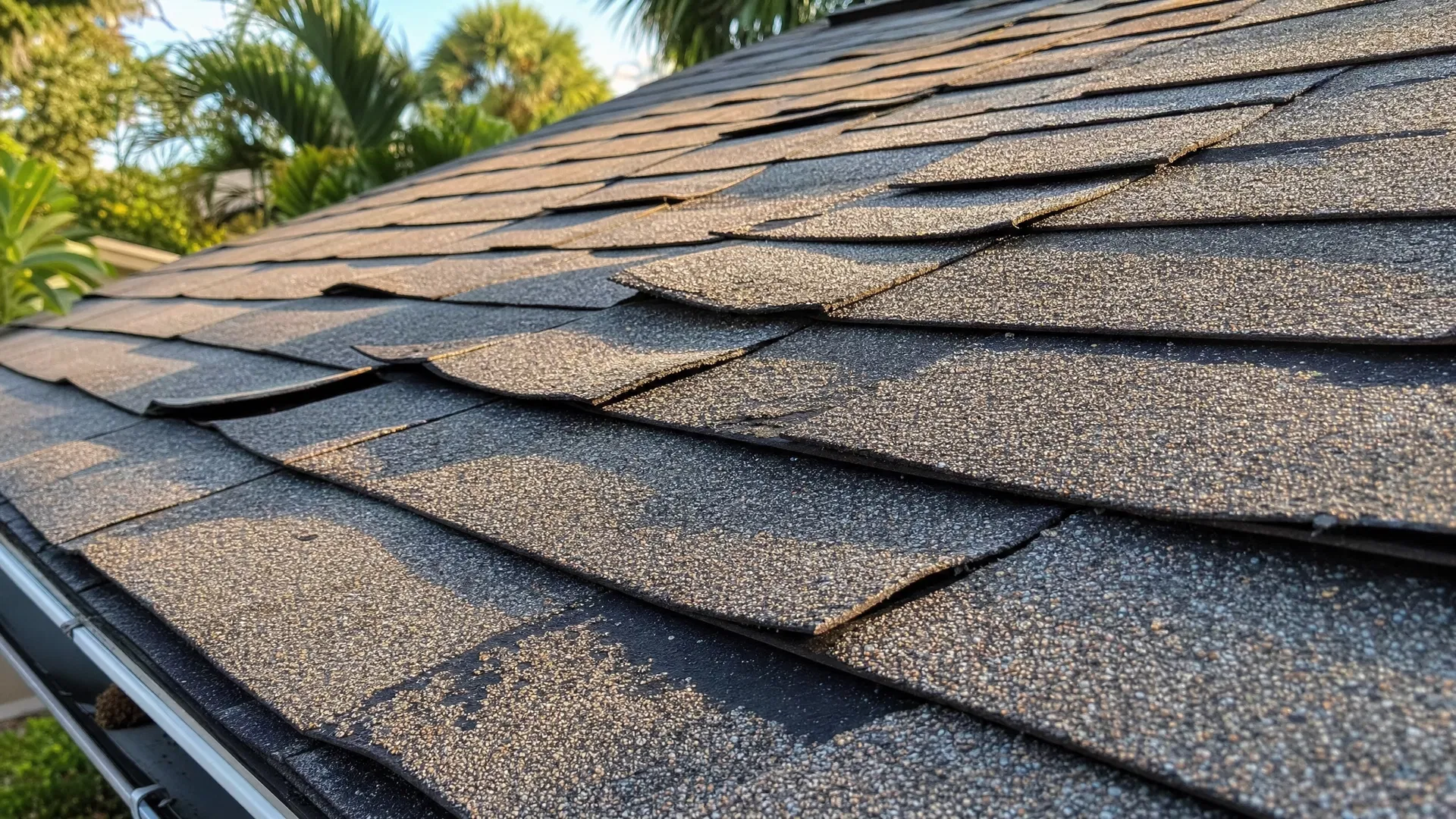
TL;DR: Curling shingles in Florida are caused by UV degradation, poor attic ventilation, improper installation, or hurricane wind damage. Cupping (edges up) and clawing (center up) are both signs the shingle seal is broken. Isolated curling can be repaired, but widespread curling — more than 25% of a roof plane — typically triggers full roof replacement under Florida Building Code Section 706.1.1.
| Shingle Condition | Description | Primary Cause | Recommended Action |
|---|---|---|---|
| Cupping | Edges turn upward, center stays flat or dips | Moisture trapped underneath or attic heat baking from below | Check attic ventilation and underlayment |
| Clawing | Edges stay flat, center bulges up or tabs curl down | Aging roof, asphalt shrinkage, brittle mat | Plan for roof replacement |
| Missing Granules | Bald spots on shingles, granules in gutters | UV degradation, age, or physical damage | Inspect for widespread wear |
| Lifted Tabs | Shingles lifted from the seal strip | Hurricane wind events, improper installation | Immediate repair to prevent leaks |
What Is the Technical Difference Between Cupping and Clawing?
Cupping and clawing are two distinct forms of shingle distortion that indicate different underlying issues with your roof.
Not all curling looks the same, and the shape tells a story. Cupping is when the edges of the shingle turn upward while the center stays flat or dips, creating a concave "cup" shape. Clawing is the opposite: the edges stay flat while the center bulges up, or the tabs curl down at the corners like a claw.
According to the National Roof Certification and Inspection Association, cupping is generally caused by moisture trapped underneath the shingle or attic heat baking it from below, while clawing is typically a sign of an aging roof in which the asphalt has become brittle and lost its grip on the fiberglass mat (nrcia.org). InspectAPedia cites the Marshall et al. (1999) study, which concluded that "cupping and clawing result from asphalt shrinkage on the top and bottom surfaces of the shingles, respectively" — the same chemical process, just expressed on opposite faces of the shingle.
In either case, the protective seal between courses is compromised, and wind-driven rain can get underneath.
What Causes Shingles to Curl in Florida's Heat?
Florida's extreme weather conditions, including intense UV radiation and high humidity, accelerate the breakdown of asphalt shingles.
1. Age and UV degradation. Asphalt shingles contain volatile oils that keep the mat flexible. UV exposure cooks those oils out over time. Florida's UV index regularly hits 11+ from April through September — the "extreme" category on the EPA scale — so the same shingle that lasts 25 years in Ohio may give out at 15–18 years here.
2. Poor attic ventilation. The Florida Building Code (Section R806) requires a minimum 1:150 net free ventilation area, or 1:300 with a balanced system of intake and exhaust vents. The Florida Roofing & Sheet Metal Contractors Association (FRSA) has stated plainly that "when a roof is improperly ventilated, heat buildup can cause shingles and underlayment to degrade, leading to issues such as blistering, curling and granule loss" (floridaroof.com). In an unventilated Tampa attic in July, deck temperatures routinely exceed 150°F.
3. Improper installation. Too few nails per shingle, nails placed above the nailing strip ("high nails"), mixed-batch shingles, or shingles installed in cool weather without proper sealing all lead to early curling and poor wind uplift resistance. GAF, Owens Corning, and CertainTeed all explicitly require correct ventilation as a condition of their warranties — a poorly ventilated roof is a denied warranty claim waiting to happen.
4. Hurricane and wind events. Florida Building Code (Section 1609, ASCE 7-22) requires roofing systems in Central Florida to resist design wind speeds of 130–150 mph (ultimate). When a shingle has been partially lifted by a tropical storm, its seal strip is broken — and on the next sunny day, the edge curls up and never re-seals.
Why Are Curling Shingles a Bigger Deal in Florida Than Elsewhere?
In Florida, curling shingles are a major concern because they create entry points for wind-driven rain during frequent thunderstorms and hurricanes.
In drier climates a curled shingle might leak a little. In Florida, the average annual rainfall is 50–60 inches (Florida Climate Center, climatecenter.fsu.edu), most of it falling in violent afternoon thunderstorms with wind gusts over 40 mph. A single curled tab becomes an entry point for sideways rain, and within one hurricane season you can be looking at saturated decking, mold in the attic insulation, and stained drywall.
Curled shingles are also a red flag for insurance carriers. Florida insurers are increasingly using drone inspections at renewal, and visibly curled, cracked, or "frosted" shingles are one of the top reasons we see policies non-renewed or written with a roof exclusion. Common warning signs that insurers look for include:
- Widespread cupping or clawing across multiple roof planes
- Significant granule loss exposing the asphalt mat
- Lifted or missing shingles from recent wind events
- Brittle or cracked shingles indicating advanced age
- Improperly sealed edges that are vulnerable to wind uplift
When to Repair vs. Replace
A few isolated curled shingles near a vent stack or on a south-facing slope can usually be replaced individually, and the underlying step flashing, drip edge, or ventilation issue corrected. But when curling is widespread — say, more than 20–25% of any single roof plane — repair is no longer the answer. Under Florida Building Code Section 706.1.1 (the "25% Rule"), more than 25% of a roof section repaired in a 12-month period generally triggers full-section replacement to current code, unless the roof was installed under the 2007 FBC or later (post-March 1, 2009), in which case Senate Bill 4-D allows partial repair only.
What Hytz Roofing Recommends
Don't walk on a curled roof — the shingles are brittle and fragments will break off, taking granules with them. Instead, schedule a professional inspection. As a GAF Master Elite contractor (a designation held by only about 2% of roofers in North America, per GAF.com), Hytz Roofing performs the same factory-trained inspection used to validate GAF's Golden Pledge warranty — and we'll tell you honestly whether you need a repair, a ventilation correction, or a full re-roof.
If your shingles are curling or falling off, it may be time for professional attention. Our roof repairs team can assess the damage and recommend the most cost-effective solution.