$6.50–$12/Sq Ft TPO Roof Cost in Tampa, Mapped to Gulf Coast Specs
TPO roof cost in Tampa runs $6.50 to $12 per square foot installed, depending on membrane thickness, attachment method, and insulation. A typical 1,500-square-foot residential flat roof typically costs between a moderate and a premium range depending on the membrane and installation choices. A 10,000-square-foot commercial roof costs vary widely depending on specifications and installation methods. Final pricing shifts with mil thickness, tear-off scope, and roof access, so treat these figures as your starting budget, not a quote.
TL;DR:
- Tampa TPO roof costs range from $6.50 to $12 per square foot, depending on membrane thickness, attachment method, and insulation choices.
- Premium systems with 80-mil fully adhered membranes and induction welding offer better wind resistance and longer warranties, especially in exposed coastal locations.
- Accurate quotes should itemize membrane type, attachment method, insulation R-value, tear-off scope, and warranty details to avoid lowball bids that lack essential specifics.
- Wind exposure significantly influences the choice of membrane thickness and attachment method, with more durable options costing more but offering better storm resistance.
- Working with certified installers ensures warranty eligibility and optimal performance, especially in Tampa’s high wind environment.
Table of Contents
- TPO Roof Cost Tampa: Low, Typical, and Premium Bid Ranges
- Line-Item Breakdown: What’s Actually in a TPO Quote
- Membrane Thickness and Attachment: The Two Biggest Price Drivers
- Sample Tampa TPO Projects: Three Real Budgets
- Warranty and Service Life: What Your Spec Buys You
- How to Get an Accurate TPO Quote in Tampa
- A Tampa Roofer’s Take on TPO Specs
- Why Cheap TPO Bids Almost Always Cost More Later
- Get a TPO Estimate Built for Your Tampa Roof
- Sources
- FAQ
TPO Roof Cost Tampa: Low, Typical, and Premium Bid Ranges
Every Tampa TPO quote falls into one of three tiers, and knowing which tier you’re looking at tells you more than the sticker price ever will.
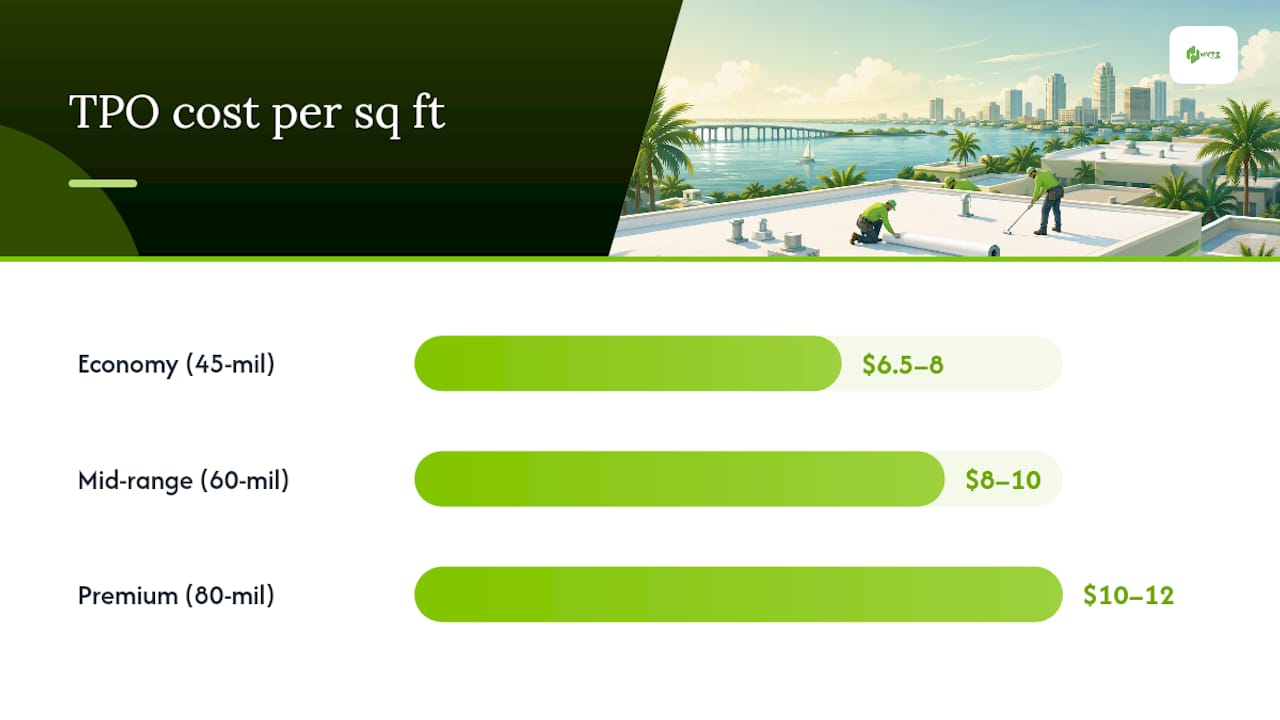
Economy bids run $6.50 to $8/sf. These typically use 45-mil membrane with mechanical attachment, the lightest and cheapest way to build a TPO roof. Mid-range bids land at $8 to $10/sf, usually 60-mil membrane, either mechanically attached or fully adhered. Premium bids run $10 to $12/sf and up, built around 80-mil fully adhered or induction-welded systems designed for high wind zones and long warranty terms. National data backs up this spread: 60-mil mechanically attached systems typically run $7 to $9/sf installed, while 80-mil fully adhered can reach $10 to $14/sf, and Tampa pricing tracks close to those national bands because material costs don’t vary much by region, but labor and wind code requirements do.
Here’s what those bands mean for real roofs:
- 1,500 sq ft residential: costs range from economy to premium pricing tiers based on membrane and installation quality.
- 2,000 sq ft small commercial: $13,000 (economy) to $24,000 (premium)
- 10,000 sq ft large commercial: costs cover a broad range reflective of different membrane thicknesses and attachment methods.
Gulf Coast wind exposure changes the calculus here more than in most parts of the country. Tampa’s building code requires roof assemblies to meet specific wind uplift ratings, and mechanically attached 45-mil systems sit at the lower end of that performance range. If your roof is in an open, wind-exposed spot near the bay or on a taller commercial building, a fully adhered or induction-welded system earns its premium fast, both in storm resistance and in the warranty terms manufacturers are willing to offer.
Line-Item Breakdown: What’s Actually in a TPO Quote
A one-line “$8 per square foot” quote tells you almost nothing. A proper Tampa TPO estimate itemizes each component, and knowing what belongs on that list is how you catch a lowball bid before it becomes a problem.
Here’s what a complete quote should break out:
- Membrane material ($1.50 to $3/sf depending on mil thickness)
- Labor and installation ($2 to $4/sf, higher for fully adhered or induction-welded systems)
- Insulation (polyiso) ($1.25 to $2.25/sf)
- Cover board ($0.50 to $1/sf, often Securock or a comparable gypsum board)
- Fasteners and adhesive ($0.30 to $0.75/sf)
- Flashing, drains, and penetrations (varies by roof complexity)
- Tear-off and disposal ($1 to $2/sf for a single-layer removal)
- Mobilization and permits (flat fee, often $500 to $1,500)
Insulation and cover board commonly account for $2.50 to $4.50 per square foot of total system cost. Insulation isn’t a line item to shop away since most manufacturer warranties require a specific R-value assembly, and skipping or downgrading it can void coverage before your roof sees its first storm.
Tampa jobs carry a few extras that don’t show up on generic cost guides; for local home improvement needs, consider trusted providers like One Day Doors & Closets of Tampa. Rooftop equipment flashing (HVAC curbs, satellite mounts) adds labor per unit. Walk pads protect the membrane on roofs with frequent foot traffic for maintenance access. And hurricane anchor points for tie-downs or equipment restraints are increasingly common asks from insurers and property managers alike, particularly on commercial buildings near the coast.
Membrane Thickness and Attachment: The Two Biggest Price Drivers
Two specification choices explain most of the price gap between a $65,000 bid and a $120,000 bid on the same commercial roof: membrane thickness and how it’s attached to the deck.
Membrane thickness:
- 45-mil: Lightest option, lowest cost, shortest expected service life. Fine for low-slope residential roofs with minimal foot traffic.
- 60-mil: The most common Tampa Bay choice. Better puncture resistance, longer warranty eligibility, and a solid balance of cost and durability.
- 80-mil: Premium thickness. Best puncture and wind resistance, required for most 25 to 30-year No Dollar Limit warranties.
Attachment method:
- Mechanically attached: Fasteners screw the membrane to the deck through the insulation. Cheapest and fastest to install.
- Fully adhered: Membrane is glued down with adhesive. Better wind uplift performance, higher labor cost.
- Induction-welded (RhinoBond): Fasteners are welded to the membrane from below rather than penetrating it. Combines fast installation with strong wind resistance, a growing favorite for Gulf Coast commercial roofs.
Pro Tip: If your roof has a lot of rooftop equipment or you’re chasing the longest warranty term available, fully adhered or RhinoBond systems are usually worth the extra $1 to $2 per square foot. The difference shows up during the next named storm, not on the invoice.
Sample Tampa TPO Projects: Three Real Budgets
These three examples assume standard conditions: single-layer tear-off, R-20 to R-25 polyiso insulation, and a moderate number of roof penetrations. Your actual bid will shift if your roof has multiple existing layers, unusual pitch, or heavy equipment loads.
- Small residential flat roof, 1,500 sq ft: Economy (45-mil mechanically attached) runs about $9,750. Standard (60-mil mechanically attached) runs about $13,500. Premium (60-mil fully adhered) runs about $16,500.
- Small commercial roof, 2,000 sq ft: A line-item calculator based on NRCA and SPRI cost data estimates $14,000 to $22,000 for a 60-mil mechanically attached system with R-20 polyiso, which lines up closely with typical Tampa contractor bids at this size.
- Large commercial roof, 10,000 sq ft: Economy runs roughly $65,000. Standard (60-mil fully adhered) runs roughly $90,000. Premium (80-mil fully adhered with high-R insulation) can reach $120,000 or more.
Access matters more than most owners expect. A roof with a working freight elevator and clear staging area costs less to build than one requiring a crane lift for materials or extensive foot traffic through occupied space. Steep-slope transitions, multiple roof levels, and a high penetration count (skylights, HVAC units, vents) all add labor hours that a flat per-square-foot number doesn’t capture.
Warranty and Service Life: What Your Spec Buys You
Two warranty types exist for TPO systems, and the difference between them often comes down to spec choices made before the crew ever shows up.
A material-only warranty covers membrane defects but not labor if something fails. A No Dollar Limit (NDL) warranty covers both material and labor for the full term, but manufacturers only offer NDL coverage on specific assemblies. A 30-year NDL warranty usually requires a premium build: thicker membrane, fully adhered or induction-welded attachment, and higher R-value insulation with a cover board.
Expected service life in Florida’s climate, by spec:
- 45-mil mechanically attached: 12 to 15 years
- 60-mil, either attachment method: 18 to 22 years
- 80-mil fully adhered: 22 to 25+ years, often with NDL eligibility
Keeping that warranty intact means staying on top of maintenance. Semiannual inspections that check seams, flashing, and drain function catch small problems before they become claims. Regular checks matter even more in Tampa Bay’s climate, where afternoon storms and UV exposure stress seams faster than in drier regions.
How to Get an Accurate TPO Quote in Tampa
A quote missing key details is a quote you can’t compare fairly against anyone else’s. Before you sign anything, make sure your written proposal spells out the specifics.
- Membrane mil thickness and brand (not just “TPO,” but 45, 60, or 80-mil and the manufacturer)
- Attachment method (mechanically attached, fully adhered, or induction-welded)
- Insulation R-value and cover board type (Securock or comparable, listed by name)
- Tear-off scope (how many existing layers, disposal included or extra)
- Warranty type and term (material-only vs. NDL, and how many years)
- Who performs the work (in-house crew vs. subcontractor)
- Proof of manufacturer certification, license, and insurance
Ask directly whether the crew is a manufacturer-certified installer. Certification status materially affects warranty eligibility, so a contractor who can’t produce it shouldn’t be writing you an NDL warranty quote in the first place.
Pro Tip: Watch for vague spec language like “TPO roofing system, price includes materials and labor” with no mil thickness, no insulation R-value, and no warranty term listed. That’s the most common way a low bid turns into a mid-project change order.
Red flags worth walking away from: no Florida contractor license number on the proposal, no proof of general liability or workers’ comp, and a timeline that seems too fast for the roof size, especially paired with a suspiciously low price.
A Tampa Roofer’s Take on TPO Specs
Wind uplift ratings and manufacturer certification aren’t boxes to check. They’re the two things that separate a roof that survives its first named storm from one that doesn’t. Hytzroofing holds Florida Contractor License #CCC1332551 and GAF Master Elite certification, a distinction held by fewer than 2% of roofing contractors nationally, along with the GAF President’s Club Award and GAF Certified Commercial Contractor status. That local licensing and manufacturer credential matters more here than in most parts of the country, because Tampa Bay’s wind exposure and code requirements punish shortcuts that other markets might tolerate.
Document storm damage thoroughly for insurance purposes: photograph membrane punctures, seam separation, and any ponding before repairs begin, since adjusters weigh dated photo evidence heavily in claim decisions.
Why Cheap TPO Bids Almost Always Cost More Later
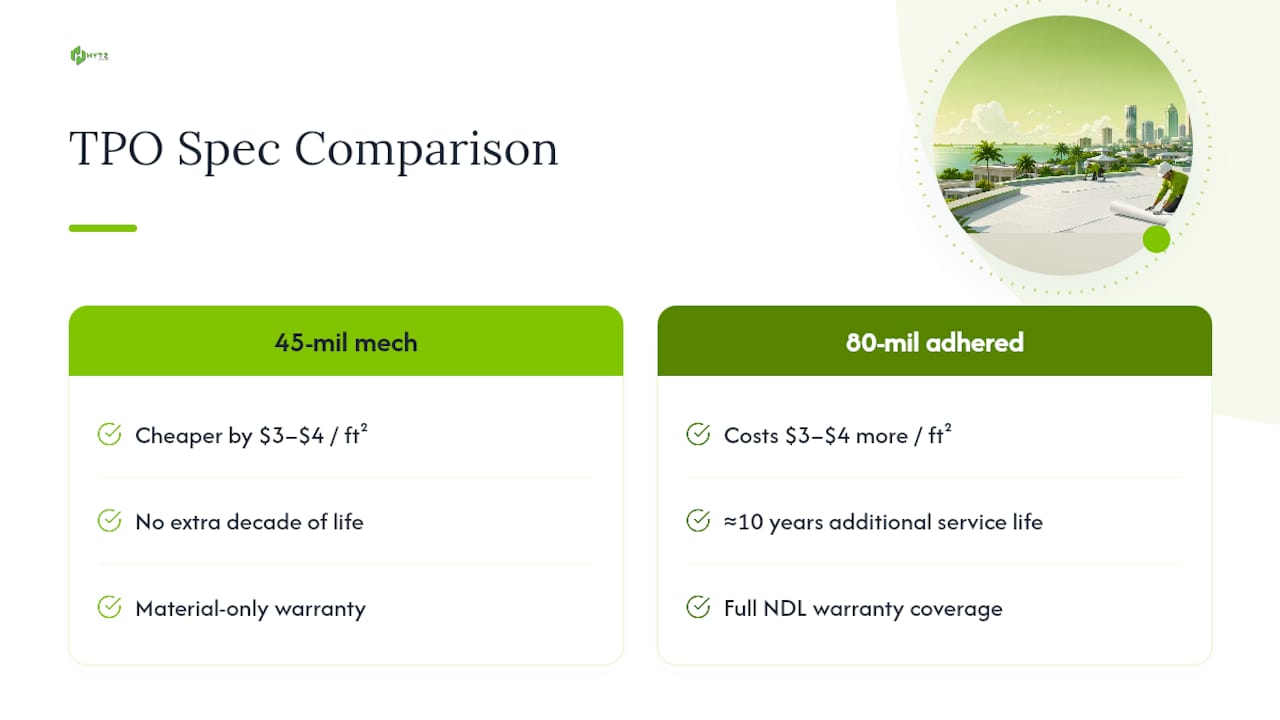
The conventional advice on TPO pricing treats it like a commodity: get three bids, pick the cheapest per-square-foot number, done. That approach fails Tampa homeowners more often than any other roofing decision I’ve seen play out. A 45-mil mechanically attached system and an 80-mil fully adhered system can carry a $3 to $4 per square foot gap, but that gap buys you a decade of extra service life and, often, the difference between a material-only warranty and full NDL coverage.
What gets overlooked is how much wind exposure should drive the spec choice, not just the budget. A roof three blocks from Tampa Bay with rooftop HVAC units has different real-world needs than an inland roof with a simple deck. Contractors who quote the same spec for both are optimizing for winning the bid, not for what survives hurricane season.
If you take one thing from this guide, make it this: read the spec line before you read the price. The number means nothing without knowing what it’s buying.
— Anthony
Get a TPO Estimate Built for Your Tampa Roof
Hytzroofing is the direct alternative to guessing at a per-square-foot number: we build itemized TPO estimates that spell out mil thickness, attachment method, insulation R-value, and warranty term before you ever sign anything.
As a GAF Master Elite contractor, licensed under Florida Contractor License #CCC1332551, our crews install TPO systems specced for Gulf Coast wind exposure rather than a generic national average. If your roof was damaged in a recent storm, we also help homeowners and property managers document and file insurance claims so the assembly you actually need gets covered. Ready to see real numbers for your roof? Request an on-site TPO roofing estimate in Tampa and get a written, itemized quote instead of a rough guess.
Sources
Cross-check any Tampa quote against these:
- TPO Roof Cost per Square Foot | Flat Roof Report
- TPO Roof Installation Cost 2026: Per Sq Ft & ISO Math | TRB
FAQ
What Is the Average Cost of a TPO Roof?
TPO roofing costs $5.50 to $9 per square foot installed nationally, though premium 80-mil fully adhered systems can reach $10 to $14/sf. In Tampa, expect $6.50 to $12/sf depending on thickness, attachment method, and insulation.
How Long Will a TPO Roof Last in Florida?
A 45-mil mechanically attached TPO roof typically lasts 12 to 15 years in Florida’s climate. An 80-mil fully adhered system can reach 22 to 25 years or more, especially with regular maintenance and manufacturer-approved installation.
How Much Does It Cost to Roof a 1,500 Sq Ft House in Florida?
A 1,500-square-foot flat roof with TPO membrane typically costs $9,750 to $16,500 in Tampa, depending on spec tier. Homeowner-facing data shows total project costs commonly ranging from about $6,500 to $24,000 depending on roof size and regional labor rates. Hytzroofing provides itemized TPO roofing estimates that break down each cost component before work begins.
What Is the 25% Roof Rule in Florida?
Florida’s roofing code provisions generally address how much of an existing roof can be repaired before full replacement or updated code compliance is triggered, and specific thresholds vary by jurisdiction and roof type. Because these rules affect permitting and insurance decisions, confirm current requirements with a licensed Tampa contractor or your local building department before finalizing a repair versus replacement decision.
Do I Need a Manufacturer-Certified Installer for a TPO Warranty?
Yes, most No Dollar Limit warranties require the installation to be performed by a manufacturer-certified contractor. Certification status directly affects warranty eligibility and is one of the first things to confirm before signing a contract.