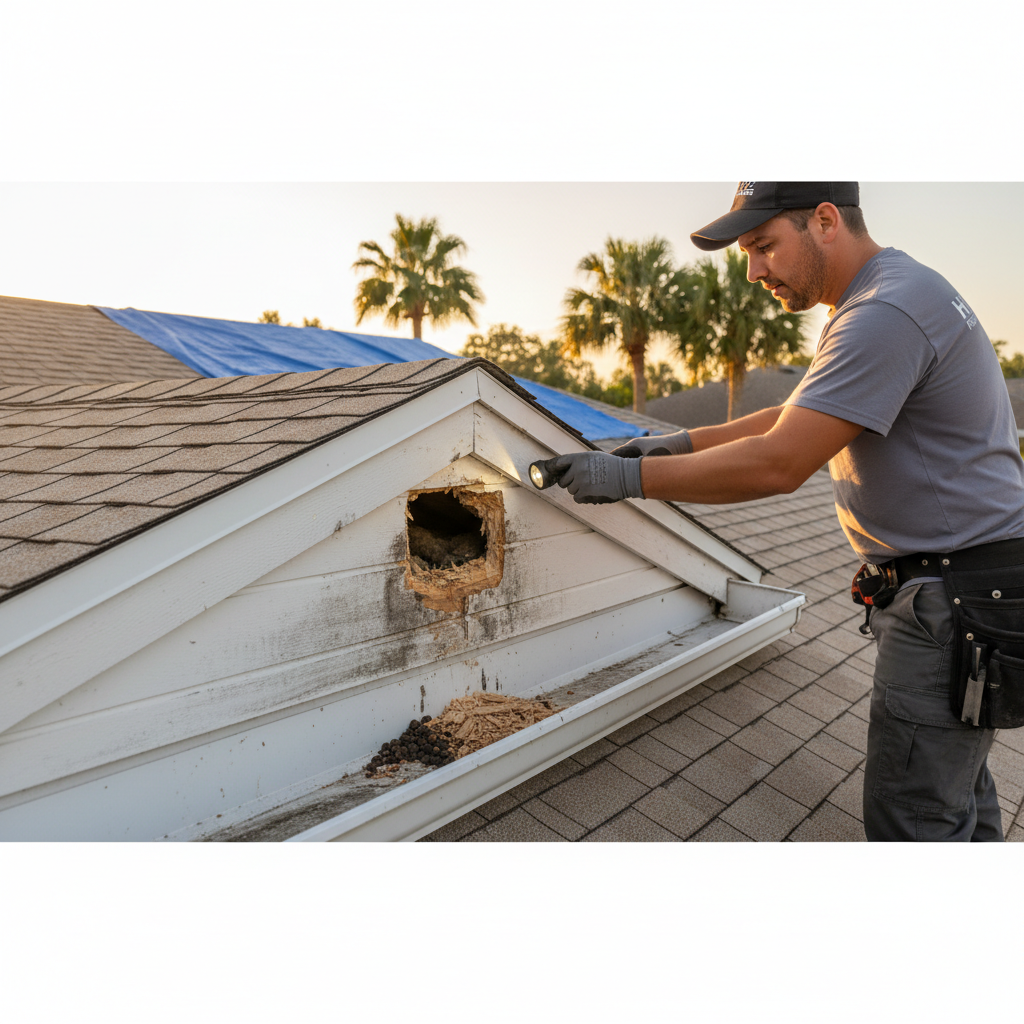
When a squirrel or raccoon chews through your fascia board, the roof edge becomes an open door. The animal can get into the soffit and attic, rain can reach framing that was never meant to stay wet, and the gutter and drip edge lose the solid wood that backs them. A hole the size of a fist can grow into rotted rafter tails, a sagging gutter, and an eave that storm winds can start to peel back.
The fix happens in a set order: confirm the animal is out, then replace the damaged wood, then restore the roof edge metal. Doing those steps in the wrong order is the most common reason the damage comes back.
Key Takeaways
- A chewed fascia board exposes three things at once: an attic entry point, wood that can rot once it stays wet, and a weakened roof edge where the gutter and drip edge attach.
- Never seal the hole until you know the animal is gone. The Illinois Department of Natural Resources suggests stuffing the opening loosely with newspaper and waiting three days before repairs.
- In Florida, the Florida Fish and Wildlife Conservation Commission (FWC) lets property owners trap nuisance wildlife, but trapped animals must be released on the property, moved under strict conditions, or euthanized humanely within 24 hours.
- Homeowners insurance often excludes damage from "birds, vermin, rodents, or insects." Squirrels are rodents, and many policies now define raccoons as vermin, so read your exact policy wording.
- Roof edges take the highest wind stress, so a fascia repair on a Tampa Bay home should end with a properly fastened drip edge, not just a patched board.
What does a fascia board do for your roof?
The fascia board is the horizontal trim board fastened across the ends of the rafters or trusses along the roof's lower edge. It closes off the open ends of the roof framing, gives the soffit a place to tie in, and serves as the mounting surface for gutters. On many Florida homes, the wood fascia is wrapped in an aluminum fascia cover.
The fascia also sits directly under the roof's metal drip edge. The Florida Building Code, Residential, 8th Edition (2023), covers drip edge installation in Section R905.2.8.5 and aluminum fascia in Section R704.3. The Florida Home Builders Association's summary of the 8th Edition changes notes that aluminum fascia is inserted under the drip edge. In practice, the fascia, the drip edge, and the gutter work as one roof edge assembly. Damage to the wood behind them affects all three.
What damage follows when a squirrel or raccoon chews through the fascia?
Chewed fascia damage usually spreads in three directions.
The attic becomes a den
The Illinois Department of Natural Resources (IDNR) Wildlife Illinois program says tree squirrels and raccoons "will chew through the eave to gain access to the attic or walls." Once inside, the animal nests in insulation and leaves droppings. Raccoons add a health concern. The U.S. Centers for Disease Control and Prevention (CDC) warns that raccoon latrines can hold raccoon roundworm (Baylisascaris) eggs, which most chemicals do not kill. The CDC recommends gloves, an N95-rated respirator in confined spaces, and removing contaminated material rather than sweeping it around.
Water reaches wood that should stay dry
A hole in the fascia lets wind-driven rain and gutter overflow into the soffit cavity and onto the rafter tails. Wet wood in a warm, humid climate softens over time. A repair crew that opens a chewed section often finds the visible hole is smaller than the soft wood around it, which is why the board should be probed well beyond the hole.
The roof edge loses its backing
Gutter hangers screw into the fascia. When the wood behind them is chewed or soft, the screws lose their grip and the gutter can pull away, dumping water against the house instead of away from it. The drip edge and starter course of shingles sit right above that weak spot. According to the U.S. Department of Energy's Building America Solution Center (published by Pacific Northwest National Laboratory), "The greatest stress roof assemblies experience in high wind zones is at roof edges," and "Most roof covering 'blow-off' occurs at roof edges." A compromised eave is the part of the roof where wind damage tends to start.
How can you tell whether a squirrel or a raccoon chewed the fascia?
The hole itself usually tells you which animal you are dealing with. IDNR notes that smaller holes usually mean a squirrel, while larger holes give access to larger animals like raccoons. Small holes drilled into the fascia can also be woodpeckers hunting for insects, according to IDNR.
| Sign or issue | Squirrel | Raccoon |
|---|---|---|
| Typical opening | Smaller, chewed hole, often at a corner or gap | Larger opening, often with soffit or fascia torn loose |
| Young in the attic | Eastern gray squirrels breed about twice a year with roughly one to four pups per litter (UF/IFAS) | Mothers may use the attic as a den; check before sealing |
| Main health concern | Nesting debris and droppings in insulation | Raccoon roundworm eggs in latrines (CDC) |
| Typical insurance treatment | Rodent; commonly excluded | Often defined as vermin in newer policy wording; varies by policy |
| Roof repair needed | Replace chewed wood, check gutter and drip edge | Same, plus soffit and any torn roof edge metal |
What must happen before chewed fascia is repaired?
The animal has to be out before the fascia is closed. Sealing a squirrel or raccoon inside, or trapping young away from their mother, usually leads to a new hole somewhere else on the roofline. IDNR's simple test: loosely stuff the hole with newspaper. If the paper is still in place after three days, it is safe to start repairs. If it has been pushed out, the animal is still using the opening.
Florida has its own rules for removal. The FWC says property owners may take nuisance wildlife that causes or is about to cause property damage, using methods such as live traps, which must be checked at least once every 24 hours. Captured native wildlife must be released on the property where it was caught, moved to a site of at least 40 contiguous acres in the same county with the landowner's written permission, or euthanized humanely within 24 hours. Because of those rules, many Tampa homeowners hire a licensed wildlife removal company for this step and schedule the roofer for after the animal is gone.
How is chewed fascia repaired so the roof edge is sound again?
A lasting fascia repair goes beyond nailing a new board over the hole. A sound repair follows this sequence:
- Remove the gutter section and roof edge metal over the damaged area so the full board can be seen.
- Probe the surrounding wood. Replace the full length of soft or chewed fascia, not just the visible hole.
- Inspect the rafter tails and the lower edge of the roof deck. If water has been getting in, rot can extend past the fascia into the framing and sheathing.
- Close the soffit and make sure any soffit vents are intact and screened, since they can become the next entry point.
- Reinstall the aluminum fascia cover and drip edge. The Building America Solution Center and the Insurance Institute for Business & Home Safety (IBHS) FORTIFIED Home standard call for drip edge fastened to the roof deck at a maximum of 4 inches on center in high-wind areas.
- Rehang the gutter into solid wood so the hangers hold.
| Task | Usually handled by |
|---|---|
| Confirming the animal is gone, trapping or exclusion | Licensed wildlife removal company |
| Attic cleanup and contaminated insulation removal | Wildlife or remediation company |
| Fascia, rafter tail, and roof deck edge replacement | Roofing contractor or carpenter |
| Drip edge, starter shingles, and roof edge flashing | Roofing contractor |
| Gutter removal and rehanging | Roofer or gutter installer |
Will homeowners insurance pay for fascia damage from squirrels or raccoons?
Homeowners insurance often will not pay for the chewing itself. Policygenius explains that a standard homeowners policy excludes loss caused by "birds, vermin, rodents, or insects," and squirrels are rodents. Raccoons were once a gray area. A 2011 analysis on the Merlin Law Group's Property Insurance Coverage Law Blog notes that a 2007 American Association of Insurance Services (AAIS) policy amendment defines vermin to include raccoons, closing a gap that earlier court decisions had read in policyholders' favor.
Coverage can change when a covered event is involved. Policygenius notes that if a covered peril, such as a storm dropping a tree on the roof, lets an animal in, the resulting damage may be covered. Because outcomes depend on exact policy language, read your policy's exclusions and talk with your agent before filing. This is general information, not legal advice.
Why does fascia damage matter more on a Tampa Bay roof?
Fascia damage matters more in Tampa Bay because the roof edge is where hurricane and tropical storm winds pull hardest. A chewed or rotted fascia board under the drip edge leaves the starter shingles and edge metal anchored to weaker material right where the Building America Solution Center says most roof covering blow-off begins. Add Florida's long rainy season and frequent afternoon storms, and a small hole left open from spring into hurricane season has months of wet weather to spread rot. Fixing it before June 1 is the practical goal.
When should you call a roofer instead of patching the fascia yourself?
Call a roofer when the damage reaches past the fascia board itself: soft wood that extends beyond the hole, a gutter pulling away, loose or bent drip edge, lifted shingles at the eave, or stains on the soffit or attic sheathing. Those signs mean the roof edge assembly needs to be opened and rebuilt, not covered over.
Hytz Roofing, a GAF Master Elite and GAF President's Club contractor licensed in Florida (#CCC1332551) with 30+ years of experience, handles roof repair in Tampa, including inspecting the eave, deck edge, and flashing after animal damage. Get the wildlife removed first, then have the roof edge inspected and rebuilt so it holds through the next storm season.
Frequently Asked Questions
Can I just cover a chewed fascia hole with metal flashing?
Covering a chewed fascia hole with metal flashing only works if the wood behind it is still solid and the animal is gone. Flashing screwed into soft or rotted fascia will not hold, and it hides the rot so it keeps spreading behind the metal. If the board is soft beyond the hole, replace that section before covering it.
Will a squirrel come back after the fascia is repaired?
A squirrel can come back, because new wood is still chewable. Squirrels and raccoons often return to a roofline they already know. Reduce the odds by trimming tree limbs that reach the roof, keeping the aluminum fascia cover and drip edge tight with no gaps at corners, and checking soffit vents and roof edge corners after storms.
Does chewed fascia mean I need a new roof?
Chewed fascia rarely means you need a new roof on its own. Most animal damage is limited to the fascia, soffit, and the first few feet of the roof edge, which can be repaired. A replacement conversation only makes sense if the inspection finds widespread deck rot, or if the roof is already near the end of its service life and the edge repair would mean disturbing shingles that cannot be reused.
Sources
- Wildlife Illinois (Illinois Department of Natural Resources): Holes in the Eaves, Fascia, or Soffit
- Florida Fish and Wildlife Conservation Commission: FAQs, Nuisance Wildlife
- CDC: Preventing Raccoon Roundworm
- UF/IFAS Extension: WISE Species Profile, Eastern Gray Squirrel (2020)
- U.S. DOE Building America Solution Center (PNNL): Roof Edge Protection
- Florida Home Builders Association: FBC Residential 8th Edition Changes, Chapters 7-9
- Policygenius: Does Homeowners Insurance Cover Animal Damage? (updated 2022)
- Property Insurance Coverage Law Blog (Merlin Law Group): Raccoons Damaging Your Roof? Are You Covered Under Your Policy? (2011)