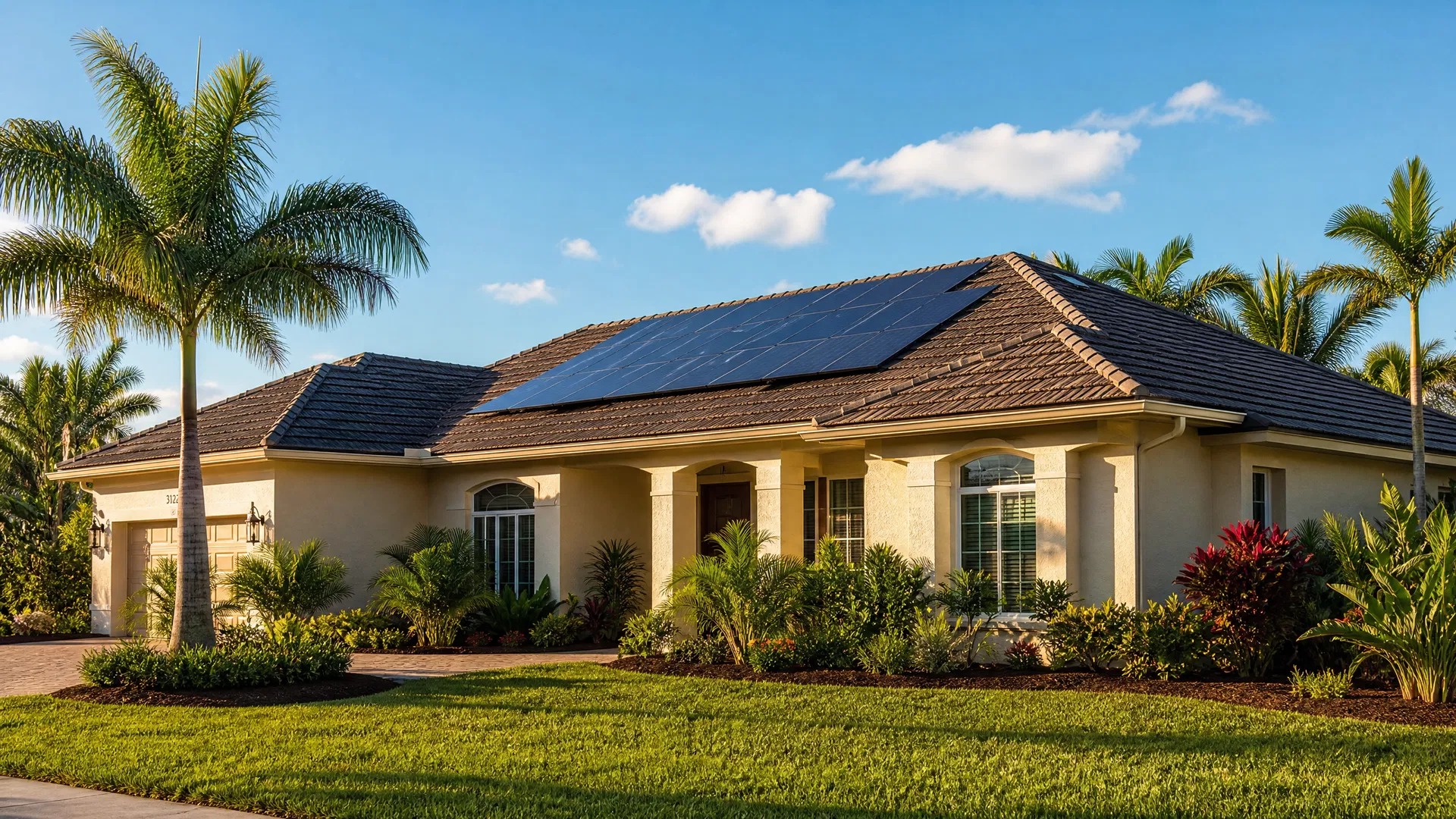
Enviroshake solar incentives for Florida homeowners in 2026 include property tax exemption, sales tax exemption, full retail net metering, and PACE financing. Florida offers a 100% property tax exemption, a sales tax exemption on solar equipment, and 1-to-1 net metering through FPL, Duke Energy, and TECO. Enviroshake is fully compatible with solar \u2014 just follow the official Solar Panel Installation Bulletin to protect your warranty.
Key Takeaways
- Enviroshake roofs are fully compatible with solar panel installations.
- Florida offers significant financial incentives for solar, including tax exemptions and net metering.
- Proper installation is crucial to maintain your Enviroshake warranty.
- PACE financing and SELF loans provide accessible funding options.
- Combining Enviroshake with solar maximizes energy savings and home value.
Table of Contents
- Why Florida Is One of the Best States for Solar
- Solar Incentives Available to Florida Homeowners in 2026
- Net Metering: Earn Bill Credits for Excess Solar Power
- PACE Financing and the Solar and Energy Loan Fund
- How Enviroshake and Solar Work Together
- Protecting Your Enviroshake Warranty During Solar Installation
- Envirocool: The Energy-Efficient Enviroshake Option
- Roofing Material Comparison: Which Roof Is Best for Solar?
- The Combined Value of Enviroshake + Solar
- Frequently Asked Questions
- Ready to Go Solar with Hytz Roofing?
Solar Incentives Compatible with Enviroshake Roofing in Florida
Florida homeowners are in a uniquely powerful position when it comes to solar energy. The state receives more annual sunshine than almost anywhere else in the country, and its utility policies \u2014 including 1-to-1 net metering and meaningful tax exemptions \u2014 make solar one of the strongest long-term investments a homeowner can make.
If your home already has an Enviroshake composite roof, the good news is that you are sitting on an ideal foundation for solar. Enviroshake is fully compatible with solar panel installation, and when paired with Florida's available incentives, the combination delivers exceptional financial and environmental returns.
This guide covers every solar incentive available to Florida homeowners in 2026, explains exactly how Enviroshake and solar work together, and walks you through the steps to protect your warranty during installation.
Florida Solar & Enviroshake Compatibility at a Glance
| Feature | Detail | Benefit for Homeowners |
|---|---|---|
| Annual Sunshine | 230+ sunny days/year | High solar energy production |
| Net Metering | 1-to-1 kWh credit | Significant bill savings, faster payback |
| Property Tax Exemption | 100% solar value excluded | No added property taxes for solar value |
| Sales Tax Exemption | 6% on solar equipment | $1,200-$2,100 upfront savings |
| Enviroshake Compatibility | Fully compatible, pre-drillable | Durable, long-lasting foundation for solar |
| Warranty Protection | Specific installation guidelines | Maintains Enviroshake lifetime warranty |
Why is Florida considered one of the best states for solar energy? {#why-florida}
Florida is ideal for solar due to its abundant sunshine, averaging over 230 sunny days annually, and favorable utility policies like 1-to-1 net metering, which significantly enhance the financial returns for homeowners.
Florida ranks in the top five states nationally for total solar installations \u2014 and for good reason. The state averages over 230 sunny days per year, giving residential solar systems more hours of peak production than most of the country. The Tampa Bay area, which includes Hillsborough, Pinellas, Pasco, and Hernando counties, receives approximately 5.5 peak sun hours per day on average \u2014 a figure that makes residential solar highly productive year-round.
Beyond sunshine, Florida's utility structure is favorable. The state's major investor-owned utilities \u2014 Florida Power & Light (FPL), Duke Energy Florida, and Tampa Electric (TECO) \u2014 all offer 1-to-1 net metering, meaning every kilowatt-hour of solar electricity you send back to the grid earns you a full credit against your bill. This policy dramatically shortens the payback period for a solar installation compared to states with less favorable buyback rates.
For Tampa Bay homeowners specifically, TECO's net metering program means your solar panels can effectively run your meter backward during the long, sun-drenched Florida summers, building up credits that offset your electricity costs during cloudier months. Duke Energy customers in the Orlando and Sarasota corridors benefit from the same full retail rate credit structure.
Florida's average residential electricity rate sits around 13 to 15 cents per kilowatt-hour, and rates have increased steadily over the past decade. Locking in your energy costs with solar now provides a hedge against future rate increases that asphalt shingle homeowners \u2014 who have no such hedge \u2014 will continue to absorb.
What solar incentives are available to Florida homeowners in 2026? {#solar-incentives}
Florida homeowners have access to a meaningful set of solar incentives that reduce the upfront cost and ongoing tax burden of going solar.
Florida homeowners have access to a meaningful set of solar incentives that reduce the upfront cost and ongoing tax burden of going solar. Here is a clear breakdown of what is currently available:
| Incentive | Estimated Savings | Who Qualifies | Notes |
|---|---|---|---|
| Florida Property Tax Exemption | $200\u2013$500/year | All FL homeowners with solar | 100% of solar value excluded from property assessment |
| Florida Sales Tax Exemption | $1,200\u2013$2,100 | All FL solar equipment buyers | Covers panels, inverters, wiring, battery storage |
| Full Retail Net Metering (TECO/FPL/Duke) | $1,500\u2013$3,000/year | Customers of major IOUs | 1-to-1 kWh credit for excess power sent to grid |
| PACE Financing (no money down) | Varies | Hillsborough, Pinellas, Orange County homeowners | Repaid via property tax assessment over 10\u201330 years |
| SELF Nonprofit Loan | Varies | Income-qualifying FL homeowners | 5\u20139.5% interest, no credit check required |
| Boynton Beach Energy Edge Rebate | $1,500 | Boynton Beach residents | $1,500 rebate for solar on primary residence |
| Dunedin Solar Grant | Up to $2,500 | Dunedin residents | $0.25/watt, up to $2,500 |
What is Florida's 100% Property Tax Exemption for Solar? {#property-tax-exemption}
Florida's 100% property tax exemption for residential solar installations means that any increase in a home's market value due to solar panels is completely excluded from property tax assessments. This allows homeowners to benefit from a higher-value home without incurring additional property taxes.
One of the most valuable and often overlooked incentives is Florida's 100% property tax exemption for residential solar installations. Solar panels typically increase a home's market value \u2014 studies suggest by $15,000 or more for an average system \u2014 but under Florida law [1] (Section 193.624, Florida Statutes) Florida Building Code, that added value is completely excluded from your property tax assessment. You get the benefit of a higher-value home without paying a single additional dollar in property taxes because of it.
This exemption applies to the solar panels themselves and any accompanying battery storage devices, making it relevant whether you install a basic grid-tied system or a full solar-plus-storage setup. The exemption is permanent and does not require annual renewal.
What is Florida's Solar Equipment Sales Tax Exemption? {#sales-tax-exemption}
Florida's solar equipment sales tax exemption removes the 6% state sales and use tax on qualifying solar energy equipment. This can save homeowners between $1,200 to $2,100 on a typical residential solar installation.
Florida also exempts solar energy equipment from its state sales and use tax [2] under Section 212.08(7)(hh), Florida Statutes. This exemption covers solar panels, inverters, mounting hardware, disconnect switches, wiring, battery storage units, and other accessories necessary for the system to function. On a typical residential solar installation costing $20,000 to $35,000, the 6% Florida sales tax exemption alone saves homeowners $1,200 to $2,100 at the point of purchase.
The exemption applies to equipment certified by the Florida Solar Energy Center (FSEC) as a qualifying solar energy component. Your solar installer should be familiar with these requirements and can confirm eligibility during the quoting process.
What is the status of the Federal Solar Tax Credit in 2026? {#federal-tax-credit}
The 30% federal residential solar tax credit (ITC) was available for homeowner-purchased systems through December 31, 2025. As of 2026, it has lapsed for cash and loan purchases but remains available for leased solar systems, with savings typically passed on through lower monthly lease payments.
The 30% federal residential solar tax credit (also known as the Investment Tax Credit, or ITC) was available for homeowner-purchased systems through December 31, 2025 under Section 25D of the Internal Revenue Code. As of 2026, the residential ITC has lapsed for cash and loan purchases of new systems. However, the credit remains available for leased solar systems \u2014 the leasing company claims it and typically passes the savings along through lower monthly lease payments.
If you are considering a solar lease or power purchase agreement (PPA), ask your installer how the federal credit factors into your pricing. For homeowners who purchased and installed a system before December 31, 2025, the 30% credit can still be claimed on your 2025 tax return using IRS Form 5695.
How does net metering allow you to earn bill credits for excess solar power? {#net-metering}
Net metering is a policy that credits solar energy system owners for the electricity they add to the grid, effectively reducing their electricity bills.
Net metering is the policy that makes solar financially compelling in Florida. Here is how it works in practice for Tampa Bay homeowners:
When your solar panels produce more electricity than your home needs \u2014 which happens frequently during sunny Florida afternoons \u2014 the excess power flows back to the utility grid. Under Florida's net metering rules, your utility company credits your account at the full retail rate for every kilowatt-hour you export. When you draw power from the grid at night or on cloudy days, those credits offset what you owe.
Credits roll over month to month within a 12-month period. At the end of the annual true-up period, any remaining excess credits are typically paid out at a reduced rate (around 3 to 5 cents per kilowatt-hour, depending on the utility). This means the optimal solar system size is one that produces roughly what you consume annually \u2014 not significantly more.
For TECO customers in the Tampa area, the full retail net metering rate makes the economics particularly attractive. A properly sized 8 to 12 kilowatt system can reduce a typical Tampa Bay electricity bill from $200\u2013$300 per month to near zero, with a payback period of 7 to 12 years depending on system cost and financing method.
It is worth noting that Florida law [3] requires the major investor-owned utilities to offer net metering, but electric cooperatives and municipal utilities are not subject to the same mandate. If you are served by a co-op or municipal utility, confirm their buyback rate before sizing your system.
What are PACE Financing and the Solar and Energy Loan Fund? {#pace-financing}
PACE (Property Assessed Clean Energy) financing and the Solar and Energy Loan Fund (SELF) are two distinct Florida-specific programs designed to help homeowners fund energy-efficient improvements, including solar installations, often with no upfront costs or traditional credit checks.
For homeowners who want to go solar without a large upfront payment, Florida offers two distinctive financing options that are not available in most other states.
What is Property Assessed Clean Energy (PACE) Financing? {#pace-financing-detail}
PACE (Property Assessed Clean Energy) Financing allows homeowners in participating counties to finance solar installations with no money down, repaid through an assessment on their annual property tax bill. Approval is based on property equity and tax payment history, making it accessible even without a traditional credit check.
Property Assessed Clean Energy (PACE) Financing allows homeowners in participating counties \u2014 including Hillsborough, Pinellas, and Orange \u2014 to finance solar installations with no money down. The loan is repaid through an assessment added to your annual property tax bill over a term of 10 to 30 years. Because the loan is attached to the property rather than the borrower, approval is based primarily on property equity and tax payment history rather than credit score. PACE financing is available through programs such as Florida PACE (floridapace.gov) and Ygrene.
PACE financing is particularly useful for homeowners who are also replacing their roof at the same time as going solar. An Enviroshake roof replacement combined with a solar installation can be financed together under a single PACE assessment, spreading the combined cost over decades while the energy savings begin immediately.
What is The Solar and Energy Loan Fund (SELF)? {#self-loan-detail}
The Solar and Energy Loan Fund (SELF) is a Florida-based nonprofit offering low-interest loans for solar and energy efficiency improvements, ranging from $3,000 to $50,000. SELF evaluates applications based on ability to repay, making it accessible to homeowners who may not qualify for traditional financing.
The Solar and Energy Loan Fund (SELF) is a Florida-based nonprofit that provides low-interest loans for solar and energy efficiency improvements. SELF loans range from $3,000 to $25,000 for most projects and up to $50,000 for solar energy systems. Interest rates range from 5% to 9.5%, and no credit check is required \u2014 SELF evaluates applications based on ability to repay, making it accessible to homeowners who may not qualify for traditional financing. SELF loans are available statewide.
How do Enviroshake and Solar Work Together? {#enviroshake-solar}
Enviroshake roofs are designed to be fully compatible with solar panel installations, providing a durable and stable foundation that supports efficient energy production and maintains warranty validity when installed correctly.
Enviroshake's official position on solar compatibility is clear: the product is designed to support solar panel installation, and doing so correctly will not void the warranty. According to Enviroshake's Solar Panel Installation Bulletin, the composite material can accommodate the mounting hardware and penetrations required for a standard racking system, provided the installation follows the specified procedures.
The key technical consideration is that solar mounting hardware must be fastened through the Enviroshake tiles and into the roof deck and structural framing \u2014 not into the tiles themselves. This is the same principle that governs solar installation on tile roofs generally: the tiles are a weather barrier, not a structural element, and the racking system must anchor to the structure beneath them.
Enviroshake tiles are manufactured from a composite blend of recycled rubber, plastic, and wood fiber, reinforced with natural fibers and elastomers. This material composition gives the tiles dimensional stability and resistance to cracking, which means they can be pre-drilled for mounting hardware without the risk of splitting that affects natural slate or clay tile. The composite material also maintains its shape under the thermal cycling that solar panels experience as they heat up during the day and cool at night.
The air gap that naturally exists between the Enviroshake tiles and the roof deck also benefits solar performance. Solar panels operate more efficiently when air can circulate beneath them, and the profile of Enviroshake tiles creates natural ventilation channels that help keep panel temperatures lower \u2014 which directly improves energy output.
How can you protect your Enviroshake warranty during solar panel installation? {#warranty}
To protect your Enviroshake warranty, ensure solar mounting hardware is fastened into the roof deck and structural framing, not the tiles, and seal all penetrations with color-matched silicone. It is also crucial to involve a Factory Trained Enviroshake Installer.
Enviroshake's lifetime warranty is one of the product's most compelling selling points, and it is fully transferable to new homeowners. To keep that warranty intact when adding solar panels, there are specific installation requirements that must be followed.
Key requirements from the Enviroshake Solar Panel Installation Bulletin:
To ensure your Enviroshake warranty remains valid and your solar installation is successful, adhere to these critical guidelines:
- Pre-Drilling Tiles: Always pre-drill Enviroshake tiles before inserting screws or fasteners. This prevents cracking and maintains the material's integrity, crucial for long-term performance.
- Structural Fastening: All solar mounting hardware must be securely fastened through the Enviroshake tiles and directly into the roof deck and underlying structural framing. The tiles themselves are not designed to bear the structural load of the solar array. This ensures the integrity of both your roof and your solar installation.
- Proper Sealing: All penetrations through the Enviroshake tiles and underlayment must be meticulously sealed with a high-quality, color-matched silicone sealant. This prevents water intrusion and maintains the weatherproofing of your roof system.
- Air Gap Maintenance: Ensure that an adequate air gap is maintained between the solar panels and the Enviroshake roof surface. This promotes ventilation, which is essential for both the efficiency of the solar panels and the longevity of the roofing material.
- Factory Trained Installer: Whenever possible, engage a Factory Trained Enviroshake Installer who is familiar with the specific requirements for solar integration. Their expertise ensures that all installation protocols are followed, safeguarding your warranty.
What is Envirocool: The Energy-Efficient Enviroshake Option? {#envirocool}
Envirocool is an energy-efficient option for Enviroshake roofs that helps reduce a home's cooling load. It achieves this by reflecting more solar radiation and absorbing less heat than traditional roofing materials.
Envirocool is a specialized option available with Enviroshake roofing that significantly enhances a home's energy efficiency. Unlike standard roofing materials that absorb a substantial amount of solar radiation, Envirocool tiles are designed with reflective properties that bounce sunlight away from your roof. This reduces heat transfer into your attic and, consequently, into your living space.
The benefit of Envirocool is a cooler home, lower air conditioning costs, and a reduced overall energy footprint. Even before solar panels are installed, an Envirocool roof contributes to energy savings, making it an excellent foundation for a comprehensive energy-efficient home system. When paired with solar, the combined effect on energy consumption and utility bills is even more dramatic.
Which roofing material is best for solar panel installation? {#comparison}
While many roofing materials can accommodate solar panels, Enviroshake stands out as one of the best choices due to its durability, longevity, and compatibility with solar mounting systems.
Choosing the right roofing material is a critical decision when planning a solar installation. Here's how Enviroshake compares to other common roofing types:
- Asphalt Shingles: Most common, but their shorter lifespan (15-25 years) often means a roof replacement is needed before or during a solar installation. The heat absorption of asphalt can also slightly reduce solar panel efficiency.
- Metal Roofs: Excellent for solar due to their longevity and ability to accommodate various mounting systems without penetrations (e.g., standing seam clamps). However, they can be more expensive upfront.
- Tile Roofs (Clay/Concrete): Compatible with solar, but installation can be more complex and prone to tile breakage. Specialized mounting hardware is often required.
- Enviroshake: Offers the best of both worlds. Its lifetime warranty (50 years) far exceeds the lifespan of solar panels, meaning your roof will outlast multiple solar arrays. The composite material is durable, pre-drillable, and its profile allows for natural ventilation beneath panels, enhancing efficiency. Its Class 4 impact rating also provides superior protection against hail, benefiting both the roof and the solar panels.
What is the combined value of Enviroshake + Solar? {#combined-value}
The combined value of an Enviroshake roof and a solar panel system lies in the synergy of long-term durability, significant energy savings, increased home value, and enhanced protection against the elements.
Pairing an Enviroshake roof with a solar panel installation represents one of the smartest long-term investments a Florida homeowner can make. The combined value extends beyond simple energy bill reductions:
- Unmatched Longevity: An Enviroshake roof comes with a lifetime warranty (50 years), ensuring your home's primary protection will outlast your solar panels, eliminating the need for costly re-installations due to roof failure.
- Significant Energy Savings: Solar panels drastically reduce or eliminate your electricity bill, while an Enviroshake roof (especially with the Envirocool option) further improves your home's thermal performance, leading to even greater savings.
- Increased Home Value: Both a premium roof and a solar energy system are highly attractive features for potential buyers, significantly increasing your home's market value and appeal.
- Enhanced Protection: Enviroshake's Class 4 impact rating provides superior resistance to hail and wind, protecting both your roof and your valuable solar investment from Florida's severe weather.
- Environmental Stewardship: Reduce your carbon footprint and contribute to a sustainable future by generating clean, renewable energy directly from your home.
Frequently Asked Questions {#faq}
Will installing solar panels void my Enviroshake warranty?
No \u2014 provided the installation follows Enviroshake's Solar Panel Installation Bulletin. The key requirements are pre-drilling tiles before penetrating them, fastening mounting hardware into the roof deck and structural framing (not the tiles), sealing all penetrations with color-matched silicone, and maintaining an air gap between the panels and the tiles. Involving a Factory Trained Enviroshake Installer in the process protects the warranty.
Can I get the federal solar tax credit if I have an Enviroshake roof?
The 30% federal residential solar tax credit (Section 25D ITC) applied to the cost of solar panels and installation equipment \u2014 not the roofing material itself. Enviroshake is a traditional roofing material and does not qualify for the solar credit on its own. However, if you installed a qualifying solar system before December 31, 2025, you can claim the 30% credit on your 2025 federal tax return. As of 2026, the residential ITC has lapsed for new cash and loan purchases.
Does Florida have a state solar tax credit?
Florida does not have a state income tax credit for solar. However, the state offers a 100% property tax exemption for the added value solar brings to your home, and a full sales tax exemption on solar equipment purchases. These two exemptions combined represent significant savings \u2014 often $2,000 to $4,000 over the first few years of ownership.
How does net metering work with TECO in Tampa?
Tampa Electric (TECO) offers full retail net metering to residential customers. When your solar panels produce more electricity than your home uses, the excess is exported to the grid and credited to your account at the same rate you pay for electricity \u2014 currently around 13 to 15 cents per kilowatt-hour. Credits roll over month to month and are settled annually. Any remaining credits at the end of the 12-month period are paid out at a reduced rate.
What is PACE financing and can I use it for both a new roof and solar?
PACE (Property Assessed Clean Energy) financing allows Hillsborough, Pinellas, and Orange County homeowners to finance energy-efficient home improvements \u2014 including roofing and solar \u2014 with no money down. The loan is repaid through your property tax bill over 10 to 30 years. You can finance a new Enviroshake roof and a solar installation together under a single PACE assessment, which simplifies the financing and allows you to begin capturing energy savings immediately.
Is Enviroshake a good choice if I plan to add solar later?
Yes \u2014 Enviroshake is one of the best roofing materials for homeowners planning a future solar installation. Its composite construction is pre-drillable without cracking risk, its lifetime warranty will outlast your solar panels, its Class 4 impact rating protects both the roof and the panels during Florida hailstorms, and its Envirocool option reduces your home's cooling load before the solar panels are even installed.
How much does a combined Enviroshake roof and solar installation cost in Tampa Bay?
A new Enviroshake roof for a typical Tampa Bay home (1,500\u20132,500 square feet of roof area) typically costs $18,000 to $35,000 depending on complexity. A residential solar system sized to offset a $250/month electricity bill typically costs $20,000 to $30,000 before incentives. Combined, the investment is $38,000 to $65,000, which can be financed through PACE with no money down and repaid over 20 years \u2014 often at a monthly cost lower than the energy savings the system generates.
Ready to Go Solar with Hytz Roofing? {#cta}
Hytz Roofing is Tampa Bay's trusted installer of Enviroshake composite roofing and can coordinate with your solar contractor to ensure your installation meets all warranty requirements. Whether you are planning a new Enviroshake roof with solar in mind, or you already have an Enviroshake roof and are ready to add panels, our team can guide you through the process.
We serve homeowners throughout the Tampa Bay area, including Tampa, Clearwater, St. Petersburg, Sarasota, Orlando, and Naples.
Contact us today for a free roof inspection and consultation. We will assess your current roof condition, confirm compatibility with your planned solar installation, and connect you with the right resources to make the most of Florida's solar incentives.
Related Resources: Hytz Roofing's Enviroshake Roofing Options | Residential Roofing Services | What Is a Class 4 Impact Rating? | Get a Free Estimate