Florida Secondary Water Barrier: Code, Installation, and What You Need to Know
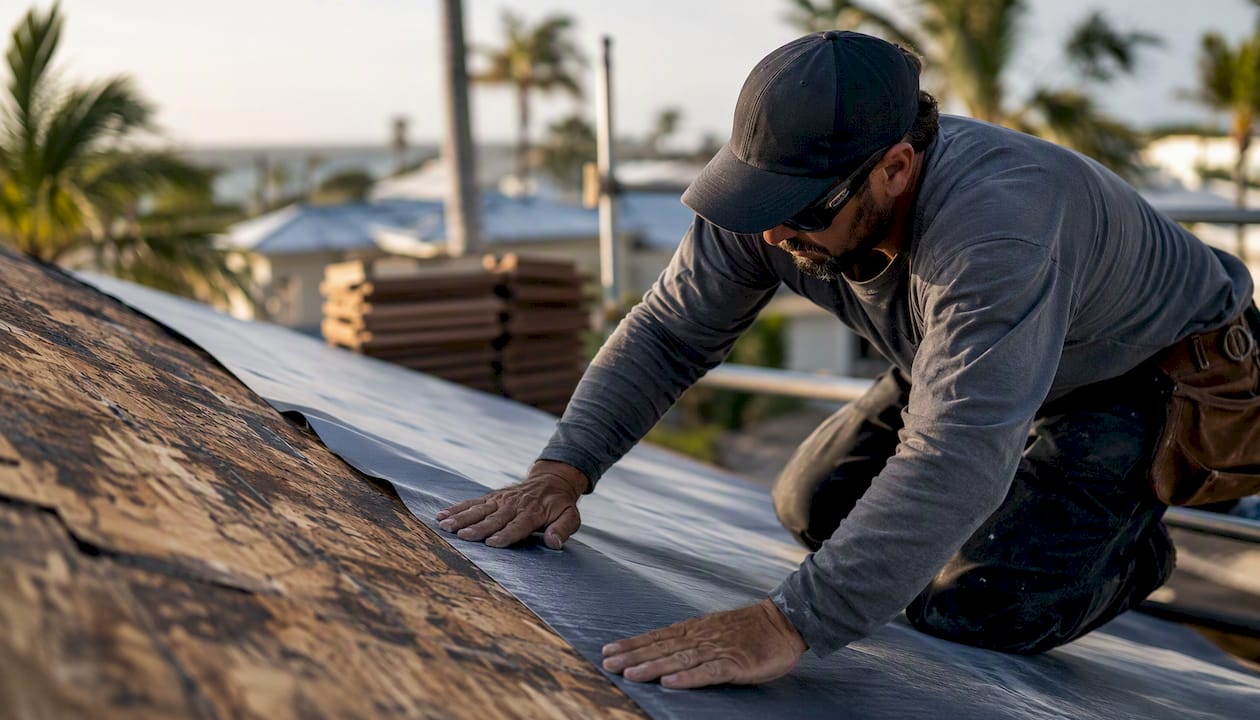
Yes, Florida requires a secondary water barrier (SWR) for most residential re-roofs. Under 2023 Florida Building Code section R908.7.2, whenever a roof covering is removed and replaced on a structure with a wood roof deck, a secondary water barrier must be installed in accordance with R905.1.1 or Section 1518.x. There is no grandfathering. If your contractor strips the deck, the current code applies.
A few exceptions exist, and they matter:
- Roof slopes under 2:12 where a continuous roof system is installed
- Clay or concrete tile assemblies installed per code that are deemed compliant
- HVHZ (High Velocity Hurricane Zone) projects, which follow stricter sealed-deck rules rather than the base SWR requirement
📋 Three things to do right now if you’re planning a re-roof:
- Ask your contractor which SWR method they plan to use and get the product name
- Confirm a building permit is pulled before work begins
- Request product data sheets showing ASTM compliance before installation starts
Key Takeaways
Florida’s 2023 Building Code requires a secondary water barrier on most residential re-roofs that expose the wood deck, with no grandfathering and stricter sealed-deck rules in HVHZ and Wind-Borne Debris Regions.
| Point | Details |
|---|---|
| SWR is required on most re-roofs | R908.7.2 triggers the requirement whenever a roof covering is removed and replaced on a wood-deck home. |
| No grandfathering applies | Exposing the deck sheathing on any re-roof activates current sealed-deck requirements, regardless of home age. |
| HVHZ demands NOA-approved products | Miami-Dade and Broward require stricter materials and installation methods beyond the base FBC text. |
| Documentation protects your insurance discount | Product data sheets, installation photos, and permit sign-off are required for wind mitigation credit and insurer acceptance. |
| Hytzroofing installs and documents SWR in Tampa Bay | As a GAF Master Elite® Contractor, Hytzroofing handles permits, sealed-deck installation, and insurance documentation packages. |
Table of Contents
- What is a secondary water barrier and why does it matter for Florida roofs?
- Does the Florida Building Code require a secondary water barrier on your roof?
- What installation methods does Florida code actually accept?
- When do the exceptions apply? Tiles, low slopes, and HVHZ details
- How does a sealed roof deck affect your wind mitigation inspection and insurance?
- 📋 Permit, inspection, and documentation checklist for SWR work
- How to choose a contractor who actually knows secondary water barrier requirements
- How Hytzroofing installs secondary water barriers in Tampa Bay
- Why Tampa Bay homeowners should take sealed decks seriously
- Hytzroofing can handle your SWR installation and inspection in Tampa Bay
- Sources
- FAQ
What is a secondary water barrier and why does it matter for Florida roofs?
A secondary water barrier is a layer of protection installed directly on the wood roof deck, underneath the primary roof covering. Its job is simple: if your shingles, tiles, or metal panels are torn off in a hurricane, the SWR keeps water out of your home until repairs can be made.
The most effective form is a sealed roof deck, created by bonding a self-adhering polymer-modified bitumen underlayment (commonly called peel-and-stick) directly to the deck surface. This creates a continuous waterproof membrane with no gaps. Post-hurricane performance data shows that sealed decks reduce interior water damage significantly when primary coverings are lost, which is exactly why Florida adopted these requirements after major storm seasons.
Here’s how the three layers differ in practice:
- Primary roof covering: Your shingles, tile, or metal panels. First line of defense, but vulnerable to high winds.
- Standard underlayment: Traditional 15# or 30# felt, or a basic synthetic. Provides some moisture resistance but is not a sealed system.
- Secondary water barrier / sealed deck: A fully adhered peel-and-stick membrane bonded to the deck. No seams, no gaps, no reliance on fasteners alone.
The distinction between a full sealed deck and a limited joint-sealing method is worth understanding. Full-deck peel-and-stick covers every square inch of the deck. Joint-sealing methods use self-adhering bitumen tape over panel seams only. Both can satisfy the code requirement depending on your location and roof type, but they are not interchangeable in all situations.
Does the Florida Building Code require a secondary water barrier on your roof?
The short answer: yes, for most re-roofs on wood-deck homes. R908.7.2 of the 2023 Florida Building Code is the governing section for existing structures. It triggers the SWR requirement the moment a roof covering is removed and replaced, pointing to R905.1.1 and Section 1518.x for the specific installation standards.
🚨 No grandfathering: A re-roof that exposes the deck sheathing triggers current sealed-deck requirements, regardless of when the home was built. This is confirmed in UpCodes’ summary of R908.7.2.
Geographic triggers make a real difference:
- Wind-Borne Debris Region (WBDR): Most of Florida falls here. Sealed-deck provisions apply to specific roof coverings under R905.1.1.
- High Velocity Hurricane Zone (HVHZ): Miami-Dade and Broward counties. Stricter requirements, NOA-approved products required, and sealed-deck expectations go beyond the base FBC text.
- Outside WBDR: Some inland areas. Base SWR requirements still apply per R908.7.2, but product standards may be slightly less restrictive.
Common exceptions to know:
- Roof slopes under 2:12 with a continuous roof system (such as TPO or modified bitumen) installed per code
- Clay and concrete tile systems installed per the applicable FBC tile section, which may satisfy the requirement through the tile assembly itself
- Certain re-cover situations where the deck is not exposed (though full tear-offs almost always trigger the requirement)
A complete re-roof down to the deck leaves no room for debate. The SWR requirement applies.
What installation methods does Florida code actually accept?
UpCodes’ compilation of R908.7.2 outlines two primary code-accepted approaches, and the one your contractor uses depends on your location and roof type.
Accepted SWR installation methods:
- Full-deck self-adhering polymer-modified bitumen underlayment (peel-and-stick): Meets ASTM D1970. Bonded directly to the entire deck surface. This is the sealed-deck approach and the most protective option.
- Joint-sealing with self-adhering bitumen tape: A minimum 4-inch-wide self-adhering bitumen tape applied over all panel joints, covered by an approved underlayment system. Acceptable in specific situations outside HVHZ.
- 30# asphalt felt or approved synthetic underlayment: Permitted in certain configurations where the code allows, though synthetic underlayments are often preferred in Florida’s climate due to better UV and moisture resistance.
Key installation details inspectors look for:
- Minimum 4-inch side laps and 6-inch end laps on peel-and-stick products
- Full adhesion with no bubbles, lifted edges, or unbonded sections
- All penetrations (pipes, vents, skylights) sealed with compatible flashing and sealant
- Deck surface clean, dry, and free of debris before membrane application
In the HVHZ, base FBC text is not enough. Products must carry a Miami-Dade Notice of Acceptance (NOA) or Florida Product Approval, and installation must follow the NOA’s specific requirements. A product that is code-compliant in Tampa may not be acceptable in Miami without that NOA documentation.
Pro Tip: Take photos at every stage: bare deck condition, membrane unrolled, laps sealed, and penetrations detailed. These photos are your proof of compliance for the permit inspection and your insurer.
When do the exceptions apply? Tiles, low slopes, and HVHZ details
Not every Florida roof triggers the full peel-and-stick requirement. Here’s where the exceptions actually apply and where homeowners sometimes get tripped up.
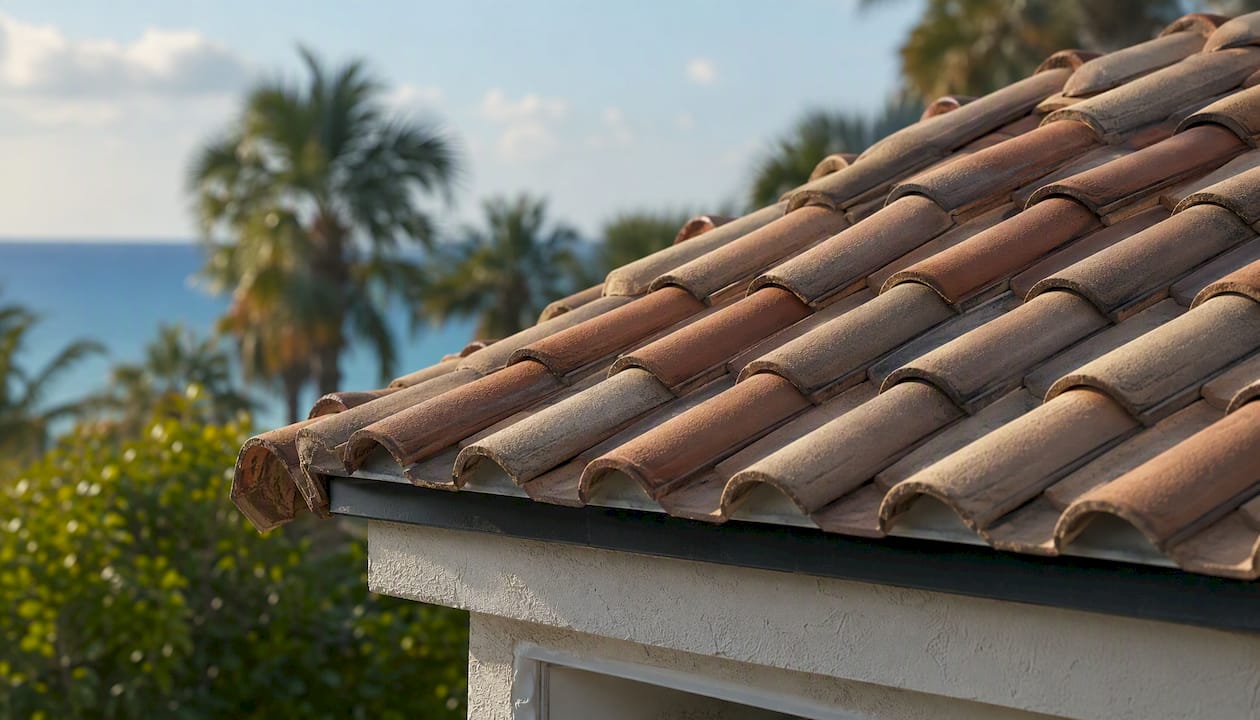
Clay and concrete tile systems: Properly installed tile assemblies can satisfy the SWR requirement through the tile system itself, provided the installation follows the applicable FBC tile section. The key word is “properly installed.” If the tile system doesn’t meet code on its own, the standard SWR requirement kicks back in. For tile-specific guidance, Hytzroofing’s tile roof repair services cover both repair and full replacement with code-compliant underlayment systems.
Roof slopes under 2:12: Low-slope roofs with a continuous roof system, such as TPO, modified bitumen, or similar membrane systems, may satisfy the requirement without a separate peel-and-stick layer. The continuous system itself acts as the waterproof barrier. This is why TPO flat roofing is a common solution for low-slope commercial and residential applications in Florida.
HVHZ (Miami-Dade and Broward): These counties go beyond the base FBC. Sealed-deck requirements in the HVHZ demand NOA-approved products and stricter installation standards. Local inspectors in Miami-Dade and Broward will verify NOA numbers on product packaging and may reject materials that lack proper approval documentation.
The most common misapplication: Contractors applying joint-tape only when the code or local jurisdiction requires full-deck coverage. Partial coverage where full coverage is required fails inspection and leaves your home exposed. Confirm with your contractor and local building department which method is required for your specific address and roof type.
How does a sealed roof deck affect your wind mitigation inspection and insurance?
A properly documented sealed roof deck can factor into your wind mitigation inspection and may influence your homeowner’s insurance premium. Florida’s wind mitigation form asks about roof deck attachment and roof covering, and a sealed deck is a recognized mitigation feature that insurers evaluate.
Sealed decks reduce interior water damage when primary coverings are stripped in high-wind events, which is the core reason insurers and wind mitigation inspectors take them seriously. The My Safe Florida Home program also references wind mitigation improvements as a path to potential insurance credits.
What your insurer typically wants to see:
- Product data sheets showing ASTM D1970 compliance or equivalent
- Manufacturer certifications and NOA (if in HVHZ)
- Building permit with the SWR line item included
- Final inspection sign-off from the building department
- Installation photos showing full adhesion and sealed penetrations
Action steps before and after installation:
- Call your insurance agent before the re-roof begins and ask what documentation they need for a wind mitigation credit.
- Confirm your contractor will pull a permit that specifically lists the secondary water barrier.
- Request a copy of the product data sheet before installation starts.
- Schedule a wind mitigation inspection after the final permit sign-off.
- Submit the completed wind mitigation form to your insurer with all supporting photos and documentation.
Some homeowners skip the wind mitigation inspection after a re-roof and miss a discount they already paid for. Don’t leave that on the table.
📋 Permit, inspection, and documentation checklist for SWR work
Getting the SWR installed correctly is step one. Documenting it properly is what protects you with your insurer and the building department.
Permit and inspection items:
- Building permit pulled before work begins, with secondary water barrier listed as a line item
- Inspector access during installation (not just at final)
- Final certificate of compliance or inspection sign-off from the local building department
Documentation to collect from your contractor:
- Product data sheets for the SWR membrane (confirm ASTM D1970 or the applicable approval)
- NOA documentation if the project is in HVHZ
- Installation photos: bare deck, membrane applied, laps sealed, penetrations detailed
- Copy of contractor’s Florida license number
- Manufacturer warranty documentation
Common documentation mistakes that cost homeowners:
- No permit pulled (contractor skips it to save time; you lose insurance credit and face code violations)
- Generic product name on paperwork with no ASTM number or approval reference
- Photos taken only at the end, not during installation (can’t prove laps were sealed)
- Missing penetration sealing photos (inspectors and insurers specifically look for this)
Pro Tip: Ask your contractor to send you a digital folder of all installation photos and product data sheets before they leave the job site. Once the crew is gone and the shingles are on, that documentation is gone too.
How to choose a contractor who actually knows secondary water barrier requirements
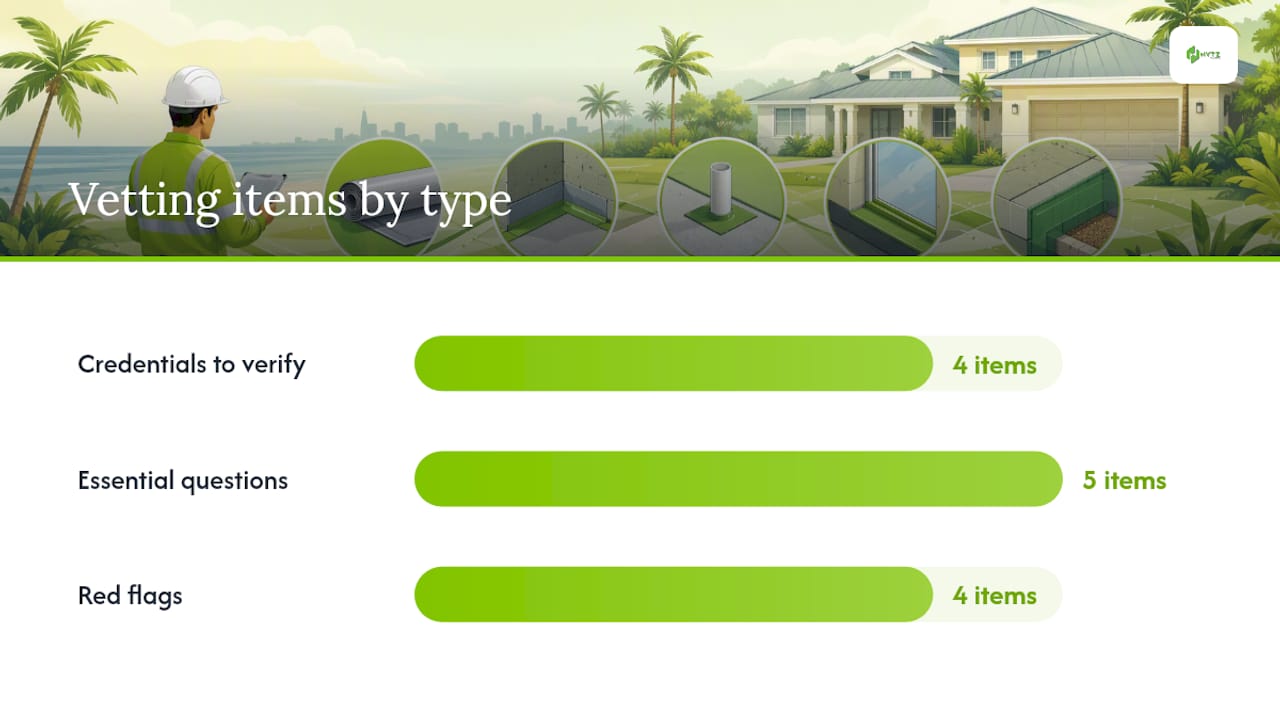
Most homeowners don’t know enough to quiz a contractor on SWR specifics, which is exactly how substandard work gets installed. These questions will tell you quickly whether a contractor knows what they’re doing.
Credentials to verify first:
- Active Florida contractor license (check the Florida DBPR license lookup)
- GAF Master Elite® or equivalent manufacturer certification
- General liability insurance and workers’ compensation coverage
- BBB Accreditation
Essential questions to ask before signing:
- Will you install a full sealed deck (peel-and-stick over the entire deck) or only taped joints?
- What specific product will you use, and what is its ASTM number or Florida Product Approval?
- Who pulls the permit, and will the SWR be listed as a line item?
- Can you provide product data sheets and installation photos before and after?
- Have you installed SWR systems in HVHZ, and do you know the NOA requirements for my county?
Red flags that should stop you cold:
- Contractor says a permit isn’t necessary or offers to skip it
- Vague product names (“we use good peel-and-stick”) with no ASTM reference
- No clear answer on who handles the inspection
- Refuses to provide documentation or photos after the job
For a deeper look at vetting local contractors, Hytzroofing’s guide to choosing the best roofing contractor in Tampa Bay covers credentials, questions, and red flags in detail. You can also review Central Florida roofing code requirements to understand the wind-speed map regions that shape what your contractor must install.
How Hytzroofing installs secondary water barriers in Tampa Bay
That credential matters here because GAF Master Elite status requires ongoing training in current installation standards, including sealed-deck requirements.
Here’s how a typical SWR installation runs on a Tampa Bay re-roof:
- Deck inspection first: Before any membrane goes down, the crew inspects the deck for soft spots, rot, and fastener pull-through. Damaged decking is replaced before the SWR is applied.
- Surface prep: The deck is swept clean and allowed to dry. In Tampa Bay’s humidity, this step gets extra attention because moisture trapped under peel-and-stick causes adhesion failure.
- Full-deck membrane application: Hytzroofing uses manufacturer-approved, ASTM D1970-compliant self-adhering polymer-modified bitumen underlayment. Rolls are applied with minimum 4-inch side laps and 6-inch end laps, with all laps rolled and pressed for full adhesion.
- Penetration detailing: Every pipe, vent, and skylight gets flashed and sealed with compatible materials before the primary covering goes on.
- Photo documentation: The crew photographs the bare deck, membrane application, lap sealing, and all penetrations. These go directly into the project file for the permit inspection and insurance documentation.
Local Tampa Bay considerations:
- Salt air near the coast can affect adhesion on certain membrane products; Hytzroofing specifies products rated for coastal exposure.
- Florida’s UV intensity degrades exposed peel-and-stick quickly. Shingle or tile installation follows the membrane within the manufacturer’s recommended window, typically within 30–60 days depending on the product.
Pro Tip: In Tampa Bay, schedule your re-roof to avoid the peak of hurricane season if possible. A sealed deck installed in spring gives you a fully documented, inspected system before the June–November window opens.
Why Tampa Bay homeowners should take sealed decks seriously
Here’s my honest take: the secondary water barrier requirement is one of the most underappreciated protections in the Florida Building Code. Most homeowners focus on shingles, tile color, or price per square foot. The SWR is invisible once the roof is done, so it gets overlooked. But it’s the layer that actually keeps your ceiling dry when a hurricane strips your primary covering.
Tampa Bay sits in a Wind-Borne Debris Region, and the Florida DEP’s water management districts underscore how seriously the state takes flood and storm-water management at every level. A sealed deck is your home’s equivalent of that infrastructure, working at the building level. Storm-ready roofing features, including sealed decks, are what separate homes that stay dry from homes that don’t after a major storm, as detailed in this storm-ready roofing guide.
My advice: when you’re planning a re-roof, don’t let a contractor talk you into skipping the permit or cutting corners on documentation. The sealed deck is a code requirement, yes, but it’s also a real financial protection. A properly documented SWR can influence your wind mitigation inspection, your insurance premium, and your ability to make a claim after a storm. Verify the permit, collect the photos, and use a licensed contractor who can answer every question on the list above without hesitation.
Hytzroofing can handle your SWR installation and inspection in Tampa Bay
If you’re planning a re-roof or need a certified inspection to confirm your current roof’s compliance, Hytzroofing covers every step. We handle permit pulling, full sealed-deck installation with ASTM D1970-compliant materials, photo documentation packages for insurers, and wind mitigation inspections that support My Safe Florida Home guidance.
For storm damage that exposed your deck, our storm damage roof repair team responds quickly and documents everything for your insurance claim. If you’re ready for a full re-roof with a properly installed secondary water barrier, get a free estimate on roof replacement and we’ll walk you through the code requirements, product options, and documentation checklist before a single nail goes in. 📋 Call us or request your estimate online today.
Sources
These are the authoritative sources to consult for permit applications, contractor conversations, and technical questions:
- 2023 Florida Building Code, Residential, Eighth Edition - R908.7.2 Roof secondary water barrier for existing structures with wood roof decks.
- Roof Secondary Water Barrier for Existing Structures With Wood Roof Decks | UpCodes
- Florida Sealed Roof Deck Guide (FBC R905.2.8.1) | RoofVista
FAQ
Is a secondary water barrier required in Florida?
Yes. Under 2023 FBC R908.7.2, a secondary water barrier is required on most residential re-roofs where the roof covering is removed and replaced on a wood deck. Exceptions apply for certain low-slope continuous systems and properly installed tile assemblies.
What is a secondary water barrier?
A secondary water barrier is a waterproof layer, typically a self-adhering polymer-modified bitumen (peel-and-stick) membrane, bonded directly to the roof deck beneath the primary covering. It protects the home’s interior if the primary roof covering is lost in a hurricane or high-wind event.
What is the 25% roof rule in Florida?
Florida’s roof rule generally refers to the threshold at which a re-roof triggers full code compliance: if a significant portion of a roof covering is replaced within a 12-month period, the entire roof must be brought up to current code, including secondary water barrier requirements. Confirm the specific threshold with your local building department, as enforcement details can vary by jurisdiction.
What is the best underlayment for a roof in Florida?
For most Florida re-roofs, a self-adhering polymer-modified bitumen underlayment (ASTM D1970 peel-and-stick) is the strongest choice because it creates a sealed deck. Where a fully adhered membrane is not required, approved synthetic underlayments are often preferred over 30# felt due to better UV resistance and moisture performance in Florida’s heat and humidity.
Recommended
- Roof Shingle Replacement Step by Step for Florida Homeowners | Hytz Roofing
- Choose the Best Roofing Contractor in Tampa Bay, Florida: Your Guide | Hytz Roofing
- Best SharpeRoof.com Alternatives for Florida Homeowners | Hytz Roofing
- Roof Repair in Tampa Bay: Your Guide to Florida’s Elements | Hytz Roofing