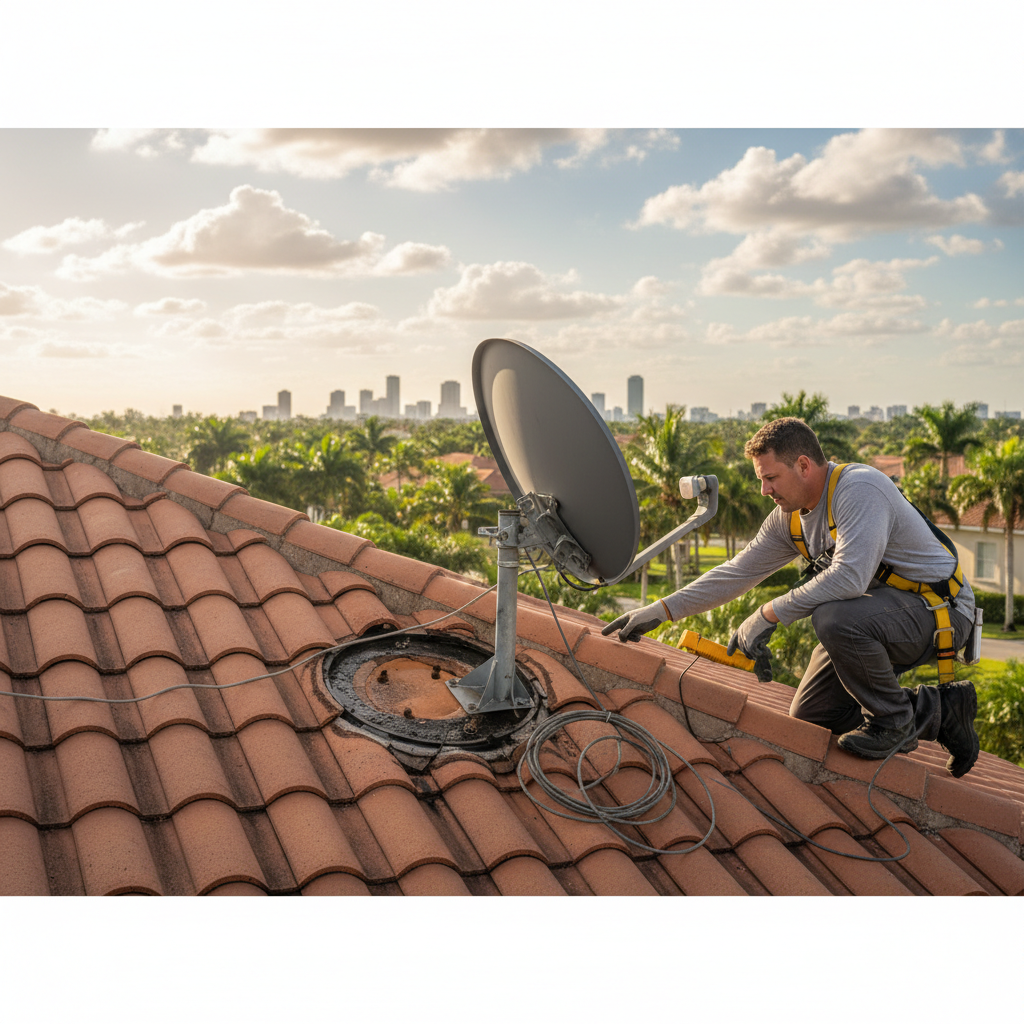
Yes. A satellite dish bolted through your shingles can cause a roof leak, and it is one of the more common sources of small, hard-to-find leaks on Tampa Bay homes. Responsibility usually falls on whoever made the holes: the installer (and the TV or internet provider that sent them) for a bad mount, a roofer who removed or reset the dish and left the holes open, or the homeowner for a do-it-yourself job. Your homeowners insurance may help with the water damage inside the house, but it rarely pays to fix the faulty mount itself, and your shingle manufacturer's warranty won't cover damage the dish caused.
Key Takeaways
- Standard roof mounts drive several lag bolts through the shingles into the rafters and rely on sealant over the holes, not metal flashing. When that sealant ages, water follows the bolts into the deck.
- The party that drilled the holes or disturbed the mount is the first place to look for responsibility. The provider is often the right place to file, because many installs are done by subcontracted crews.
- Florida's clocks are short: two years for a negligence claim, five years for a claim on a written contract, and one year to give your property insurer notice of a claim (Florida Statutes 95.11 and 627.70132).
- GAF shingle warranties exclude damage caused by rooftop satellite dishes, so a dish leak is a workmanship problem, not a manufacturer defect.
- The cheapest fix is prevention: a wall, fascia, or pole mount keeps the dish off the shingles entirely.
How does a satellite dish installation cause a roof leak?
A satellite dish installation causes a roof leak by putting new holes in the one layer of the house designed to have as few holes as possible. Satellite installer standards show how this works. Viasat's published Quality Installation Standards for a shingle roof mount call for securing the footplate with two 3-inch lags through the center holes into a rafter and four 2-inch lags through the corner holes, then securing support poles to adjacent rafters with more lags. The holes are then sealed "with tar-based sealant." That is six or more penetrations for the base alone, and the only waterproofing is a bead of sealant.
A properly flashed roof penetration, like a plumbing vent boot, uses metal or rubber flashing tucked under the shingle course above it, so water is shed over the hole instead of relying on a seal. Sealant on its own is a maintenance item. Florida sun, heat, and the daily expansion and contraction of the mount wear it down, and once it cracks, water runs down the lag bolt and into the roof deck.
Other common ways a dish leads to a leak:
- A missed rafter. A lag that misses the rafter holds nothing and leaves an open hole through the decking.
- Wind load on the mount. A dish acts like a small sail in a thunderstorm or tropical storm. Repeated flexing loosens lags and breaks the seal.
- Foot traffic. Technicians walking to the dish for repairs or re-aiming can crack shingles or tiles, especially on concrete tile roofs.
- Abandoned mounts. When a homeowner switches providers, the old dish often stays, or gets pulled off with the bolt holes left behind.
- The cable entry. Coaxial cable that enters through a wall or soffit without a drip loop and a sealed entry can let water into the wall, which can look like a roof leak from inside.
Who is responsible for roof damage from a satellite dish installation?
Responsibility for satellite dish roof damage depends on who did the work that failed, when it failed, and what paperwork you have. The table below shows the usual parties. It is a general guide, not legal advice; for a disputed claim of any size, talk to a Florida attorney.
| Who | When they are usually responsible | What to check |
|---|---|---|
| Satellite installer and the TV or internet provider | The leak traces to the mount, lag bolts, or sealant from their installation, or a technician cracked shingles or tiles during a service visit | Your work order or install date, your service agreement, and photos of the mount |
| Roofing contractor | The roofer removed the dish during a reroof and left holes, or reinstalled the dish onto the new roof | Your roofing contract, scope of work, and workmanship warranty |
| Homeowner | Do-it-yourself installation, or a dish that was left in place for years with no sealant upkeep | Maintenance history; a roofer can still repair it, but there is no one else to bill |
| Homeowners insurance company | Possibly the sudden interior water damage that results from the leak; rarely the faulty mount itself | The policy's faulty workmanship and seepage exclusions |
| Shingle manufacturer | Generally not responsible for damage caused by a dish | The exclusions section of your shingle warranty |
| HOA, condo association, or landlord | Depends on who owns and maintains the roof under your governing documents or lease | Declaration of covenants, maintenance responsibilities, or lease terms |
How long do Florida homeowners have to make a claim for satellite dish roof damage?
Florida homeowners have limited time to pursue satellite dish roof damage, and the clock depends on the type of claim. Under Florida Statutes section 95.11, an action founded on negligence must be brought within two years, and an action on a contract founded on a written instrument within five years. If you plan to use your property insurance for the resulting water damage, section 627.70132 bars a claim unless the insurer gets notice within one year after the date of loss.
When the clock starts running can be a legal question in its own right, especially for a slow leak that went unnoticed. The practical point is simpler: report the damage as soon as you find it, to the provider and, if you plan to file, to your insurer.
Will homeowners insurance pay for a roof leak caused by a satellite dish?
Homeowners insurance may pay for part of the damage from a satellite dish roof leak, but usually not for the mount repair itself. Most property policies contain a faulty workmanship exclusion. As the International Risk Management Institute (IRMI) explains, many of these exclusions come with an "ensuing loss" exception: the insurer won't pay to redo the faulty work, but it may owe for a separate covered loss that results from it. Insurers and courts don't always agree on how far that exception reaches for water damage. IRMI's commentary describes cases going both ways when faulty work led to a leaky roof and mold.
Many policies also exclude water that seeps in slowly over a long period, which matters for dish leaks because they often drip for months before a ceiling stain shows up. Read your policy's workmanship and seepage language, and expect the insurer to ask how long the leak has been active.
Does a satellite dish leak affect my shingle warranty?
A satellite dish leak won't be covered by your shingle warranty. GAF (the shingle manufacturer behind the Golden Pledge warranty) excludes damage "to or caused by" rooftop satellite dishes and other radio or TV devices in its Golden Pledge Limited Warranty. Mounting a dish doesn't cancel coverage for the rest of the roof, but the shingles and decking damaged by the mount are excluded. Our guide to everyday actions that can sink a shingle warranty claim covers this and similar exclusions in more detail.
What should I do if a satellite dish is leaking into my house?
If a satellite dish is leaking into your house, document first and repair second, so you don't lose the evidence that shows who is responsible.
- Stop the interior damage. Put a bucket under the drip, move belongings, and dry the area.
- Photograph everything. Take pictures of the ceiling stain, the attic decking under the mount if you can safely reach it, and the dish from the ground with a zoom lens.
- Find your paperwork. Locate the install date, work order, and account information from the provider.
- Get a roofer's inspection in writing. A licensed roofer can confirm whether the leak traces to the mount and note the cause in a report. That report is what the provider or insurer will want to see.
- File with the provider. Submit a damage claim with your photos and the roofer's report. Keep a written record of every call and claim number.
- Decide whether to involve your insurer. If there is interior damage, give notice within the one-year window, even while the provider claim is pending.
Hytz Roofing, a GAF Master Elite contractor (Florida license #CCC1332551), handles leak tracing and repair across Tampa Bay. See our Tampa roof leak and shingle repair services to schedule an inspection.
Can my HOA or landlord stop me from installing a satellite dish to protect the roof?
An HOA or landlord generally cannot ban a satellite dish on property you own or exclusively control, but the federal rule leaves room for reasonable limits. The Federal Communications Commission's Over-the-Air Reception Devices (OTARD) rule, 47 CFR 1.4000, prohibits restrictions, including HOA rules and lease provisions, that impair installation of a satellite dish one meter or less in diameter on property within the user's exclusive use or control. A restriction "impairs" installation if it unreasonably delays it, unreasonably increases its cost, or blocks an acceptable-quality signal.
The rule allows restrictions needed for a clearly defined safety objective or for historic preservation, as long as they are no more burdensome than necessary. It also applies only to areas under your exclusive use or control, so a shared condominium roof is generally not covered. In practice, an association can often require a preferred location, such as a rear wall or pole, as long as you still get a usable signal at a reasonable cost. That preference often protects the roof as well.
How can I install a satellite dish without risking a roof leak?
The way to install a satellite dish without risking a roof leak is to keep it off the shingles. Installer standards already list alternatives: Viasat's standards include wall, under-eave, side, and pole mounts, and its shingle roof mount guidance says to stay close to the roof's edge and ideally not over living space. Ask the installer for a non-roof mount before the technician climbs the ladder.
If the dish has to go on the roof, ask a roofer to flash the mount, or check the seal yourself once a year from a ladder or with binoculars. On a tile roof, Viasat's standard requires keeping the mount at least three feet from any flashing and avoiding broken or cut tiles, which shows how much care the job takes on tile.
Frequently Asked Questions
Should I remove an old satellite dish I no longer use?
Yes, but have the holes repaired properly when the dish comes off. Pulling the lags and squirting caulk into the holes leaves the same weak point the mount had. A roofer can replace the damaged shingles and seal or replace any decking that got wet, which is cheaper to do now than after a leak shows up on the ceiling.
Does a leak around a satellite dish mount mean I need a new roof?
Usually not. A leak at a dish mount is normally a localized repair: remove or reset the mount, replace the shingles around it, and repair any wet decking. A full replacement only comes into the conversation if the inspection finds widespread rot or the roof is near the end of its life for other reasons.
What happens to my satellite dish during a roof replacement?
The dish has to come off for the roofing crew to install the new roof, and that step is where damage disputes often start. A Roofing Contractor magazine column written from the satellite-service side noted how often dish service calls follow a new roof install. Before work begins, agree in writing whether the roofer will reinstall the dish, cap the old holes, or leave reinstallation to your provider, and whether you'd like to move the dish to a wall or pole mount instead.
Sources
- Viasat, Quality Installation Standards (QIS): https://eguide.field.viasat.com/quality-installation-standards/
- 47 CFR 1.4000, Restrictions impairing reception of television broadcast signals, direct broadcast satellite services or multichannel multipoint distribution services (Cornell Legal Information Institute): https://www.law.cornell.edu/cfr/text/47/1.4000
- Florida Statutes section 95.11, Limitations other than for the recovery of real property: https://m.flsenate.gov/statutes/95.11
- Florida Statutes section 627.70132, Notice of property insurance claim: https://m.flsenate.gov/statutes/627.70132
- IRMI, "Ensuing Loss: Getting Around a Property Policy's Defective Construction Exclusion": https://www.irmi.com/articles/expert-commentary/ensuing-loss-getting-around-a-property-policys-defective-construction-exclusion
- Roofing Contractor, "The Do's and Don'ts of Satellite Dish Removal for Roofers": https://www.roofingcontractor.com/articles/92240-the-dos-and-donts-of-satellite-dish-removal-for-roofers
- Hytz Roofing, "What Everyday Actions Accidentally Void a Shingle Warranty?" (summarizes GAF Golden Pledge Limited Warranty RESWT161L exclusions): https://hytzroofing.com/blog/everyday-actions-that-void-shingle-warranty