Roofing Repair vs Restoration: What Florida Owners Must Know
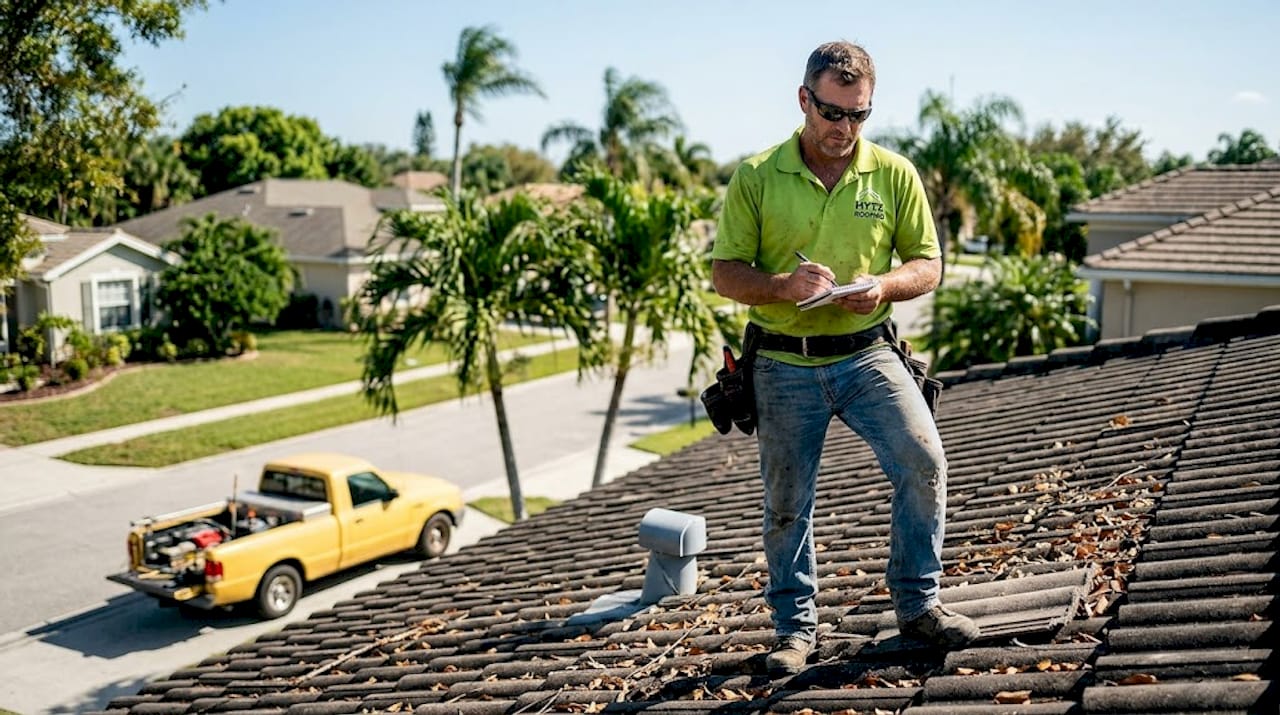
Roofing Repair vs Restoration explains the differences, typical goals, and when each approach is appropriate for Florida homes.
If you’re staring at a damaged roof and wondering whether you need a repair or a full restoration, you’re not alone. The difference roofing repair and restoration represent is one of the most misunderstood topics in property management. Get it wrong, and you either overspend on a fix you didn’t need or put a bandage on a wound that needs surgery. For Florida homeowners and property managers dealing with brutal heat, humidity, and storm seasons, picking the right approach can mean the difference between a roof that lasts and one that fails in the next big storm.
Table of Contents
- Key takeaways
- The difference between roofing repair and restoration explained
- What the roof restoration process actually involves
- Repair vs restoration: a clear side-by-side comparison
- How to decide: repair or restoration for your Florida property
- Warning signs that your roof needs attention now
- My take: why Florida property owners get this choice wrong
- Ready to get the right answer for your roof?
- FAQ
Key takeaways
| Point | Details |
|---|---|
| Repair is targeted and reactive | Roof repair fixes specific, localized damage like leaks or broken shingles without touching the rest of the roof. |
| Restoration is a system-wide treatment | The roof restoration process covers cleaning, patching, sealing, and coating the entire roof surface to extend its lifespan. |
| Cost gap is significant | Restoration costs $400 to $700 per square versus $1,000-plus per square for full replacement, making it a budget-smart middle option. |
| Florida’s climate drives faster deterioration | Humidity, heat, and storms accelerate roof wear, meaning the repair vs restoration decision needs climate-specific thinking. |
| Moisture levels are the deciding factor | Roofs with over 20% to 25% insulation saturation are generally not candidates for restoration and need full replacement. |
The difference between roofing repair and restoration explained
Before you call a contractor, you need to know exactly what you’re asking for. Roof repair and restoration are not interchangeable. Repair is reactive and targeted. Restoration is proactive and covers the whole system.
Roof repair addresses specific, localized problems. We’re talking about a missing shingle after a storm, a cracked flashing joint letting water in around a chimney, or a small section of underlayment that got compromised. A repair crew comes in, identifies the problem area, fixes it, and leaves. The rest of your roof is untouched.
Roof restoration is a different scope entirely. It treats the entire roof surface rather than just the trouble spots. Think of it as a full reconditioning: cleaning, patching multiple wear areas, applying primer, sealing seams, and coating the surface with a protective layer. It doesn’t remove and replace your existing roofing material. It builds on top of what’s already there and strengthens it.
Here’s the practical breakdown of what roofing repair covers:
- Fixing individual leaks at their source
- Replacing broken, cracked, or missing shingles or tiles
- Repairing damaged or lifted flashing around vents, skylights, and edges
- Sealing small punctures or gaps in flat roof membranes
- Addressing localized storm damage from wind or hail
Repairs are typically quicker and less expensive upfront. Minor repairs run $150 to $450, while major repairs can push $2,000 to $6,500 or more as of 2026 depending on the extent of damage and material costs in Florida. But here’s what many property owners miss: repeated repairs on an aging roof add up fast, and they never address the underlying deterioration happening across the full surface.
What the roof restoration process actually involves
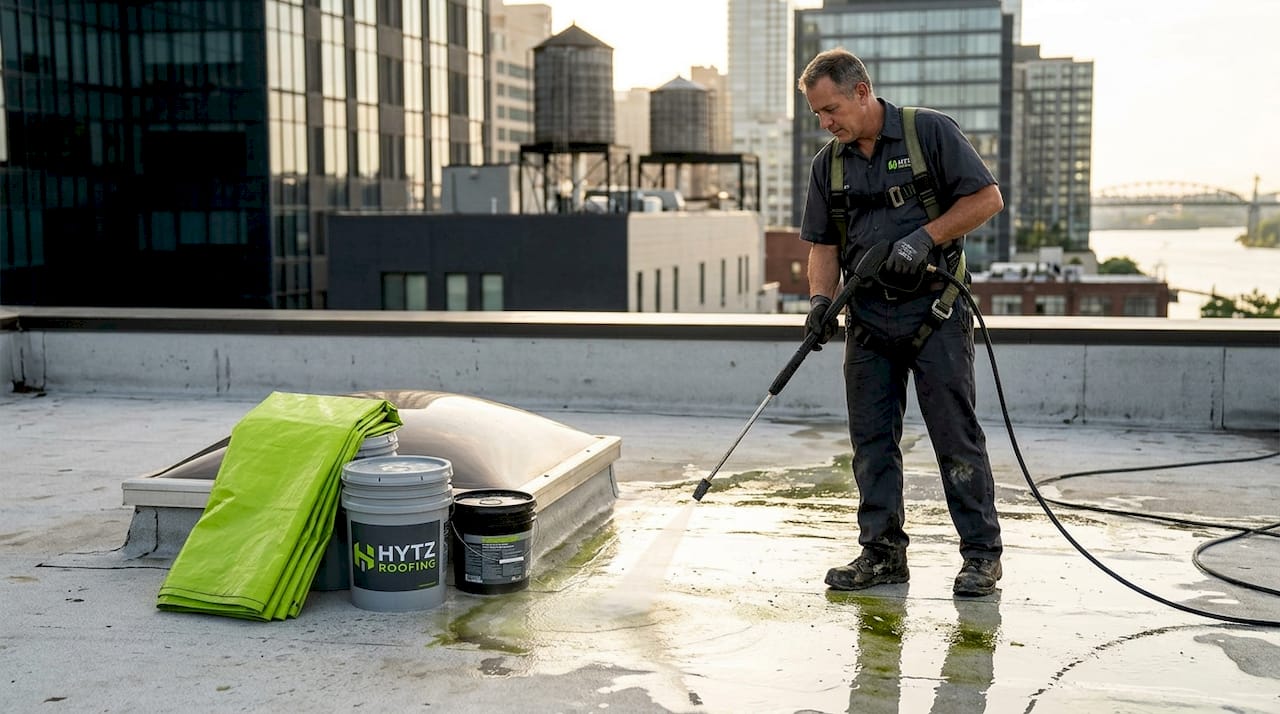
Restoration is not just slapping paint on old shingles. It’s a structured, multi-step process that requires professional assessment and the right materials to work properly.
The roof restoration process typically follows these steps:
- Thorough cleaning to remove algae, dirt, moss, and biological growth that compromise adhesion
- Structural inspection to identify all areas needing patching or reinforcement before coatings go on
- Substrate patching for cracks, seams, and minor damage across the full roof surface
- Priming to prepare the surface and improve coating adhesion
- Protective coating application using high-performance elastomeric or silicone products designed for weather resistance
Restoration covers cleaning, patching, priming, and coating without removing existing roofing materials. That’s a big deal. No dumpsters in your driveway. No weeks of torn-off roofing. It’s far less disruptive than a full replacement.
The cost difference is equally compelling. Restoration runs $400 to $700 per square, while full replacements start at $1,000 per square. For a mid-size Florida home with a 25-square roof, that’s a potential savings of $7,500 to $15,000.
Restoration also delivers real long-term benefits. A well-executed restoration can add 10 to 15 years to your roof’s lifespan, and durable coatings can carry up to a 15-year material warranty. It also improves curb appeal noticeably, which matters if you’re planning to sell or lease a property.
Pro Tip: Ask your contractor to show you the adhesion test results before any coating is applied. Skipping this step is how restoration projects fail early. Proper adhesion testing and core sampling validate whether the substrate can actually support the new coating system.
The ideal candidate for restoration is a roof that has widespread but not catastrophic deterioration. Age between 10 and 20 years, showing signs of wear across the surface but still structurally sound underneath. In Florida specifically, roofs dealing with algae staining, UV degradation, and minor storm wear often fall right in this category.
Repair vs restoration: a clear side-by-side comparison
Here’s where the rubber meets the road. Understanding the difference between repair and restoration on paper is one thing. Knowing which one your roof actually needs is another.
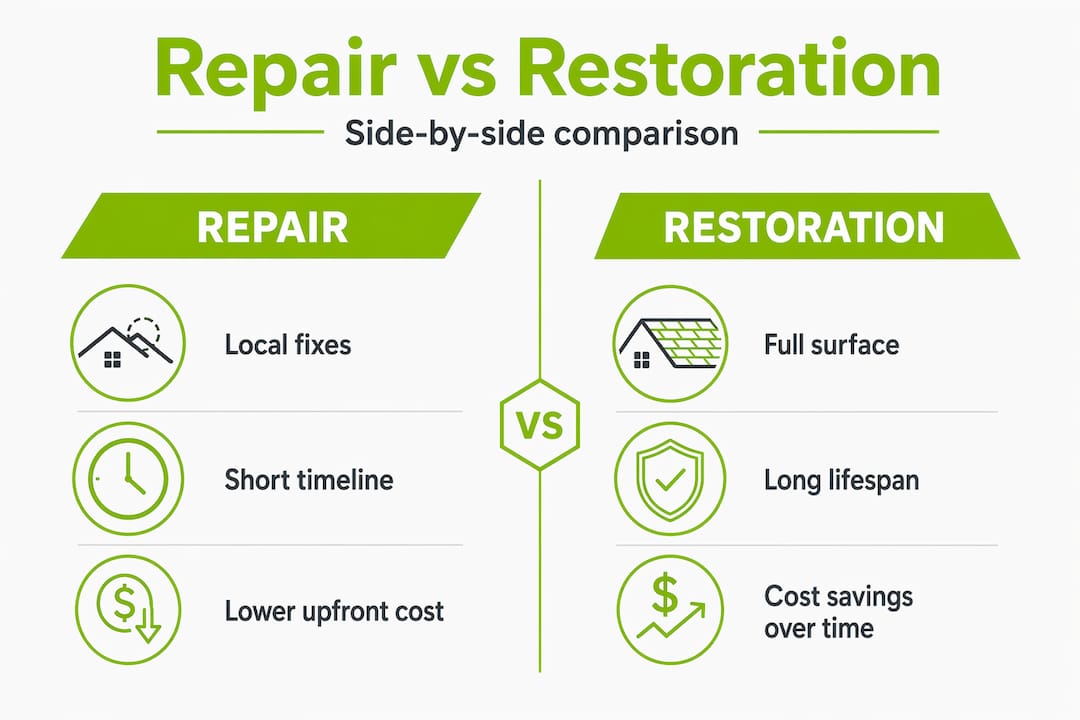
| Factor | Roof repair | Roof restoration |
|---|---|---|
| Scope | Localized, problem-specific | Full roof surface treatment |
| Cost range | $150 to $6,500+ per project | $400 to $700 per square |
| Lifespan impact | Minimal (fixes the issue only) | Adds 10 to 15 years |
| Disruption | Low | Moderate but no tear-off |
| Best for | New or minor isolated damage | Aging roofs with widespread wear |
| Florida weather suitability | Reactive to storm events | Proactive against humidity and UV |
Repairs make sense when your roof is relatively new, when damage is clearly isolated, or when you’re dealing with the aftermath of a specific storm event. If a tree branch punched through two shingles, you don’t need a restoration. You need professional repair work on those two shingles.
Restoration makes sense when:
- Your roof is 10 to 20 years old and showing widespread surface deterioration
- You’ve made two or more repairs in the past few years and problems keep returning
- Your roof has widespread algae, UV bleaching, or coating breakdown across the surface
- You want to extend roof life without the expense and disruption of full replacement
One critical limitation that stops many restoration projects before they start: moisture in the substrate. Roofs with over 20% to 25% insulation saturation are not candidates for restoration. Trapped moisture kills coating adhesion and creates long-term structural risk. If that’s the situation, full replacement is the only responsible path forward.
How to decide: repair or restoration for your Florida property
Florida’s climate is not kind to roofs. Humidity, storms, and intense heat accelerate wear in ways that homeowners in drier climates simply don’t face. That context matters when you’re making this decision.
Start with a professional inspection. A qualified roofer will do more than look at your roof from the driveway. They’ll check for:
- Active leaks and their source locations
- Moisture saturation levels using infrared scanning or core sampling
- The condition of seams, flashing, and penetration points
- Surface adhesion quality on existing coatings or membranes
- Overall structural integrity of the deck below
Pro Tip: Schedule your inspection before hurricane season, not after. Florida storm damage can compound existing wear quickly, and knowing your roof’s condition before the season hits gives you time to choose the right solution without being rushed.
From a cost-benefit standpoint, think about your timeline. If you plan to own the property for five or more years, restoration often pays off compared to repeated repairs on a deteriorating surface. If the roof is under 10 years old with a single problem, repair wins every time.
Restoration also pays dividends on property value. A restored roof with a transferable material warranty is a real selling point. It signals to buyers or tenants that the property is well-maintained and protected.
One more factor specific to Florida property managers: restoration handles widespread weather-related deterioration better than spot repairs do. If your commercial property took multiple small hits from a recent storm season, restoration may be the smarter play to address the cumulative damage across the full roof.
Warning signs that your roof needs attention now
Don’t wait until you have a bucket in the hallway to take action. These are the signs that tell you something needs to happen soon, whether that’s a repair or a restoration.
Knowing the signs you need roof restoration versus a quick repair saves you from making an expensive mistake. Here’s a practical way to read what your roof is telling you:
- Multiple leaks appearing in different areas point to widespread system failure. One leak is a repair. Three leaks in three locations is a restoration conversation.
- Curling, cracking, or missing shingles across significant portions of the roof signal surface-level deterioration that repair can’t fully address.
- Blistering or peeling on existing coatings on flat or low-slope roofs means the protective layer has failed and the membrane underneath is exposed.
- Visible algae or moss growth across large sections of the roof is not just cosmetic. It traps moisture and accelerates breakdown of the roofing material beneath.
- Granule loss in gutters after every rainstorm means your shingles are at the end of their protective life.
Delayed repairs worsen the roofing system and increase your costs significantly over time. A $400 repair today can prevent a $4,000 structural problem six months from now.
Pro Tip: Walk your property after every significant storm and look for displaced flashing, lifted shingle edges, and debris accumulation in gutters. Catching Tampa roof leak issues early means simpler, cheaper fixes.
Routine maintenance is your best insurance policy. Clear gutters twice a year, trim overhanging branches, and schedule a professional inspection annually. Preventive repairs and maintenance cycles significantly extend the time before you need a major restoration or replacement. That’s real money staying in your pocket.
My take: why Florida property owners get this choice wrong
I’ve seen this play out more times than I can count. A homeowner calls for what they think is a simple repair. We get up on the roof, and what’s really there is a surface that’s been patched four or five times over a decade, with a substrate that’s quietly absorbing moisture with every rainstorm.
The mistake most people make is thinking repair is always the conservative, responsible choice. Sometimes it is. But sometimes you’re spending $800 here and $1,200 there, and two years later you’re looking at a full replacement anyway, having spent money on repairs that bought you nothing but time.
What I’ve learned is that the structural health of the roof underneath the visible surface is everything. You can’t make a smart repair vs restoration decision without knowing what the deck looks like and how much moisture is already in the system. In Florida, humidity gets into roofing assemblies in ways that aren’t obvious until you start testing.
My honest advice to property managers: build restoration into your capital planning before a roof becomes a crisis. A proactive restoration on a 14-year-old roof is a fraction of the cost of an emergency replacement after a hurricane. And working with a contractor who has the credentials and equipment to actually assess substrate conditions, not just quote you from the ground, is the difference between a good decision and a costly guess. Finding the right roofing contractor is step one in making any of this work.
— Anthony
Ready to get the right answer for your roof?
Not sure whether your roof needs a repair or a full restoration? That’s exactly where Hytzroofing comes in. As a GAF Master Elite Contractor in Florida, Hytzroofing brings the expertise, equipment, and credentials to give you a straight, honest assessment of your roof’s condition.
Hytzroofing handles both targeted roof repairs and full restoration projects across Florida, so you’ll get the right recommendation for your specific situation, not just the one that’s easiest to sell. With the GAF President’s Club Award, the 2024 Brava Roof Tile Excellence Award, and an Angi Super Service Award 2025 on the board, the track record speaks for itself. BBB Accredited with an A+ rating and fully licensed under Florida Contractor License #CCC1332551.
Contact Hytzroofing today to schedule your inspection and get a clear picture of what your roof actually needs.
FAQ
What is the main difference between roof repair and restoration?
Roof repair fixes a specific, localized problem like a leak or missing shingles, while restoration treats the entire roof surface through cleaning, patching, and protective coating to extend its overall lifespan.
How do I know if my roof needs restoration instead of repair?
If you’ve had multiple repairs in the past few years, see widespread surface deterioration, or notice algae and coating failure across large sections of the roof, restoration is likely the better fit than another targeted repair.
Can any roof in Florida be restored?
Not every roof qualifies. Roofs with more than 20% to 25% insulation saturation are not candidates for restoration because trapped moisture prevents coatings from adhering properly. A professional moisture test is required before any restoration decision.
Is roof restoration worth the cost compared to repair?
For roofs showing widespread wear, restoration delivers significantly more value. Restoration costs $400 to $700 per square versus $1,000-plus for full replacement, and it can add 10 to 15 years to your roof’s life, making it a strong investment for mid-life roofs.
How does Florida’s climate affect the repair vs restoration decision?
Florida’s heat, humidity, and storm seasons accelerate roof deterioration faster than in most U.S. climates. This makes restoration particularly valuable for Florida properties dealing with cumulative weather-related surface damage rather than isolated storm incidents.
Recommended
- Weathering the Storm Expert Tips for Roof Leak Repair in Tampa Fl
- Introducing Enviroshake to Your Hoa
- GAF Master Elite Roofer in Tampa, FL | Hytz Roofing
- 15 Urgent Roof Issues to Fix Before the Next Florida Storm
Related Hytz Roofing Services