If a roofing contractor in Florida took your deposit and stopped answering, start a paper trail today: gather the contract and every payment record, check whether a permit was ever pulled, then send a written demand by certified mail, return receipt requested, to the address on the contract. Florida Statute 489.126 sets hard deadlines for contractors who take more than 10% up front, and failing to respond to that certified demand within 30 days can support an inference that the contractor had no just cause, which is the step that opens the door to a criminal referral, a licensing complaint, and, for licensed contractors, the state's Homeowners' Construction Recovery Fund.
This guide walks Tampa Bay homeowners through those steps in order. It is general information from Hytz Roofing, not legal advice; for a large deposit, talk to a Florida construction attorney before you terminate the contract, because termination can limit your options under state law.
Key Takeaways
- Florida Statute 489.126 requires a contractor who takes more than 10% of the contract price on a residential job to apply for permits within 30 days of payment and start work within 90 days after the permits are issued, unless there is just cause or you agreed in writing to a longer period.
- The certified-mail demand letter matters most. Under 489.126, if the contractor neither performs nor refunds within 30 days of a written demand, intent and lack of just cause may be inferred. Saying they "meant to pay it back" is not a defense.
- Misusing a deposit is a crime in Florida: a third-degree felony from $1,000 to under $20,000, and a second-degree felony from $20,000 to under $200,000.
- The Florida Homeowners' Construction Recovery Fund can pay up to $30,000 per claim for a roofing (Division II) contract signed on or after July 1, 2024, but only if the contractor was licensed and you first win a judgment, arbitration award, or restitution order.
- If you paid by credit card, a billing dispute must reach the card issuer within 60 days after the first statement showing the charge.
When does Florida law treat a missing roofer as a deposit violation or an abandoned job?
Florida law has two separate clocks, and which one applies depends on whether the roofer ever started work.
No work started. Under Florida Statute 489.126(2), a contractor who receives an initial payment of more than 10% of the contract price for work on residential property must apply for the necessary permits within 30 days and begin work within 90 days after all permits are issued. The deadlines do not apply if the contractor has just cause, if you agreed in writing to a longer period, or if no permit is required.
Work started, then stopped. Under 489.126(3), a contractor who has been paid more than the value of the work completed may not fail or refuse to perform for any 90-day period (or the period set in your contract). Separately, the licensing law, Florida Statute 489.129(1)(j), says a project "may be presumed abandoned after 90 days" if the contractor terminates without just cause or without proper notice to the owner, or fails to perform without just cause for 90 consecutive days. Proper notice means a certified letter explaining why the contractor stopped.
| Your situation | Florida deadline | Statute | What you send |
|---|---|---|---|
| Paid more than 10% up front, no permit applied for | Permit application due within 30 days of payment | 489.126(2)(a) | Certified demand to apply for the permit, start work, or refund |
| Permit issued, crew never showed up | Work must start within 90 days of permit issuance | 489.126(2)(a) | Certified demand to start work or refund |
| Tear-off or partial work done, then silence | No 90-day gap allowed if paid more than work is worth | 489.126(3); 489.129(1)(j) | Certified demand to finish or refund the excess |
| Contractor ignores your demand letter | 30 days after the demand | 489.126(2)(b), (3)(b), (4) | Nothing more. Intent and lack of just cause may now be inferred. |
Before you assume the worst, look for a reason that counts as just cause: a permit stuck in review, a manufacturer backorder, or a change order you never signed. A contractor who is behind but still communicating is a different problem from one who has vanished.
What should a homeowner do first when a roofing contractor stops answering?
Work through these steps in order. Each one builds the record that the later remedies depend on.
- Collect everything. Get the signed contract, the estimate, cancelled checks, card or bank statements, texts, emails, and voicemails. Screenshot the contractor's website and social pages now, before they disappear.
- Verify the license. Search the contractor's name and license number on the Florida Department of Business and Professional Regulation (DBPR) lookup at MyFloridaLicense.com. Whether the contractor was licensed decides which remedies you have (see the table further down).
- Check the permit record. Search your address on the permit portal for your jurisdiction: Hillsborough County for unincorporated areas, or the City of Tampa within city limits. If no permit application exists and you paid more than 10%, the 30-day clock in 489.126 is the one to cite.
- Send the certified demand letter. Mail it certified, return receipt requested, to the address in the contract (or the licensing address if the contract has none). State the contract date, the amount paid, the work promised, the statute, and a clear demand: start the work or refund the deposit within 30 days. Pinellas County Consumer Protection notes that it can provide a notice with the required 489.126 language, so if you live in Pinellas, call them before you write your own.
- Calendar day 30. Keep the green return-receipt card. If day 30 passes with no refund and no crew, move on to the reporting and recovery steps below.
Is it a crime in Florida for a roofer to keep a deposit without doing the work?
Yes, it can be. Florida Statute 489.126(4) and (5) make it a crime to misapply a deposit covered by the statute, and the severity scales with the amount taken:
| Amount received | Offense under 489.126(5) |
|---|---|
| Under $1,000 | First-degree misdemeanor |
| $1,000 to under $20,000 | Third-degree felony |
| $20,000 to under $200,000 | Second-degree felony |
| $200,000 or more | First-degree felony |
The statute says intent can be inferred when the contractor fails to refund within 30 days of your written demand, and that intending to pay the money back later is not a defense. Most roof deposits in Tampa Bay land in the third-degree felony range, which is why local law enforcement will take a report. In Hillsborough County, the Sheriff's Office runs recurring stings on contractor fraud. Its "Operation Bad Builder," announced October 22, 2026, led to 50 arrests of unlicensed contractors, with homeowners reminded never to pay the full balance up front and to verify licenses on MyFloridaLicense.com.
A conviction can come with restitution, and a restitution order is also one of the documents that qualifies you for the state recovery fund.
Where do Tampa Bay homeowners report a roofer who took a deposit?
File with every agency that fits. Each one does something different.
- DBPR Construction Industry Licensing Board (CILB) for licensed contractors. DBPR's own fact sheet warns that a licensing complaint is "not designed to award damages," so it will not get your money back by itself, but discipline and restitution orders can follow.
- Local law enforcement (Hillsborough County Sheriff's Office, Tampa Police, or your city's department) for the criminal side under 489.126. Bring the contract, proof of payment, and your certified demand with its return receipt.
- Hillsborough County Development Services for construction fraud or unlicensed activity: (813) 272-5600, permitting@hcfl.gov, or the county's online construction-fraud form. The county says it responds within five working days.
- Pinellas County Consumer Protection for Pinellas homeowners: (727) 464-6200 or consumer@pinellascounty.org.
How can a homeowner actually get the deposit back?
Your options depend mostly on how you paid and whether the roofer held a valid Florida license.
| Recovery route | Works for | Key limit or deadline |
|---|---|---|
| Credit card billing dispute (Fair Credit Billing Act) | Deposits paid by credit card | Written dispute must reach the issuer within 60 days after the first statement showing the charge. Debit cards carry weaker protection. |
| Small claims court | Any contractor, licensed or not | Claims up to $8,000, not counting costs, interest, and attorney fees (Florida Small Claims Rule 7.010) |
| County or circuit civil suit | Larger deposits | Florida allows five years to sue on a written contract (Fla. Stat. 95.11(2)(b)). An attorney is usually worth it here. |
| Criminal restitution | Cases prosecuted under 489.126 | Ordered by the court at sentencing. Collection depends on the defendant's assets. |
| Homeowners' Construction Recovery Fund | Licensed contractors only | Up to $30,000 per claim for Division II (roofing) contracts signed on or after July 1, 2024; filed within one year after the related court, criminal, or administrative case ends |
Pay with a credit card if you can, and remember the 60-day window. If you paid with a check or cash, small claims court is usually the fastest civil route for deposits up to $8,000.
How does the Florida Homeowners' Construction Recovery Fund work for roofing deposits?
The Florida Homeowners' Construction Recovery Fund, run by DBPR, is a last-resort fund for homeowners harmed by licensed contractors. Florida Statute 489.141 lists the conditions. The short version:
- The contractor must have held a valid, current Florida license when you signed. If the roofer was unlicensed, the fund will not pay.
- You need a final Florida court judgment, an arbitration award, or a CILB restitution order based on certain violations, including abandonment under 489.129(1)(j).
- You must first exhaust any bond, insurance, or warranty that applies, and show you tried to collect from the contractor.
- You must file within one year after the related civil, criminal, or administrative action ends.
Under 489.143, the cap for Division II contractors (the category that includes roofing) is $30,000 per claim and $600,000 total per licensee for contracts signed on or after July 1, 2024. Division I contractors (general, building, and residential) have higher caps of $100,000 per claim and $2 million per licensee. The fund pays actual damages only, not attorney fees or punitive damages. According to a February 2024 Florida House staff analysis, the fund awarded 232 claims totaling about $4.45 million in fiscal year 2022-23, so it does pay out. Expect it to take time, though.
Florida contracts for residential work over $2,500 must include a written notice of your recovery fund rights. If yours does not, note that in your DBPR complaint.
Can a roofer's unpaid suppliers put a lien on a house after the roofer disappears?
Yes. This risk catches many homeowners off guard. If your roofer ordered shingles or hired a subcontractor and never paid them, those companies may have lien rights against your property even though you paid the roofer. Under Florida Statute 713.06, a supplier or subcontractor without a direct contract with you must serve a Notice to Owner before starting work or within 45 days after starting. The required notice warns that you may have to "pay twice" if you don't collect a written release each time you pay the contractor.
If any Notice to Owner arrived in your mailbox, keep it and call that company. It may tell you whether materials were ever ordered for your job, and a supplier who delivered to your address is a witness in your case. Do not pay a new contractor or any supplier for the same scope without written lien releases.
How can a homeowner get the roof finished after a contractor walks off the job?
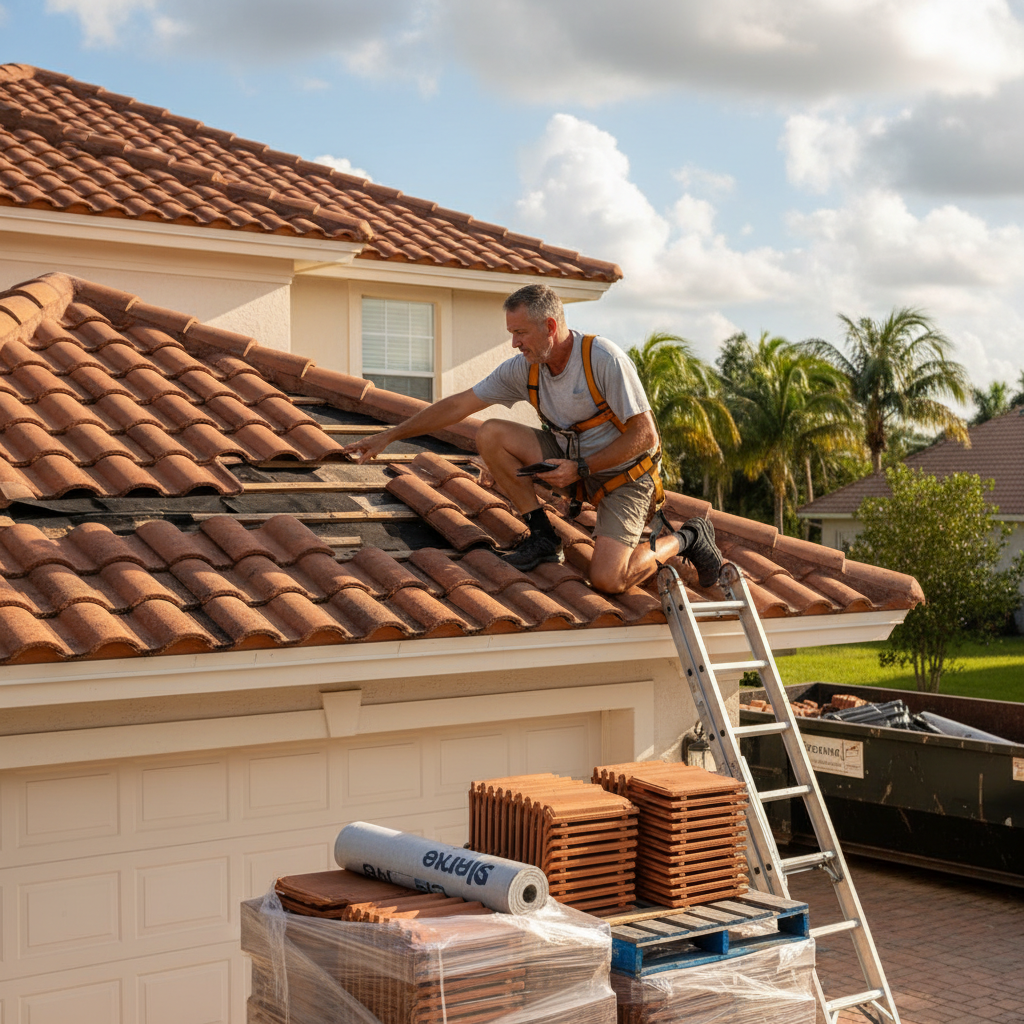
An exposed or half-torn-off roof cannot wait for a court case. Hire a licensed roofer to dry in the roof first, then get a written estimate to finish. That estimate also documents your damages. Before the new contractor starts, confirm whether the old permit is still open, because the new roofer will usually need to take over or replace it with the building department. Photograph the roof's condition before any new work begins so your evidence of the first contractor's partial work survives.
If you are in Tampa Bay and need a roof completed or replaced after a contractor left, Hytz Roofing (Florida license #CCC1332551, GAF Master Elite) handles permitting, inspections, and final sign-off on every project. You can see how the process works on our Tampa roof replacement service page.
Frequently Asked Questions
How much deposit can a roofer legally ask for in Florida?
Florida law does not cap a roofing deposit at a fixed percentage. Instead, Florida Statute 489.126 adds obligations once a contractor takes more than 10% of the contract price: apply for permits within 30 days and start work within 90 days after permits are issued. A request for a large deposit before any permit or material order deserves extra scrutiny, and Hillsborough County deputies advise homeowners never to pay the full balance up front.
What if the roofer who took my deposit was unlicensed?
The criminal deposit statute, 489.126, still applies, because it defines "contractor" to include anyone who performs or promises to perform contracting work, whether or not they hold a license. You can still report to law enforcement and sue in small claims or civil court. You cannot recover from the Homeowners' Construction Recovery Fund, though, because it only covers licensed contractors. Report unlicensed activity to DBPR and, in Hillsborough County, to Development Services.
Should I cancel the contract as soon as the roofer stops responding?
Not before you send the certified demand letter and, ideally, talk to an attorney. Pinellas County Consumer Protection specifically cautions that terminating the contract can limit your options under Florida law, because the 489.126 remedies are built around the contractor's failure to perform after your written demand. Send the demand, wait the 30 days, and document everything. Then decide on termination with advice.
Does a DBPR complaint get my deposit back?
Not directly. DBPR's complaint process can discipline a licensee and may lead to a restitution order, but DBPR says the complaint process is not designed to award damages. Filing a DBPR complaint alone also does not qualify you for the recovery fund. You still need a judgment, award, or restitution order. File the complaint, and pursue a civil or criminal route at the same time.
Sources
- Florida Statutes 489.126, Moneys received by contractors (Florida Senate)
- Florida Statutes 489.143, Payment from the fund (Florida Senate)
- Florida Statutes 489.141, Conditions for recovery; eligibility (Florida Senate)
- Florida Statutes 713.06, Liens of persons not in privity; Notice to Owner (Florida Senate)
- Florida House staff analysis, HB 1217 (2024), Homeowners' Construction Recovery Fund data
- Jimerson Birr, Abandoned construction project violation, 489.129(1)(j) text
- Pinellas County Consumer Protection, Abandoned Residential Construction Projects
- Hillsborough County, Report Construction Fraud
- Florida Building Commission / DBPR, Filing a complaint against a contractor (fact sheet)
- The Florida Bar, Florida Small Claims Rules (eff. July 1, 2026), Rule 7.010
- Federal Trade Commission, Billed for merchandise you never received (archived)
- FOX 13 Tampa Bay, 50 unlicensed contractors busted in Hillsborough County during "Operation Bad Builder" (Oct. 22, 2026)
- Louis Law Group, A contractor abandoned my project in Florida (95.11 limitations periods)