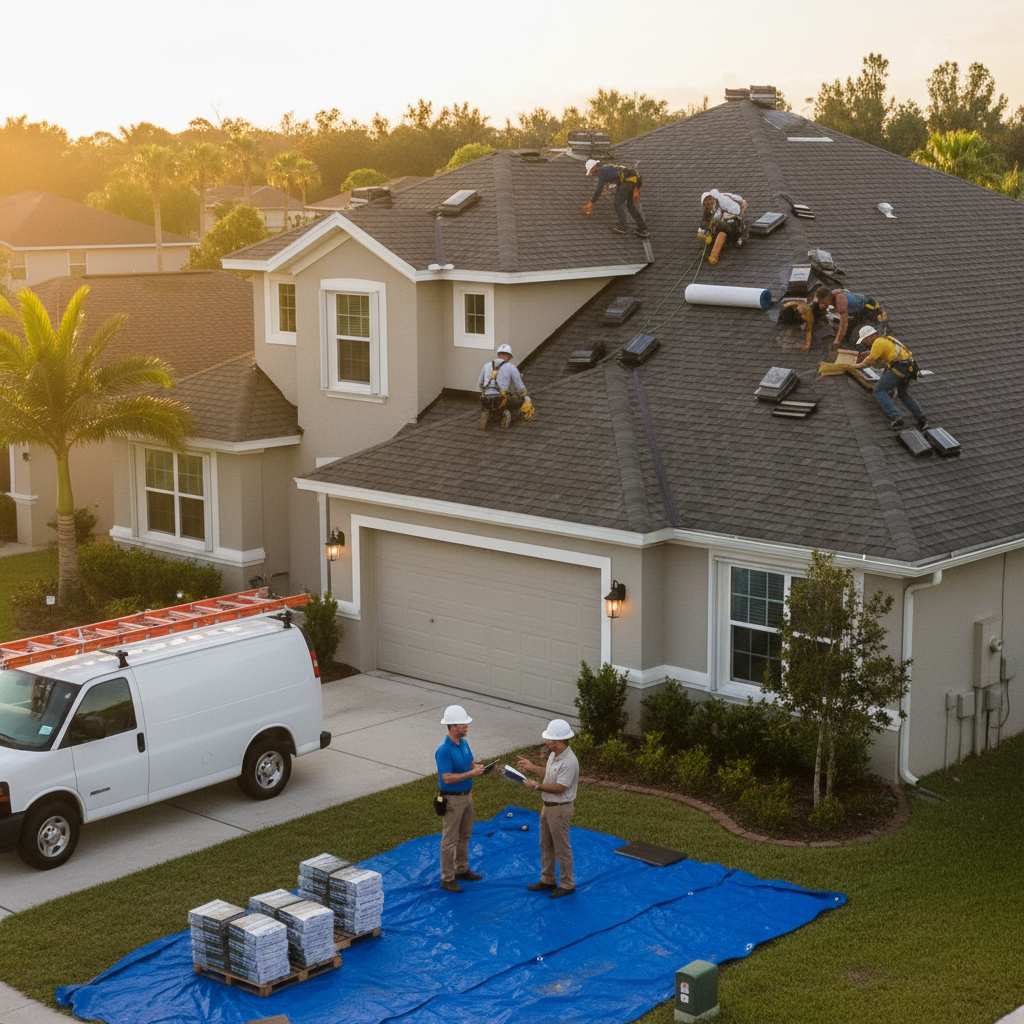
Most established roofing companies offer financing, but very few lend the money themselves. When a roofer says it "offers financing," it means the company has a partnership with one or more outside lenders and helps you apply through them. In Tampa Bay, Hytz Roofing is one of those companies: it advertises 0% financing for qualified homeowners and lists partner lenders on its roof replacement page. The more useful question is whether a roofer's financing is actually a good deal compared with a loan you could line up on your own, and that is what this guide helps you judge.
Key takeaways
- Many roofing contractors offer financing, but the loan comes from a licensed third-party lender, not the roofer. GAF, the shingle manufacturer, states plainly that it does not provide financing itself.
- Contractor financing is fast and sometimes carries promotional terms, but the Federal Trade Commission (FTC) advises homeowners never to accept it without comparing loan terms elsewhere.
- Ask for the cash price and the financed price side by side. Lender fees charged to the contractor can be built into the project price.
- "No interest if paid in full" is deferred interest: miss the payoff deadline and interest is charged back to the original purchase date.
- In Florida, residential PACE roof financing is a lien repaid on your property tax bill, capped by statute at 10% of household income per year and 20% of the home's just value.
Which roofing companies offer financing?
Most full-service residential roofing companies offer some form of financing, especially those certified by a major shingle manufacturer. GAF's homeowner guidance says "many contractors offer financing for your roof project" and tells homeowners to ask their contractor directly. GAF also makes clear that it does not lend: any loan promoted through its programs comes from "licensed and regulated third party financial organizations unaffiliated with GAF."
That arrangement is the norm across the industry. The roofing company handles the estimate and the installation, a partner lender handles the credit decision, and you repay the lender. So there is no single list of "roofing companies that offer financing." The practical way to find one is to ask each contractor you are getting quotes from three things: whether they offer financing, which lenders they work with, and what loan types those lenders provide.
In the Tampa area, Hytz Roofing offers financing for qualified homeowners. Its roof replacement page names Upgrade for personal financing and Movement Mortgage for home equity line of credit (HELOC) options.
How does roofing contractor financing work?
Roofing contractor financing follows a predictable sequence. The roofer inspects the roof and gives you a written quote. You apply with the roofer's partner lender, usually online or on a tablet during the appointment. GAF notes that credit decisions "can often be made in fewer than 60 seconds" and some lenders fund in as little as one business day. Once approved, the lender pays the contractor, typically in stages tied to the work, and you make monthly payments to the lender.
According to GAF, contractor-offered roof loans can include deferred-interest and deferred-payment plans, varying interest rates, and terms ranging from 2 to 15 years. Some carry no collateral requirement, no fees, or no prepayment penalty, but those features depend on the specific loan, not on the roofer.
One cost is easy to miss. Lenders that offer low promotional rates through contractors often charge the contractor a fee, sometimes called a dealer fee, and that fee can be folded into the project price. The Consumer Financial Protection Bureau (CFPB) studied this practice in solar lending in August 2024 and found dealer fees "often increase the loan cost by 30% or more above the cash price." That report covered solar installers, not roofers, and fees vary widely by lender and program. The lesson still applies to any home improvement loan: ask the roofer for the cash price and the financed price in writing, and compare them.
What roof financing options do Tampa homeowners have?
A Tampa homeowner paying for a new roof over time usually chooses among five routes. The right one depends on your credit, your home equity, and how quickly you can pay the balance down.
| Financing option | Who lends the money | Secured by your home? | What to watch for |
|---|---|---|---|
| Contractor-arranged installment loan | A third-party lender partnered with the roofing company | Usually no | Lender fees built into the project price; compare the cash price |
| Deferred-interest promotional plan | A third-party lender or card issuer, often arranged by the contractor | No | Interest is charged back to day one if the balance is not paid in full by the deadline |
| Personal loan from your own bank or credit union | Your chosen lender | No | Rate depends on your credit; you pay the roofer directly, which can make a cash price available |
| HELOC or home equity loan | A bank, credit union, or mortgage lender | Yes | Your home is the collateral; closing costs and variable rates on many HELOCs |
| Residential PACE financing | A PACE program administrator working through a local government | Yes, as a lien repaid on the property tax bill | Florida statutory limits, a lien with the same priority as property taxes, and possible complications when selling or refinancing |
Is roofing contractor financing better than a loan from your own bank?
Roofing contractor financing is not automatically better or worse than a bank loan; it wins on convenience and sometimes on promotional terms, and it loses when lender fees inflate the project price. The FTC's advice on home improvement projects is direct: "Never agree to financing through your contractor without shopping around and comparing loan terms."
A fair comparison takes one afternoon. Get the contractor's loan offer in writing with the annual percentage rate (APR), term, monthly payment, and total of payments. Then prequalify with your own bank or credit union for the same amount. Many lenders prequalify with a soft credit check. Compare the total cost of each loan, not just the monthly payment, and ask the roofer whether the price changes if you pay with outside financing or cash.
Promotional offers need an extra read. The CFPB tells consumers to "look for the 'if.'" A "0% intro APR" offer charges no interest on the balance during the promotion. A "no interest if paid in full within 12 months" offer is deferred interest: if any balance remains when the promotion ends, interest is added back from the original purchase date. A deferred-interest roof loan is a good deal only if you are confident you can pay it off in time.
What does Florida law require for PACE roof financing?
Florida's Property Assessed Clean Energy (PACE) law allows homeowners to finance qualifying improvements through a voluntary assessment on their property. Section 163.08, Florida Statutes, lists wind-resistance upgrades among qualifying residential improvements, including installing wind-resistant shingles, bracing gable ends, and reinforcing roof-to-wall connections. That is why PACE comes up so often in roofing conversations here.
Section 163.081 sets several protections that matter to Tampa homeowners:
- Payment cap: the annual PACE payment cannot exceed 10% of the property owner's annual household income.
- Size cap: the total assessment is generally limited to 20% of the property's just value, unless the mortgage holder consents in writing to more.
- Mortgage holder notice: the owner must give written notice to the mortgage holder at least 5 business days before signing the financing agreement.
- Tax history: property taxes must be current, with no delinquencies in the prior 3 years.
- Right to cancel: the homeowner can cancel within 3 business days after signing, without penalty.
PACE is repaid as a non-ad valorem assessment on the property tax bill, and it creates a lien of equal dignity to county taxes. Missed payments can put the home at risk, and some mortgage lenders require a PACE lien to be paid off before a sale or refinance. Federal rules tightened as well: the CFPB's PACE rule under Regulation Z took effect March 1, 2026, applying Truth in Lending Act ability-to-repay requirements and PACE-specific Loan Estimate and Closing Disclosure forms.
What red flags should homeowners watch for when a roofer offers financing?
Most contractor financing is legitimate, but federal enforcement shows what goes wrong when controls are weak. In July 2021 the CFPB took action against GreenSky, a fintech company that runs home improvement loan programs through contractors. The CFPB found GreenSky received at least 6,000 complaints between 2014 and 2019 from consumers who said they never requested their loans, and the company's own investigations found merchant fault in at least 1,600 of them. GreenSky was ordered to provide up to $9 million in refunds and loan cancellations and to pay a $2.5 million civil penalty.
These warning signs deserve a pause:
- The roofer wants to fill out the loan application for you, or asks you to sign before you have seen the loan terms.
- Any document has blank spaces, or you are asked to sign something you have not read.
- The contractor pushes a loan secured by your home when an unsecured option would cover the job, or asks you to transfer your deed. The FTC warns never to transfer a deed without consulting an attorney or someone you trust.
- You are asked to pay the full project price up front. The FTC advises against it.
- A contract signed in your home lacks a written notice of your right to cancel within three business days, which the FTC's Cooling-Off Rule generally requires for sales made at your home.
Before signing anything, confirm the roofer's license on the Florida Department of Business and Professional Regulation (DBPR) license verification site, and keep your own copy of every loan document.
What questions should you ask a roofing company about its financing?
Asking a roofing company these questions before you apply will surface most problems:
- Which lenders do you work with, and is the loan from them or from you?
- What is the APR, the term, the monthly payment, and the total of all payments?
- Is the promotional offer 0% interest, or deferred interest that is charged back if I miss the deadline?
- Is the project price different if I pay cash or bring my own financing?
- Is the loan secured by my home or recorded as a lien?
- Is there a prepayment penalty?
- When does the lender release money to you, and is any of it paid before work begins?
A contractor that answers all seven clearly and in writing is one you can compare fairly against your bank.
How does Hytz Roofing handle roof financing in Tampa Bay?
Hytz Roofing offers financing for qualified homeowners across Tampa Bay, including 0% financing options, through partner lenders. The company's page on roof replacement in Tampa lists Upgrade personal financing and Movement Mortgage HELOC options, so homeowners can choose between an unsecured loan and a home equity line depending on the project and their situation.
Hytz Roofing is a GAF Master Elite and GAF President's Club contractor with more than 30 years of experience, licensed in Florida under #CCC1332551. Financing terms are reviewed with you before paperwork is signed, and you are free to compare them against your own bank's offer. To get a written estimate and see which financing options fit your project, call Hytz Roofing at (813) 436-0761 for a free inspection.
What else do homeowners ask about roof financing?
Can I finance a new roof with fair or poor credit?
Financing a roof with fair or poor credit is sometimes possible, but approval and rates depend on the lender. A roofer that works with more than one lender can give you more than one chance at approval. Home equity products depend more on how much equity you have, and Florida PACE eligibility depends heavily on the property, though federal ability-to-repay rules now apply to PACE as of March 1, 2026. Prequalifying with a soft credit check shows your options without affecting your score.
How long are typical roof loan terms?
GAF reports that roof loans offered through contractors range from about 2 to 15 years. A longer term lowers the monthly payment but usually raises the total interest you pay. Ask for the total of payments on each term you are offered before choosing one.
Can I pay off a roof loan early?
Many roof loans allow early payoff without a penalty, and GAF lists "no prepayment penalties" among common loan features, but you need to confirm it on your specific loan. For Florida PACE financing, the required pre-signing disclosure must state that prepayment carries no penalty. Paying early matters most on deferred-interest plans, where the full balance must be cleared before the promotion ends.
Can a roofer help me finance my insurance deductible?
A roofer can arrange a loan for your share of a storm repair, but it cannot make the deductible disappear. Florida law, section 489.147, prohibits contractors from offering to waive, rebate, or pay a homeowner's insurance deductible as an incentive. A standard loan that you repay in full is a different transaction; confirm the terms in writing just as you would for any other roof loan.
Sources
- GAF: Roof Financing Tips
- Federal Trade Commission: How To Avoid a Home Improvement Scam
- Consumer Financial Protection Bureau: How to understand special promotional financing offers
- Consumer Financial Protection Bureau: Report on markup fees in solar energy loans (August 2024)
- Consumer Financial Protection Bureau: Action against GreenSky (July 2021)
- Federal Register: Residential Property Assessed Clean Energy Financing (Regulation Z)
- Florida Statutes section 163.08
- Florida Statutes section 163.081
- Florida DBPR: Verify a License