Florida Roof Replacement Cost: 2026 Prices by Material
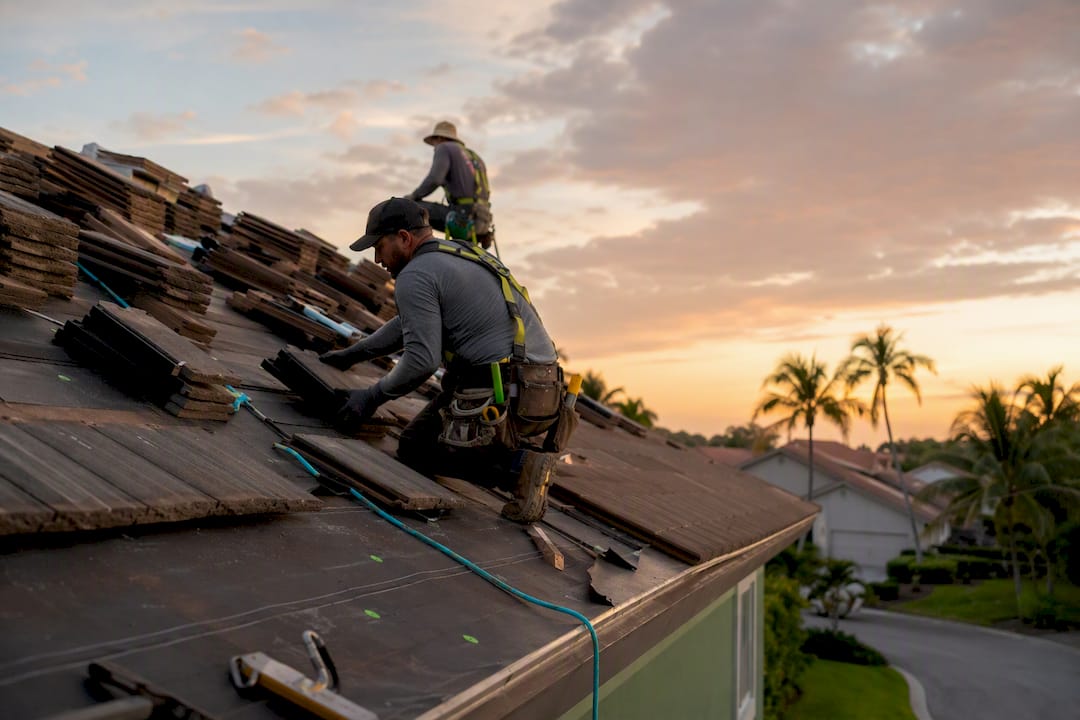
Most full roof replacements in Florida run $8,500 to $35,000, with a typical 2,000 sq ft architectural asphalt job landing near $12,000 to $18,000 depending on your region and any code-driven upgrades. That’s the number for a standard single-family home in average condition, not a mansion with six dormers or a beach house facing the Gulf.
Coastal exposure and High-Velocity Hurricane Zone (HVHZ) rules push totals higher, sometimes into the $22,000 to $36,000 range for impact-rated systems, while tile and metal cost more upfront than asphalt but often last decades longer. A few things can move your number fast:
- Material choice: asphalt is cheapest, metal and tile cost more per square
- Coastal location: HVHZ counties add wind-rating and fastening requirements
- Roof condition: rotted decking found after tear-off adds cost nobody quotes upfront
None of these ranges replace an on-site inspection. Get a written, itemized quote before you budget a dollar figure into your renovation plan.
Key Takeaways
Florida roof replacement costs depend primarily on material choice, home size, and location, with statewide totals ranging from $8,500 to $35,000 and HVHZ counties commanding the highest premiums.
| Point | Details |
|---|---|
| Know your baseline range | Budget $12,000 to $18,000 for a standard 2,000 sq ft architectural asphalt roof; adjust up for tile, metal, or HVHZ zones. |
| Insist on itemized quotes | Require separate lines for materials, labor, tear-off, permits, and decking allowance before comparing bids. |
| Understand insurance triggers | ACV vs RCV policies and code-driven 25% repair thresholds affect what your insurer pays and what code requires. |
| Plan around permitting delays | Dry-in and final inspections, especially post-storm, can extend your timeline beyond the quoted schedule. |
| Choose a credentialed local contractor | Hytzroofing is a GAF Master Elite Contractor with License #CCC1332551 offering itemized estimates and insurance claim support in Tampa Bay. |
Table of Contents
- Roof Replacement Cost Florida: Prices by Material and Home Size
- What a Real Florida Roofing Estimate Includes
- What Drives Florida Roofing Prices Up or Down?
- Does Insurance Cover a Roof Replacement in Florida?
- How Long Does a Florida Roof Replacement Take?
- Six Questions to Ask Before Signing a Roofing Contract
- What Tampa Bay Roofs Actually Teach Us About Cost
- Ready for a Free, Itemized Roof Estimate in Tampa Bay?
- Sources
- FAQ
Roof Replacement Cost Florida: Prices by Material and Home Size
The material you pick and the square footage of your roof decide most of your bill. Here’s how the numbers typically shake out across common Florida home sizes, based on installed per-square-foot ranges reported by Big Easy Roofers and regional averages from Modernize.
Location shifts these numbers too. South Florida’s HVHZ counties (Miami-Dade, Broward, and parts of the Keys) typically run at the top of every range because of stricter product approval requirements and tighter labor supply. Central Florida, including Tampa Bay, sits in the middle. North Florida usually lands lowest, with less wind-code pressure and lower labor demand.
To turn these ranges into a rough project estimate yourself, try this:
- Measure or pull your roof’s square footage from a prior permit or appraisal.
- Divide by 100 to get your “roofing squares” (one square = 100 sq ft).
- Multiply squares by the per-square-foot range for your material.
- Add 10 to 15% if your home has steep pitch, multiple valleys, or more than one story.
- Add a decking allowance (often $500 to $2,500) since sheathing condition is unknown until tear-off.
- Compare your total against at least two local, itemized quotes before deciding.
What a Real Florida Roofing Estimate Includes
A legitimate roofing estimate breaks costs into distinct line items, not one lump number. If your quote is a single price with no breakdown, that’s your first red flag.
Look for these components on every quote:
- Material cost (shingles, tile, metal panels, underlayment)
- Labor cost, listed separately from materials
- Tear-off and disposal of the old roof
- Permit fees paid to your local building department
- Secondary water barrier or self-adhering underlayment (increasingly required in coastal counties)
- Flashing around chimneys, vents, and skylights
- Fastener type and pattern (matters for wind rating)
- Ventilation upgrades
- Decking repair or replacement allowance
- Cleanup and haul-away
- Manufacturer and workmanship warranty terms in writing
Hidden add-ons tend to surface after tear-off begins. Rotted plywood decking, an unexpectedly steep pitch, or a jurisdiction that requires HVHZ-rated products can all add cost mid-project. A detailed line-item walkthrough helps you spot which of these are normal and which are padding.
Pro Tip: Never accept a quote that lumps “materials and labor” into one number. Ask for them separately, along with a written line for permit fees. If a contractor won’t itemize, that’s usually because the markup is hidden inside the bundle.
What Drives Florida Roofing Prices Up or Down?
Florida’s building code and climate create cost swings you won’t see in most other states. Florida Residential Code Chapter 9 sets wind-uplift and fastening standards that directly affect labor time and material specs, especially in HVHZ counties where every product needs a Notice of Acceptance (NOA).
The biggest local drivers include:
- Wind rating requirements: HVHZ zones require NOA-approved products, which typically cost 5% to 20% more than standard equivalents.
- Coastal exposure: salt air accelerates fastener corrosion, often requiring stainless steel components near the water.
- Roof geometry: steep pitches, multiple valleys, and dormers increase waste and labor hours.
- Decking condition: soft or delaminated plywood found during tear-off adds material and labor not visible in the original quote.
- Permit and inspection demand: busy post-storm seasons stretch permitting timelines and labor availability.
Wind mitigation upgrades can also shift the scope of a project. Insurers frequently require documentation of hip roofs, secondary water barriers, and approved fastening before granting premium discounts, and that documentation sometimes changes what the contractor installs. A completed wind mitigation inspection can lower your annual premium even after accounting for the roof’s higher upfront cost.
Does Insurance Cover a Roof Replacement in Florida?
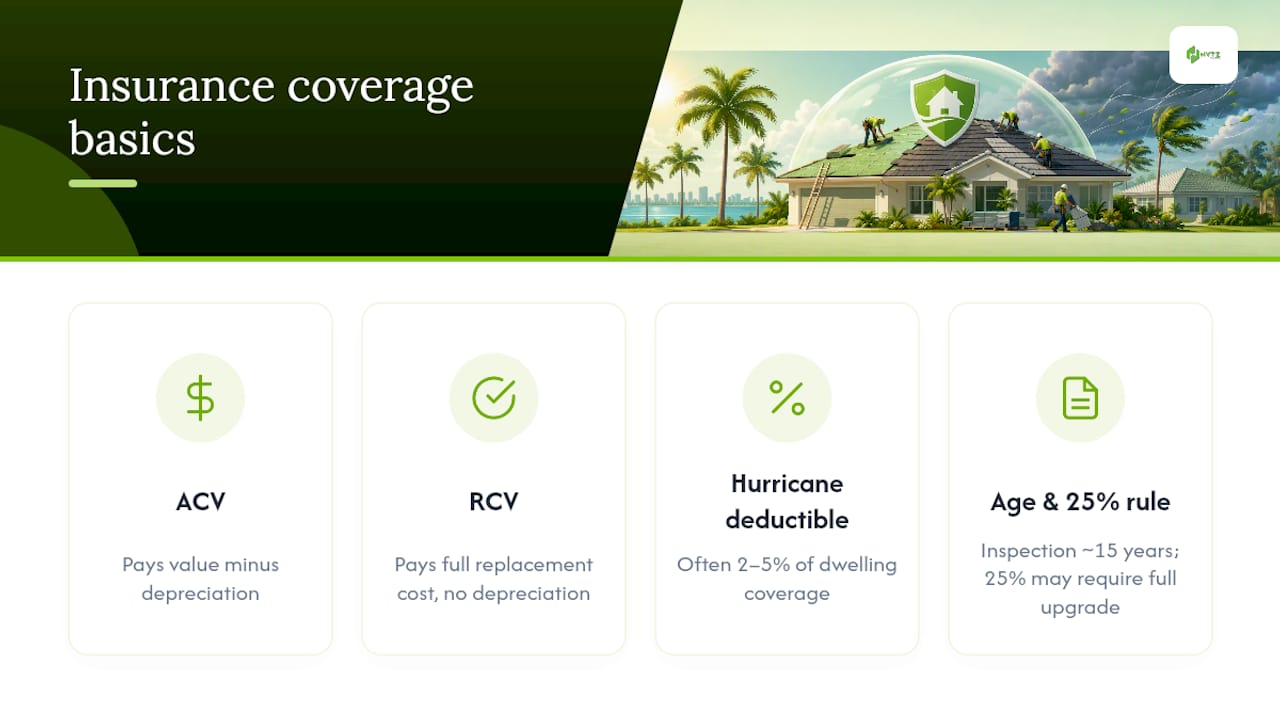
Insurance coverage in Florida depends heavily on your policy type and your roof’s age. Most carriers write roof coverage as either Actual Cash Value (ACV), which factors in depreciation, or Replacement Cost Value (RCV), which pays to replace the roof without a depreciation deduction. Many Florida policies also carry a separate hurricane deductible, often 2% to 5% of your dwelling coverage, which is distinct from your standard deductible.
You’ve likely heard of the “15-year rule” and the “25% rule.” Neither is a single, universal statute. In practice, insurers often use roof age (commonly around 15 years) as a trigger to require an inspection before renewing or writing a policy, since older roofs statistically fail more often in wind events. The 25% threshold generally refers to a building-code principle: when repairs affect roughly a quarter or more of the existing roof, code officials can require the entire roof system to be brought up to current wind and fastening standards rather than patched piecemeal. Exact application varies by carrier and local jurisdiction, so confirm specifics with your insurer and building department before assuming either rule applies to your situation.
Pro Tip: Ask your contractor for wind mitigation documentation, NOA compliance paperwork, and signed permit closeouts once the job wraps. That paperwork is often what gets you an insurance discount or supports a future claim.
How Long Does a Florida Roof Replacement Take?
A typical project moves through five stages: quote, permit approval, tear-off, dry-in inspection, and final inspection. Many Florida jurisdictions, including Pinellas County, require that mid-job dry-in inspection to confirm underlayment and flashing are correctly installed before the finished roofing goes on. Skipping or mistiming that inspection can stall the whole project.
Expect delays during peak hurricane season and the months right after a major storm, when permitting offices and contractor schedules both back up. There’s no dependable “cheapest” time of year to replace a roof in Florida. Material costs and contractor availability shift with storm activity, and any seasonal savings tend to disappear quickly.
Financing options worth comparing:
- Home equity loans or lines of credit: typically the lowest interest rate if you qualify
- PACE financing: available through the Florida PACE program for qualifying energy or resilience upgrades
- FHA Title I loans: a federal option for smaller home improvement financing
- Contractor financing: convenient but compare the APR and total cost against the alternatives above
Cool-roof and energy-efficient materials may also qualify for utility or DOE-backed programs that reduce cooling costs over the life of the roof.
Six Questions to Ask Before Signing a Roofing Contract
Getting an accurate quote means getting a contractor onto your actual roof. Online calculators can’t see your decking condition or your roof’s pitch complexity. Ask every contractor these six questions before you sign anything:
- Are you licensed and insured in Florida, and can you provide proof?
- Which products are NOA-approved for my zone, and are they included in this quote?
- What’s your decking repair allowance, and how is it billed if more is needed?
- Who pulls the permit, and what inspections are scheduled?
- What does the manufacturer warranty cover versus your workmanship warranty?
- What’s your realistic start date and completion timeline?
Red flags include a large upfront deposit before any work starts, a vague one-line scope of work, no permit fee listed anywhere, or unverifiable product approval numbers. A local contractor vetting checklist can help you sort legitimate bids from lowball ones.
Pro Tip: Get everything in writing and compare quotes brand-for-brand. A $9,000 quote using a builder-grade shingle isn’t cheaper than a $12,000 quote using an architectural, wind-rated product. It’s a different roof.
What Tampa Bay Roofs Actually Teach Us About Cost
Statewide ranges are a starting point, not a promise. On Tampa Bay jobs, the surprises tend to repeat: soft decking under old three-tab shingles, HVHZ-adjacent fastening requirements creeping north from Pinellas and Hillsborough code updates, and homeowners trying to schedule a replacement in the six weeks after a named storm when every contractor in the region is booked solid.
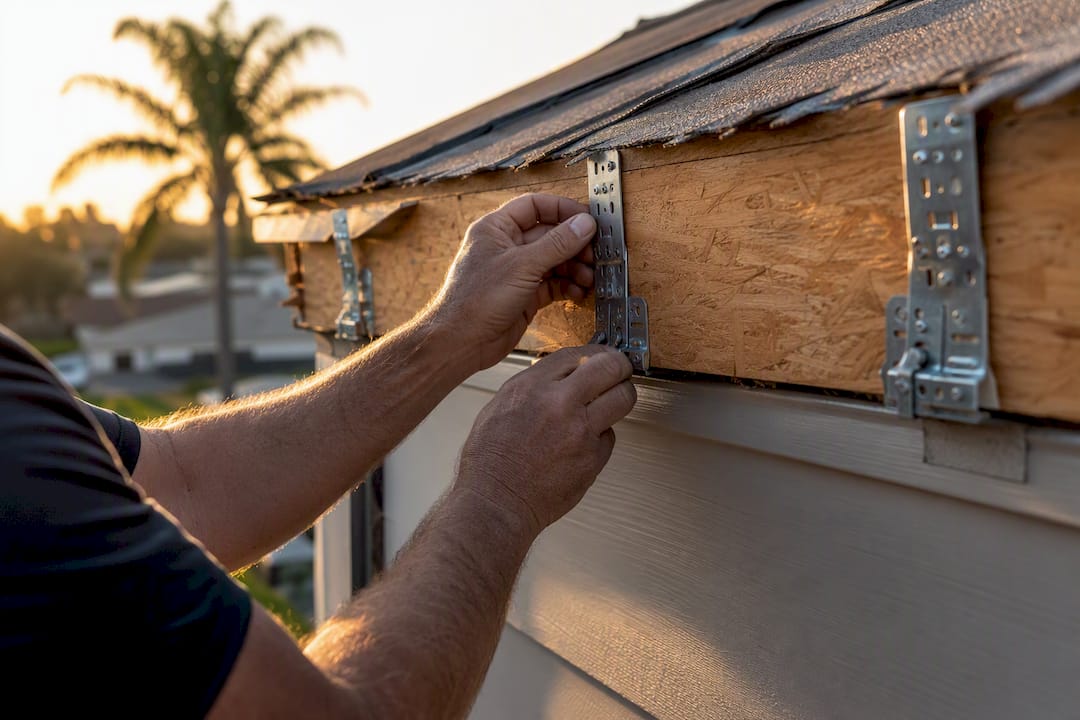
A wind mitigation inspection changes outcomes more often than homeowners expect. Two nearly identical homes can see meaningfully different insurance premiums based on documented roof-to-wall connections and secondary water barriers. If your roof was built or replaced before those standards tightened, get it inspected before assuming your premium is fixed.
Hytz Roofing is a GAF Master Elite Contractor and holds the GAF President’s Club Award for installation quality, along with Florida Contractor License #CCC1332551. Those credentials matter less as a badge and more as a practical filter: fewer than 2% of roofing contractors nationally hold Master Elite status, largely because it requires sustained quality control most companies never bother pursuing.
Ready for a Free, Itemized Roof Estimate in Tampa Bay?
If your roof was damaged by a recent storm, Hytzroofing handles both the storm damage repair and the insurance claim paperwork, so you’re not translating adjuster language on your own while also chasing contractor bids. That’s the real difference from piecing a project together yourself: one licensed team handles the inspection, the itemized estimate, the permit, and the insurance documentation together.
Hytzroofing is a GAF Master Elite Contractor, a GAF Certified Commercial Contractor, and a BBB A+ accredited business serving Tampa Bay and Central Florida, backed by Florida Contractor License #CCC1332551. Our team handles residential replacement, certified wind mitigation inspections, and financing options, and we install everything from asphalt shingles to tile roofing systems. If a roof replacement is uncovering deck-level issues elsewhere on your property, this deck replacement cost guide is worth a look before you finalize your budget.
Request a free, on-site estimate for your roof replacement and get an itemized quote with permit handling included, no guesswork required.
Sources
- Codes
- Energy
This article is general information, not a substitute for advice from a qualified financial advisor. Consult a qualified financial professional about your own circumstances before acting on anything here.
FAQ
How much does it cost to roof a 1,500 sq ft house in Florida?
Expect roughly $8,250 to $11,250 for architectural asphalt shingles, with metal or tile running higher, often $13,500 to $33,000 depending on material and coastal location.
What is the 15-year roof rule in Florida?
There’s no single statewide statute called the “15-year rule.” In practice, many insurers use roof age around 15 years as a trigger to require an inspection before renewing or issuing a policy.
What is the 25% roof replacement rule in Florida?
The 25% principle refers to building-code practice where repairing roughly a quarter or more of an existing roof can require the entire system to be brought up to current wind and fastening code, rather than patched section by section.
What time of year is the cheapest to replace a roof in Florida?
There isn’t a reliably cheapest season. Post-storm demand, material price swings, and contractor backlogs tend to erase any seasonal pricing advantage.
Does homeowners insurance cover a full roof replacement in Florida?
Coverage depends on your policy type. RCV policies typically pay full replacement cost, while ACV policies factor in depreciation, and most Florida policies carry a separate hurricane deductible.