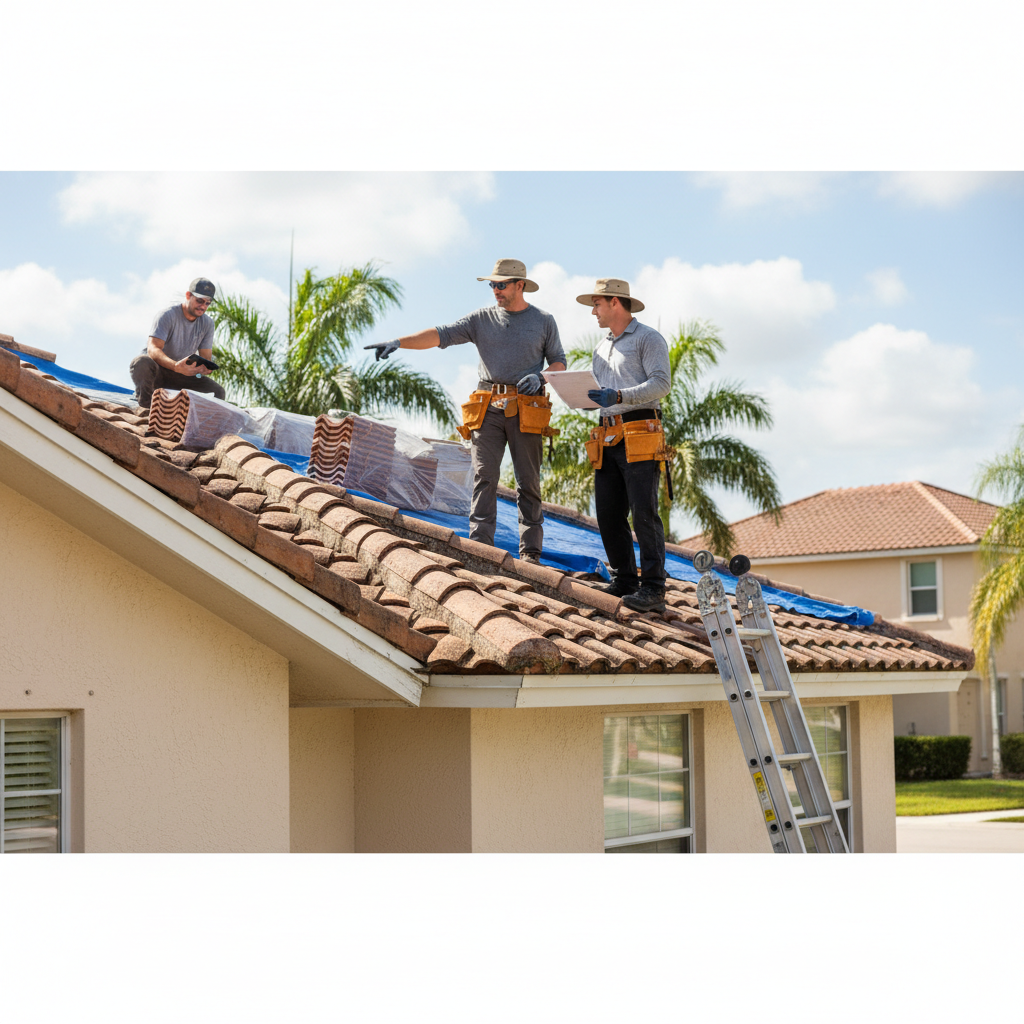
Ask any roofer four questions to find out whether they will hand your whole job to someone else: who will physically be on your roof, whose license goes on the permit, who from their company supervises the work, and who stands behind the workmanship warranty if the crew is gone. A contractor that runs its own jobs answers all four with names and documents. A company that only sells the job and passes it to another crew tends to go vague on the first and last questions. In Florida you don't have to take anyone's word for it, because licenses, workers' compensation coverage, permits and lien notices are all things you can check yourself.
Key Takeaways
- Subcontracting is legal and common in Florida roofing. The real risk is a full hand-off, where the company you signed with never supervises the crew that does the work.
- Under Florida Statutes section 489.113(3), a general contractor without a roofing certification must subcontract the roofing work. If the company on your contract is a general contractor, someone else will be doing your roof.
- The license number on your permit should belong to the company on your contract. You can check both on the Florida Department of Business and Professional Regulation (DBPR) site and on the Hillsborough County HillsGovHub permit portal.
- Florida law requires the contractor to get workers' compensation proof from its subcontractors (section 440.10(1)(c)). Ask to see the crew's certificate or exemption.
- A Notice to Owner from a company you've never heard of is often the first written sign of who is really doing the work. Hold final payment until you have the contractor's final payment affidavit and lien releases.
Is it a problem if a roofer subcontracts the entire roofing job?
Subcontracting a roofing job is not automatically a problem. Florida's contracting law, section 489.113(2) of the Florida Statutes, lets workers who are not individually licensed perform work under the supervision of a certified or registered contractor, as long as that licensed contractor stays responsible for the work and the work is within the scope of its license. Plenty of solid roofing companies use outside specialty crews for gutters, sheet metal or skylights.
The trouble starts when the company that sold you the roof is mostly a sales operation. In a full hand-off, the salesperson signs you, a different company's crew shows up, and nobody from the contracting company checks the work. That setup creates four gaps a homeowner feels later:
- Workmanship accountability. If a flashing detail leaks in year two, the selling company may point to a crew it no longer uses.
- Manufacturer warranty eligibility. Enhanced warranties often depend on who installed the roof, not who sold it.
- Workers' compensation. An uninsured crew working on your house is a risk you never agreed to.
- Construction liens. An unpaid subcontractor or supplier can file a lien against your property even after you've paid in full.
Which questions reveal whether a roofer is subcontracting the whole job?
The questions below are designed so that a vague answer is itself useful information. Ask them before you sign, and ask for the answers in writing when the answer involves a name or a number.
| Question to ask the roofer | What a clear answer sounds like | What a warning sign sounds like |
|---|---|---|
| Who will physically be on my roof, and do they work for you or for another company? | A direct answer: "our crew" or "a subcontracted crew we've used for years, here's their company name." | "Our guys" with no follow-up detail, or a change of subject. |
| Is your license a roofing license or a general contractor license? | A certified roofing contractor license number you can look up (Florida certified roofing licenses begin with CCC). | A general or building contractor license with no roofing certification, which means the roofing must be subcontracted under section 489.113(3). |
| Whose license number will be on the permit? | The same company and license as your contract. | A different company's name, or "the crew pulls its own permits." |
| Who from your company supervises my job, and how often will they be on site? | A named project manager and specific visits: tear-off, deck inspection, dry-in and final walkthrough. | "The crew lead handles everything" when the crew lead works for another company. |
| Can I see workers' compensation proof for the crew that will do the work? | A certificate of insurance or a state exemption certificate you can verify online. | Only the selling company's certificate, or "they're covered, don't worry." |
| Who honors the workmanship warranty, and does it change if you stop using this crew? | Your contracting company, in writing, regardless of which crew installed the roof. | A warranty issued by the crew's company, or no written workmanship terms. |
| Who registers the manufacturer warranty, and is the installer the certified contractor? | The certified contractor registers it and is the contractor of record on the installation. | Uncertainty about who registers it or whose certification applies. |
| Will I get lien releases and a final payment affidavit before I make final payment? | Yes, from the contractor, the crew and major suppliers. | Pushback, or a request for full payment before any paperwork. |
Why does the "whose license is it" question matter so much in Florida?
The license question matters because Florida law decides who is allowed to do roofing in the first place. Section 489.113(3) of the Florida Statutes says a contractor must subcontract all roofing work, along with electrical, plumbing, mechanical and several other trades, unless that contractor holds a state certificate or registration in that trade. Section 489.113(3)(g) adds that general, building and residential contractors certified after 1973 cannot act as or advertise as roofing contractors unless they are also certified or registered as roofing contractors.
So if you hire a remodeling company or general contractor for a reroof, a subcontracted roofing crew is not a possibility. It is a legal requirement unless the company holds its own roofing certification. That is fine if you know it going in and the roofing subcontractor is properly licensed. It is a problem if you thought you were hiring a roofer.
Section 489.113(5) also states that a certificate is not transferable. A crew cannot borrow another company's license to cover a job. To check any license, search the company or license number on the DBPR license verification site. Florida DBPR's own homeowner guidance is simple: ask for license information, then confirm it yourself before doing business.
How can a Tampa homeowner verify a roofer's answers instead of trusting them?
A Tampa-area homeowner can check most of these answers with public records in under an hour. Each check below lines up with one of the questions in the table above.
- License check. Look up both the contracting company and any named subcontractor on the DBPR site. Confirm the license type, status and the name it is issued to.
- Workers' compensation check. The Florida Division of Workers' Compensation runs a public Proof of Coverage database and a separate exemption search. In construction, coverage is required once a business has one or more employees, and that count includes owners who are corporate officers.
- Permit check. Hillsborough County lets you look up permit records on the HillsGovHub portal. The county's homeowner guidance says that when you hire a contractor, the contractor obtains the permits. The contractor on that permit record should match your contract.
- Notice to Owner check. Under section 713.06(2)(a) of the Florida Statutes, subcontractors and suppliers who don't contract directly with you must serve a Notice to Owner before they start or within 45 days after starting if they want to keep lien rights. If a notice arrives from a roofing company you've never heard of, that company is probably the one doing your roof.
None of these checks accuse anyone of anything. A roofer who runs a clean operation expects them.
What does the workers' compensation question protect a homeowner from?
The workers' compensation question tests whether the contractor follows its own legal duties. Section 440.10(1)(b) of the Florida Statutes treats a contractor and its subcontractors' employees on a job as part of one business, and makes the contractor liable for securing compensation for those employees unless the subcontractor has secured it. Section 440.10(1)(c) goes further: a contractor "shall require a subcontractor to provide evidence of workers' compensation insurance," and a corporate subcontractor whose officer is exempt must give the contractor a copy of the exemption certificate.
In practice, that means a contractor who subcontracts properly already has these documents on file. If the company can't produce the crew's certificate or exemption, either it doesn't know who the crew is or it isn't collecting what the law requires. Roofing is dangerous work, and you don't want an uncovered injury claim tied to a job on your house.
How do lien releases and the final payment affidavit expose a hidden subcontractor?
Florida's Construction Lien Law turns paperwork into a way to see who touched your job. When final payment comes due, section 713.06(3)(d) requires the contractor to give you a sworn affidavit stating that all lienors under its contract have been paid in full, or listing those who haven't been and how much each is owed. The statute also says the owner holds back the final payment until that affidavit is furnished.
The statutory Notice to Owner form warns, in capital letters, that a lien can be filed against your property "EVEN IF YOU HAVE PAID YOUR CONTRACTOR IN FULL," and that you may end up "PAYING TWICE" if subcontractors or suppliers go unpaid. Asking up front for lien releases from the crew and major suppliers, and for the final affidavit before final payment, forces the contractor to name every company involved. A roofer who is handing off the entire job has to put the crew's name on paper.
What contract terms keep a subcontracted roofing job accountable?
If a roofer tells you openly that a subcontracted crew will do the installation, that can still work out well. The protection comes from the contract. Ask for language that covers these points:
- The contracting company is the contractor of record and stays responsible for all work, including any subcontractor's work.
- The names of subcontractors who will work on your roof, with a requirement to tell you before a different crew is substituted.
- A named supervisor from the contracting company and the inspection points they will attend.
- Workers' compensation and liability insurance certificates for every crew on site.
- Lien releases from subcontractors and suppliers, plus the final payment affidavit, before final payment.
- A written workmanship warranty issued by the contracting company, not the crew.
For manufacturer warranties, read who the warranty requires as installer. GAF's Golden Pledge Limited Warranty brochure states that the roof "MUST be installed by a GAF Master Elite Roofing Contractor" and that the contractor must register the warranty within 30 days of installation. Ask how the company meets that requirement on your job. This article is general information, not legal advice. For a large or unusual contract, a Florida construction attorney can review the terms.
How does Hytz Roofing answer these questions?
Hytz Roofing holds Florida certified roofing contractor license #CCC1332551, which means the company is licensed to perform the roofing itself rather than being required to subcontract it as a general contractor would. Hytz Roofing is also a GAF Master Elite contractor and a GAF President's Club award recipient, and its team brings 30+ years of combined experience serving homeowners across the Tampa Bay area. The company's team page lists its named project managers, so you know who to ask for.
We encourage every homeowner to ask us each question in the table above, and to check the answers on the DBPR, workers' compensation and HillsGovHub sites. If you're planning a reroof and want those answers in writing before you sign, start with a roof replacement inspection and written estimate in Tampa.
Frequently Asked Questions
Is it illegal for a Florida roofing contractor to use subcontractors?
No. Florida allows licensed roofing contractors to use subcontractors and to have unlicensed workers perform work under their supervision, provided the licensed contractor remains responsible for the work. What Florida prohibits is unlicensed contracting and transferring a license certificate to someone else. The issue for a homeowner is not whether subcontractors are used but whether the licensed company on your contract actually supervises and stands behind the job.
Can I require in my contract that the roofer not subcontract my job?
You can ask for it, and some contractors will agree, but a blanket ban may not fit how every company operates. A more practical approach is a clause that names approved subcontractors, requires your notice before any substitution, and keeps the contracting company responsible for all work and the workmanship warranty. That gives you the accountability you're after without forcing a company to change its crew structure.
Does receiving a Notice to Owner mean something is wrong with my roofer?
No. A Notice to Owner is a routine step that subcontractors and suppliers use to preserve their lien rights under section 713.06 of the Florida Statutes, and many reputable jobs generate several of them from shingle and material suppliers. Read each one to see who sent it. Keep every notice, because these are the companies you'll want lien releases from before final payment.
What if the crew that shows up is different from the one I was promised?
Stop and call the contracting company's named project manager before work continues. Ask who the crew works for, request that crew's workers' compensation proof, and confirm the permit still lists the contractor on your agreement. If your contract named approved subcontractors, a substitution without notice is a contract issue to raise in writing right away.
Sources
- Florida Statutes section 489.113, Qualifications for practice; restrictions (Florida Senate, 2026)
- Florida Statutes section 440.10, Liability for compensation (Florida Senate)
- Florida Statutes section 713.06, Liens of persons not in privity; proper payments (Florida Senate, 2025)
- Florida Division of Workers' Compensation, Coverage Requirements
- Florida Division of Workers' Compensation, Proof of Coverage database
- Florida DBPR, "Florida DBPR Urges Floridians to Use Only Licensed Professionals for Home Repairs" (October 11, 2022)
- Hillsborough County, Permits for Homeowners
- GAF, Golden Pledge Limited Warranty brochure (RESWT161B)
- Hytz Roofing, Our Team