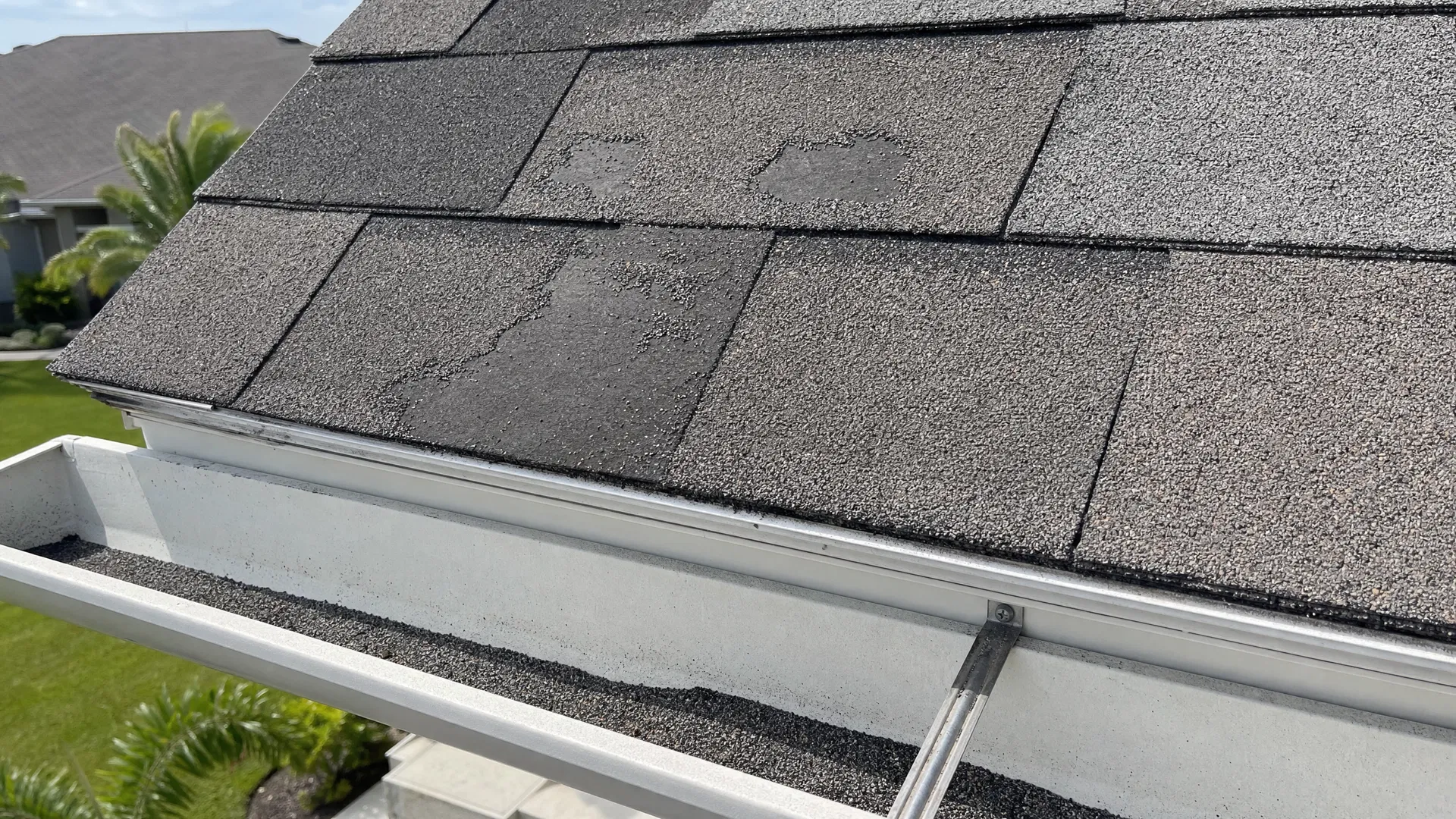
Granules are the "secret sauce" of asphalt shingles. These tiny, ceramic-coated rocks are embedded in the asphalt layer during manufacturing and form the first line of defense against Florida’s brutal sun and storms. They’re what give your roof its color and texture, but more importantly, they perform several critical jobs at once:
| Factor | Details |
|---|---|
| Purpose of Granules | Protect asphalt from UV, provide fire resistance, add weight, reflect heat |
| Normal Loss | Small amounts after new roof installation or heavy storms |
| Abnormal Loss | Bald spots, large accumulations in gutters, uneven shedding, impact marks |
| Florida-Specific Causes | Intense UV, wind-driven rain (hurricanes), hail, heat cycling, pressure washing |
| Consequence | Accelerated shingle degradation, reduced roof lifespan, insurance issues |
- Block UV radiation so the asphalt below doesn’t dry out and crack.
- Provide fire resistance, earning the assembly its Class A fire rating.
- Add weight and abrasion resistance against wind-driven rain.
- Reflect heat — particularly important in Florida, where granule color directly affects attic temperatures.
When the granules go, the asphalt is exposed to direct UV — and shingle degradation accelerates dramatically.
What is the difference between normal and abnormal granule loss?
Normal granule loss involves small amounts after new roof installation or heavy storms, while abnormal loss includes bald spots, large accumulations, or uneven shedding.
Normal (don’t panic):
- A modest amount of granules in gutters during the first one to three rainfalls after a new roof. InterNACHI confirms that "loose" manufacturing granules wash off during the first heavy rains and "does not indicate a problem with the shingles themselves" (nachi.org). InterNACHI
- Light, even shedding after a heavy summer storm.
- A barely visible thinning on the oldest, south-facing slope of a 15–20 year-old roof.
Abnormal (call a roofer):
- Bald spots where the black asphalt mat is clearly visible from the ground.
- An inch or more of granules accumulated in a downspout discharge.
- Granules concentrated only on certain slopes — usually south or west — indicating UV-accelerated damage.
- Granule loss combined with circular impact marks (potential hail damage).
- Shiny, reflective patches on the roof surface — the asphalt itself is showing through.
What are the specific causes of premature granule loss in Florida?
In Florida, premature granule loss is often caused by intense UV radiation, wind-driven rain from hurricanes, hail, heat cycling, and improper pressure washing.
1. Intense UV. Florida’s UV exposure is among the highest in the continental United States. UV degrades the polymer-modified asphalt that bonds granules to the mat. South- and west-facing slopes routinely show granule loss years before the rest of the roof.
2. Hurricane and thunderstorm wind-driven rain. A direct hit from sustained 60+ mph winds can scour granules off shingles. After Hurricane Ian (2022) and Hurricane Idalia (2023), inspectors across Central Florida reported widespread granule loss on roofs that otherwise looked fine — the storm’s wind-driven rain had effectively sandblasted them.
3. Hail. Hail is less common in Florida than in the Midwest, but it does happen — particularly with the supercell thunderstorms that spin off tropical systems. Even pea-sized hail creates circular bruised areas where granules are knocked loose; the surrounding mat then ages at an accelerated rate.
4. Heat cycling. With attic temperatures swinging from 90°F overnight to 150°F+ at midday, the asphalt-granule bond expands and contracts thousands of times a year. Over a decade, this thermal cycling alone loosens the bond.
5. Pressure washing. Don’t. A pressure washer at typical residential settings will strip granules off in minutes and void most manufacturer warranties.
How does granule loss affect your roof’s lifespan?
Granule loss exposes the underlying asphalt to UV and oxidation, significantly reducing the shingle’s useful life and often indicating the roof is in its last 20% of service.
Once granules are lost, the underlying asphalt is exposed to UV and oxidation, and the shingle’s remaining useful life drops sharply. The NRCA identifies significant, uneven granule loss as among the top early indicators of asphalt-shingle failure. NRCA Combined with curling or cracking, it generally means the roof is in the last 20% of its serviceable life.
For Florida insurance purposes, granule loss matters because most carriers will not renew a homeowners policy on a shingle roof showing visible bald spots — and replacement-cost coverage can be reduced to actual cash value once a roof shows clear wear.
What steps should you take if you notice granule loss?
If you observe granule loss, you should take photos, schedule a professional inspection, identify the underlying cause, and check your warranty coverage.
If you see granules in your gutters and you can’t remember the last roof inspection:
- Take a photo of the gutter accumulation and any visible bare patches.
- Schedule a free Hytz Roofing inspection. We document with photos and a written report you can share with your insurance carrier.
- Don’t accept "just replace a few shingles" as a fix until the underlying cause — UV age, storm damage, ventilation, or manufacturing defect — has been identified.
- Check warranty coverage. If your roof was installed by a GAF Master Elite contractor under a GAF Golden Pledge warranty, premature granule loss from a manufacturing defect is covered for up to 50 years (gaf.com). GAF
As Master Elite installers, we work with GAF directly on warranty claims, and we can register the same warranty for new installations.
Granule loss is one of the clearest signs your roof needs a professional evaluation. Schedule a free roof inspection with our Tampa Bay team today.