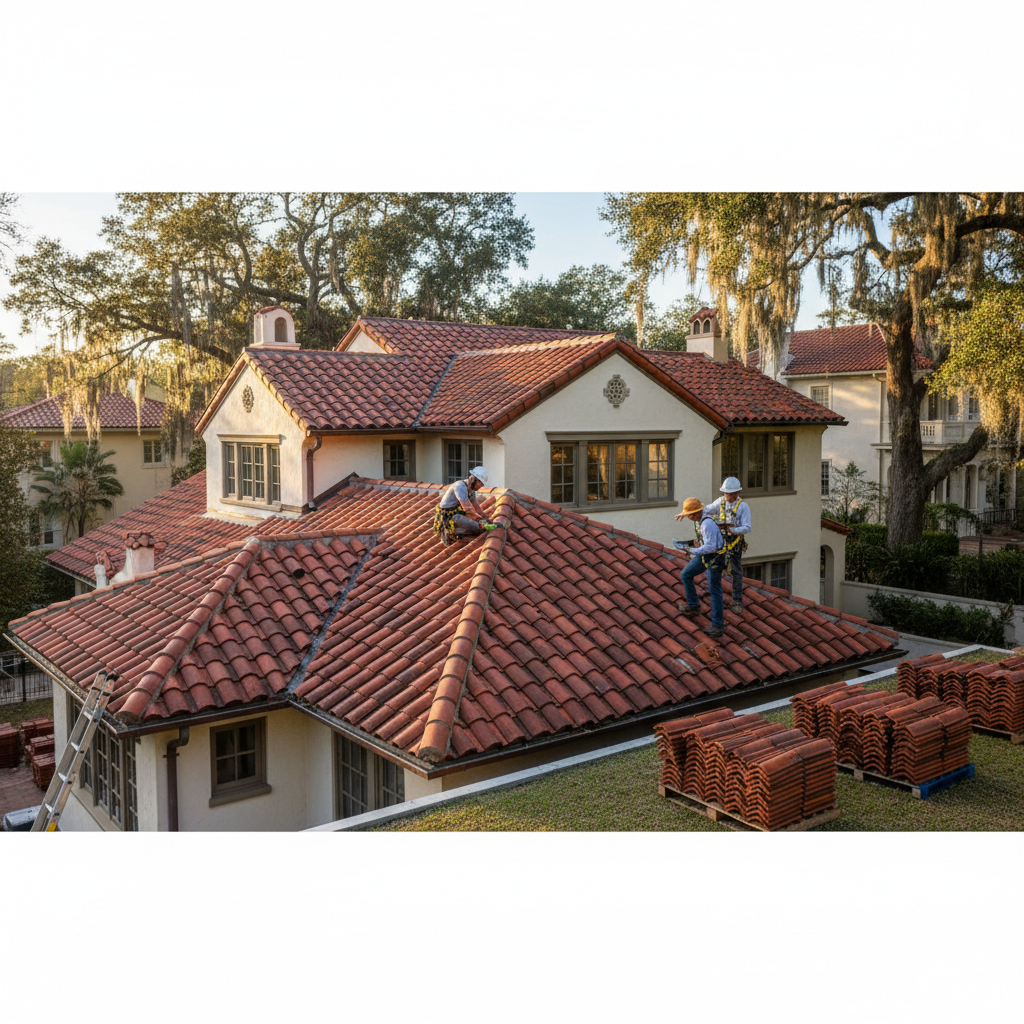
To replace a roof under strict HOA or historic district rules, get the written approval before you get the building permit, and make your application match the rules on paper. In a Florida homeowners' association (HOA), that means reading your declaration and architectural guidelines, picking a product the documents already allow, and submitting a complete request to the architectural review committee. In a City of Tampa historic district, it means getting a Certificate of Appropriateness (COA), which staff can often issue for a like-for-like roof that keeps the existing roofline.
Most delays come from treating these approvals as an afterthought. A contractor can be scheduled, materials can be ordered, and the job still can't start because the HOA hasn't met or the historic preservation office wants a material sample. The rest of this guide covers what each set of rules actually controls, what Florida law limits, and how to move an application through without a fight.
Key Takeaways
- An HOA can only regulate what its recorded declaration or published guidelines say it can. Florida Statutes section 720.3035 limits architectural review to authority "specifically stated or reasonably inferred" in those documents.
- If a Florida HOA denies your roof request, it must tell you in writing which rule it relied on and which part of the project doesn't conform. A vague "no" doesn't meet the statute.
- Every Florida HOA must adopt hurricane protection specifications, and those cover roof systems recognized by the Florida Building Code that meet ASCE 7-22. A board can't deny a request that conforms to its own specifications.
- In Tampa's local historic districts (Hyde Park, Seminole Heights, Tampa Heights and Ybor City), a COA is required before roof work. Staff can approve replacement with approvable materials and no change to the roofline. A material change or roofline change goes to a public hearing.
- A National Register of Historic Places listing alone puts no federal restrictions on a private owner's roof. Local district designation is what creates the review.
What can a Florida HOA actually control about a roof replacement?
A Florida HOA can control what its governing documents give it power to control, and no more. Under Florida Statutes section 720.3035(1), an association's or architectural committee's review authority extends only as far as it is specifically stated or reasonably inferred in the declaration or published guidelines, and standards must be applied the same way to every owner.
In practice, HOA roof rules usually cover visible choices: material type (shingle, tile or metal), color or color family, profile, and sometimes a specific manufacturer line. Some declarations require the roof to match neighboring homes or an existing "unified building scheme." Most say nothing about underlayment, fasteners or decking, because those aren't visible and are governed by the Florida Building Code and your permit.
Section 720.3035(2) adds a protection owners often miss: if the declaration lists options for materials, design or location, the association can't stop you from choosing among those listed options. If the guidelines approve three shingle colors, the board can't decide it only likes one of them this year.
Who pays and who replaces also depends on the documents. In many condominiums and some townhome communities, the declaration makes the roof the association's responsibility, which turns the question into a building-wide project rather than an individual application. Check that before you collect bids.
Can an HOA deny a stronger, hurricane-rated roof?
A Florida HOA generally can't deny a roof that conforms to the hurricane protection specifications it is required to adopt. Section 720.3035(6), as amended in 2024, requires every HOA board or committee, regardless of when the community was created, to adopt hurricane protection specifications for each structure on a parcel. Those specifications can set color and style, but they must comply with the applicable building code.
The statute's definition of hurricane protection expressly includes "roof systems recognized by the Florida Building Code which meet ASCE 7-22 standards," alongside items such as impact windows, storm shutters and reinforced garage doors. Under section 720.3035(6)(b), the board may not deny an application that conforms to its specifications, notwithstanding other provisions in the governing documents. The board can still require adherence to an existing unified building scheme.
The useful move for a homeowner: ask the management company for the community's adopted hurricane protection specifications before choosing a product. If your proposed roof fits them, you're on firm ground. If the community hasn't adopted any yet, point that out in writing, since the statute says the board must.
How do you get HOA approval for a new roof without delays?
The fastest HOA approvals come from complete applications that mirror the community's own rules. Boards and architectural committees often meet monthly, so an incomplete packet can cost you a full cycle.
- Pull the documents. Get the recorded declaration, the architectural guidelines and the adopted hurricane protection specifications. Note any required forms, deposits or neighbor-notice steps.
- Choose from the approved list. Pick a material, manufacturer line and color the guidelines already name. Your contractor can provide product data sheets and a physical sample or color chip.
- Submit a full packet. Include the application form, the signed contract or proposal showing scope, the product name and color, photos of the current roof, and any manufacturer specifications the form requests.
- Get the decision in writing. An approval letter protects you later. A denial must, under section 720.3035(4)(a), state with specificity the rule or covenant relied on and the part of the project that doesn't conform.
- Then pull the permit. HOA approval doesn't replace a building permit, and a building permit doesn't override HOA rules. You need both.
If a denial looks inconsistent with the documents, the written reasons make it easier to fix the application or challenge the decision. Section 720.3035(4)(b) lets an owner harmed by an unreasonable, knowing and willful infringement of these rights recover damages, costs and reasonable attorney's fees. That's a legal question for a Florida attorney, but it's leverage worth knowing about before a dispute escalates.
What does a Tampa historic district require before a roof replacement?
In the City of Tampa's local historic districts, a Certificate of Appropriateness (COA) is required before roof work starts. The city's Architecture Review and Historic Preservation office lists four districts: Ybor City, Hyde Park, Seminole Heights and Tampa Heights. The Architectural Review Commission (ARC) and the Barrio Latino Commission (BLC) review COA applications, and applications are submitted online through the city's Accela portal.
The city's ARC/BLC submission requirements list "repair or replacement of roof with approvable materials and with no change in roof line" as work eligible for administrative (staff) approval. For staff review, the city asks for a signed, notarized application, an agent authorization affidavit if your contractor applies for you, material selections and any exhibits staff needs. Work that changes the roofline, or uses a material that doesn't fit the building, goes to a regular public hearing, which runs on a fixed monthly calendar with public notice at least 30 days before the hearing.
The district design guidelines explain what "approvable" means. Both the Hyde Park and Seminole Heights guidelines say roofing should be replaced with materials similar to the original in size, color and texture, and that the original roofline may not be altered. Both note that sawn wood shingles and metal roofing were historically common, clay tile appeared on Mediterranean Revival buildings, and asphalt shingles came later. The Hyde Park guidelines show 5V-crimp sheet metal, patterned interlocking metal and clay tile as appropriate examples.
Roof edges matter as much as the roof surface. Both sets of guidelines say original eave details, such as exposed rafter tails and brackets, should be retained or repaired, and both state that metal or synthetic soffits and fascia are not compatible with the district's character. If your reroof includes fascia or soffit work, plan for wood.
How do HOA rules and historic district rules compare for a roof?
HOA rules and historic district rules both control what a roof looks like, but they come from different legal sources and work differently.
| Question | Florida HOA | City of Tampa historic district |
|---|---|---|
| Source of authority | Recorded declaration and published guidelines (Fla. Stat. 720.3035) | City ordinance and adopted district design guidelines |
| Who reviews | HOA board or architectural review committee | ARC/BLC staff, or the ARC or BLC at a public hearing |
| What you get | Written approval from the association | Certificate of Appropriateness |
| Typical focus | Material type, color, consistency with neighbors | Historic character: material similar in size, color and texture; roofline; eaves, fascia and soffits |
| Fast path | Product and color already on the approved list | Staff approval for approvable materials with no roofline change |
| Denial rules | Must cite the specific rule and the non-conforming element in writing | Set by the city's review process; a hearing is the path for non-staff items |
| Hurricane-rated upgrades | Can't deny a request that meets the HOA's adopted hurricane protection specifications | Still reviewed for appearance; ask staff early about materials |
| Solar panels | Can't be prohibited; HOA may pick roof location within the statute's limits (Fla. Stat. 163.04) | COA required; placement not visible from the front street is the approvable path in Hyde Park and Seminole Heights |
Some homes sit under both. A house in a historic district can also be in an HOA or a deed-restricted neighborhood, and each approval is separate. Start with whichever review body meets less often.
Does a National Register listing restrict your roof?
A National Register of Historic Places listing, by itself, doesn't restrict what a private owner does with a roof. The National Park Service states that listing places no federal restrictions on non-federal owners unless the project receives federal assistance, and that owners may do what they wish within the framework of local laws or ordinances.
The local ordinance is what counts. A Tampa home inside one of the city's designated local districts needs a COA whether or not it's on the National Register. A National Register-listed home outside a local district usually faces no historic roof review at all, though an HOA may still apply. If you're unsure which applies to your address, Tampa's Architecture Review and Historic Preservation office can confirm it: (813) 274-3100, option 3.
What should your roofing contractor handle for an HOA or historic home?
Your roofing contractor should handle the paperwork that depends on product details: manufacturer data sheets, color samples, scope of work, the city COA application as your authorized agent where allowed, and the building permit after approvals are in hand. You, as the owner, usually have to sign the HOA application and the notarized historic application.
Ask any contractor three things up front. Have they submitted to your HOA or to Tampa's ARC before? Will they hold the start date until approvals are in writing? And can they offer an approvable material that still meets current wind requirements, such as a 5V-crimp metal roof in a district where metal was historically common?
Hytz Roofing, a Florida-licensed roofing contractor (license #CCC1332551) with GAF Master Elite and President's Club recognition and more than 30 years in the trade, builds approval time into the schedule for these projects. If you're planning a roof in an HOA or historic neighborhood, our Tampa roof replacement services page covers materials, permitting and how a project runs from inspection to final sign-off.
Frequently Asked Questions
Can my HOA make me use a more expensive roofing material than the one I want?
A Florida HOA can require a material only if its declaration or published guidelines give it that authority. If the documents require tile, for example, the board can enforce that rule, but it must apply it equally to every owner. If the documents list several acceptable options, Florida Statutes section 720.3035(2) says the association can't stop you from choosing any of them, including the less expensive one.
What happens if I replace my roof without HOA or historic approval?
Replacing a roof without required approval exposes you to enforcement. An HOA can pursue remedies under its declaration, which may include fines or a demand to bring the roof into compliance. In a Tampa historic district, the design guidelines require a COA before roof work starts, so unapproved work risks having to be corrected to meet the guidelines. Because a roof is expensive to redo, getting approval first is far cheaper than fixing it afterward.
Can a Tampa historic district deny a metal roof?
A Tampa historic district can require that a replacement roof suit the building's historic character. The Hyde Park and Seminole Heights guidelines describe metal roofing as historically common, and Hyde Park's guidelines show 5V-crimp and patterned sheet metal as appropriate examples. Whether metal is approvable on a particular house depends on the original roofing and the architectural style, so ask staff before you commit to a material.
Can an HOA block solar panels when I replace my roof?
A Florida HOA cannot prohibit solar collectors. Under Florida Statutes section 163.04, a deed restriction or covenant can't ban them, though the association may decide the specific roof location if the panels face within 45 degrees east or west of due south and its choice doesn't impair the system's effective operation. Historic district placement rules are separate and still require a COA in Tampa's districts.
Sources
- Florida Statutes section 720.3035, Architectural review: Florida Senate
- Florida Statutes section 163.04, Energy devices based on renewable resources: Florida Senate
- City of Tampa, Historic Preservation information
- City of Tampa, ARC/BLC application submission requirements
- City of Tampa, Hyde Park Historic District design guidelines
- City of Tampa, Seminole Heights Historic District design guidelines
- National Park Service, National Register of Historic Places FAQs