Hail Damage Roof Signs Every Tampa Bay Homeowner Should Know
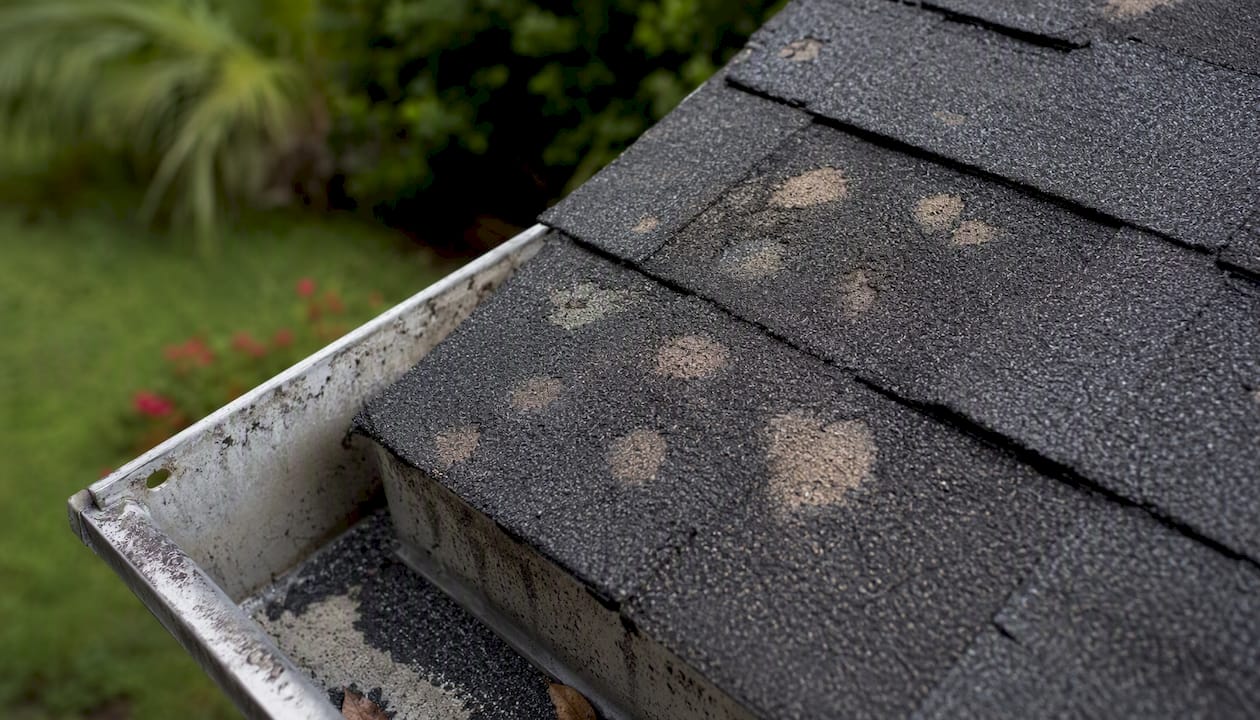
The most reliable hail damage roof signs are granule loss visible in your gutters, soft “bruised” spots on asphalt shingles, and dents on metal components like gutters, AC condenser fins, and flashings. If you spot any of these after a storm, here’s what to do right now:
- 🚨 Stay off the roof. Hail weakens shingles and can make surfaces slippery and unstable.
- 📋 Document from the ground. Photograph your gutters, downspouts, AC unit, vehicles, and any visible roof slopes before anything is cleaned up.
- 💬 Call for a certified inspection. A professional will use collateral-surface analysis, test-square counts, and provide a written report — exactly what your insurer needs.
A certified inspector will check for impact evidence on non-roof surfaces first, then examine ridge and valley areas (the most vulnerable spots), and finally open representative 100-square-foot test squares on each slope to count damaged shingles. That report becomes your primary claim document.
Key Takeaways
Granule loss in gutters, soft bruised spots on shingles, and dents on metal components are the most reliable hail damage roof signs — document them from the ground before calling a certified inspector.
| Point | Details |
|---|---|
| Start from the ground | Check gutters, AC unit, vehicles, and siding for dents before touching the roof. |
| 1.0-inch hail is the damage threshold | The NWS severe threshold is quarter-size (1.0 inch); older roofs sometimes sustain damage to varying degrees below that size. |
| Bruising is functional damage | A soft, spongy spot on a shingle means a fractured mat that shortens roof life, even if it’s invisible from the ground. |
| Document before anything is cleaned | Photograph granule piles, dents, and storm details with timestamps; save NWS storm reports for your claim. |
| Hytzroofing provides certified inspections | As a GAF Master Elite® Contractor, Hytzroofing delivers written inspection reports and insurance claim support in Tampa Bay. |
Table of Contents
- 1. Safe ground checks you can do right now around your property
- 2. What to look for on asphalt, metal, tile, and wood roofs
- 3. How gutters and downspouts reveal shingle granule loss
- 4. How to tell hail damage apart from wear, blistering, or foot traffic
- 5. When should you call a roofing professional or your insurer?
- 6. Step-by-step: how to document damage and file your insurance claim
- 7. What hail size actually damages a roof?
- 8. Do’s and don’ts after a hailstorm 🚨
- What Tampa Bay homeowners get wrong after a hailstorm
- Hytzroofing certified inspections for Tampa Bay storm damage
- Sources
- FAQ
1. Safe ground checks you can do right now around your property
You don’t need to climb anything to gather useful evidence. Start at the driveway and work your way around the house.
Look at your car first. Fresh dents on the hood, roof, or trunk of a vehicle parked outside during the storm are one of the clearest indicators that hail was large enough to cause roof damage. The same logic applies to your AC condenser: bent or flattened fins on the outdoor unit suggest meaningful impact force.
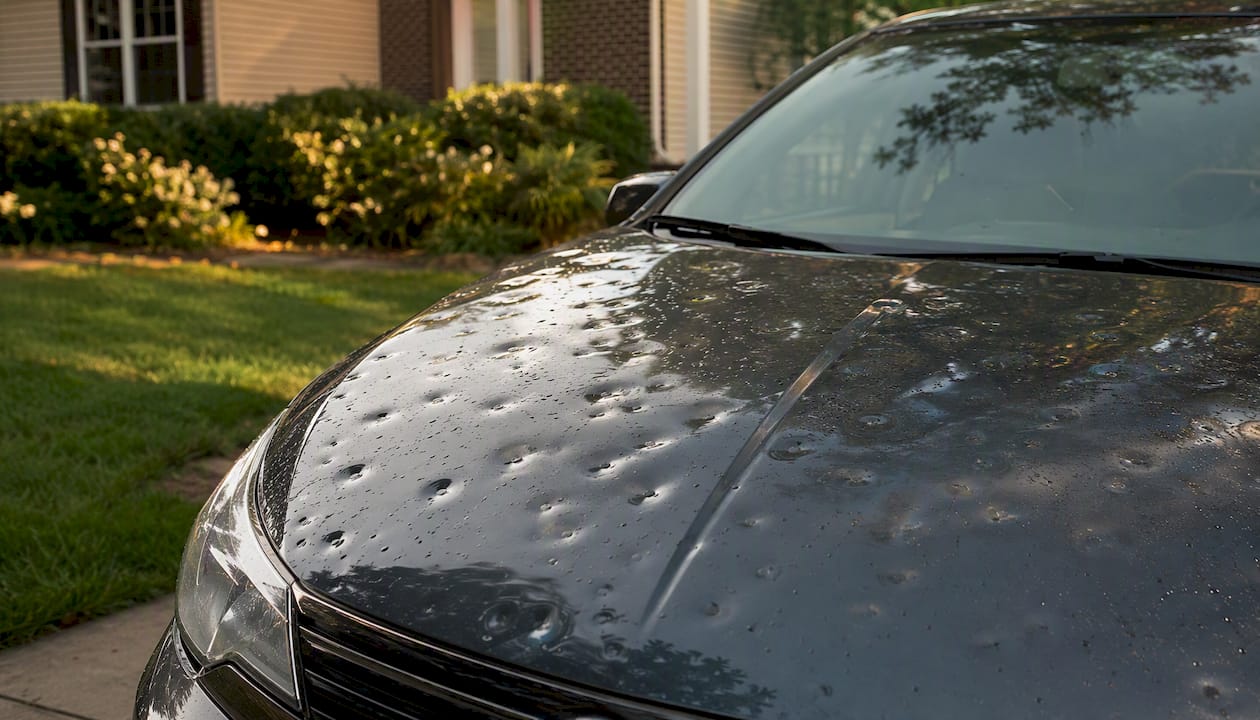
Walk the perimeter and check gutters and downspouts for visible dents along the top edge. Look at wood fencing, aluminum siding, and any painted metal surfaces for circular impact marks. These collateral dents act as a proxy for hail size and help establish that damaging hail actually fell at your address — a key requirement for any insurance claim.
Pro Tip: Take wide-angle shots of each side of your house, then close-ups of every dent or mark you find. Turn on your phone’s timestamp feature before you start. Note the wind direction during the storm if you remember it — slopes facing the storm tend to show more damage.
🚨 Stay clear of areas where debris may still be loose overhead, and never set up a ladder near a power line.
2. What to look for on asphalt, metal, tile, and wood roofs
Different roofing materials show hail impact in different ways. Knowing what to look for on your specific roof type saves time and prevents you from misreading normal wear as storm damage.
Asphalt and composition shingles are the most common roof type in Tampa Bay, and they show damage in three ways. First, look for circular dark spots where granules have been knocked off, leaving the shiny asphalt mat exposed. Second, check for soft “bruise” spots. A bruised shingle has a fractured reinforcing mat underneath — you can feel it by pressing gently, and it feels slightly spongy or soft compared to the firm surrounding area. InspectApedia notes that bruised shingles may not be visible from the ground but can be felt on close inspection, and they represent functional damage because the fractured mat shortens the shingle’s service life. Third, look for exposed fiberglass substrate where the mat is fully compromised.
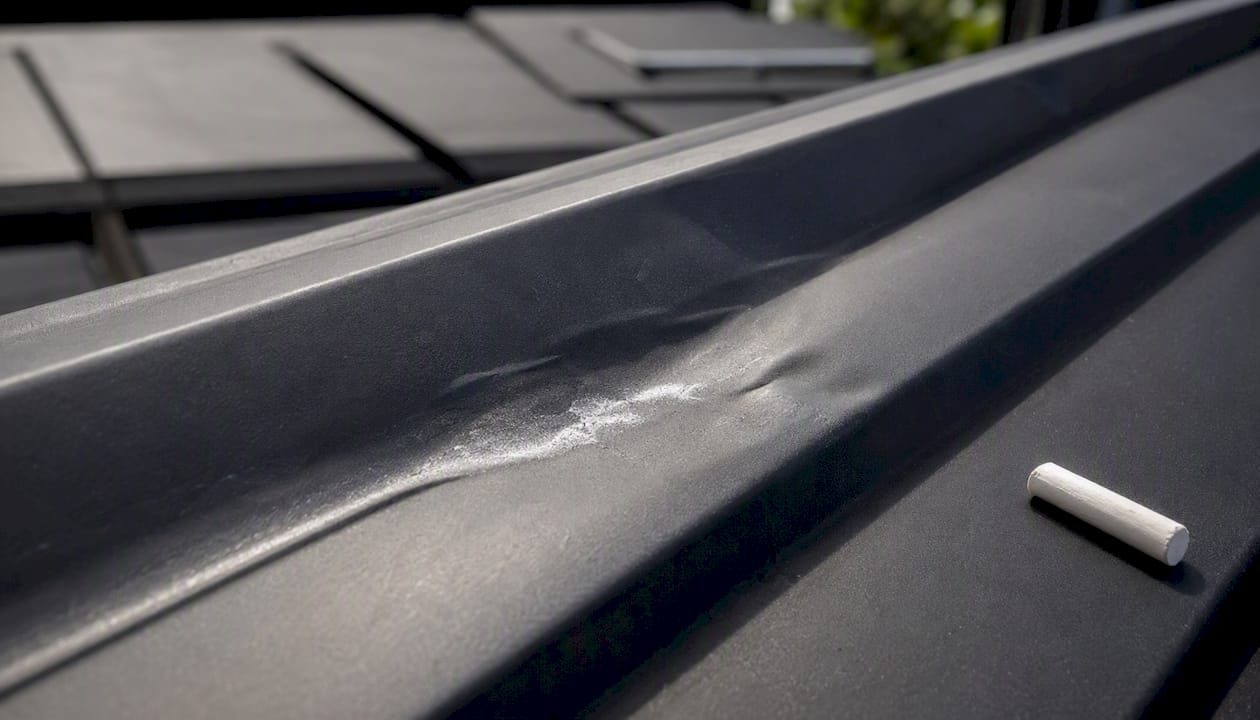
Metal roofing and flashings show dents, scouring of the paint or protective coating, and occasionally loosened fasteners around seams. Progressive’s homeowner guidance notes that metal roofs are more resistant to hail than asphalt in many cases, but large hailstones can still dent seams and damage coatings. A quick chalk test works well here: rub chalk lightly across a metal surface and wipe it off — fresh dents will hold chalk in the low point and stand out clearly.
Tile and concrete roofs — common throughout Tampa Bay — show chips, cracks, or fractures with fresh, sharp edges. Old weathered chips look rounded and discolored; fresh hail fractures have clean, bright edges and sometimes a small circular impact point at the center.
Wood shingles and shakes show fresh orange-brown splits with sharp edges and a visible impact mark at the origin point. Weathered splits, by contrast, look gray and rounded at the edges.
Pro Tip: Leave roof walking to a licensed professional. Hail-damaged shingles are more fragile than they look, and foot traffic can create new damage that complicates your claim. Ask about drone inspection — it gives a full roof view without anyone stepping on the surface.
3. How gutters and downspouts reveal shingle granule loss
Gutters are one of the most useful places to check after a hailstorm, and you never have to leave the ground.
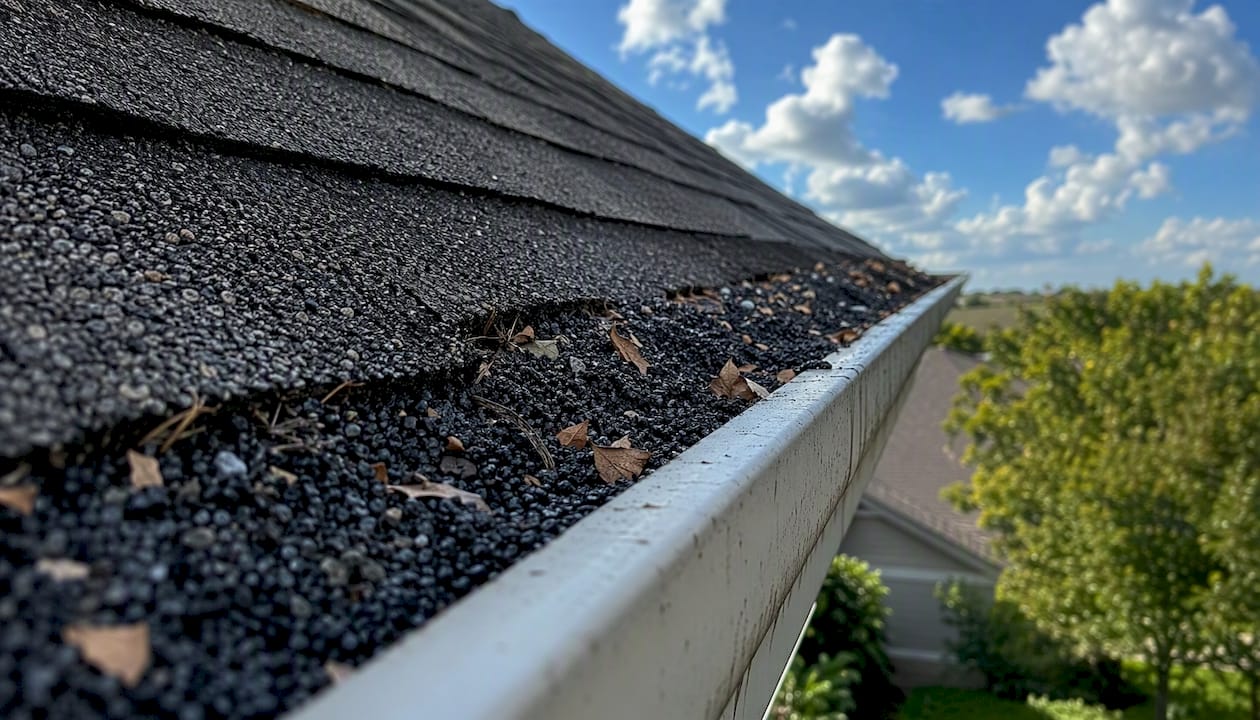
After a significant hail event, granules knocked off asphalt shingles wash down the slope and collect at the gutter outlet and in the downspout splash block. A large, fresh pile of dark granules — especially if it wasn’t there before the storm — is a strong indicator of impact-related granule loss. InspectApedia confirms that granule loss visible in gutters or downspouts and fresh-looking exposed asphalt are reliable ground-level indicators of shingle impact from hail.
Look for directional patterns too. Slopes facing the storm’s wind direction typically show more granule loss than sheltered slopes. If your south-facing or west-facing gutters have heavy accumulation and the north-facing side is clean, that pattern is consistent with a directional hail event — and it’s worth noting in your documentation.
📋 Document granule piles before rain washes them away. Scoop a small handful onto a white sheet of paper and photograph it next to a coin or ruler for scale. Note which gutter (and which roof slope it drains) in your photo caption. This kind of labeled evidence carries real weight with adjusters.
Check chimney caps, pipe boots, and ridge vents while you’re at it. Dents or scouring on these metal components, combined with granule accumulation in the gutters below, builds a consistent picture that hail was damaging enough to affect the shingles. Larry’s Gutters explains how gutters absorb hail impact and what to look for in Florida specifically.
Pro Tip: If your gutters have gutter guards, check the guards themselves for dents or punctures. They often show impact marks more clearly than the gutter body.
4. How to tell hail damage apart from wear, blistering, or foot traffic
Not every mark on a roof is hail damage. Misidentifying normal wear as storm damage — or missing real damage because it looks like wear — both create problems. Here’s how to read the difference.
The most reliable method is to compare roof signs with collateral damage on nearby surfaces. If your car has fresh dents and your AC fins are bent, that confirms hail fell with enough force to damage roofing materials. Without that corroborating evidence, a circular dark spot on a shingle could be a blister, a manufacturing defect, or foot-traffic bruising. Haag Global recommends using collateral-surface analysis alongside a test-square protocol to determine whether hailfall was capable of causing observed roof conditions and to distinguish hail damage from other causes.
| Condition | Pattern | Feel | Distribution |
|---|---|---|---|
| Hail impact | Circular spots, random across slope | Soft/bruised center, granule loss | Random, concentrated on storm-facing slopes |
| Normal granule wear | Uniform thinning, especially at edges | Firm, no soft spot | Evenly spread, worse on south-facing slopes |
| Blister rash | Raised bubbles that may pop open | Soft bubble, not a depression | Scattered, often in clusters |
| Foot traffic | Scuff marks, crushed granules in lines | Firm, no circular depression | Linear paths, near access points |
Hail impacts are typically random in placement across a slope, with each spot showing a small circular depression and missing granules at the center. Wear patterns are gradual and uniform. Blistering from trapped moisture or manufacturing defects produces raised bubbles rather than depressions. Foot-traffic damage follows linear paths near ladders or ridge access points.
When the call is close, don’t guess. A professional forensic inspection using Haag-style test squares is the right move — it removes the ambiguity and gives you a defensible, documented result.
Pro Tip: If you see damage on your roof but no collateral dents on your car or AC unit, mention that to your inspector. It doesn’t rule out hail, but it shifts the diagnostic weight toward other causes.
5. When should you call a roofing professional or your insurer?
Some situations are clear-cut. Others need a judgment call. Here are the practical triggers that tell you it’s time to pick up the phone.
Call a certified roofing professional when you see: visible granule piles in gutters after a storm, multiple circular impact spots on any roof slope visible from the ground, dents on gutters or metal components, or when local news or the National Weather Service reports golf-ball-size (1.75-inch) or larger hail in your area.
A certified inspection covers more than a visual scan. The inspector will check collateral surfaces first, then examine ridge and valley areas where shingles have less structural support and fail at lower impact forces. They’ll open test squares — typically 100 square feet per slope — to count the number of damaged shingles and determine whether the damage meets the threshold for a functional loss claim. You’ll receive a written report with photos, test-square results, and an estimated scope of damage.
Most reputable contractors offer a free initial inspection for storm damage. If the damage is confirmed, the written report goes directly to your adjuster. The inspector can also be present during the adjuster’s visit to walk through the findings together, which often leads to a more complete claim settlement.
Pro Tip: Ask any inspector you hire whether they follow Haag Global’s inspection protocol. That standard is widely recognized by insurers and adjusters, and a report built on it carries more weight than a general contractor’s walk-around.
6. Step-by-step: how to document damage and file your insurance claim
Good documentation is what separates a paid claim from a denied one. Follow this sequence.
- Secure safety first. Stay off the roof. Walk the perimeter and photograph collateral damage — vehicles, AC unit, gutters, siding — before anything is moved or cleaned.
- Record the storm details. Note the date, approximate time, and storm duration. If hail fell, photograph it next to a ruler, a coin, or a common object (a quarter is 1 inch in diameter) to document size. Save any local NWS storm reports or severe-weather alerts for your area — the Insurance Information Institute notes that recorded storm events and local reports help validate claims.
- Collect granule evidence. Photograph gutter accumulation before rain washes it away. Scoop a sample onto paper and photograph it with a scale reference.
- Get a written inspection report. Request a report from a certified roofer that lists test-square results, the number of impacted shingles per slope, and photo documentation. This is your primary claim document.
- File promptly. Contact your insurer as soon as you have dated photos and a contractor report. Most policies have a claim-filing window, and delays can complicate coverage. Keep copies of every communication.
- Temporary repairs. If you have active leaks, a licensed contractor can install a temporary tarp. Document the tarp installation with photos and keep the invoice. Licensed temporary repairs are generally acceptable to insurers when documented separately — but avoid any permanent repairs until your adjuster has completed their inspection.
Pro Tip: Pull up the NWS storm report for your zip code at weather.gov and save a screenshot. Adjusters use these reports to verify that a qualifying hail event occurred at your address on the date you’re claiming.
7. What hail size actually damages a roof?
Size matters, but it’s not the whole story.
The National Weather Service defines 1.0-inch (quarter-size) hail as the severe threshold — the point at which hail begins to reliably damage vehicles and roofs. Hail below that size can still cause cosmetic marks, but functional damage to roofing materials becomes much more likely at and above 1.0 inch. At 1.5–2.0 inches (golf ball to egg size), the probability of significant shingle damage increases substantially.
That said, size alone doesn’t determine outcome. IBHS research documents that roof condition and installation quality play a major role in whether hail causes functional damage or just cosmetic marks. An older roof with weathered, brittle shingles can sustain functional damage from hail that would leave a newer roof with only surface marks. Low-support areas like ridges and valleys are also more vulnerable — shingles there flex more on impact and fracture at lower force thresholds.
The practical takeaway: if hail reached 1.0 inch or larger at your address, a professional inspection is warranted regardless of what you can see from the ground. The test-square and collateral-surface checks matter more than the reported hail size alone.
8. Do’s and don’ts after a hailstorm 🚨
Do:
- Stay off the roof and inspect from the ground only.
- Photograph all collateral damage (vehicles, AC unit, gutters, siding) immediately.
- Move vehicles under cover if another storm is forecast.
- Contact a licensed contractor for emergency tarping if you have active leaks.
- Save NWS storm reports and any local severe-weather alerts for your records.
- File your insurance claim promptly once you have dated photos and a written inspection report.
Don’t:
- Climb the roof if you’re not a trained roofing professional. Hail-damaged shingles are fragile, and a fall risk is real.
- Make permanent repairs before your adjuster completes their inspection — it can void coverage for that portion of the damage.
- Sign a contractor agreement or Assignment of Benefits (AOB) document without reading it carefully and getting a written estimate first.
- Assume small hail caused no damage. On an older or weathered roof, even sub-inch hail can accelerate granule loss and shorten service life.
- Delay documentation. Granule piles wash away, dents get cleaned up, and storm reports get harder to retrieve as time passes.
What Tampa Bay homeowners get wrong after a hailstorm
Tampa Bay’s hail events are different from what most national guides describe. Our storms tend to be fast-moving, wind-driven, and directional — meaning one side of your roof can take a beating while the other looks fine. That asymmetry trips up a lot of homeowners who do a quick visual check from the driveway, see nothing obvious, and assume they’re in the clear.
The biggest mistake I see is homeowners walking their own roofs. It’s understandable — you want to know what’s up there. But on a hail-damaged asphalt roof, foot traffic creates new bruising and granule loss that can muddy the evidence picture. Your adjuster may not be able to separate storm damage from walk-around damage, and that ambiguity rarely resolves in the homeowner’s favor.
The second mistake is waiting. Tampa Bay’s rainy season runs from June through September, and a small hail puncture or bruised shingle that goes uninspected can become a leak within weeks. By the time water shows up on your ceiling, you’re dealing with secondary damage — and insurers scrutinize secondary damage claims much more closely than primary storm claims.
Salt-coast corrosion is a real factor here too. Once hail dents a metal component — a gutter, a flashing, an AC fin — the protective coating is compromised. In our coastal environment, that exposed metal starts corroding faster than it would inland. Document those dents and get them addressed quickly.
If your insurer sends a one-line denial, don’t accept it as final. A written inspection report from a certified contractor, built on a recognized protocol, gives you the documentation to request a re-inspection or file a supplemental claim. We’ve seen that process work for Tampa Bay homeowners more times than I can count.
Hytzroofing certified inspections for Tampa Bay storm damage

After a hailstorm, the last thing you need is uncertainty about your roof. Hytzroofing is a GAF Master Elite® Contractor — a credential held by fewer than 2% of roofing contractors in North America — with direct experience handling hail and storm damage claims throughout Tampa Bay and Central Florida.
Our certified inspections include collateral-surface analysis, test-square documentation, and a full written report formatted for insurance adjusters. We can be present during your adjuster’s visit and help document the complete scope of damage so nothing gets missed. If your roof needs repair or replacement, we offer flexible financing options and handle the claim process alongside you.
📋 Ready to find out what’s actually on your roof? Request your storm damage inspection today — no pressure, just answers.
Sources
These are the primary sources used throughout this guide. Save the links for reference during your inspection or insurance claim.
FAQ
How do you identify roof damage from hail?
Look for circular dark spots with missing granules on asphalt shingles, soft bruised areas you can feel by pressing gently, and dents on gutters, flashings, or AC units. Granule accumulation in gutters after a storm is one of the most reliable ground-level indicators.
Can 0.75-inch hail damage a roof?
Sub-inch hail rarely causes functional damage to a new roof in good condition, but the NWS severe threshold is 1.0 inch. On an older or weathered roof, hail can accelerate granule loss and bruise already-brittle shingles — a professional inspection is still worth requesting if your roof age or condition makes you concerned.
What is the 25% rule for roofing?
If a hail inspection finds widespread damage across multiple slopes, your contractor should flag whether this threshold applies under your local code.
How do you prove hail damage on a roof for an insurance claim?
The strongest evidence package includes timestamped photos of collateral dents (vehicles, AC unit, gutters), granule accumulation photos with a scale reference, a written inspection report from a certified roofer with test-square results, and a saved NWS storm report confirming hail at your address on the claim date. Haag Global’s protocol of collateral-surface analysis plus test squares is the standard insurers and adjusters recognize.