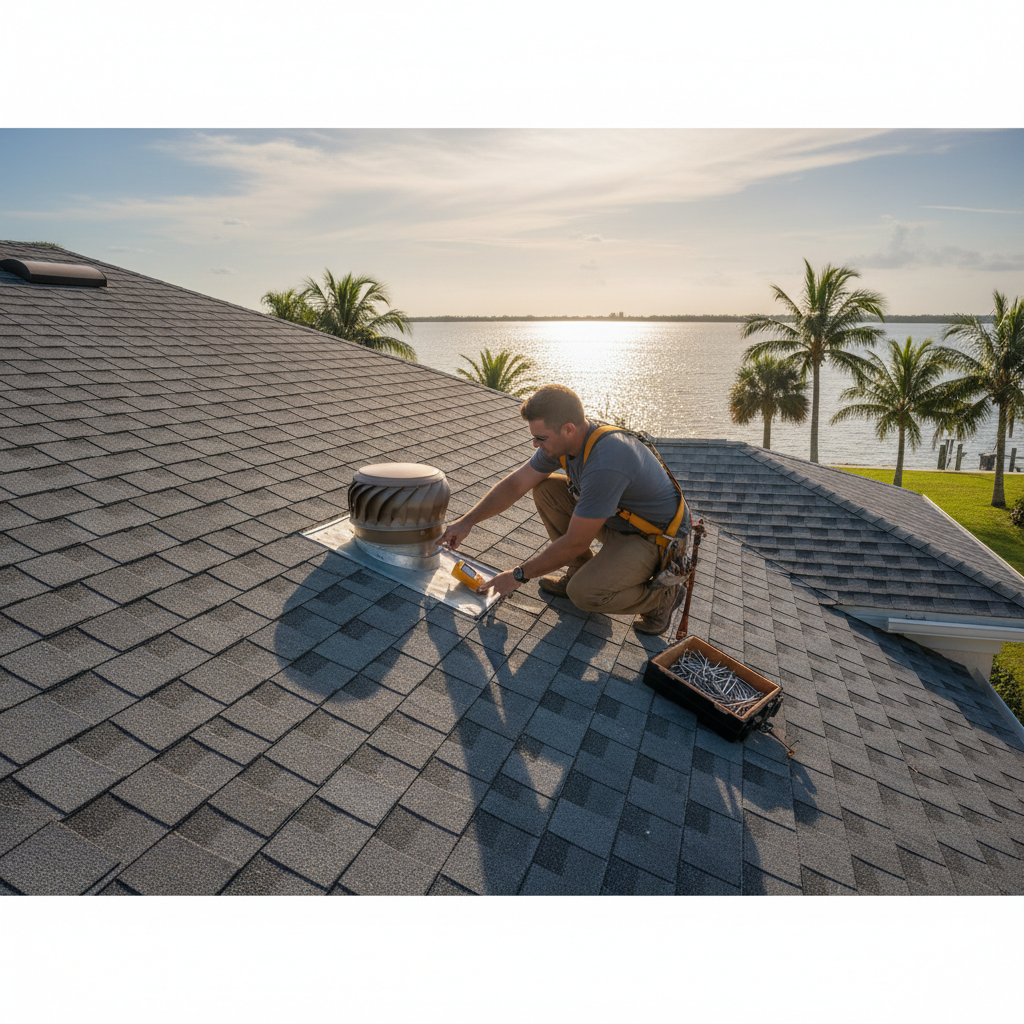
Living near saltwater doesn't change the shingle much, but it changes almost everything that holds the shingle down. Salt air attacks metal, so a coastal roof needs corrosion-resistant nails, drip edge and flashing, and heavy coastal wind calls for a shingle with a high wind classification (ASTM D7158 Class H or ASTM D3161 Class F) installed with a high-wind nailing pattern and sealed edges. For Tampa Bay homes within 3,000 feet of the coast, the 2026 Florida Building Code adds new fastener corrosion rules that take effect on December 31, 2026.
Key Takeaways
- Salt spray rarely ruins the asphalt shingle itself; it corrodes the nails, drip edge, flashing and vent hardware, and that metal is usually what fails first.
- Florida code requires every asphalt shingle to carry a wind classification matched to your site's design wind speed. GAF states that all of its shingles test to Class H, the top D7158 class.
- A waterfront lot with open water upwind can fall outside the "standard conditions" the D7158 wind classes assume, so the shingle class should be checked against that exposure, not just the map speed.
- The 9th Edition (2026) Florida Building Code adds Section 1711 (and R332 in the residential code): fasteners within 3,000 feet of the coastal shoreline must meet new corrosion-resistance levels, with stricter rules inside 300 feet. FRSA, Florida's roofing contractors association, warns that many standard galvanized shingle nails may not qualify.
- Manufacturer warranties generally don't cover the metal. The GAF roofing system warranty excludes metal work and flashings, so corrosion-grade metal is something you have to specify, not something a warranty backstops.
What changes about a shingle roof when you live near saltwater?
Salt-laden air settles on the roof, mixes with humidity and eats through the protective coating on steel. Asphalt and fiberglass don't rust, which is why a coastal shingle roof often looks fine from the street while the problems build at the edges: drip edge that streaks orange, nail heads that rust through, step flashing that pits along a wall.
The guidance from federal and insurance-research sources is consistent about distance. The Federal Emergency Management Agency (FEMA) Coastal Construction Technical Fact Sheet 7.3 recommends stainless steel nails for shingle roofs within 3,000 feet of saltwater. The Insurance Institute for Business & Home Safety (IBHS) FORTIFIED Home program requires hot-dip galvanized or stainless steel fasteners for homes within 3,000 feet of a saltwater shoreline. That 3,000-foot figure is now written into Florida's code as well (more on that below).
So the practical shift is this: on a coastal home you're buying a metal specification as much as a shingle. Ask what the nails, drip edge, valley metal and flashing are made of, because a premium shingle fastened with ordinary hardware can loosen at the connection points long before the shingle wears out.
What wind rating do shingles need for a coastal Tampa home?
The Florida Building Code, Residential (FBC-R) requires asphalt shingles to be tested to ASTM D3161, ASTM D7158 or TAS 107, and the required class depends on the ultimate design wind speed (Vult) mapped for your site. Hillsborough County's development-services GIS viewer maps the Risk Category II design speeds for the 8th Edition (2023) code, built on ASCE 7-22, and draws a 140 mph line through the county; homes on one side of it fall in a 140 mph zone. The Florida Building Commission's ASCE 7-22 fact sheet notes peninsula wind speeds didn't change from the previous maps, though maps get modified locally, so the building department's number is the one that counts.
Here is how the two common wind tests compare. The ASTM D7158 speeds come from the Asphalt Roofing Manufacturers Association (ARMA) technical bulletin published in March 2026.
| Wind classification | Test standard | What it covers |
|---|---|---|
| Class D | ASTM D7158 (uplift) | Basic wind speed up to 116 mph |
| Class G | ASTM D7158 (uplift) | Basic wind speed up to 155 mph |
| Class H | ASTM D7158 (uplift) | Basic wind speed up to 194 mph |
| Class F | ASTM D3161 (fan-induced wind) | The highest D3161 class; accepted with D7158 Class H as the FORTIFIED minimum |
The catch for waterfront homes is in the fine print. ARMA's bulletin says those D7158 classes assume "standard conditions": wind exposure B or C, a mean roof height of 60 feet or less, and no topographic speed-up. A house facing open water across Tampa Bay or the Gulf can sit in Exposure D, which is outside those assumptions. ARMA publishes a lookup table for those cases and says some combinations need a site-specific design and a call to the shingle manufacturer. In plain terms, a shoreline home should get a Class H shingle and a contractor who has checked the exposure, not just the map.
The good news is that Class H isn't exotic. GAF states in its technical bulletin TAB-R-159 that all GAF shingles are rated ASTM D7158 Class H and ASTM D3161 Class F, and the rating is printed on the bundle wrapper, so you can check it on delivery day.
What nails does a coastal shingle roof need under the 2026 Florida Building Code?
Baseline rules haven't changed. ARMA's July 2024 nailing bulletin requires corrosion-resistant roofing nails of galvanized steel, stainless steel, aluminum or copper, with at least a 12-gauge shank, a 3/8-inch head, and enough length to penetrate 3/4 inch into the deck.
What's new is the 9th Edition (2026) Florida Building Code, effective December 31, 2026. It adds Section 1711, "Corrosion Resistance-Saltwater Environments" (repeated as Section R332 in the residential code), and the roofing chapter applies it to roofing nails, screws and clips. FRSA Technical Director Mike Silvers summarized the roofing impact in August 2026: the requirements apply within 3,000 feet of the "coastal shoreline," get stricter within 300 feet, and shingle nails fall in the "unconditioned interior, vented enclosed" exposure category. His advice to contractors is blunt: many galvanized shingle fasteners may not meet the new requirement, so purchase orders should call for nails that comply with Section 1711.1.1.2, or use stainless steel that complies with Section 1711.1.1.1.
| Distance from the coastal shoreline | Exposed fasteners (metal edge, counterflashing, visible screws) | Shingle nails (vented, enclosed exposure) |
|---|---|---|
| Within 300 ft | Stainless steel | Enhanced galvanized or better |
| 300 to 3,000 ft | Galvanized to the Section 1711 standard, or stainless | Enhanced galvanized or better |
| Beyond 3,000 ft | Section 1711 adds nothing; normal code fastener rules apply | |
The table reflects Engineering Express's August 2026 reading of Table 1711.1; it's an engineering firm's interpretation, not a code ruling. Tampa Bay adds a wrinkle, because the code doesn't define "coastal shoreline." Engineering Express reads it as a saltwater body subject to crashing waves and generally excludes inland brackish rivers and canals, while FRSA notes a possible declaratory statement asking whether those canals and rivers count. If your home sits on a canal in Apollo Beach or near the bay in South Tampa, ask the contractor how the local building official is applying Section 1711 at your address before you sign.
How should heavy coastal wind change the way shingles are installed?
A wind rating only holds if the shingle is fastened and sealed the way it was tested, and coastal guidance goes past the code minimum in several places. The building code requires the number of nails in the manufacturer's instructions but never fewer than four per strip shingle. FEMA Fact Sheet 7.3 and the FORTIFIED Home re-roofing checklist both call for six nails per shingle in high-wind installations.
The FORTIFIED Home hurricane re-roofing checklist (version 2022.1) lists the other upgrades:
- Re-nail the roof deck with 8d ring-shank nails at 4 inches on center.
- Seal the roof deck, using flashing tape over deck seams with underlayment, a two-layer #30 felt system, or a full self-adhered membrane.
- Install drip edge over the underlayment at rakes and eaves, fastened at 4 inches on center, staggered.
- Adhere starter strips at both the eaves and the rakes, either embedded in roof cement or self-adhered.
Edges matter because wind lifts a roof from its perimeter. FEMA's fact sheet adds dabs of asphalt roof cement under shingles along the rakes and at hips and ridges, and the 2026 code adds a prescriptive option of roof cement spots on each side of hip and ridge shingles as an alternative to a tested ridge product.
Does a GAF shingle warranty cover coastal wind and salt damage?
Wind, yes, if the system qualifies. Salt corrosion of the metal, no.
GAF's WindProven Limited Wind Warranty has no maximum wind speed and no named-storm exclusion. It requires GAF Timberline shingles with LayerLock Technology plus four GAF accessories: starter strips, roof deck protection, ridge cap shingles, and either a leak barrier or attic ventilation. GAF lists the term as 15 years. Under the current GAF Roofing System Limited Warranty (document RESWT163L-0426, for products installed after January 1, 2025), shingles without LayerLock get wind coverage only up to 130 mph with "Special Installation" (six nails per shingle and GAF starter strip at eaves and rakes) or 110 mph without it.
The same warranty excludes metal work and flashings from coverage, and it excludes damage caused by improper fastening. Corroded drip edge or pitted flashing on a waterfront house won't be a shingle warranty claim. That's the strongest argument for paying for stainless or code-compliant coastal hardware at installation instead of hoping the warranty catches it later.
What should a coastal Tampa homeowner ask a roofer before signing?
Bring these to every estimate appointment and get the answers written into the contract:
- How far is my home from the coastal shoreline for Section 1711 purposes, and what nail and metal specification are you using because of it?
- What wind class is printed on this shingle's bundle, and did you check my exposure category or just the wind speed map?
- Are you nailing six per shingle and sealing the starter at both eaves and rakes?
- What metal is the drip edge and flashing, and is it compatible with the fasteners so it won't corrode where they touch?
- Which manufacturer warranty will this roof qualify for, and what does it exclude?
Hytz Roofing is a GAF Master Elite and GAF President's Club contractor (Florida license #CCC1332551) with more than 30 years of experience on Tampa Bay roofs. Our page on asphalt shingle roofing in Tampa explains how we spec a full shingle system, and we'll walk through the coastal fastener and wind questions above on any estimate.
FAQ
Do I have to switch from shingles to metal or tile if I live on the water?
No. Asphalt shingles remain code-approved for coastal Florida homes as long as they carry the required wind classification and are installed with corrosion-resistant fasteners and edge metal suited to the location. A waterfront roof built with Class H shingles, six-nail fastening, sealed edges and stainless or Section 1711-compliant hardware addresses the two coastal threats directly. Metal and tile have their own coastal requirements and aren't automatically better.
My house is a few miles inland. Do the saltwater rules still apply?
The new Section 1711 corrosion rules apply only within 3,000 feet of the coastal shoreline, so a home a few miles inland follows the normal fastener requirements. The wind requirements still apply everywhere: your shingle must carry the class required for your mapped design wind speed, and Hillsborough County's maps place part of the county inside the 140 mph line for typical homes. Inland homes also skip the Exposure D question that waterfront lots face.
Are aluminum or copper roofing nails a good option near saltwater?
ARMA lists aluminum and copper as acceptable corrosion-resistant roofing nail materials, and FRSA notes that Section 1711 sets minimums for ferrous fasteners (steel) and doesn't address nonferrous ones like copper or aluminum. Whether they're the right choice depends on the shingle manufacturer's instructions and on compatibility with the drip edge and flashing, since mixing dissimilar metals can speed up corrosion at the point of contact.
Sources
- FRSA: A Roofing Perspective on the New FBC Corrosion Resistance Requirements (Mike Silvers, August 2026)
- FRSA: Changes in the 2026 9th Edition of the Florida Building Code (effective date)
- Engineering Express: Coastal Corrosion Requirements and the 2026 Florida Building Code (August 2026)
- ARMA: Using ASTM D7158 Where Standard Conditions Do Not Apply (March 2026)
- ARMA: Nail Application of Asphalt Shingles (July 2024)
- FEMA Home Builder's Guide to Coastal Construction, Technical Fact Sheet 7.3: Asphalt Shingle Roofing for High-Wind Regions
- IBHS FORTIFIED Home Hurricane Re-Roofing Checklist (v2022.1)
- U.S. DOE Building America Solution Center: Asphalt Shingle Roofs
- GAF TAB-R-159: Florida Building Code, Residential, Asphalt Shingle Wind Ratings
- GAF Roofing System Limited Warranty (RESWT163L-0426)
- GAF WindProven Limited Wind Warranty
- Florida Building Commission: Wind Loads, Impacts from ASCE 7-22 (June 2024)
- Florida Building Commission: 2026 FBC Significant Changes
- Hillsborough County DSD GIS: Wind Borne Debris Category 2 (ASCE 7-22) layer