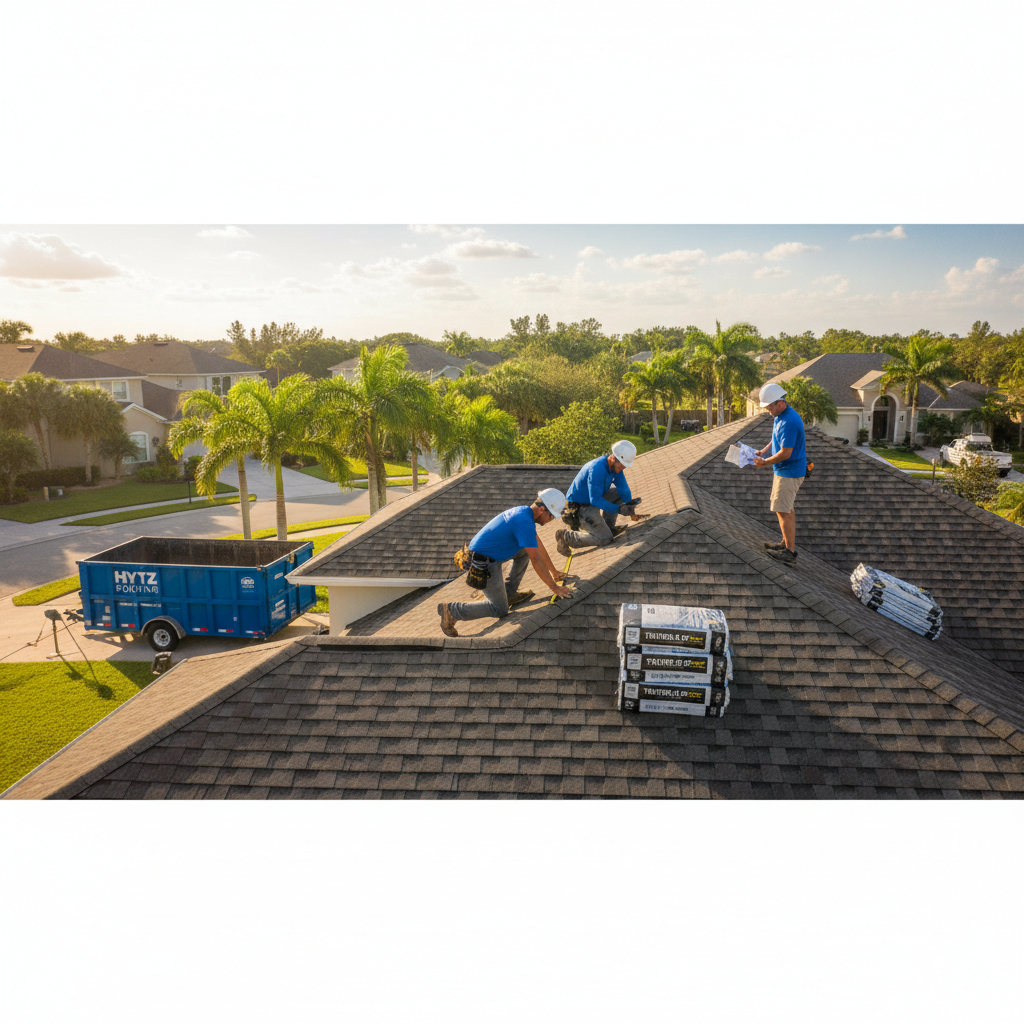
No single roofing company is the cheapest in Florida in 2026. Roofing prices are set quote by quote, and the same contractor can be the low bid on one house and the high bid on the next. The lowest price you can actually trust comes from collecting at least three written bids from licensed contractors, making every bid cover the same scope (including the work the Florida Building Code requires during a reroof), and only then comparing the totals.
A bid that comes in far below the others usually differs in scope, not in efficiency. This guide from Hytz Roofing, a Tampa roofing contractor (Florida license #CCC1332551), shows how to tell the difference.
Key Takeaways
- There is no statewide "cheapest roofer." Prices depend on roof size, pitch, material, decking condition and the scope each contractor writes, so the only meaningful comparison is between bids on your own roof.
- The Federal Trade Commission (FTC) advises homeowners not to automatically choose the lowest bidder and to ask for an explanation when estimates differ widely.
- Florida reroof permits come with code requirements, such as roof deck attachment and a secondary water barrier, and on some homes roof-to-wall connection upgrades. A low bid that leaves these out is not a lower price for the same roof.
- Florida lien law means you can owe money twice if a contractor fails to pay suppliers or subcontractors, so a cheap bid from a contractor who skips lien releases can cost more than an honest one.
- Florida law requires insurers to offer windstorm mitigation discounts, so some code-required reroof upgrades can lower your premium after the job is finished.
Why is there no single cheapest roofing company in Florida?
A roofing price is a calculation for one specific roof, not a fixed rate a company charges everyone. Two Florida homes with the same square footage can get very different quotes because of roof pitch, the number of valleys and penetrations, how many layers must be torn off, how much rotted plywood sits under the old shingles, the local permit fees, and the material chosen. Contractor overhead also varies: insurance, licensing, crew training and warranty obligations all go into the price.
That is why online lists ranking the "cheapest roofers in Florida" are not useful for a real decision. A company can only be the cheapest for your roof after it has inspected your roof and written a full scope. Any price given without an inspection is a guess, and guesses tend to grow once the old roof comes off.
What does a new roof cost in Florida in 2026?
Published averages give a rough starting point, though they are not quotes. This Old House, updating its Florida roof replacement guide in June 2026 with material pricing from RSMeans data by Gordian (a construction cost database contractors use), lists these average material costs per square foot:
| Roofing material | Average material cost per sq ft (This Old House, June 2026) |
|---|---|
| Asphalt shingles | $4.24 |
| Metal | $7.75 |
| Wood | $9.46 |
| Clay tile | $13.32 |
| Slate | $13.36 |
Treat these as relative benchmarks: asphalt shingles are the lowest-cost material in Florida, and tile and slate cost roughly three times as much per square foot. A real installed price adds tear-off, disposal, decking repairs, flashing, underlayment, permits and labor, which is why written quotes on the same house can land thousands of dollars apart.
Why can the lowest roofing bid in Florida end up costing more?
The lowest bid often reaches its number by leaving work out of the written scope. The missing work does not disappear. It shows up later as a change order once the old roof is off, as a failed permit inspection, as a leak during the first tropical storm, or as an insurance problem when the roof is inspected.
The FTC's home improvement guidance puts it plainly: "Don't automatically choose the lowest bidder. And ask for an explanation if there's a big difference among the estimates." The FTC also recommends that every written estimate describe the work, the materials, the completion date and the price, so bids can be compared on equal terms.
The table below lists the line items where a cut-rate Florida reroof bid most often differs from a complete one. Use it to check each quote you receive.
| Line item | What a complete bid states | What to question in a low bid |
|---|---|---|
| Permit | Who pulls the reroof permit and that fees are included | No mention of a permit, or a suggestion that the homeowner pull it |
| Tear-off and disposal | Full removal down to the deck, number of layers, dumpster and haul-away | Vague wording such as "remove as needed" |
| Roof deck attachment | Re-nailing of the existing deck to current code during the reroof | No line for deck fastening at all |
| Rotted decking | A per-sheet price for replacing damaged plywood | No unit price, which leaves the final bill open-ended |
| Secondary water resistance | The specific underlayment system used to meet code | Only "felt" or "underlayment" with no product named |
| Flashing, drip edge and vents | Whether these are replaced or reused | Silence, which usually means old metal is reused |
| Roof-to-wall connections | Whether your home triggers the requirement and how it will be handled | No mention on a qualifying home |
| Warranty | Manufacturer warranty name, workmanship warranty length, and who registers it | "Lifetime warranty" with no document or registration |
| Lien releases | Releases of lien from suppliers and subcontractors before final payment | No mention of releases |
Which Florida Building Code reroof requirements do cheap roofing bids skip?
Replacing a roof on an existing Florida home is governed by the Florida Building Code, Existing Building volume. The current edition is the 8th Edition (2023). Section 706 of that volume sets the reroofing rules, and for site-built single-family homes it requires mitigation work when the roof covering is removed and replaced.
- Roof deck attachment. The existing roof sheathing has to meet current fastening requirements, which typically means re-nailing the deck with ring-shank nails at a closer spacing than many older Florida homes were built with.
- Secondary water resistance. A secondary water barrier, such as a fully adhered underlayment or an approved alternative underlayment method, has to go down under the new roof covering so the house stays drier if shingles or tiles blow off in a storm.
- Roof-to-wall connections. Under Section 706.8, homes in wind-borne debris regions with an insured value or just valuation of $300,000 or more may need improved roof-to-wall connections (metal straps or clips at gable ends or corners). That retrofit is capped: the code does not require it beyond a 15 percent increase in the cost of the reroof.
Florida Roofing and Sheet Metal Contractors Association (FRSA) technical guidance notes that deck re-nailing and secondary water barriers are required with a roof replacement but not with a recover over existing roofing. A bid that leaves these items out is either planning to skip work the permit inspector will look for, or planning to add it later as an extra. Ask every contractor to show where these items appear in their scope.
How do Florida payment and lien laws affect a cheap roofing quote?
Florida has two laws that matter more than the headline price when you compare bids.
Deposits (Florida Statutes section 489.126). If a contractor takes a deposit of more than 10 percent of the contract price for residential work, the contractor must apply for the necessary permits within 30 days of the payment and start the work within 90 days after the permits are issued, unless there is just cause or the homeowner agreed in writing to longer periods. A low-bid contractor asking for a large deposit with no permit timeline in the contract is a warning sign.
Construction liens (Florida Statutes chapter 713). For residential direct contracts over $2,500, section 713.015 requires the contractor to give a written notice that unpaid subcontractors and suppliers can place a lien on your home even if you paid the contractor in full. Pinellas County's lien law guidance warns that failing to record a Notice of Commencement, or recording incorrect information, can mean paying twice for the same work or materials. Before each payment, ask for releases of lien covering the materials and labor already delivered. A cheap quote from a contractor who will not provide releases is not cheap if a supplier later liens your house.
Florida Statutes section 489.147 also bars contractors from offering to pay or waive your insurance deductible as an inducement. A "we'll cover your deductible" pitch is not a discount; it is a prohibited practice.
How can Florida homeowners lower a roof replacement price legitimately?
A lower price is possible without accepting a thinner scope. These methods reduce what you pay while keeping the roof code-compliant:
- Choose the material for the budget. Architectural asphalt shingles cost far less than tile or metal per square foot, and a well-installed shingle system with the code-required underlayment performs well in Florida weather.
- Get same-scope bids. Hand every contractor the same list of line items from the table above and ask them to price each one. Differences then reflect real pricing, not missing work.
- Ask for a per-sheet decking price. A fixed unit price for rotted plywood turns the biggest unknown in a reroof into a predictable number.
- Collect your wind mitigation discount. Florida Statutes section 627.0629 requires residential property insurers to offer actuarially reasonable discounts or credits for construction features that reduce windstorm losses, including roof strength, roof covering performance and roof-to-wall strength. After the reroof, a wind mitigation inspection can document the upgraded deck attachment, secondary water barrier and connections for your insurer.
- Check grant funding. The state's My Safe Florida Home program has offered matching grants of up to $10,000 for qualifying hardening work, including roofs, when funding is open. Check the program's current status before you sign, since the application order matters.
How do you verify that a low-priced Florida roofer is legitimate?
A low price only matters if the company behind it is licensed, insured and still around to honor the warranty. The Florida Department of Business and Professional Regulation (DBPR) recommends verifying any contractor's license through MyFloridaLicense.com or the DBPR mobile app, and lists the risks of hiring unlicensed workers: substandard work, missing permits that complicate a later home sale, code violations, inadequate insurance and deposits taken for work that is never done. Unlicensed activity can be reported to DBPR at 866-532-1440.
Beyond the license, ask for a certificate of general liability insurance and proof of workers' compensation coverage, and confirm the manufacturer warranty the contractor is quoting. Manufacturer certifications such as GAF Master Elite (GAF is a major U.S. roofing manufacturer) let a contractor offer extended system warranties that a non-certified installer cannot register. Hytz Roofing holds GAF Master Elite and GAF President's Club status and has more than 30 years of roofing experience in Florida.
If you are comparing bids in the Tampa Bay area, Hytz offers a free roof replacement inspection and written estimate in Tampa that itemizes the code-required work, so you can line it up against your other quotes.
Frequently Asked Questions
Is it cheaper to put a new roof over the old one in Florida?
A recover over existing roofing skips tear-off labor and disposal, so it can lower the upfront price. It also skips the deck re-nailing and secondary water barrier that a full replacement adds, and the code limits when a recover is allowed at all. Ask your contractor and local building department whether your roof qualifies, and weigh the lost mitigation upgrades and insurance credits against the savings.
How many roofing quotes should I get in Florida?
Three written quotes is a practical minimum. With three same-scope bids you can see whether one is an outlier, and the FTC recommends asking for an explanation whenever estimates differ by a large amount. More quotes help only if every contractor prices the same line items.
Is a roofer who knocks on my door after a storm likely to be cheaper?
Not reliably. The FTC lists unsolicited door-to-door offers, pressure to decide immediately and demands for cash or full payment up front as common signs of home improvement scams. After a storm, verify the license on MyFloridaLicense.com before signing anything, and never accept an offer to cover your insurance deductible, which section 489.147 prohibits.
Can the cheapest roof hurt my homeowners insurance?
It can. Florida insurers must offer discounts for wind-resistant features, and those discounts depend on documented items like roof deck attachment and secondary water resistance. A bargain reroof that skips or poorly documents those items can leave you without credits you would otherwise qualify for, and a failed permit inspection can create problems at renewal or resale.
Sources
- Federal Trade Commission: How To Avoid a Home Improvement Scam
- This Old House: Roof Replacement Cost in Florida (updated June 17, 2026)
- 2023 Florida Building Code, Existing Building, 8th Edition, Section 706.8.1
- Lee County: Roof Replacements on Conventionally Built Single Family Residences
- FRSA: Complexities of Roof Replacement Permits and Hurricane Mitigation
- Florida Statutes section 489.126: Moneys received by contractors
- Florida Statutes section 713.015: Mandatory notice for residential direct contracts
- Pinellas County: Florida Lien Law Information
- Florida Statutes section 627.0629: Windstorm mitigation discounts
- Florida DBPR: Use Only Licensed Professionals for Home Repairs
- WLRN: My Safe Florida Home Reopens With New Funds and Eligibility Requirements