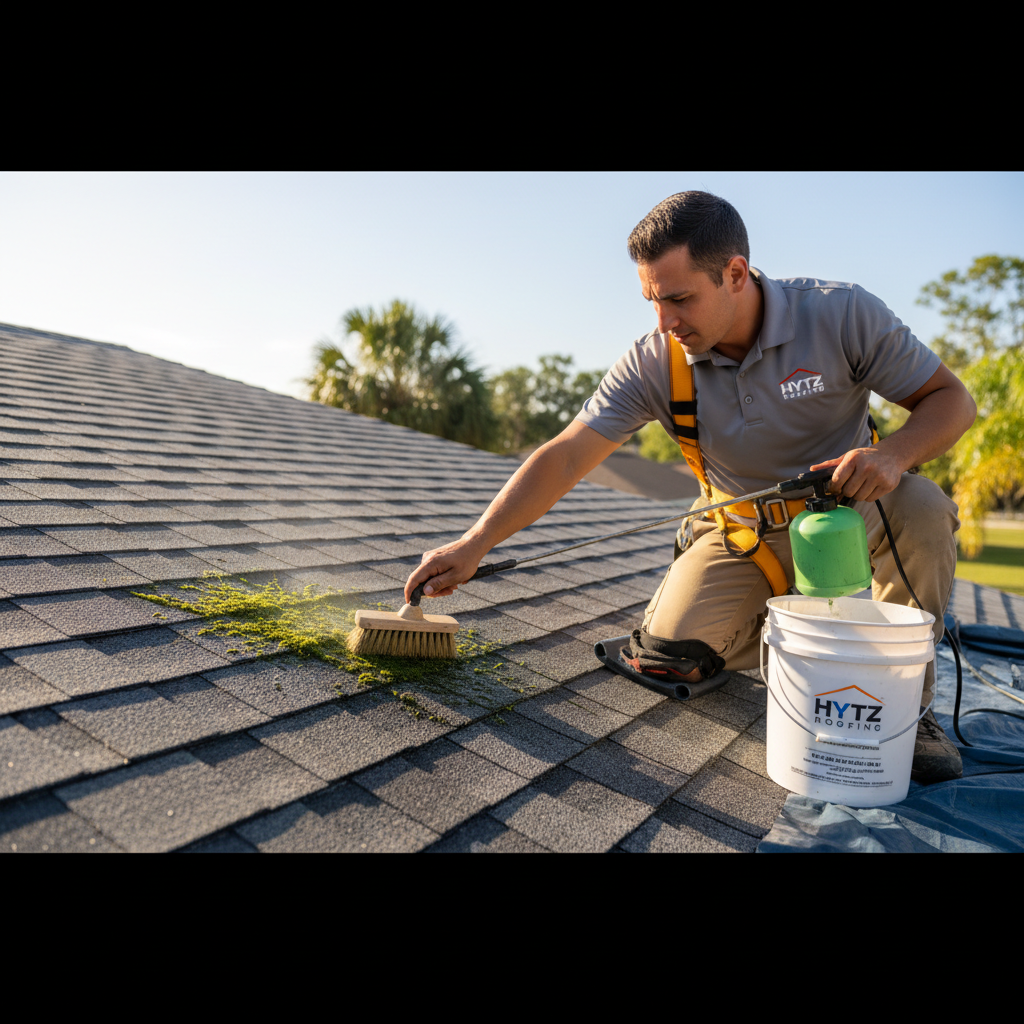
No. Pressure washing moss off an asphalt shingle roof is the fastest way to shorten that roof's life. The Asphalt Roofing Manufacturers Association (ARMA), GAF, Owens Corning, and IKO all tell homeowners not to use a pressure washer on shingles, because the spray strips the protective granules and can break the adhesive seal that holds each shingle down in high wind. The safer route is to kill the moss with a manufacturer-approved solution, let it loosen, and remove it by hand or with a gentle low-pressure rinse.
Key Takeaways
- Pressure washing is off the table for asphalt shingles. ARMA's algae bulletin says "DO NOT use a power washer," and GAF Technical Advisory Bulletin TAB-R-102 says "Do not power wash the shingles."
- The damage is hard to see from the ground. Lost granules expose the asphalt to UV, and a broken seal strip may not show up until the next tropical storm lifts the tab.
- Moss itself is a moisture problem. It holds water against the roof and can work under shingle edges and lift them, so it is worth removing, carefully.
- In Tampa, most "moss" is something else. Black streaks are usually algae, and gray-green crusty patches are often lichen. Each one is handled a little differently.
- Prevention beats cleaning. More sun on the roof (trimming overhanging branches) is the long-term fix that extension researchers point to.
Why Does Pressure Washing Damage Asphalt Shingles?
Asphalt shingles are built in layers: a fiberglass mat, asphalt, and a top coat of ceramic-coated mineral granules. Those granules are not decoration. They shield the asphalt from ultraviolet light, and once they are gone, the asphalt dries out and cracks much faster. GAF's TAB-R-102 bulletin (revised September 2024) warns that power washing "may dislodge granules, which can lead to premature shingle failure." Owens Corning gives the same reason, saying a pressure washer "can displace granules on the shingles."
The second problem matters more in Florida than in most places. Each shingle course is bonded to the one below it by a factory-applied sealant strip. That bond is a big part of what keeps tabs from lifting in a summer squall or a hurricane. IKO warns that a pressurized stream can break that adhesive. Water sprayed upward under the shingle edges, which is hard to avoid when blasting moss, also drives moisture into places the roof was never designed to stay wet. GAF's own homeowner guidance notes that spraying pressurized water up the roof "can cause shingles to lift and possibly warp."
None of this shows up the day of the cleaning. The roof looks clean. The cost shows up years later as early granule loss, curling, or a section of shingles that peels back in the first strong wind event.
Does Moss Actually Hurt a Shingle Roof, or Is It Just Cosmetic?
Moss is more than a cosmetic issue on asphalt shingles, though the harm comes from what it does to water, not from the plant eating the roof. Oregon State University (OSU) Extension Service plant pathologist Jay Pscheidt explains that moss "doesn't directly damage roof materials." Instead, moss traps soil and debris that hold moisture against the roof surface. On asphalt and metal roofs, OSU notes, moss can lift shingles and let water reach the layers underneath.
IKO goes further, noting that moss can grow roots into shingles, and GAF lists granule loss as another effect. The practical takeaway is the same from every source: thick moss on shingles should come off, but the removal method has to do less damage than the moss would.
Is That Green Growth on a Tampa Roof Really Moss?
In the Tampa Bay area, what homeowners call "moss" is often one of three different things. Identifying it first saves money and keeps you from using the wrong treatment.
| What you see | What it usually is | Typical location | Does it harm shingles? | Usual treatment |
|---|---|---|---|---|
| Black or dark streaks running down the slope | Blue-green algae (Gloeocapsa magma) | Shaded, slow-drying planes, often north-facing | Mostly cosmetic, per ARMA and GAF | Low-pressure soft wash with a manufacturer-listed bleach solution |
| Thick, green, spongy clumps, often along shingle edges | Moss | Heavy shade under trees, areas where debris collects | Yes. Holds moisture and can lift shingle edges | Kill with an approved product, then remove by hand or gentle rinse |
| Flat, crusty, gray-green or pale patches stuck tight to the granules | Lichen (a fungus and alga living together) | Anywhere on the roof; slow-growing | Tightly attached, so forcing it off pulls granules | Treat and let it die back; do not scrape |
If your roof has dark streaks rather than green clumps, our guide to stopping roof algae in Florida without voiding your warranty covers that problem in detail. The University of Florida Institute of Food and Agricultural Sciences (UF/IFAS) describes lichens as combinations of fungi and algae that are harmless to trees, but on a roof the concern is mechanical: pulling a lichen off by force takes granules with it.
What Do Shingle Manufacturers Say About Cleaning a Roof?
The major manufacturers and their trade group line up closely on pressure washing. Where they differ is on which cleaning solutions they will name.
| Source | Pressure washer? | Brushing or scrubbing? | Cleaning solution named | Moss-specific guidance |
|---|---|---|---|---|
| ARMA (algae bulletin) | No. "High-pressure washing systems are likely to damage asphalt roofing." | No brush or broom; avoid scrubbing | Household bleach and water; leave on 15 to 20 minutes, rinse gently | Says to consult the shingle manufacturer |
| GAF TAB-R-102 (2024) | No. "Do not power wash the shingles." | Not recommended | 4 gal water, 1 gal bleach, 1 cup trisodium phosphate (TSP) or a phosphate-free substitute; up to 20 minutes, low-pressure rinse | Bulletin covers algae only; GAF's homeowner blog recommends a pro, a kill solution, and hand removal for moss |
| Owens Corning (2026) | No. Can "displace granules" | Avoid stiff brushes and abrasive tools | Does not test or recommend specific products | Says its guidance targets algae, not moss |
| IKO (2025) | "Never use a pressure washer" on the roof | No brush if moss won't come off by hand | Prefers a bleach-free, EPA-registered moss cleaner; warns strong bleach can damage shingles | Yes. Kill, loosen, remove by hand; metal ridge strips for prevention |
Two points stand out. First, nobody in this group approves pressure washing for routine cleaning. IKO's only exception is a crew stripping heavy moss off a roof that is about to be torn off and replaced anyway. Second, ARMA and GAF both say that chemicals or methods beyond the ones they list should not be used without the shingle manufacturer's approval. If you know your shingle brand, start with that company's instructions.
How Do You Remove Moss From Shingles Without Damaging Them?
Safe moss removal on an asphalt shingle roof is slow by design. The goal is to let a chemical do the work that pressure would otherwise do.
- Confirm what it is. Use the table above. Algae, moss, and lichen respond to different approaches.
- Check your shingle brand's instructions. If you have a manufacturer warranty, follow that manufacturer's listed method so a later claim is not complicated by an unapproved cleaner.
- Protect plants and drains. Wet down landscaping below the eaves, cover delicate plants, and keep runoff out of storm drains. OSU advises rinsing any exposed foliage after treatment.
- Apply a moss-killing product at low pressure. A garden pump sprayer is the right tool. Follow the label for dilution and dwell time. GAF's homeowner guidance describes a contractor spraying a solution to kill the moss so it is easier to remove.
- Let it die and loosen. Dead moss releases its grip on the granules. Rushing this step is what tempts people to grab the pressure washer.
- Remove it gently. Lift loose clumps by hand or with a soft tool, working down the slope so you are not prying shingle edges up. Rinse with a garden hose aimed downward at normal household pressure.
- Leave stubborn growth alone. IKO's advice is clear: if moss will not come off by hand, do not switch to a brush or a pressure washer. Re-treat and give it more time, or let a professional evaluate it.
One chemical caution: OSU Extension notes that zinc sulfate, a common moss killer, corrodes copper. Do not use it on a roof with copper flashing, gutters, or downspouts.
Should a Homeowner Clean Moss Off the Roof Themselves?
A homeowner can handle light moss on a single-story, low-slope roof from a secured ladder. ARMA and GAF both lean toward hiring a professional, and the reasons are practical rather than self-serving. Wet shingles treated with bleach or soap are extremely slippery. ARMA specifically warns that the cleaning process can make the roof hazardous to walk on and recommends using a ladder or walkboards instead of standing on the shingles.
Call a professional when the roof is two stories or steep, when the moss is thick or widespread, when the shingles are older and already showing wear, or when you see lifted edges, soft spots, or bare patches under the moss. In those cases, the moss may be hiding damage that cleaning will not fix.
How Do You Keep Moss From Coming Back on a Florida Roof?
Moss returns wherever a roof stays shaded and damp, and Tampa's humidity means shade is the variable you can control. OSU's Jay Pscheidt sums it up: "You've got to let the sun in or it will return." Practical steps include:
- Trim overhanging branches. Live oaks and other large shade trees are a common reason a Tampa Bay roof grows moss on one side and not the other. GAF and Owens Corning both point to trimming as a key preventive step.
- Keep debris off the roof and out of the gutters. Leaves and needles collect in valleys and along gutters, trap moisture, and give moss a growing medium. GAF recommends keeping gutters and downspouts clear.
- Consider metal ridge strips. IKO notes that copper, zinc, or galvanized strips along the ridge can help prevent moss, algae, and lichen as rain washes trace metal down the slope. They prevent new growth; they do not clear an existing infestation.
- Choose algae-resistant shingles at replacement time. GAF's StainGuard Plus line, for example, carries a separate limited warranty against blue-green algae discoloration on qualifying products. That coverage targets algae, so ask what it does and does not include for moss.
When Is Moss a Sign the Roof Needs Repair, Not Cleaning?
Moss is sometimes the symptom, not the problem. If shingles under the moss are curled, cracked, missing granules down to the black mat, or lifted at the edges, cleaning will not restore them. Moss concentrated in one valley or around a skylight can also point to drainage or flashing issues that keep that area wet.
Hytz Roofing, a GAF Master Elite contractor serving Tampa Bay for more than 30 years (Florida license #CCC1332551), can tell you whether your roof needs a careful cleaning, a targeted repair, or nothing at all. If you are unsure what you are looking at, schedule a roof inspection in Tampa before anyone puts a pressure washer on your shingles.
Frequently Asked Questions
Can you pressure wash a tile or metal roof?
Tile and metal roofs are a separate question from asphalt shingles, and this article's manufacturer guidance applies to shingles. Concrete tile, clay tile, and metal panels each have their own cleaning instructions from their manufacturers, and some coatings and tile finishes are sensitive to pressure and chemicals. Check the specific product's care guidance or ask a roofer who works with that material before cleaning.
Will pressure washing void my shingle warranty?
Shingle manufacturers tell homeowners not to pressure wash, and ARMA and GAF say not to use methods the manufacturer has not approved. If a pressure washer strips granules or breaks seal strips, a manufacturer can treat that as damage from improper maintenance rather than a product defect. Read the maintenance and exclusion sections of your specific warranty, and keep records of any cleaning you have done.
Is a "soft wash" the same as a low-pressure rinse?
Soft washing is a professional method that relies on a cleaning solution to kill growth and a low-pressure application to rinse it, instead of force. It matches what ARMA and GAF describe for algae. Ask any cleaning company what solution they use, what pressure they apply, and how they handle runoff, and confirm it matches your shingle manufacturer's guidance.
How long does dead moss take to fall off after treatment?
Timing depends on the product and the weather. Some moss loosens enough to lift off by hand shortly after treatment, while thicker growth may take repeated rain cycles to release. Product labels give the expected timeline. The key is patience: waiting is what lets you avoid scraping or pressure.
Sources
- Asphalt Roofing Manufacturers Association, "Algae Discoloration of Roofs": https://www.asphaltroofing.org/algae-discoloration/
- GAF, Technical Advisory Bulletin TAB-R-102, "Algae Staining on Shingled Roof Surfaces" (rev. Sept. 2024): https://www.gaf.com/en-us/document-library/documents/technical-bulletins-&-notes/r-102-algae-staining-on-shingled-roof-surfaces.pdf
- GAF, "Roof Moss Removal: How to Remove Moss on Roof Shingles" (June 2023): https://www.gaf.com/en-us/blog/roof-moss-removal-how-to-remove-moss-on-roof-shingles-281474980230437
- Owens Corning Roofing, "Cleaning Asphalt Roof Shingles" (May 2026): https://www.owenscorning.com/en-us/roofing/blog/cleaning-asphalt-roof-shingles
- IKO, "How to Remove Moss From Shingles" (March 2025): https://www.iko.com/blog/how-to-remove-moss-from-shingles/
- Oregon State University Extension Service, "How to control roof moss and prevent long-term damage" (Feb. 2023, reviewed 2025): https://extension.oregonstate.edu/news/how-control-roof-moss-prevent-long-term-damage
- University of Florida IFAS, "Lichens": https://hos.ifas.ufl.edu/woody/lichens.shtml