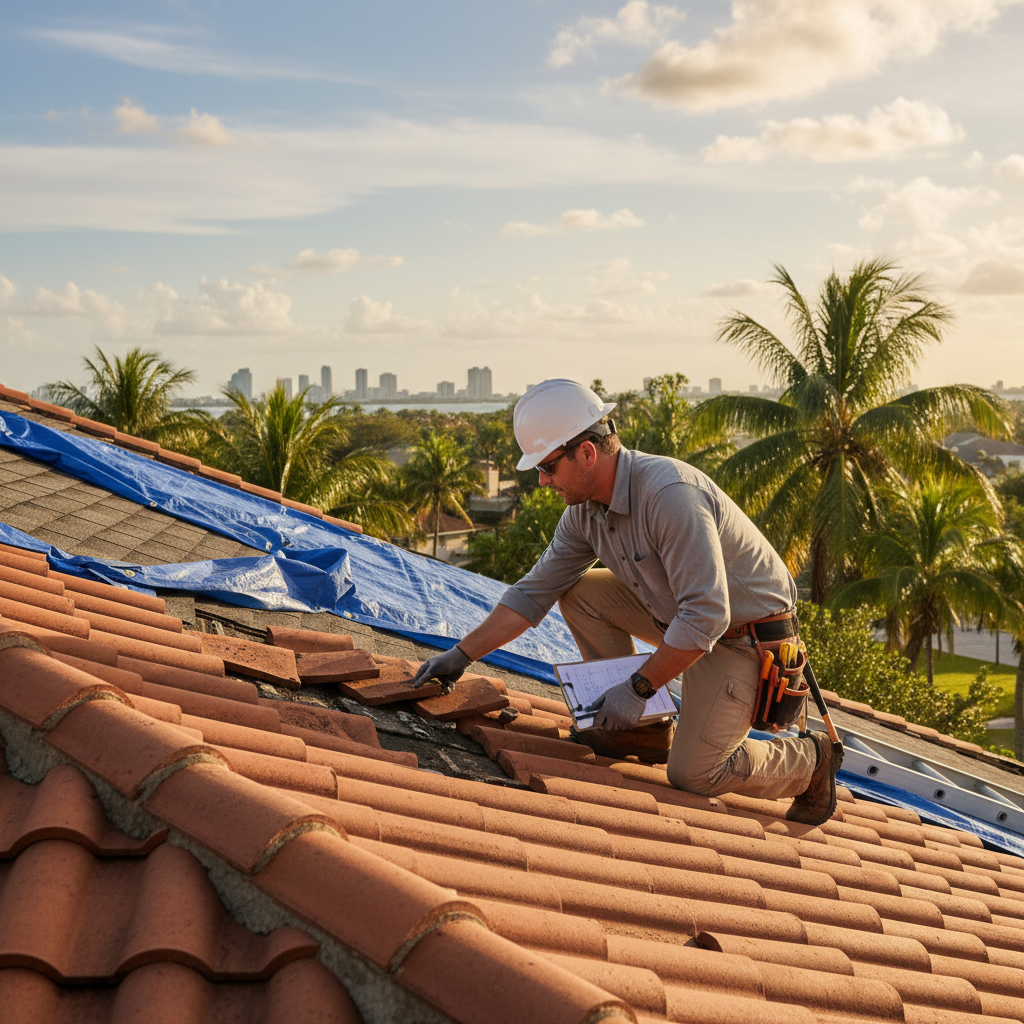
An affordable roofer for storm damage repairs is a Florida-licensed, insured local contractor who gives you a written, itemized estimate, repairs only what the storm actually damaged, and documents the work well enough for your insurer to pay its share. In Florida, the biggest number on your side of the ledger is usually your insurance deductible, not the roofer's price, so the cheapest-looking bid is often not the least expensive outcome. Any roofer who offers to "cover" or waive your deductible is breaking Florida law, and that offer is a reason to walk away rather than a discount.
Key Takeaways
- For an insured storm loss, your out-of-pocket cost is driven mostly by your deductible. Florida hurricane deductibles are often a percentage of your dwelling limit (2%, 5%, or 10%), and they apply once per calendar year across all hurricane losses.
- Florida Statute 489.147 bars contractors from offering to waive your deductible, give rebates or gifts for an inspection or claim, or interpret your policy without a public adjuster license. Violations carry fines of up to $10,000 each.
- Since 2022, roofs built or replaced under the 2007 Florida Building Code or later can be repaired beyond 25% without forcing a full re-roof, which keeps many storm repairs smaller and cheaper.
- You generally have 1 year from the date of loss to report a new claim. During a declared state of emergency, you can cancel a roofing contract within 10 days of signing (or by the official start date, whichever comes first) without penalty.
What makes a storm damage roofer affordable rather than just cheap?
An affordable storm damage roofer keeps your total cost low over the life of the repair. A cheap roofer only keeps the first invoice low. The difference shows up months later, when a rushed patch leaks again, a missing permit stalls a home sale, or an insurer refuses to pay for work that was never documented.
The table below compares the signals Florida homeowners see most often after a storm.
| What you see | Affordable storm roofer | Cheap storm roofer |
|---|---|---|
| License | Florida certified or registered roofing license you can verify online with the DBPR | No license number, an out-of-state license, or "working under" someone else's license |
| Estimate | Written, itemized scope of materials and labor (a good faith itemized estimate is required under Florida Statute 489.147 for claim-related work) | Verbal price or a single lump-sum number |
| Deductible | Tells you plainly that the deductible is your responsibility | Offers to "eat," waive, or rebate your deductible |
| Payment | Reasonable deposit schedule tied to work stages | Large upfront cash payment before materials arrive |
| Scope | Repairs what the storm damaged, and explains when code actually requires more | Pushes a full replacement for minor damage, or skips permits to shave cost |
| Documentation | Photos, measurements, and notes your adjuster can use | Little or no written record of the damage or the fix |
How much of a storm damage roof repair will you actually pay out of pocket in Florida?
For a covered storm loss, your out-of-pocket cost for a roof repair is usually your deductible plus anything your policy excludes. The roofer's price matters most when the damage is smaller than the deductible, because then you pay the whole bill yourself.
Florida Statute 627.701 requires insurers to offer hurricane deductible options of $500, 2%, 5%, and 10% of the policy's dwelling limit (with some exceptions for higher-value homes). The same statute says the hurricane deductible applies on an annual basis to all covered hurricane losses in a calendar year. If a second hurricane damages your roof in the same year, you do not start a new percentage deductible from zero; what you already absorbed counts toward it.
Here is simple math showing how much the percentage matters. These figures are calculations, not quotes.
| Dwelling coverage limit | 2% hurricane deductible | 5% hurricane deductible | 10% hurricane deductible |
|---|---|---|---|
| $250,000 | $5,000 | $12,500 | $25,000 |
| $350,000 | $7,000 | $17,500 | $35,000 |
| $500,000 | $10,000 | $25,000 | $50,000 |
Non-hurricane storms, such as a summer thunderstorm or a tornado outside a named hurricane, typically fall under your policy's all-other-perils deductible instead. Check the declarations page of your policy for both numbers before you compare roofer bids. If the estimated repair is below your deductible, you are shopping as a cash customer, and comparing two or three itemized estimates makes sense.
Why is a roofer who offers to waive your deductible a red flag in Florida?
A roofer who offers to waive, pay, or rebate your deductible is offering something Florida law prohibits. Florida Statute 489.147 bars contractors from offering a rebate, gift, gift card, cash, coupon, waiver of any insurance deductible, or any other thing of value in exchange for a roof inspection or for filing a claim. The same law bars contractors from interpreting your policy's coverage for you unless they hold a public adjuster license, and it allows fines of up to $10,000 per violation.
The practical problem is simple. If a contractor absorbs the deductible, that money has to come from somewhere, usually an inflated claim or thinner workmanship. Both put the homeowner in a worse spot than paying the deductible on an honest repair.
How do you verify a storm damage roofer before signing?
Verifying a storm damage roofer takes about ten minutes and protects you from the most expensive mistake: paying someone who is not licensed. Florida treats unlicensed contracting during a declared state of emergency as a third-degree felony under Florida Statute 489.127, which tells you how common the problem is after hurricanes.
- Look up the license on the Florida Department of Business and Professional Regulation (DBPR) license search and confirm the name on the license matches the company on your contract.
- Use the state's Disaster Contractors Network, which the Florida Department of Financial Services recommends for finding licensed contractors by county after a storm.
- Ask for proof of general liability and workers' compensation coverage.
- Get the estimate in writing, itemized, before any work beyond emergency tarping.
- Avoid large upfront payments and anyone who asks for cash only. The Department of Financial Services specifically warns about unsolicited offers that demand payment upfront.
If you sign in a rush during a declared state of emergency, Florida Statute 489.147 gives you the right to cancel a roofing contract without penalty within 10 days of signing or by the official start date of the work, whichever comes first.
Does Florida's 25% roof rule force a full replacement after storm damage?
Florida's 25% roof rule no longer forces a full replacement for many newer roofs, and that change matters for storm repair costs. Under the older rule, repairing more than 25% of a roof section in a 12-month period required replacing the entire roof section to current code. Senate Bill 4-D, signed in May 2022, added an exception: if a roof was built, repaired, or replaced in compliance with the 2007 Florida Building Code or later, only the repaired portion must meet current code, according to an analysis by Haag, a forensic engineering firm.
The 2007 code took effect March 1, 2009, so a roof permitted after that date generally qualifies. For a Tampa homeowner with a 2012 shingle roof and one wind-damaged slope, that can mean a targeted repair instead of a new roof. For an older roof, the 25% threshold can still apply, and an honest roofer should show you the math rather than leave it vague.
What should you do in the first days after storm damage to keep repair costs down?
The first days after a storm decide whether a small repair stays small. Water that gets into decking, insulation, and drywall turns a shingle repair into interior restoration.
- Stop the water first. Emergency tarping is a normal, claim-friendly step. The Florida Department of Financial Services advises making emergency repairs to prevent further damage and keeping records of them.
- Photograph before anything is touched. Take dated photos and video from the ground and inside the home, including ceiling stains.
- Keep every receipt. Tarps, emergency service calls, and additional living expenses may be reimbursable under your policy.
- Report the claim promptly. Florida Statute 627.70132 requires notice of a new or reopened claim within 1 year of the date of loss, and a supplemental claim within 18 months.
Are there programs that help Florida homeowners pay for roof storm upgrades?
The My Safe Florida Home program offers free wind mitigation inspections and grants of up to $10,000 for qualifying hardening work, including stronger roof-to-deck attachments, roof-to-wall connections, and secondary water resistance for the roof. The program does not pay for storm damage repairs themselves, but pairing a needed repair with eligible upgrades can lower future risk and may support wind mitigation discounts on your insurance premium. Funding and eligibility change between legislative sessions, so check the program site for current status before planning around it.
How does Hytz Roofing handle storm damage repairs for Tampa Bay homeowners?
Hytz Roofing is a Tampa-based roofing contractor, Florida license #CCC1332551, with GAF Master Elite and GAF President's Club recognition from GAF, the roofing manufacturer, and a team with more than 30 years of experience. We are not the lowest bidder in every neighborhood after a storm, and we say so. What we aim for is the lowest total cost to you: a clear inspection, photos your adjuster can use, a written itemized estimate, the right permits, and a repair scoped to what the storm actually did.
If your roof took a hit, start with our storm and leak roof repair service in Tampa to schedule an inspection and see how the process works.
Frequently Asked Questions
Can I choose my own roofer, or does my insurance company pick one?
In most Florida homeowners policies, you choose your own licensed roofer. Some policies include optional managed repair programs where the insurer selects the contractor, so read your policy or ask your agent whether you opted into one. Either way, the insurer pays based on the covered damage, and you remain responsible for your deductible.
Should I get more than one estimate for a storm damage roof repair?
Getting two or three written, itemized estimates is sensible, especially when the repair may fall below your deductible and you are paying cash. Compare line items such as underlayment, flashing, decking replacement, and permit fees rather than the total alone. A much lower number usually means something on that list is missing.
Is a roof repair cheaper than filing an insurance claim?
A roof repair can be cheaper to handle without a claim when the cost is below or near your deductible, because the insurer would pay little or nothing and the claim can still show up in your claims history. When damage is widespread, such as multiple slopes, interior water damage, or lost decking, filing is usually worthwhile. An inspection with photos helps you decide before you call your insurer.
What happens if a second storm damages my roof in the same year?
For hurricane losses, Florida Statute 627.701 applies the hurricane deductible on a calendar-year basis, so amounts you already paid toward that year's hurricane deductible count against a later hurricane claim. Non-hurricane storms fall under your separate all-other-perils deductible, which usually applies per claim.
Sources
- Florida Statute 489.147, Prohibited property insurance practices (The Florida Senate)
- Florida Statute 627.701, Hurricane deductibles (The Florida Senate)
- Florida Statute 627.70132, Notice of property insurance claim (The Florida Senate)
- Florida Statute 489.127, Unlicensed contracting penalties (The Florida Senate)
- Important Updates to the Florida Building Code's 25% Rule (Haag, August 2022)
- Hurricane Recovery Resources (Florida Department of Financial Services)
- License Search (Florida DBPR)
- Disaster Contractors Network
- My Safe Florida Home